
How to Prepare for an AI-Driven Future (Practical Guide)
A practical, beginner-friendly guide to preparing for an AI-driven future. Learn steps for individuals and organizations: skills to learn, governance, pilot projects, ethical considerations, and a ready-to-use checklist.



How to Prepare for an AI-Driven Future — A Practical Guide
Overview: Artificial intelligence is reshaping products, services, and careers. This guide explains practical steps individuals and organizations can take today to be ready for an AI-driven future. It is written for beginners, managers, students, and small-business owners who want clear, actionable advice without technical jargon.
Why preparation matters
AI is not a single technology; it is a set of tools that can automate tasks, make predictions, and suggest decisions. Preparing matters because:
- Competitive advantage: Early, responsible adoption helps organizations improve productivity and customer experiences.
- Risk management: Poorly designed systems can introduce bias, privacy issues, and operational failures.
- Career resilience: Workers who learn to collaborate with AI will remain more adaptable.
What this guide covers
This article covers:
- Concrete personal skills to learn
- Organizational steps: pilots, data hygiene, governance, monitoring
- Ethical and safety considerations
- A practical checklist to act on immediately
- Where to learn and which roles to consider
Understand the basics (quick primer)
If you need a basic definition of AI or want to review fundamentals, start with what-is-artificial-intelligence-a-complete-beginners-guide. For a short course on how machine learning works, see how-does-machine-learning-work-explained-simply.
For individuals: skills and mindset
Not everyone needs to become a data scientist. The most valuable path is to combine domain knowledge with basic AI literacy.
Core skills to focus on
- AI literacy: Understand what AI can and cannot do. Read ai-myths-vs-reality-what-ai-can-and-cannot-do to avoid common misunderstandings.
- Data awareness: Learn how data is collected and why quality matters. Practically, practice cleaning a spreadsheet and checking for missing values.
- Basic statistics: Mean, median, variance, and understanding correlation vs causation are surprisingly powerful.
- Prompting and tooling: Learn to use AI tools for writing, design, or productivity—see top-ai-tools-for-beginners-to-boost-productivity.
- Communication: Be able to explain model limitations to non-technical stakeholders—clear communication reduces misuse.
Mindset and habits
- Curiosity: Experiment with free AI tools and small projects.
- Continuous learning: Schedule weekly time to read or try a new tool.
- Ethical thinking: Question who benefits and who may be harmed by an AI system; learn from ethical-ai-explained-why-fairness-and-bias-matter.
For organizations: a pragmatic roadmap
Organizations should move cautiously—fast pilots and careful governance beat large unmonitored deployments.
Step 1 — Clarify the problem
Ask: what decision will AI inform or automate? Avoid adopting AI because it is fashionable. A clear problem statement helps measure success.
Step 2 — Inventory existing data
Document what data you have, where it is stored, who owns it, and how clean it is. If you don''t have useful data, start collecting small, structured datasets with clear consent.
Step 3 — Start with a small pilot
Pilots help you learn quickly with limited risk. A pilot should have:
- Clear success metrics
- A small, cross-functional team
- A plan for monitoring performance and unintended effects
See intelligent-automation-explained-ai-and-automation for how AI and automation combine in practical pilots.
Step 4 — Governance and vendor checks
Create simple governance: a checklist that includes vendor documentation requests, data lineage, testing plans, and a rollback plan. If you buy a model from a vendor, request their evaluation reports and sample data descriptions.
Step 5 — Monitoring and maintenance
Deployed models need monitoring for accuracy, drift, and fairness. Track simple metrics like accuracy by segment, rate of human overrides, and customer complaints.
Ethics, risk, and legal considerations
AI systems can reproduce bias and produce unfair outcomes. Early work on ethics reduces regulatory and reputational risk.
- Fairness checks: Evaluate outcomes for different groups where possible.
- Transparency: Keep clear documentation of model purpose, data sources, and limitations.
- Privacy: Use data minimisation and proper consent.
For a focused primer on responsibility and safety, read is-artificial-intelligence-safe-risks-ethics-and-responsible-use.
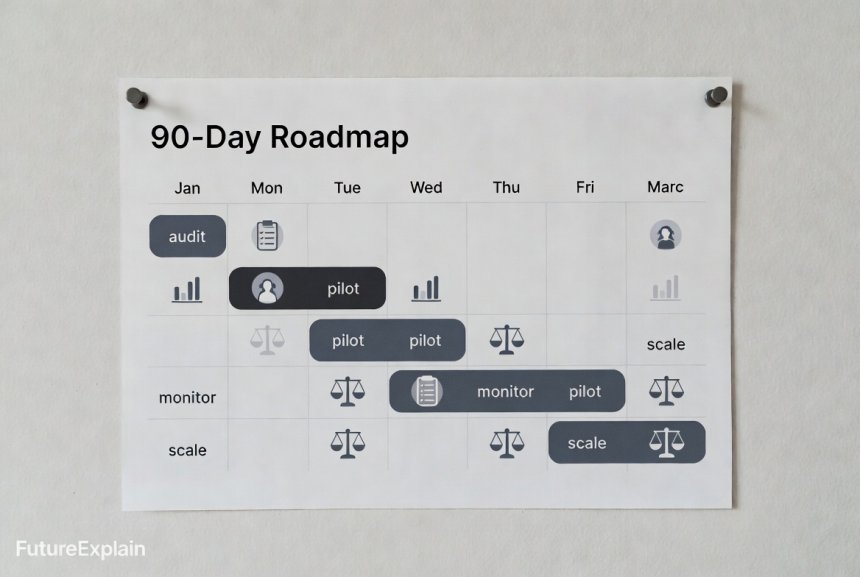
Practical checklist: first 90 days
Use this checklist as a minimal roadmap for the first three months.
- Week 1: Hold an internal session to explain what AI can do and identify 2–3 candidate processes. Link a short primer like what-is-automation-a-beginners-guide for automation context.
- Week 2–3: Inventory data and document gaps. Choose one pilot with a measurable outcome.
- Week 4–6: Run a pilot with small sample; document dataset and test for obvious biases.
- Month 2: Build monitoring dashboards for pilot metrics; incorporate human review.
- Month 3: Decide to scale, pause, or iterate. Prepare a short vendor questionnaire if using third-party models.
Reskilling programs and learning resources
Teams don''t need advanced degrees to work productively with AI. Useful programs:
- Short courses on data literacy and statistics
- Hands-on workshops with no-code tools—see best-automation-tools-for-non-technical-users
- Internal brown-bag sessions where teams present simple experiments
Roles and career paths
AI-related work creates new roles and reshapes existing ones. Common beginner-friendly roles include:
- AI Product Manager: Defines what problems to solve and how success is measured.
- Data Steward: Ensures data quality and access for experiments.
- AI Ethicist / Reviewer: Performs fairness checks and documents limitations.
- Automation Specialist: Uses no-code tools to automate repetitive work—see no-code-vs-ai-tools-what-should-beginners-choose.
Read ai-careers-explained-beginner-friendly-career-paths for guidance on entry-level training and pathways.
How small businesses can act cheaply and effectively
- Focus on automation where small improvements save time—see automation-made-easy-simple-tech-tips-for-everyday-life.
- Use free AI tools to prototype workflows before buying premium services—see best-free-ai-tools-you-can-use-without-technical-skills.
- Partner with local universities for low-cost evaluation projects.
Case examples (short)
Example 1: A small retailer used an AI tool to predict low-stock items, starting with a 2-week pilot and a simple manual override. Returns: fewer stockouts, small revenue improvement.
Example 2: A support team used an AI assistant to draft replies; human review lowered response time without increasing errors. They iterated on prompts and trained staff on verification.
For more on how personalization systems work, see how-ai-personalization-works-netflix-youtube-amazon.
Measuring success
Define a few key performance indicators (KPIs) before you start:
- Accuracy or error rate of the model
- User satisfaction or complaint rate
- Human time saved per week
- Number of incidents requiring rollback
Common pitfalls and how to avoid them
- Jumping to big models: Start small—pilot and measure.
- Ignoring governance: A short checklist reduces long-term risk.
- Underestimating data work: Most successful projects spend the most time preparing data.
Long-term perspective: careers and learning pathways
To prepare for the next 3–5 years, consider a mix of skills: technical literacy, domain expertise, and governance knowledge. For career planning read skills-you-should-learn-to-stay-relevant-in-the-ai-era and future-of-artificial-intelligence-next-5-years.
Where to find help and tools
Use the following approach when choosing tools:
- Start with free tools and prototypes
- Use vendor evaluations and ask for documentation
- Prefer tools that allow easy human review and clear rollback
For a curated list of productivity tools see top-ai-tools-for-beginners-to-boost-productivity.
Putting it all together — a one-page plan
Here is a short template you can copy:
- Goal: One-sentence description of the problem.
- Success metric: What improvement would justify the project?
- Data needed: Sources, owner, format, quality level.
- Pilot timeline: 6–8 weeks with milestones
- Monitoring: Simple dashboard metrics
- Governance: Vendor checklist and rollback plan
Next reading (internal loop)
To continue learning within our series, read:
- how-to-start-learning-ai-without-a-technical-background
- ai-careers-explained-beginner-friendly-career-paths
- ethical-ai-explained-why-fairness-and-bias-matter
- how-to-use-ai-responsibly-beginner-safety-guide
Final words
Preparing for an AI-driven future is a practical, manageable process. Focus on small experiments, clear metrics, and governance. Invest in basic skills and keep ethical considerations central. Use this guide as a checklist and return to the linked articles for deeper learning.
Helpful links to earlier topics
- what-is-artificial-intelligence-a-complete-beginners-guide
- ai-vs-automation-whats-the-difference-and-why-it-matters
- ai-in-customer-support-how-chatbots-really-work
Call to action: Pick one small pilot from the checklist and schedule 90 days of work. Revisit this article and the linked guides while you iterate.
Share
What's Your Reaction?
 Like
1400
Like
1400
 Dislike
12
Dislike
12
 Love
180
Love
180
 Funny
35
Funny
35
 Angry
1
Angry
1
 Sad
0
Sad
0
 Wow
95
Wow
95

















Praise: Very clear and useful for our team planning.
Hi hazelhoward — glad it helped. Start small and iterate; the linked career and skills articles can help plan learning paths.
Question: How should startups prioritise which models to audit?
Hi henrycox — prioritise audits by impact: models affecting money, safety, or essential access should be audited first.
Short opinion: This is a well-structured practical guide.
Experience: Adding human review reduced issue rates significantly.
Question: Are there affordable tools for small teams to audit fairness?
Hi averivera — affordable audit tooling exists, and starting with manual spreadsheet checks is a practical first step.
Short opinion: Helpful and concise; good for meetings.