
Is Artificial Intelligence Safe? Risks, Ethics, and Responsible Use
A balanced guide exploring AI safety, potential risks, and ethical questions. Learn how to use artificial intelligence responsibly and what safeguards are in place.


Is Artificial Intelligence Safe? Risks, Ethics, and Responsible Use
As artificial intelligence becomes more integrated into our daily lives—from the recommendations on our phones to the chatbots on websites—a natural question arises: is this technology safe? The answer isn't a simple yes or no. Like any powerful tool, from electricity to the internet, AI presents both tremendous benefits and legitimate concerns that deserve careful consideration.
This guide will help you understand the landscape of AI safety by breaking it down into three main areas: technical risks, societal impacts, and ethical considerations. We'll explore what researchers and developers are doing to address these challenges and provide practical guidance for using AI responsibly in your own life. By the end, you'll have a more nuanced understanding that moves beyond fear or hype toward informed engagement.
Understanding the Different Types of AI Safety Concerns
When people ask if AI is safe, they're often thinking about different things. Some imagine futuristic scenarios from movies, while others worry about more immediate, practical issues. Let's separate these concerns into categories that are easier to understand and evaluate.
First, there are technical and operational risks. These include software bugs, security vulnerabilities, or systems that don't perform as expected in real-world conditions. An AI medical diagnostic tool that occasionally misreads scans, or a facial recognition system that works poorly in certain lighting, represents this category of risk.
Second, there are societal and economic impacts. This encompasses how AI affects jobs, privacy, misinformation, and social dynamics. The concern that AI might displace certain types of work, or that deepfake technology could be used maliciously, falls into this category. These issues are complex because they involve human systems, not just technology.
Third, there are ethical and alignment concerns. This addresses whether AI systems reflect human values, avoid harmful biases, and operate transparently. Questions about who is responsible when an AI makes a mistake, or whether an algorithm treats all people fairly, belong here. Developing what some call "AI literacy"—the ability to understand, use, and critically evaluate AI—is key to navigating these issues.

Real Risks Worth Understanding
Let's examine some specific concerns that researchers, ethicists, and policymakers are actively discussing. Understanding these will help you move from vague worry to informed awareness.
Algorithmic Bias and Fairness
One of the most documented issues in AI is algorithmic bias. Since AI systems learn from existing data, they can inherit and even amplify human biases present in that data. For example, a hiring algorithm trained primarily on resumes from male candidates might inadvertently disadvantage female applicants. A loan approval system trained on historical data might perpetuate patterns of discrimination.
The problem isn't that AI is intentionally discriminatory, but that it uncritically replicates patterns from its training data. This makes continuous monitoring and correction essential. As we develop more ethical AI systems, addressing bias remains a top priority for responsible developers.
Privacy and Data Security
AI systems, particularly those that personalize experiences, often require substantial data about users. This raises legitimate privacy concerns. Where is your data stored? How is it used? Could it be combined with other data to reveal sensitive information about you?
Furthermore, as AI becomes more integrated into critical infrastructure—from healthcare to transportation—it creates new potential targets for cyberattacks. Ensuring these systems are secure against malicious interference is a significant technical challenge that requires ongoing investment and vigilance.
Transparency and the "Black Box" Problem
Some advanced AI systems, particularly complex neural networks, can be difficult for even their creators to fully understand. When an AI recommends denying a loan or diagnosing a disease, it's important to know why it reached that conclusion. This "black box" problem—where inputs go in and answers come out with unclear reasoning in between—challenges accountability.
This is why the field of Explainable AI (XAI) has emerged, focusing on making AI decision-making more transparent and interpretable. When we can understand an AI's reasoning, we can better trust its outputs and identify when something has gone wrong.
Economic Displacement and Job Market Shifts
Perhaps the most discussed societal concern is how AI will affect employment. It's true that AI can automate certain tasks, particularly routine, repetitive ones. However, the full picture is more nuanced than simple "robots taking jobs."
As we explored in our article on how AI is changing jobs, technology historically transforms work rather than simply eliminating it. New roles emerge even as others change or fade. The key challenge is ensuring people have opportunities to develop the skills needed in an AI-augmented economy, particularly those uniquely human skills that machines cannot replicate.
Safeguards and Responsible Development
Understanding risks is only half the picture. The other half involves examining the numerous efforts underway to develop AI safely and responsibly. This work happens at multiple levels—from individual engineers to international organizations.
Many technology companies have established AI ethics boards and principles. These internal groups develop guidelines for responsible AI development, review potentially sensitive projects, and advocate for safety considerations throughout the design process. Common principles include fairness, transparency, accountability, and privacy protection.
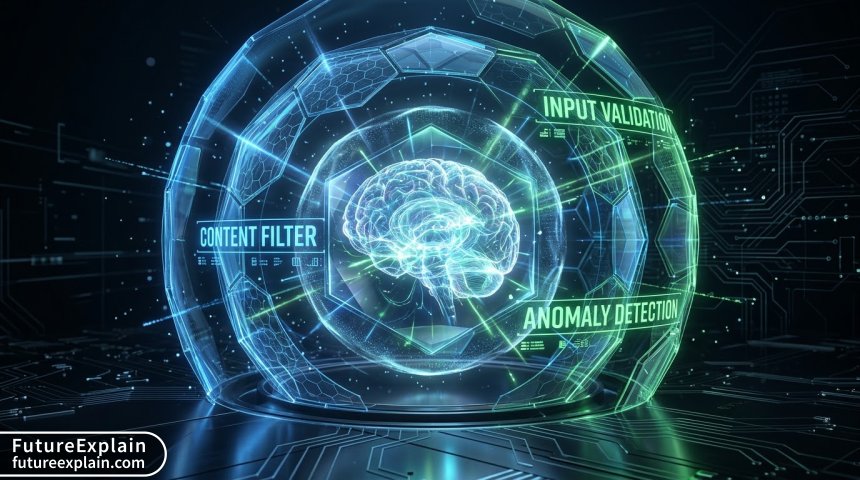
There's also growing investment in technical safety research. This includes developing techniques to make AI systems more robust, reliable, and aligned with human values. Researchers work on methods to detect and mitigate biases, improve system security, and ensure AI behaves predictably even in unexpected situations.
Increasingly, we're seeing the development of regulatory frameworks and standards. Governments and international bodies are creating guidelines and, in some cases, laws governing AI development and deployment. The European Union's AI Act is one prominent example, classifying AI systems by risk level and imposing different requirements for each category.
Professional fields are also adapting. Just as consulting firms are establishing ethical guardrails and new governance structures for their AI tools, other industries are developing their own standards and best practices to ensure AI is used responsibly within their specific contexts.

How to Use AI Responsibly as an Individual
AI safety isn't just something for researchers and policymakers to worry about. As users of AI tools, we all have a role to play in promoting responsible use. Here are practical steps you can take:
- Stay Informed: Make an effort to understand both the capabilities and limitations of the AI tools you use. Recognizing that AI can make mistakes or reflect biases is the first step toward using it critically.
- Protect Your Privacy: Be mindful about what information you share with AI systems. Check privacy policies, use settings to limit data collection when possible, and think twice before sharing sensitive personal information.
- Maintain Human Oversight: Use AI as an assistant, not a replacement for your own judgment. Always review AI-generated content, double-check its facts, and apply your own critical thinking. This "human in the loop" approach is crucial for responsible use.
- Report Problems: If you encounter biased, inaccurate, or otherwise problematic AI behavior, report it to the developers. Your feedback helps improve these systems.
- Develop Your AI Literacy: Just as we develop critical thinking skills for evaluating information online, we need to develop skills for interacting with AI. This means learning to craft good prompts, interpret AI outputs thoughtfully, and understand the basic principles of how these systems work.
For a more detailed guide on putting these principles into practice, see our upcoming article on how to use AI responsibly.
A Balanced Perspective on the Future
Is AI safe? The most honest answer is that AI safety is an ongoing project, not a finished achievement. Significant risks exist and deserve serious attention, but they're not inevitable outcomes. Through responsible development, thoughtful regulation, and informed use, we can maximize AI's benefits while minimizing its harms.
The conversation about AI often swings between extreme optimism and excessive fear. A more productive approach recognizes that technology reflects the values and choices of its creators and users. The future of AI safety depends not just on technical solutions, but on the ethical frameworks, social systems, and individual practices we build around this technology.
As you continue to explore AI, remember that developing a critical yet constructive perspective is one of the most valuable skills you can cultivate. Question claims that seem too good to be true, but also recognize genuine progress. Understand the real capabilities and limitations of AI, and approach this powerful technology with both curiosity and caution.
Ultimately, the question "Is AI safe?" might be less important than "How do we make AI safer?" That's a question we can all help answer—through the tools we choose to use, the standards we support, and the thoughtful approach we bring to this transformative technology.
Share
What's Your Reaction?
 Like
487
Like
487
 Dislike
15
Dislike
15
 Love
203
Love
203
 Funny
31
Funny
31
 Angry
12
Angry
12
 Sad
18
Sad
18
 Wow
102
Wow
102
















The practical tips for individual users are exactly what I needed. I use AI writing tools but always feel a bit uneasy about it. Having specific steps to use them more responsibly—like always fact-checking and being mindful of privacy—makes me feel more in control.
I appreciate how this article doesn't just list problems but also talks about solutions and what's being done. The section on safeguards gave me more confidence that serious people are working on these issues. It's not just a free-for-all.
The "black box" problem explanation was very helpful. I've heard the term before but didn't really get what it meant. Now I understand why explainable AI matters, especially for high-stakes decisions like medical diagnoses or loan approvals.
I run a small business and we're starting to use AI for customer service. The "human in the loop" advice is golden. We learned the hard way that letting a chatbot handle everything without oversight can backfire. Now we use it to draft responses that our team reviews and personalizes.
The economic displacement section hit home. My grandson is worried about choosing a career that won't be automated. It's reassuring to read that it's more about transformation than elimination, but I still worry for young people entering the job market.
David, your concern is understandable and shared by many. The key is focusing on developing adaptable skills. We have several upcoming articles in our Future Trends & Careers category that address exactly this, including one on skills for the AI era and another on AI career paths. Encourage your grandson to think about combining technical knowledge with uniquely human skills like creativity and empathy—that combination is likely to be valuable regardless of how technology evolves.
As a teacher, I'm trying to figure out how to talk about AI ethics with my students. This article gives me a great framework to start with—especially the distinction between technical, societal, and ethical concerns. The "AI literacy" concept is crucial.