
Skills You Should Learn to Stay Relevant in the AI Era
A practical, beginner-friendly guide to the essential skills to learn for staying relevant in the AI era. Covers technical, analytical, and human skills, learning paths, and how to build a personal development plan.



Skills You Should Learn to Stay Relevant in the AI Era
Introduction
The rise of artificial intelligence is changing how work gets done, but the future is not just about machines — it is about the mix of technology skills and human strengths that let people thrive. This article explains which skills matter, why they matter, and how you can learn them in practical steps. It is written for beginners and non-technical professionals who want an actionable roadmap to stay relevant.
Why skills matter more than titles
Job titles can change rapidly, but skills compound. Learning the right set of skills lets you adapt across roles and industries. Employers increasingly value people who can:
- Understand data and make data-informed decisions
- Use automation and AI tools responsibly
- Work with cross-functional teams
- Communicate insights clearly
Rather than chasing a single job title, focus on a T-shaped skill profile: a broad base of transferable skills plus deeper expertise in one or two areas.
Categories of skills to prioritise
We group useful skills into three categories: foundational technical skills, applied tool skills, and human (soft) skills. All three are important and complementary.
1. Foundational technical skills
- Data literacy: Learn to read basic charts, calculate averages and percentages, and understand what datasets mean. Data literacy is about asking the right questions of data, not becoming a data scientist.
- Basic statistics and probability: Concepts like mean, median, variance, correlation, and basic probability help you interpret results and avoid simple mistakes.
- Introduction to machine learning concepts: Familiarity with terms such as supervised learning, classification, regression, overfitting, and validation helps when you talk to technical colleagues or evaluate AI tools. See also how-does-machine-learning-work-explained-simply.
- Computational thinking: Break problems into steps, recognise patterns, and design repeatable processes that can be automated.
2. Applied tool skills
- Spreadsheet mastery (Excel or Google Sheets): Spreadsheets remain the most widely used tool for business data. Learn formulas, pivot tables, and simple automation to save time and spot trends.
- Basic SQL: Learning to write simple SELECT queries and filters allows you to fetch relevant data from databases — a practical skill for analysts and many other roles.
- No-code automation and workflow tools: Platforms like Zapier, Make, or Power Automate let you connect apps and automate routine tasks without programming. See best-automation-tools-for-non-technical-users for ideas.
- Familiarity with AI-powered productivity tools: Try tools for summarization, drafting, and research. Understanding their strengths and limitations helps you use them responsibly. For tool recommendations, review top-ai-tools-for-beginners-to-boost-productivity.
- Basic coding (optional but valuable): A gentle introduction to Python can unlock further AI learning. Python is widely used for data tasks and has beginner-friendly libraries. If coding is not your path, focus on using APIs and integrations through no-code tools.
3. Human skills that compound technology
- Critical thinking and judgement: AI can provide suggestions, but choosing when to act requires human judgement. Learn to ask follow-up questions and validate outputs.
- Communication and storytelling with data: The ability to translate numbers into clear recommendations is rare and valuable.
- Collaboration and cross-functional working: Many AI projects are interdisciplinary. Practice working with product managers, engineers, designers, and operations staff.
- Ethical awareness: Understand fairness, privacy, and responsible AI basics so you can spot potential harms and mitigate them. See ethical-ai-explained-why-fairness-and-bias-matter.
- Learning agility: The habit of continuous learning — how to learn new tools and concepts quickly — may be the single most valuable skill.
How to prioritise what to learn
Time is limited. Use this decision process to choose the first skills to learn:
- Relevance to your role: What skills will help you solve current problems at work? Start there to show immediate value.
- Transferability: Choose skills that apply across teams (e.g., data literacy, communication).
- Effort vs impact: Prefer high-impact, low-effort wins (e.g., spreadsheet automation) over low-impact, high-effort learning.
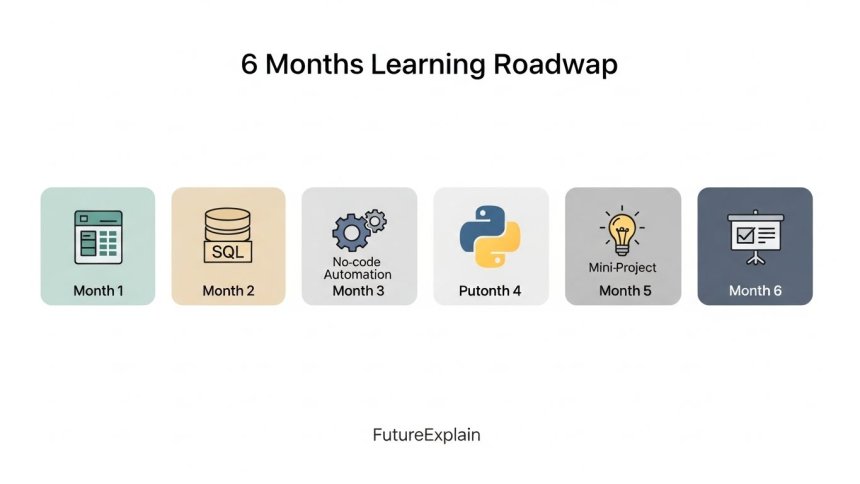
Suggested 6-month learning roadmap
This practical roadmap assumes 3–6 hours per week. Adjust pace as needed.
Month 1 — Data literacy + spreadsheets
- Learn pivot tables, filters, basic formulas, and simple data cleaning.
- Practice by cleaning a small dataset from your work or a public source.
Month 2 — SQL basics and data storytelling
- Complete simple SQL tutorials (SELECT, WHERE, JOIN basics).
- Prepare a short report with charts and 2–3 insights you can present to your manager.
Month 3 — No-code automation + productivity AI
- Create 1–2 automations using Zapier/Make (e.g., auto-create tasks from form responses).
- Explore an AI writing/summarization tool and evaluate its quality on real work examples.
Month 4 — Intro to Python or deeper tool use
- Decide whether to learn Python fundamentals (if relevant) or deepen no-code skills.
- Build a small script or workflow that saves time at work.
Month 5 — Domain project and ethics
- Design a mini-project that solves a real problem (e.g., automate a report, improve response times).
- Document data handling and ethical considerations for the project.
Month 6 — Present results and plan next steps
- Share project outcomes, measured impact, and lessons learned with stakeholders.
- Create a 6–12 month plan for deeper learning or additional projects.
Project ideas you can build quickly
- Automate meeting notes: record action items and push them to a task board using no-code tools.
- Weekly report automation: pull key metrics and generate a summary email automatically.
- Simple sentiment monitoring: use an AI tool to summarize customer feedback weekly.
- Expense categorization: use spreadsheet formulas or a small script to classify expenses for bookkeeping.
How to learn effectively — techniques that work
Choose active learning methods rather than passive reading:
- Project-based learning: Build something small early.
- Spaced repetition: Revisit concepts at intervals.
- Peer learning: Join a study group or pair with a colleague.
- Teach what you learn: Writing a short internal note or giving a 10-minute demo solidifies knowledge.
Measuring progress and demonstrating value
Measure both learning and impact:
- Learning KPIs: Time spent, courses completed, mini-projects delivered.
- Impact KPIs: Time saved, errors reduced, customer response time improvements, cost savings.
Reskilling vs upskilling — practical differences
Upskilling means learning new skills that extend your current role (e.g., learning SQL as a business analyst). Reskilling means training for a new role (e.g., moving from finance operations to a data analyst role). Make choices based on personal interest, role stability, and market demand.
Common career paths and recommended focus areas
Below are sample roles and skills you might focus on:
- Product manager: Prioritise data literacy, user research, and AI basics to understand model behaviour.
- Operations manager: No-code automation, process design, and performance measurement.
- Marketing professional: Analytics, personalization tools, and A/B testing basics.
- Customer support lead: AI-assisted triage tools, sentiment analysis, and workflow automation.
- Early-career professionals/students: Broad foundational skills: spreadsheets, basic programming concepts, and strong communication.
How organisations support learning
Encourage your employer to support learning through:
- Paid access to online courses
- Time allocation for learning (e.g., a learning day per month)
- Internal projects and shadowing opportunities
- Mentorship programs
Common fears and practical responses
Many people worry about being "replaced." Practical responses:
- Fear: "AI will take my job" — Response: Focus on tasks where human judgment, empathy, and creativity matter.
- Fear: "I don''t have a technical background" — Response: Start with data literacy and no-code tools; technical depth can come later.
- Fear: "I won''t find time" — Response: Aim for small weekly steps and project-based learning that shows quick wins.
Connecting this guidance to other topics
If you want to understand AI concepts in more depth, read what-is-artificial-intelligence-a-complete-beginners-guide and how-does-machine-learning-work-explained-simply. For practical tool recommendations, see top-ai-tools-for-beginners-to-boost-productivity and best-free-ai-tools-you-can-use-without-technical-skills. If you''re planning a career move, the series on careers and learning paths like ai-careers-explained-beginner-friendly-career-paths and how-to-start-learning-ai-without-a-technical-background will be useful.
Practical checklist before you finish
- Pick one small project you can complete in 4 weeks.
- Choose two concrete skills to learn in the next 3 months (one technical, one human).
- Schedule weekly learning time and one demo to show results.
- Create a measurement plan for impact (time saved, errors reduced, customer metric improved).
Conclusion
Staying relevant in the AI era is less about mastering every new technology and more about combining practical technical knowledge with strong human skills. Start with data literacy and simple automations, pick one applied tool to learn, and invest consistently in communication and critical thinking. With small, applied projects and a habit of continuous learning, you can add immediate value and prepare for longer-term opportunities.
Share
What's Your Reaction?
 Like
1500
Like
1500
 Dislike
12
Dislike
12
 Love
220
Love
220
 Funny
20
Funny
20
 Angry
3
Angry
3
 Sad
2
Sad
2
 Wow
80
Wow
80

















Experience: Documenting our small projects saved time during handovers — thanks for the reminder to document.
Praise: The emphasis on measurable impact is especially useful for managers.
Short opinion: A great starter guide for teams and individuals.
Experience: Small wins helped sustain momentum for months of learning.
Praise: Balanced and practical; will share with my team.
Short opinion: Good mix of soft skills and technical guidance.