
AI in Finance: Fraud Detection, Compliance, and Risk
Artificial intelligence is revolutionizing the financial industry by enhancing fraud detection capabilities, automating regulatory compliance, and improving risk management. This comprehensive guide explores how machine learning algorithms identify suspicious transactions in real-time, how natural language processing helps financial institutions navigate complex regulations, and how predictive analytics assess credit and market risks. We examine practical implementations from major banks and fintech companies, discuss the challenges of implementing AI systems in heavily regulated environments, and provide actionable steps for businesses looking to adopt these technologies. The article also addresses ethical considerations, data privacy concerns, and the future trajectory of AI in finance.


The Quiet Revolution: How AI Is Transforming Financial Security and Compliance
Every day, trillions of dollars move through the global financial system in millions of transactions. In this vast, interconnected network, traditional methods of fraud detection and risk management are increasingly inadequate. Artificial intelligence has emerged not as a luxury but as a necessity for financial institutions seeking to protect assets, comply with regulations, and manage risks in an increasingly complex environment. This transformation is happening not just in Wall Street trading floors but in community banks, payment processors, insurance companies, and fintech startups worldwide.
The financial industry faces unprecedented challenges: sophisticated cybercrime networks employ AI themselves to launch attacks, regulatory requirements multiply across jurisdictions, and market volatility demands faster, more accurate risk assessment. In this environment, AI systems provide the speed, pattern recognition, and analytical depth that human teams alone cannot achieve. This article explores how artificial intelligence is being deployed across three critical areas of finance—fraud detection, regulatory compliance, and risk management—and what this means for businesses, consumers, and the future of financial security.
Understanding AI's Role in Modern Finance
Before diving into specific applications, it's essential to understand what "AI in finance" actually means. Unlike the speculative trading algorithms of popular imagination, most financial AI today focuses on pattern recognition, anomaly detection, predictive analytics, and natural language processing. These systems don't replace human judgment but augment it, processing vast amounts of data to highlight what requires human attention.
Financial institutions generate enormous datasets: transaction records, customer interactions, market movements, regulatory filings, news articles, and social media sentiment. Traditional analysis methods struggle with this volume and variety, but machine learning algorithms thrive on it. By training on historical data, these systems learn to recognize patterns indicative of fraud, predict which transactions might violate regulations, and assess the risk profiles of clients and investments with unprecedented accuracy.

Visuals Produced by AI
AI-Powered Fraud Detection: From Reactive to Proactive Security
The Evolution of Fraud Detection Systems
Financial fraud detection has evolved through several generations. Early systems relied on simple rule-based approaches: "flag any transaction over $10,000" or "alert on international transactions." These generated massive false positive rates—some estimates suggest 95% of alerts were false positives, overwhelming investigation teams. The second generation incorporated basic statistical models, but still struggled with sophisticated, evolving fraud patterns.
Modern AI systems represent a paradigm shift. Instead of looking for specific known patterns, machine learning models identify anomalies—behaviors that deviate from established norms for a given customer, merchant, or transaction type. These systems continuously learn and adapt, recognizing new fraud patterns as they emerge. A 2024 study by the Association of Certified Fraud Examiners found that organizations using AI fraud detection identified fraud 58% faster and reduced losses by 52% compared to those using traditional methods.
How Machine Learning Detects Financial Fraud
Supervised learning algorithms train on labeled historical data—millions of transactions marked as legitimate or fraudulent. They learn to recognize subtle patterns that human analysts might miss: the timing of transactions, sequences of activities, device fingerprints, geographical patterns, and behavioral biometrics (how someone types, swipes, or holds their phone).
Unsupervised learning approaches are particularly valuable for detecting novel fraud types. These algorithms cluster similar transactions and flag outliers without needing prior examples of fraud. For instance, if 99.9% of transactions from a particular merchant fall within certain parameters, the 0.1% that differ significantly might warrant investigation—even if they don't match any known fraud pattern.
Real-world implementation often combines multiple approaches. JPMorgan Chase's AI fraud system, for example, processes over 150 billion data points daily, evaluating approximately 450 risk factors per transaction in milliseconds. The system has reduced false positives by 50% while increasing fraud detection rates by 25% compared to previous systems.
Practical Applications Across Financial Sectors
Payment Fraud Detection: AI systems monitor credit card, debit card, and digital payment transactions in real-time. When you make an unusual purchase, your bank's AI system evaluates hundreds of factors: your typical spending patterns, the merchant's risk profile, location data, device information, and even the timing relative to your other activities. If the risk score exceeds a threshold, the transaction might be blocked or trigger additional verification.
Account Takeover Prevention: Cybercriminals increasingly use credential stuffing attacks (trying username/password combinations from other breaches) to hijack accounts. AI systems analyze login attempts for subtle anomalies: typing rhythm, mouse movements, connection patterns, and behavioral biometrics that are difficult to fake.
First-Party Fraud Identification: Also known as "friendly fraud," this occurs when legitimate customers make purchases then falsely dispute charges. AI analyzes customer history, purchasing behavior, and dispute patterns to identify potentially fraudulent claims before they're processed.
Synthetic Identity Fraud Detection: One of the fastest-growing fraud types involves creating identities using combinations of real and fake information. AI systems detect these by analyzing the relationships between data points across applications and identifying patterns inconsistent with genuine identities.
Regulatory Compliance: Navigating the Complex Landscape with AI
The Compliance Challenge in Modern Finance
Financial institutions operate under thousands of regulations spanning multiple jurisdictions: anti-money laundering (AML), know your customer (KYC), sanctions screening, trade surveillance, consumer protection, and privacy regulations like GDPR and CCPA. Manual compliance processes are not only expensive—major banks spend $100 million to $1 billion annually on compliance—but also prone to human error.
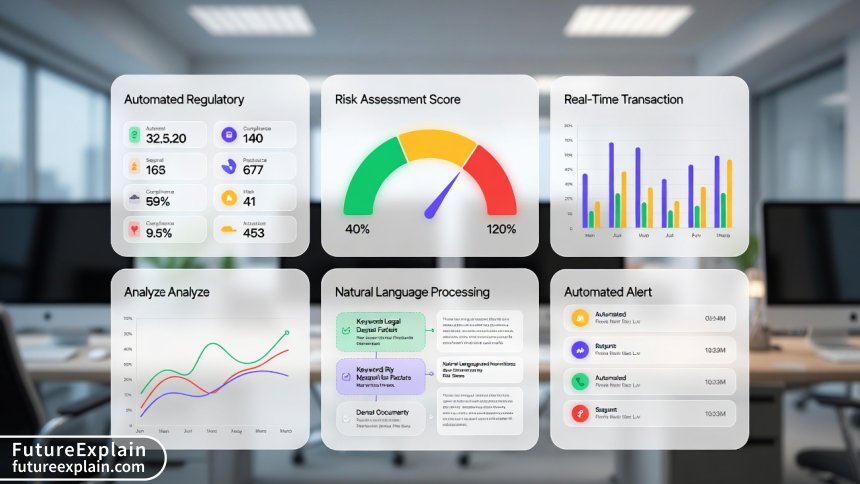
AI transforms compliance from a cost center into a strategic advantage through automation, accuracy, and proactive risk management. Natural language processing (NLP) algorithms can read and interpret regulatory documents, identifying requirements and mapping them to internal processes. Machine learning models monitor transactions against constantly updated watchlists and detect subtle patterns indicative of money laundering or sanctions evasion.
Visuals Produced by AI
AI Applications in Regulatory Compliance
Automated Transaction Monitoring: Traditional rule-based systems generate excessive alerts for AML compliance—some banks investigate 100 false alerts for every true positive. AI systems reduce this noise by understanding context and learning which patterns genuinely warrant investigation. HSBC reported a 60% reduction in false positives after implementing AI transaction monitoring while improving detection of suspicious activity.
Intelligent KYC/Onboarding: Customer due diligence requires verifying identities, assessing risk profiles, and screening against sanctions lists. AI automates document verification (passports, licenses, utility bills), extracts relevant information, and continuously monitors customer relationships for changes in risk profile. This reduces onboarding time from days to minutes while improving accuracy.
Regulatory Change Management: With hundreds of regulatory updates annually, tracking requirements is daunting. AI systems monitor regulatory publications globally, categorize changes by relevance to specific business units, and even suggest necessary process adjustments. This proactive approach helps institutions avoid compliance gaps and potential penalties.
Communications Surveillance: Financial regulators require monitoring employee communications for market abuse, insider trading, and inappropriate conduct. AI analyzes emails, chat messages, and voice communications (after conversion to text) for patterns suggesting misconduct, significantly reducing the volume requiring human review.
The Rise of RegTech: Specialized AI for Compliance
Regulatory Technology (RegTech) companies have emerged as specialized providers of AI-powered compliance solutions. These platforms offer several advantages over in-house development:
- Cross-institutional learning: By serving multiple clients, RegTech platforms can identify emerging patterns across the industry
- Rapid updates: Specialized providers can quickly adapt to regulatory changes
- Cost efficiency: Cloud-based solutions reduce infrastructure costs
- Expertise concentration: RegTech companies attract compliance and AI specialists
Major financial institutions increasingly adopt hybrid approaches, using RegTech solutions for specific functions while developing proprietary AI for competitive differentiation.
Risk Management: Predictive Analytics for Financial Stability
From Historical Analysis to Predictive Risk Assessment
Traditional risk management largely relies on historical data and stress testing based on past scenarios. AI introduces predictive capabilities, assessing risks based on current conditions and forward-looking indicators. This shift is particularly valuable in today's rapidly changing economic environment, where historical patterns may not predict future risks accurately.
Machine learning models analyze diverse data sources: market movements, economic indicators, news sentiment, social media trends, geopolitical developments, and even weather patterns that might affect supply chains or commodity prices. By detecting subtle correlations and early warning signals, these systems provide more accurate and timely risk assessments.
Credit Risk Assessment Revolution
AI is transforming how lenders evaluate creditworthiness. Traditional credit scoring models use limited data points (payment history, debt levels, length of credit history) and treat all applicants within broad categories similarly. AI models can incorporate thousands of data points—with appropriate privacy safeguards—to create more nuanced risk assessments.
Alternative data sources, when used ethically and with proper consent, can help individuals with limited credit history access fair lending. These might include:
- Cash flow analysis from bank account data (with permission)
- Rental payment history
- Utility bill payment patterns
- Educational and employment verification
- Behavioral data from financial management apps
Research by the National Bureau of Economic Research found that machine learning credit models can reduce default rates by 15-25% compared to traditional models while expanding credit access to underserved populations when properly designed.
Market and Operational Risk Management
Market Risk: AI systems analyze market conditions in real-time, identifying potential flash crashes, liquidity shortages, or correlation breakdowns before they cause major disruptions. These systems can also optimize hedging strategies and portfolio allocations based on predicted market movements.
Operational Risk: This encompasses risks from internal processes, people, systems, or external events. AI monitors IT systems for potential failures, analyzes employee behavior for insider threat indicators, and assesses third-party vendors for supply chain risks. Predictive maintenance algorithms can identify equipment likely to fail before it causes operational disruption.
Concentration Risk: Financial institutions need to avoid excessive exposure to particular sectors, geographies, or counterparties. AI systems continuously analyze exposure across all dimensions, alerting when concentrations approach risky levels based on current economic conditions.
Implementation Challenges and Considerations
Data Quality and Accessibility
AI systems are only as good as their training data. Financial institutions often struggle with:
- Data silos: Information trapped in legacy systems
- Inconsistent formats: Different departments recording similar data differently
- Historical data gaps: Incomplete records, especially for rare events like major fraud cases
- Labeling challenges: Determining ground truth for training supervised models
Successful AI implementation requires addressing these data infrastructure issues first. Many institutions establish data lakes or data mesh architectures to consolidate and standardize information before deploying sophisticated AI.
Explainability and Regulatory Approval
Financial regulators increasingly demand explainable AI—systems whose decisions can be understood and justified. The "black box" problem, where even developers don't fully understand why a model makes specific decisions, poses significant challenges for heavily regulated industries.
Techniques like LIME (Local Interpretable Model-agnostic Explanations) and SHAP (SHapley Additive exPlanations) help provide post-hoc explanations for model decisions. Some institutions are developing inherently interpretable models that sacrifice some predictive power for transparency, particularly in high-stakes applications like credit denial.
Integration with Legacy Systems
Most financial institutions operate complex ecosystems of legacy systems, some decades old. Integrating modern AI solutions requires careful architectural planning. Common approaches include:
- API-based integration: AI services called via APIs from existing systems
- Gradual replacement: Modernizing systems module by module
- Dual operation: Running AI systems in parallel with legacy systems during transition
- Cloud migration: Moving appropriate workloads to cloud platforms with native AI services
Ethical Considerations and Responsible AI
Algorithmic Bias and Fair Lending
AI systems can inadvertently perpetuate or amplify existing biases in historical data. If past lending decisions discriminated against certain groups, models trained on that data may learn to do the same. Financial institutions must implement rigorous bias testing and mitigation strategies, including:
- Regular audits for disparate impact across protected classes
- Bias detection during model development and deployment
- Diverse development teams to identify potential blind spots
- Transparent criteria for automated decisions affecting consumers
The Consumer Financial Protection Bureau has issued guidance emphasizing that lenders remain responsible for fair lending compliance regardless of whether decisions are made by humans or algorithms.
Privacy and Data Protection
AI systems often require extensive data, raising privacy concerns. Financial institutions must navigate complex regulations like GDPR (giving EU citizens control over their data) and sector-specific rules like GLBA in the United States. Key principles include:
- Data minimization: Collecting only what's necessary for specific purposes
- Purpose limitation: Using data only for stated, legitimate purposes
- Transparency: Clearly informing customers about data usage
- Security: Protecting data throughout its lifecycle
- Consumer control: Providing options to access, correct, or delete data
Human Oversight and Final Accountability
Despite AI's capabilities, human oversight remains essential. Financial institutions establish governance frameworks specifying:
- Which decisions can be fully automated versus requiring human review
- Escalation procedures for high-risk or uncertain cases
- Regular quality assurance checks on AI system outputs
- Clear lines of accountability for AI-driven decisions
The Future of AI in Finance
Emerging Trends and Technologies
Federated Learning: This approach allows models to be trained on decentralized data without transferring sensitive information. Multiple institutions can collaborate to build better fraud detection models while keeping customer data private—particularly valuable for detecting cross-institutional fraud patterns.
Quantum Machine Learning: While still emerging, quantum computing promises to solve certain financial optimization problems exponentially faster than classical computers. Early applications might include portfolio optimization, risk simulation, and cryptographic security.
Generative AI for Synthetic Data: Creating realistic synthetic financial data for model training and testing while preserving privacy. This helps address data scarcity for rare events like specific fraud types or extreme market conditions.
Explainable AI Advancements: Ongoing research into making complex models more interpretable without sacrificing performance, potentially through hybrid approaches combining neural networks with symbolic reasoning.
Regulatory Evolution
Regulators worldwide are developing frameworks for responsible AI in finance. The European Union's AI Act, Singapore's FEAT principles, and the U.S. Executive Order on AI all signal increased regulatory attention. Financial institutions should expect:
- More specific requirements for model validation and documentation
- Increased focus on algorithmic fairness and transparency
- Potential licensing or certification requirements for high-risk AI applications
- Cross-border regulatory coordination as financial AI operates globally
Getting Started with AI in Finance: Practical Steps
For financial institutions beginning their AI journey, we recommend:
- Start with a focused pilot: Choose a specific, high-value use case like reducing false positives in fraud detection or automating a particular compliance process.
- Assess data readiness: Evaluate data quality, accessibility, and labeling for your chosen application.
- Build cross-functional teams: Include compliance, risk, IT, business units, and data scientists from the beginning.
- Establish governance early: Define accountability, oversight procedures, and ethical guidelines before deployment.
- Plan for scale: Design pilot projects with broader implementation in mind, considering integration, monitoring, and maintenance requirements.
- Engage regulators proactively: Discuss plans with relevant regulators before major deployments, particularly for novel applications.
Conclusion
Artificial intelligence is no longer a futuristic concept in finance—it's a present-day necessity for institutions seeking to combat increasingly sophisticated threats, navigate complex regulatory environments, and manage risks in volatile markets. The transformation extends beyond technology to encompass new governance models, skill requirements, and ethical frameworks.
Successful AI implementation requires balancing innovation with responsibility, leveraging technological capabilities while maintaining appropriate human oversight. Financial institutions that master this balance will not only achieve operational efficiencies but also build stronger customer relationships through enhanced security, fairer decisions, and more personalized services.
The journey toward AI-enabled finance is ongoing, with new capabilities and challenges emerging regularly. By staying informed about developments, engaging with the regulatory community, and prioritizing ethical considerations, financial institutions can harness AI's potential while maintaining the trust that underpins the entire financial system.
Further Reading
Share
What's Your Reaction?
 Like
14210
Like
14210
 Dislike
85
Dislike
85
 Love
3250
Love
3250
 Funny
420
Funny
420
 Angry
110
Angry
110
 Sad
65
Sad
65
 Wow
325
Wow
325

















We've implemented AI for trade surveillance. The reduction in false positives has been dramatic, but we've also caught several instances of market manipulation that would have been missed. The ROI calculation needs to include avoided regulatory fines, not just efficiency gains.
I'm a student studying fintech. This article gives a great overview of career opportunities. Which skills are most in demand right now for AI in finance roles?
Yusuf, great question! The most sought-after skills include: machine learning (especially for unstructured data), data engineering, regulatory knowledge (AML/KYC regulations), cybersecurity, and importantly, the ability to communicate complex technical concepts to non-technical stakeholders.
The regulatory evolution section is crucial. We're already seeing different approaches in the EU, US, and Asia. Staying compliant across jurisdictions requires dedicated legal/tech teams. The cost of non-compliance could outweigh AI benefits if not managed carefully.
How do these systems handle adversarial attacks? If fraudsters know what patterns trigger alerts, they might adapt their methods to avoid detection.
Anna, we use adversarial training - deliberately trying to fool our models during training to make them more robust. Also, ensemble methods combining multiple models make systems harder to game. But it's an ongoing arms race.
Excellent article overall. I'd add that talent acquisition is a major challenge - finding people who understand both finance and AI. We've had success with internal training programs rather than trying to hire everything externally.
The integration challenges with legacy systems are real. We're still running COBOL applications from the 80s. API-based integration has worked best for us, but performance can be an issue with real-time fraud detection.