
Future of Artificial Intelligence: What to Expect in the Next 5 Years
A clear, beginner-friendly look at where artificial intelligence is headed over the next five years. Learn practical trends, likely advances, risks, and how individuals and businesses can prepare responsibly.



Future of Artificial Intelligence: What to Expect in the Next 5 Years
Introduction
Artificial intelligence (AI) is already part of daily life — from search suggestions to photo tagging. But what will AI look like five years from now? This article explains likely developments, practical impacts, and how students, professionals, and small business owners can prepare responsibly. The goal is clear, unbiased guidance: no hype, just useful, beginner-friendly insight.
Why a five-year horizon?
A five-year timeframe is long enough for meaningful technical progress and product changes, but short enough to make practical plans. It allows organizations to invest in skills and pilots without banking on uncertain, distant breakthroughs.
Key technical trends to watch
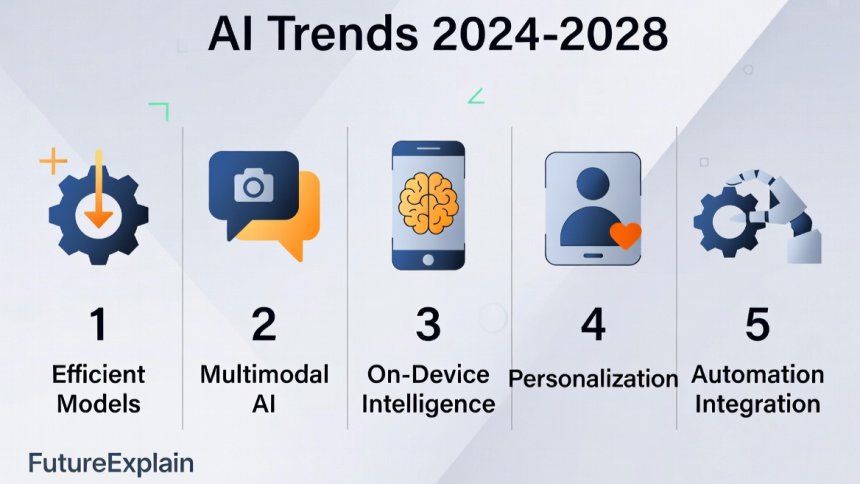
1. Better, smaller, and more efficient models
Large models from recent years showed dramatic abilities. The next five years will likely bring more efficient architectures and training techniques that deliver similar capabilities with fewer resources. Expect improvements in model compression, distillation, and hardware-aware design so that advanced models can run on laptops, phones, and edge devices.
2. Multimodal AI becomes mainstream
Multimodal models that understand text, images, audio, and video together will grow more capable and economical. This enables more natural tools: voice + image assistants that understand context, tools that summarize video and audio, and search experiences that mix media types.
3. Better real-time and on-device intelligence
Low-latency, private on-device AI will expand. We''ll see more features processed locally for privacy and responsiveness — speech recognition, wake-word assistants, camera-based suggestions, and offline capabilities that work without constant cloud access.
4. More practical fine-tuning and personalization
Instead of training models from scratch, teams will increasingly fine-tune smaller, general models for specific tasks or users. This makes personalization and domain adaptation more accessible to small teams without massive compute budgets.
5. Richer tool integration and automation APIs
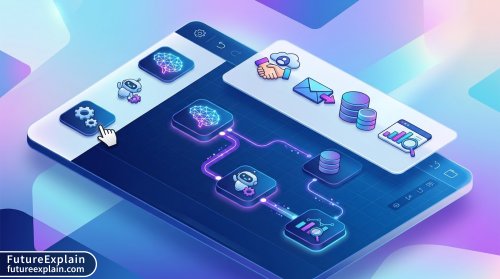
AI will be embedded into workflows with clearer integration points (APIs and low-code connectors). Expect better tools for combining AI with automation systems — connecting language models to databases, calendars, and productivity apps more safely.
Product and industry impacts
1. Knowledge work augmentation
Rather than outright replacing most skilled jobs in five years, AI will amplify productivity. Routine drafting, summarization, coding suggestions, and research assistance will be common. Job roles will shift toward oversight, quality control, and higher-level decision making.
2. Automation in customer-facing services
Chatbots and virtual agents will become more context-aware and capable of handling complex flows. However, human oversight will remain necessary for ambiguous or sensitive cases. For a clear explanation of how chatbots work, see ai-in-customer-support-how-chatbots-really-work.
3. Smarter consumer products
Devices and apps will become more anticipatory — suggesting the right actions at the right time. Recommendation systems will continue evolving; for a deeper look at personalization, see how-ai-personalization-works-netflix-youtube-amazon.
4. Industry-specific AI
Sectors like healthcare, manufacturing, and finance will adopt targeted AI systems (diagnostic assistants, predictive maintenance, fraud detection). These systems often need careful validation and regulation compliance.
Jobs, skills, and careers
Which jobs change most quickly?
Roles with routine and repetitive tasks will see the most immediate automation. Examples include basic data entry, simple content moderation, or repetitive coding tasks. Jobs that blend judgment, empathy, or complex problem solving (teachers, clinicians, managers) will see augmentation rather than wholesale replacement.
Skills that will be valuable
- AI literacy: Understanding what AI can and cannot do (see what-is-artificial-intelligence-a-complete-beginners-guide).
- Data skills: Basic data handling, cleaning, and interpretation.
- Prompting & evaluation: Designing good prompts, testing outputs, and measuring quality.
- Domain expertise + AI: Combining domain knowledge with AI tools to make better decisions.
- Soft skills: Critical thinking, communication, and change management.
How to reskill practically
Start with short, project-based learning: apply a small AI tool to a real problem (automating reports, building a summarized inbox). Use no-code and low-code tools if you lack programming experience (see no-code-vs-ai-tools-what-should-beginners-choose).
Practical actions for businesses and teams
1. Run safe pilots
Choose low-risk, high-value use cases: internal summarization, automated tagging, or pilot chatbots with human-in-the-loop review. Use shadow mode testing before public launches — generate recommendations but don''t display them until validated.
2. Invest in measurement
Define KPIs (time saved, error rate reduction, satisfaction) and run controlled A/B tests. Short-term click metrics can be misleading — track long-term retention and quality.
3. Prioritize privacy and compliance
Use data minimization, anonymization, and on-device processing when possible. Follow sector rules (healthcare, finance) and document data flows. For responsible use basics, read how-to-use-ai-responsibly-beginner-safety-guide.
4. Combine human oversight with automation
Design workflows where AI handles routine work and humans make final decisions for sensitive or high-value tasks.
Ethics, governance, and regulation
1. Expect evolving regulation
Governments will continue to create frameworks for AI safety, explainability, and data protection. Businesses should design with regulation in mind: audit trails, explainability features, and impact assessments.
2. Fairness and bias mitigation
Bias can appear in training data and amplify real-world inequalities. Teams should monitor model outcomes across user groups, add fairness constraints where needed, and surface diverse recommendations intentionally. For an introduction to fairness and bias, see ethical-ai-explained-why-fairness-and-bias-matter.
3. Transparency and user control
Explainable recommendations and options to opt-out or adjust personalization settings increase trust. Be conservative about sensitive personalization (health, political content).
Technology stacks and practical tooling
Managed vs open-source
Smaller teams benefit from managed AI services and off-the-shelf tools; larger teams often use open-source stacks for customization and cost control. Useful starting points include managed NLP APIs, simple collaborative filters for recommendations, and low-code automation platforms (see top-ai-tools-for-beginners-to-boost-productivity).
Integration with automation
AI + automation provides large productivity gains: automatically triage emails, extract structured data from documents, or generate drafts for human review. For practical automation examples, read automation-made-easy-simple-tech-tips-for-everyday-life.
Risks and realistic limits
1. Over-trusting outputs
AI models can produce plausible but incorrect information. Human verification is crucial for factual or safety-critical tasks.
2. Misinformation and misuse
Generative tools can be misused to create convincing false content. Organizations should deploy provenance checks and watermarking where appropriate.
3. Unequal benefits
AI adoption may concentrate advantages in organizations that can invest heavily. Policymakers and leaders should consider access and workforce transition policies.
How individuals can prepare
1. Learn foundational AI concepts
Understand basics like how models learn, what data they use, and major limitations. Our beginner guide is a good start: What Is Artificial Intelligence? A Complete Beginner’s Guide.
2. Build small projects
Even non-technical users can benefit from project-based learning: automate a repetitive task with a chatbot, create a content summarizer, or experiment with a no-code recommender. See practical tool guides at best-automation-tools-for-non-technical-users and how-to-start-learning-ai-without-a-technical-background.
3. Focus on transferable skills
Data literacy, critical thinking, communication, and domain knowledge remain valuable. Emphasize skills that complement AI, not compete with it.
Five practical scenarios to watch
- Customer support: AI triage + human resolution for complex issues.
- Marketing: Automated creative drafts with human curation.
- Healthcare: Diagnostic suggestions with clinician oversight.
- Manufacturing: Predictive maintenance as standard practice.
- Education: Personalized learning paths scaled with AI tutors.
Measuring success and avoiding common mistakes
Don''t judge AI projects by novelty alone. Use clear success metrics, start small, iterate, and include human reviewers. Avoid rushing to production without experiments and monitoring.
Further reading and connections
To build stronger foundations read about how machine learning works: how-does-machine-learning-work-explained-simply. If you''re planning product integration, the guidance in intelligent-automation-explained-ai-and-automation helps combine automation with AI effectively.
Conclusion
Over the next five years AI will continue to change how we work and live. Expect better, smaller models, wider multimodal capabilities, stronger on-device features, and richer integration with workflows. The most important preparation is practical: learn core concepts, run safe pilots, measure impact, and prioritise ethics and privacy. That approach will help individuals and organisations benefit from AI while managing risk.
For related posts that expand on practical tools and ethical concerns, see how-to-use-ai-responsibly-beginner-safety-guide, skills-you-should-learn-to-stay-relevant-in-the-ai-era, and ai-careers-explained-beginner-friendly-career-paths.
Share
What's Your Reaction?
 Like
1050
Like
1050
 Dislike
12
Dislike
12
 Love
185
Love
185
 Funny
22
Funny
22
 Angry
3
Angry
3
 Sad
1
Sad
1
 Wow
78
Wow
78













Question: Will small businesses be able to access good AI tools affordably in the next five years?
Short opinion: This article should be required reading for product managers.
Experience: Our company noted increased throughput after adding simple AI-assisted workflows.
Question: For content creators, how can AI be used without losing authenticity?
Use AI for drafts and ideation but maintain human editing and voice. Declare AI assistance when appropriate to keep transparency.
Praise: Well-structured and calming tone for a complex topic.
Question: How aggressive should exploration be when balancing novelty and relevance?
Start small (5-10% exploration) and monitor user impact. Adjust based on catalogue size and performance.