
AI Careers Explained: Beginner-Friendly Career Paths
A clear, practical guide to AI-related career paths for beginners. Learn common roles, required skills, realistic entry routes, and how to prepare with projects and learning steps for non-technical starters.



AI Careers Explained: Beginner-Friendly Career Paths
Introduction
Artificial intelligence is reshaping industries, and with that change comes a range of new career opportunities. But the idea of "working in AI" often feels vague to beginners. This article breaks down realistic career paths, what each role does, the skills employers expect, and how you can start — even without a technical degree.
Why this guide matters
If you are a student, career-changer, or a professional upskilling in your current job, this guide gives practical direction: which roles are accessible, which require deeper technical study, and which rely primarily on domain knowledge and communication. We avoid hype and focus on concrete steps you can take.
High-level categories of AI-related roles
AI jobs fall into a few broad categories. Understanding these helps you choose a path that matches your strengths and interests.
- Data & Analysis: Data Analyst, Business Intelligence (BI) Analyst
- Model & Engineering: Machine Learning Engineer, Data Scientist
- Product & Design: AI Product Manager, UX for AI
- Operations & Infrastructure: MLOps Engineer, AI Operations
- Ethics & Governance: AI Ethics Specialist, Responsible AI roles
- Tooling & Prompting: Prompt Engineer, AI Solutions Specialist
Role 1 — Data Analyst (Most accessible entry point)
What they do: Collect, clean, and interpret data; create dashboards and reports; help teams make data-informed decisions.
Why it''s beginner-friendly: Many employers hire analysts with strong spreadsheet skills and a basic understanding of SQL and data visualization.
Core skills
- Spreadsheets (Excel / Google Sheets)
- Basic SQL queries (SELECT, WHERE, GROUP BY)
- Data visualization (Tableau, Power BI, or Google Data Studio)
- Clear communication and storytelling with data
How to start
- Build a small portfolio: clean a public dataset, create a 1-2 page dashboard, and write 2–3 insights.
- Follow the learning roadmap in skills-you-should-learn-to-stay-relevant-in-the-ai-era for concrete first steps.
- Apply for junior analyst roles or internships; highlight projects and impact.
Role 2 — BI Analyst / Reporting Specialist
What they do: Build business-facing dashboards, automate reporting, and define metrics for decision-making.
Skills: SQL, dashboard design, knowledge of business metrics, occasional scripting or automation using tools like Python or no-code platforms.
Role 3 — Machine Learning Engineer (technical)
What they do: Implement, train, and deploy machine learning models; write production code; work closely with data engineers and product teams.
Why it''s more advanced: Requires programming (often Python), understanding of ML algorithms, and software engineering skills to put models into production.
Core skills
- Python programming and libraries (NumPy, pandas, scikit-learn, TensorFlow/PyTorch basics)
- Data preprocessing, feature engineering
- Model evaluation and validation
- Familiarity with cloud platforms or MLOps tools for deployment
How to start
- Take beginner Python + ML courses focused on hands-on projects.
- Build one or two small models and document the workflow: data → model → evaluation.
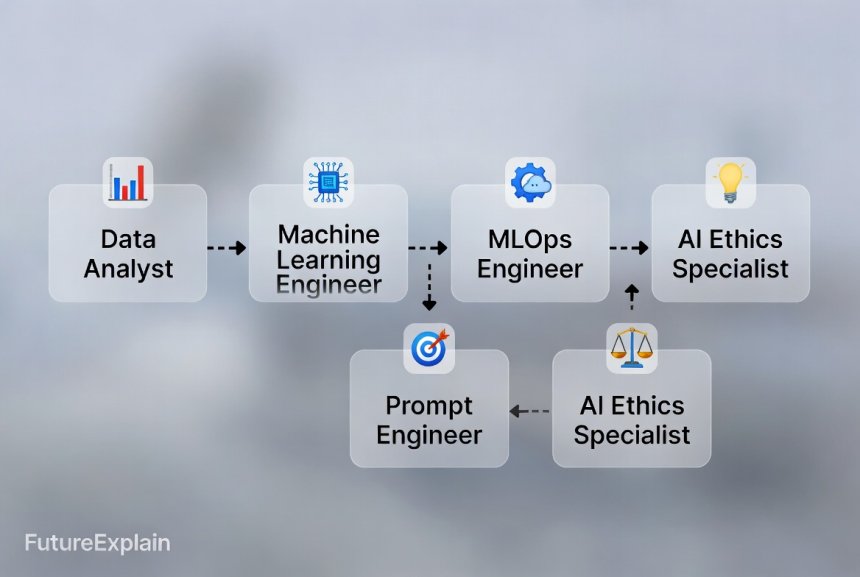
- If you are non-technical, follow a path via data analyst → data scientist → ML engineer as you build programming skills. See how-does-machine-learning-work-explained-simply for conceptual background.
Role 4 — Data Scientist (research + applied)
What they do: Combine statistics, domain expertise, and machine learning to solve complex problems and derive actionable insights.
Distinction: Data scientists often focus on experiments, hypotheses, and model research, while ML engineers focus on productionising models.
Role 5 — MLOps / AI Infrastructure
What they do: Build and maintain infrastructure to train, test, and deploy models; automate pipelines; ensure reproducibility and monitoring.
Skills: DevOps basics, containerisation (Docker), CI/CD, cloud services, and monitoring tools.
Role 6 — AI Product Manager
What they do: Define product goals, coordinate between data teams and business stakeholders, prioritize features, and measure impact.
Why non-technical candidates can succeed: PMs require strong domain knowledge, communication, prioritization skills, and enough technical literacy to work with engineering teams.
How to prepare
- Learn to frame problems clearly: define goal, success metrics, data needs, and user impact.
- Work on small projects with engineers or analysts and document outcomes.
- Read practical product-focused materials and study case studies.
Role 7 — UX / Design for AI
What they do: Design interfaces that make model outputs interpretable, usable, and safe for users. They consider human trust, feedback loops, and explainability.
Designers who learn basic AI concepts and ethics are in demand, especially for consumer-facing AI products.
Role 8 — Prompt Engineer / AI Solutions Specialist
What they do: Craft prompts, evaluate outputs, and integrate large language models (LLMs) into workflows or apps. They design instruction styles and guardrails for better model behavior.
Why it''s accessible: Prompt engineering often rewards domain knowledge, creativity, and testing rather than deep model internals — a practical role for non-engineers.
Role 9 — AI Ethics, Policy & Responsible AI
What they do: Identify fairness, privacy, and safety risks; set governance; and ensure responsible deployment.
Skills: Ethics frameworks, regulatory knowledge, risk assessment, stakeholder management. See ethical-ai-explained-why-fairness-and-bias-matter for deeper context.
How to choose a path
To pick, consider:
- Your current strengths: Are you stronger at communication, domain knowledge, or technical tasks?
- Learning commitment: Technical roles need longer technical learning plans; product and ethics roles may leverage domain strengths faster.
- Job market in your region: Look at job ads to see common entry requirements.
Practical entry routes for non-technical professionals
Not all AI roles require deep coding. Here are realistic routes:
- Data Analyst: Learn Excel → SQL → visualization. Build dashboards for your team.
- Prompt Engineer / Content Specialist: Learn LLM tooling, prompt design, and evaluation methods. Create a portfolio of useful prompts and examples.
- AI Product or Project Manager: Learn basic ML concepts, prioritize user value, and run small cross-functional projects. See also how-to-start-learning-ai-without-a-technical-background.
- AI Ethics / Governance: Study case studies, frameworks, and regulation; propose simple governance steps for your organisation.
Building a portfolio that matters
Employers care about demonstrated impact. A short portfolio of 2–4 mini-projects is more persuasive than certificates.
- Project format: goal → data/tools → steps → result/impact → what you learned.
- Example projects: customer feedback summarizer using an LLM; automated weekly report pipeline using SQL + spreadsheet + automation; simple classification model for internal QA (if you have data).
- Present outcomes: quantify time saved, error reduction, or increased engagement.
Skills checklist by role (quick reference)
- Data Analyst: Excel, SQL, data visualization, storytelling
- Machine Learning Engineer: Python, ML libraries, model evaluation, deployment basics
- AI Product Manager: product design, metrics, ML literacy
- MLOps: containers, CI/CD, cloud services
- Prompt Engineer: LLM behavior, evaluation, prompt templates
- AI Ethics: fairness, privacy, auditing
Sample 3-month learning plan for non-technical starters
Goal: move into an AI-adjacent role (data analyst / prompt engineer / product coordinator)
- Month 1: Data literacy and spreadsheets; complete a dashboard project.
- Month 2: Learn basic SQL and explore an LLM for summarization; build a small automation.
- Month 3: Create a portfolio page and present the project to a manager or online community.
Interview preparation and resumes
Employers often look for evidence of problem solving and impact:
- List projects with clear outcomes and tools used.
- Practice technical basics (SQL queries, data interpretation) and behavioral questions that show teamwork and learning ability.
- For product/ethics roles, prepare to discuss trade-offs and responsible approaches to model use.
Where to find jobs and how to apply
Look beyond "AI" labeled jobs; many roles are under product, operations, or analytics. Search for junior positions and internships. When applying, tailor your CV to the job: if it asks for SQL, mention a project where you used SQL and the impact it had.
Certifications vs real projects
Certifications can help with filtering tools, but real projects show the ability to apply skills. Prioritize projects that are measurable and relevant to the role you seek.
Ethics, safety, and long-term perspective
As you pursue an AI career, always consider safety, privacy, and fairness in your work. Learn foundational ideas in responsible AI — these are increasingly expected across roles. For practical ethics guidance, see how-to-use-ai-responsibly-beginner-safety-guide.
Next steps and staying adaptable
AI careers evolve. Stay adaptable by practicing learning habits: set small project goals, document outcomes, share your work, and ask for feedback. Revisit and update skills every quarter.
Further reading and related guides
To deepen your knowledge, check these related articles in our series:
- skills-you-should-learn-to-stay-relevant-in-the-ai-era — for the skill roadmap.
- how-to-start-learning-ai-without-a-technical-background — for non-technical learning paths.
- ethical-ai-explained-why-fairness-and-bias-matter — for ethics and fairness.
- future-of-automation-in-offices-and-businesses — for context on automation roles and how AI integrates into workplaces.
Conclusion
There is no single path to an AI career. Choose a role aligned with your strengths, build applied projects, and demonstrate impact. Whether you become a data analyst, product manager, MLOps engineer, or ethics specialist, the key is practical experience, continuous learning, and clear communication of results. Small, focused projects and learning steps will get you started and show employers you can add value right away.
Share
What's Your Reaction?
 Like
1600
Like
1600
 Dislike
15
Dislike
15
 Love
250
Love
250
 Funny
25
Funny
25
 Angry
5
Angry
5
 Sad
3
Sad
3
 Wow
90
Wow
90

















Experience: Measuring impact helped secure more learning time from leadership.
Praise: Very accessible for non-technical readers.
Constructive feedback: Examples of interview tasks would be a helpful follow-up piece.
Short opinion: Balanced and practical; sharing this with my team.
Experience: Documentation saved effort when handing projects over.
Question: How often should I update my portfolio?
Hi henrycox — update quarterly or after any project with measurable results; include short notes on what changed.