
Will AI Replace Humans? A Realistic Explanation
A balanced, beginner-friendly look at whether AI will replace human jobs. Understand realistic risks, which roles will change first, how to prepare, and practical steps for individuals and organizations.


Will AI Replace Humans? A Realistic Explanation
Overview
Every few years a new wave of technology creates the same question: will machines take our jobs? Artificial intelligence (AI) raises this question more loudly because of its fast progress and media attention. This article explains the answer clearly and calmly. We will look at how AI augments and automates work, which tasks are most at risk, and how individuals and organizations can respond practically. This is a balanced, beginner-friendly guide designed for non-technical readers, students, professionals, and small business owners.
Understanding the core difference: tasks vs jobs
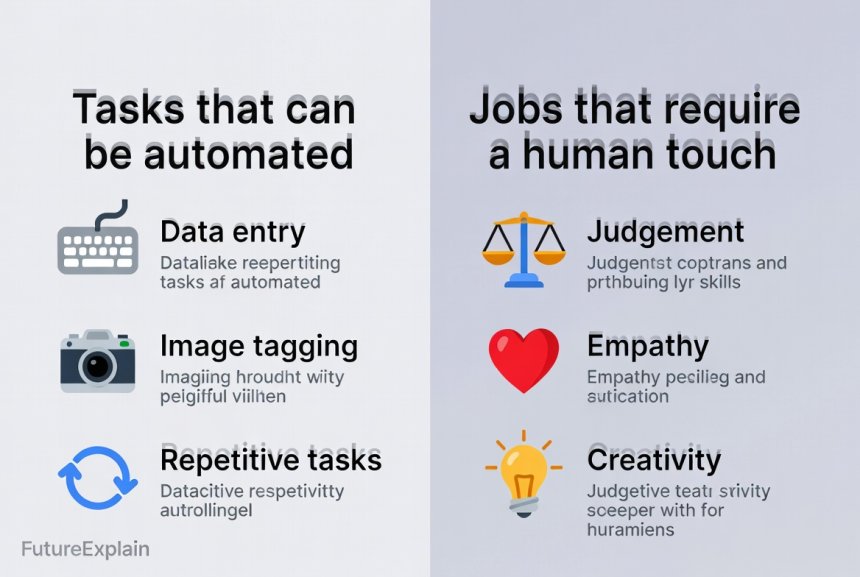
One reason conversation about AI and employment becomes confusing is the difference between jobs and tasks. A job is a bundle of tasks: some are repetitive, some require judgement, and others need social skills.
- Tasks: Discrete actions like entering data, classifying images, writing short emails, or scheduling a meeting.
- Jobs: Collections of tasks plus responsibilities, relationships, and decision-making. Examples: teacher, nurse, accountant.
AI is better at automating specific tasks than entire jobs. Over time, AI may automate many tasks inside jobs, changing how humans work, rather than eliminating the job completely.
Which tasks are most likely to be automated?
Routine, predictable tasks
Tasks that follow clear rules or patterns are the easiest to automate. This includes repetitive data entry, standardised report generation, basic transaction processing, and template-based writing.
Pattern recognition at scale
AI excels at recognizing patterns in images, audio, and text. This makes tasks like image tagging, fraud detection, and preliminary document review good candidates for automation.
High-volume content drafting
Modern language models can produce drafts — short summaries, email templates, and first-pass content. These drafts still require human review for accuracy and tone, but they reduce time spent on routine drafting.
Tasks less likely to be automated soon
- Complex decision-making under uncertainty: Strategic planning, interdisciplinary problem solving, and high-stakes clinical decisions.
- Empathy, trust, and negotiation: Human care work, high-level management, and therapeutic roles.
- Creative leadership and ethics: Setting values, long-term trade-offs, and building social consensus.
Will whole jobs disappear?
Historically, new technology has both displaced and created jobs. Early automation removed many repetitive factory tasks but created new roles in programming, maintenance, design, and supervision. The same pattern is likely with AI: certain roles will shrink while new ones emerge that require human oversight, AI system design, domain expertise, and interaction skills.
For example:
- Basic transcription and simple customer support tasks may shift to automated systems, while support managers and escalation specialists remain essential.
- Junior content writers may use AI to produce first drafts, but editors, curators, and strategy writers continue to add human value.
- Accountants who automate reconciliation tasks will still be needed for tax strategy, complex compliance, and client relations.
Industries likely to see faster change
Change will not be uniform across sectors. Some industries will experience faster automation of tasks due to available data and clear rules:
- Finance — Automated reporting, fraud detection, and portfolio rebalancing.
- Customer support — Chatbots for standard queries; humans for complicated cases. See ai-in-customer-support-how-chatbots-really-work for details.
- Transportation & logistics — Route optimisation, demand forecasting, and warehouse automation.
- Marketing & content — Drafting and personalization tools that augment human teams (see top-ai-tools-for-beginners-to-boost-productivity).
- Manufacturing — Predictive maintenance and quality inspection using computer vision.
What about creative fields?
Creativity is often seen as uniquely human. AI can assist creativity by generating ideas, variations, or visual prototypes. But creative work includes context, cultural judgement, and authorship decisions that remain human strengths. The conversation is less about replacement and more about redefinition: creators may use AI as a tool to accelerate ideation and production while preserving a human voice and purpose.
Why many jobs will be augmented, not replaced
There are practical, technical, and social reasons why augmentation is more likely than wholesale replacement in the near-to-medium term:
- Technical limits: AI models make mistakes and can produce plausible-sounding errors. In high-stakes settings humans are still needed to verify and decide.
- Value of human relationships: Trust, empathy, and social negotiation are hard to replicate.
- Regulation and risk management: Industries like healthcare and finance require explainability and audit trails; regulators often demand human oversight.
- Organizational inertia: Replacing entire teams is costly and risky. Most organisations prefer incremental automation that preserves control.
For a broader view of how AI changes jobs and which roles are safer, review how-ai-is-changing-jobs-and-which-jobs-are-safe.
What skills will matter most?
Technical plus human strengths
Rather than trying to "compete with AI" on brute processing, workers should focus on skills that AI augments well:
- Domain expertise: Deep knowledge that guides AI use and interprets outputs.
- Data literacy: Basic ability to understand data, vet model outputs, and ask the right questions.
- Prompting & evaluation: Designing and testing prompts or model behaviours for quality and bias.
- Communication and empathy: Explaining decisions and building relationships that machines cannot.
- Creative judgment: Selecting and shaping AI outputs into meaningful, original work.
Practical reskilling steps
- Start with short online courses that combine theory and projects.
- Apply AI tools to real tasks — e.g., automate a weekly report and measure time saved.
- Learn to evaluate model output quality and bias.
- Strengthen transferable skills such as problem solving and communication.
For a guide to practical skills and learning paths, see skills-you-should-learn-to-stay-relevant-in-the-ai-era and how-to-start-learning-ai-without-a-technical-background.
How organisations should respond
1. Map tasks before jobs
Identify which tasks in a role are repetitive and which require human judgement. Automate low-risk, high-volume tasks first, then redesign roles around the remaining human strengths.
2. Run human-in-the-loop pilots
Test AI in controlled environments where humans can correct and improve outputs. Use "shadow mode" where AI runs, but humans make the final decision, to collect reliability data before deployment.
3. Measure and iterate
Track outcomes that matter: accuracy, time saved, user satisfaction, and downstream effects. Avoid focusing solely on short-term engagement metrics.
4. Invest in worker transition
Provide learning opportunities, mentorship, and time for employees to adapt. Organisations that reskill existing teams often retain institutional knowledge and move faster than those who hire entirely new talent.
Policy and social considerations
Because technological change affects livelihoods, public policy has a role to play. Key areas include:
- Education and lifelong learning: Public and private programmes that fund reskilling for mid-career workers.
- Social safety nets: Temporary support and transition services to reduce economic disruption.
- Regulation: Standards for explainability, fairness, and accountability in sensitive sectors.
- Access and inclusion: Ensuring smaller organisations and underrepresented groups can benefit from AI tools.
Policymakers and leaders should aim for solutions that encourage innovation while protecting workers—balancing incentives and safeguards.
Common misconceptions and clarifications
AI is not a single thing
"AI" includes many approaches — simple rules, classic machine learning, and complex deep learning models. Lumping these together causes confusion.
Not all automation is malicious
Automation can reduce drudgery and create opportunities for more meaningful work. The issue is how change is managed and who captures the benefits.
Displacement does not equal unemployment
History shows technology often changes the type of work rather than eliminating the need for human effort. New roles appear in training, system oversight, domain expertise, and ethics management.
Practical steps for individuals
- Inventory your tasks: List tasks you do weekly. Identify repetitive work that could be automated and the tasks requiring judgement or people skills.
- Try small projects: Use an AI tool to automate or speed up one task. Measure time saved and accuracy impact.
- Learn applied skills: Short courses in data literacy, AI fundamentals, and tool use are effective. Project-based learning works best.
- Emphasise human strengths: Practice communication, critical thinking, and domain specialization.
How managers should design jobs for the AI era
Job design should emphasise human oversight, value-added judgement, and continuous adaptation:
- Clearly separate tasks suitable for automation from those needing human discretion.
- Build feedback loops: collect user feedback and error logs to refine both AI and human processes.
- Recognise and reward learning: incentivise employees to upskill and experiment safely with AI.
For guidance on combining AI with automation, refer to intelligent-automation-explained-ai-and-automation and our practical automation tips at automation-made-easy-simple-tech-tips-for-everyday-life.
Measuring impact: realistic KPIs
Good KPIs link automation to outcomes, not just activity. Useful measures include:
- Time saved per task
- Error rate before and after automation
- Customer satisfaction and resolution times
- Employee time spent on higher-value work
Conclusion — a practical answer
Will AI replace humans? Not in a simple, uniform way. AI will automate many tasks — especially routine and pattern-based work — and will augment many jobs. Some roles may shrink; others will evolve or expand. The realistic response is preparation: understand tasks, experiment with pilots, measure outcomes, and invest in the skills and social supports that let people work with AI, not be replaced by it.
To deepen your understanding, start with our beginner guides: what-is-artificial-intelligence-a-complete-beginners-guide and how-does-machine-learning-work-explained-simply. If you are planning workforce changes, consult skills-you-should-learn-to-stay-relevant-in-the-ai-era and ai-careers-explained-beginner-friendly-career-paths for practical next steps.
Share
What's Your Reaction?
 Like
950
Like
950
 Dislike
8
Dislike
8
 Love
160
Love
160
 Funny
18
Funny
18
 Angry
2
Angry
2
 Sad
1
Sad
1
 Wow
70
Wow
70












Constructive feedback: A downloadable checklist would make adoption easier.
Short opinion: Useful read for anyone worried about job security.
Experience: We retained staff by retraining and changing role descriptions.
Question: Any quick ways to spot overfitting in small pilot models?
Monitor performance on holdout sets and test on fresh data; watch for big drops in new data performance.
Praise: Calm, educational tone — perfect for leadership briefings.
Question: For sectors with heavy regulation, how should pilots be documented?
Keep clear logs, decision trails, and human review records; involve compliance early in pilot design.