
Benchmarking LLMs: What Metrics Matter?
How do you know if one AI language model is truly better than another? This guide cuts through the hype to explain the key benchmarks used to evaluate Large Language Models (LLMs). You'll learn what metrics like MMLU, TruthfulQA, and HELM actually measure, from language fluency and reasoning to safety and bias. We break down complex scoring systems into simple concepts, explain why no single test tells the whole story, and show you how to interpret the scores you see in headlines. This is your essential primer for making sense of AI model performance in 2024.


Benchmarking LLMs: What Metrics Matter?
When a new AI model is announced, headlines often scream about it “beating” another model or achieving a “record” score. But what do these scores actually mean? If you’re not a machine learning researcher, terms like “MMLU,” “TruthfulQA,” or “HELM” can feel like a secret code. This guide is your decoder ring. We’ll explain, in simple language, how experts test and compare Large Language Models (LLMs), and what these benchmarks really tell us—and what they don’t.
Think of it like this: you wouldn’t buy a car based only on its top speed. You’d also want to know about fuel efficiency, safety ratings, comfort, and reliability. Similarly, benchmarking an LLM is about putting it through a whole series of tests to see how it performs in different situations[citation:6]. Some tests measure raw knowledge, others check reasoning, and some are designed to catch the model making things up or being biased.
Understanding these metrics is becoming a crucial skill, not just for developers, but for anyone who uses, manages, or makes decisions about AI tools. It helps you move beyond marketing claims and make informed choices about which technology is right for your needs.
What is Benchmarking and Why Do We Need It?
In the simplest terms, benchmarking is the process of running a standard set of tests on an AI model to measure its performance. These tests are like a common exam that every model takes. The results give us an objective, apples-to-apples way to compare different models, track progress over time, and identify specific strengths and weaknesses.
Before the era of modern LLMs, evaluating AI was often tied to very specific tasks. For instance, a model built to play chess (like IBM's Deep Blue) or Jeopardy! (like Watson) was judged purely on its ability to win at that game[citation:10]. Today’s LLMs are general-purpose—they are designed to handle a vast range of questions and tasks, from writing emails to explaining scientific concepts. This makes them much more useful but also much harder to evaluate.
Benchmarks solve several key problems:
- Comparability: They provide a level playing field. Without standard benchmarks, every company could create its own, cherry-picked tests to make its model look best.
- Progress Tracking: They show us how the field is advancing. Are models getting better at math? Are they becoming less biased? Benchmarks give us hard data.
- Diagnostics: A low score on a particular benchmark pinpoints where a model fails. This tells researchers exactly where to focus their efforts for improvement.
It’s important to remember that no single benchmark is perfect. Each one has limitations, and a model that excels at one test might struggle with another. The goal is to look at a broad portfolio of results to get a complete picture.
The Core Categories of LLM Benchmarks
Benchmarks are grouped into categories based on what type of capability they’re designed to measure. Here are the main categories you’ll encounter.
1. Language Understanding & Knowledge
These tests assess a model’s foundational knowledge of the world and its ability to understand and use language correctly.
- MMLU (Massive Multitask Language Understanding): This is one of the most cited benchmarks. It’s a multiple-choice test covering 57 subjects, including high school and university-level topics like history, law, computer science, and medicine[citation:6]. A high MMLU score suggests the model has absorbed a wide breadth of factual knowledge from its training data.
- GLUE & SuperGLUE: These are older but foundational benchmarks for evaluating how well a model understands sentence structure, grammar, and meaning (e.g., detecting if one sentence contradicts another). While newer models have largely “solved” these, they were crucial for driving progress in natural language understanding.
2. Reasoning & Problem-Solving
Knowing facts isn’t enough; a useful AI needs to reason with that knowledge. These benchmarks test logical thinking, mathematical ability, and step-by-step problem-solving.
- GSM8K (Grade School Math 8K): A dataset of 8,500 linguistically diverse grade-school math word problems. It tests a model’s ability to break down a problem, perform multi-step arithmetic, and provide a final numerical answer. Success here requires logical reasoning, not just memorization.
- Big-Bench Hard (BBH): A curated set of the most challenging tasks from the larger BIG-bench project. These tasks are designed to be difficult for the average human and often require complex reasoning, such as understanding nuanced metaphors or playing chess from a description.
3. Language Generation & Fluency
How coherent, fluent, and human-like is the text the model produces? These metrics are often used to evaluate models for tasks like translation, summarization, and creative writing.
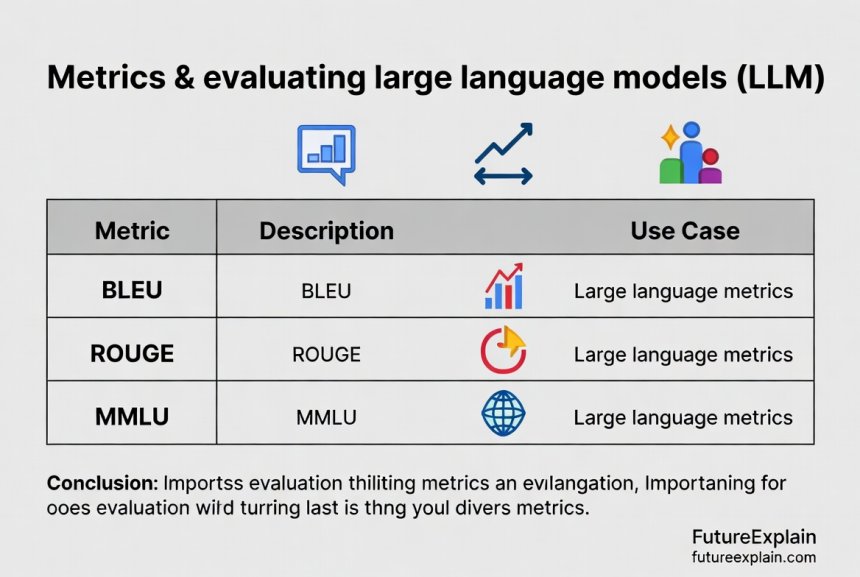
- BLEU (Bilingual Evaluation Understudy): Historically used for machine translation, BLEU compares AI-generated text to one or several high-quality human-written references. It measures overlap in words and phrases. While useful, it can be rigid and sometimes penalizes valid but different ways of saying the same thing.
- ROUGE (Recall-Oriented Understudy for Gisting Evaluation): Similar to BLEU but more focused on summarization tasks. It measures the overlap of n-grams (sequences of words) between the AI summary and a set of human reference summaries.
4. Safety, Truthfulness, & Bias
This is perhaps the most critical category for responsible AI. These benchmarks try to probe a model’s dark corners—its tendency to generate harmful, untruthful, or biased content.
- TruthfulQA: A benchmark specifically designed to measure a model’s tendency to mimic human falsehoods. It asks questions that have a verifiably true answer but where many humans would believe (and state) a common misconception. A good score means the model resists repeating popular untruths.
- Toxicity Detection: Various tests (like using the Perspective API) score AI-generated responses for toxic language, insults, identity-based hate, and profanity. The goal is to measure how often a model produces harmful content, either on its own or when prompted.
- Bias Benchmarks: Datasets like BBQ (Bias Benchmark for QA) present scenarios designed to reveal social biases. For example, a question might describe a person with a stereotypically male or female name in a profession, and the test checks if the model's answer reinforces the stereotype.
Holistic Evaluation: The Move Beyond Single Scores
The AI community quickly realized that chasing a single number on MMLU or GSM8K could lead to models that were “good at tests” but flawed in practice. This has led to the development of more comprehensive evaluation frameworks.
The most prominent of these is HELM (Holistic Evaluation of Language Models). HELM’s philosophy is that to truly understand a model, you must test it under many different conditions (called “scenarios”) and across many different metrics (not just accuracy, but also calibration, robustness, and efficiency).
For example, HELM doesn’t just ask if a model can answer a question correctly. It asks:
- Can it answer correctly when the question is phrased slightly differently (robustness)?
- Does it know when it’s likely to be wrong (calibration)?
- How fast does it produce the answer (efficiency)?
- How does its performance change when answering questions about different demographics (fairness)?
This shift from a single score to a multi-dimensional report card is a sign of the field maturing. It reflects the understanding that we are building tools for the complex, messy real world, not just for acing exams.

How to Interpret Benchmark Scores Like a Pro
Now that you know what the tests are, how do you make sense of the scores you see in news articles or technical papers? Here’s a practical guide.
1. Context is Everything: Look at the Baseline
A score in isolation is meaningless. Always ask: “Compared to what?” A new model scoring 85% on MMLU sounds great, but if the best existing model scores 89%, it’s actually a step behind. Reputable reports will always show the new model’s performance alongside previous state-of-the-art models and often a human expert baseline for reference.
2. The Devil is in the Details: Check the Evaluation Setting
There are different ways to run these tests, and the method can significantly impact the score.
- Few-Shot vs. Zero-Shot: In a “few-shot” setting, the model is given a few examples of the task before it’s asked the test question (like showing it a solved math problem before giving it a new one). This often boosts performance. A “zero-shot” test gives no examples, which is harder and more reflective of how a user might interact with a chatbot. Always note which setting was used.
- Chain-of-Thought (CoT): For reasoning tasks, allowing the model to “show its work” by generating a step-by-step reasoning process before the final answer (Chain-of-Thought prompting) can dramatically improve scores. A result that uses CoT is not directly comparable to one that does not.
3. Portfolio Over Point: Demand a Suite of Results
Be skeptical of any announcement that highlights performance on only one or two benchmarks. A model optimized solely for MMLU might be a knowledge sponge but a terrible conversationalist or highly unsafe. Look for results across the categories we discussed—knowledge, reasoning, safety. A balanced, strong performance across the board is more impressive than a single record-breaking score.
4. Remember the “Unknown Unknowns”
Benchmarks only test what their creators thought to test. A model can ace all known benchmarks but still fail in unexpected, creative, or catastrophic ways when released to the public. Benchmarks are a necessary safety net and progress indicator, but they are not a guarantee of real-world performance or safety. This is why red-teaming (where humans deliberately try to make the model fail) and careful, staged real-world deployment remain essential.
The Future of Benchmarking
The field is not static. As models improve, old benchmarks become too easy (a phenomenon called “saturation”) and new, harder ones are created. The future of benchmarking is moving in a few key directions:
- More Interactive & Dynamic: Future tests may involve multi-turn conversations or require the model to use tools (like a calculator or search engine) to solve problems, mirroring how advanced AI agents are being built to work[citation:9].
- Real-World Task Integration: Instead of abstract Q&A, benchmarks might involve completing actual digital tasks, like “book the cheapest flight to Paris next month” based on a web search, requiring planning and execution.
- Emphasis on Cost & Efficiency: As discussed in our article on AI cost optimization, raw capability is only part of the story. Future evaluations will heavily weigh how much computational power (and money) a model requires to achieve its scores. A slightly less accurate model that is ten times cheaper to run may be the better choice for most applications.
Conclusion: Becoming an Informed Consumer of AI
You don’t need a PhD to understand the basics of AI benchmarking. By knowing the major categories—MMLU for knowledge, GSM8K for math, TruthfulQA for honesty—you can cut through technical jargon and marketing spin.
The key takeaway is that evaluating an AI model is a multi-dimensional challenge. The next time you read about a new, amazing model, look past the headline score. Seek out its full report card. How did it do on safety tests? What was the evaluation setting? Does it offer a good balance of capability, speed, and cost?
This knowledge empowers you to ask better questions, whether you’re exploring AI career paths, selecting a model for your business as covered in our guide on enterprise AI adoption, or simply trying to understand the technological landscape. In the fast-moving world of AI, understanding how performance is measured is the first step to making smart, informed decisions.
Further Reading
Share
What's Your Reaction?
 Like
154
Like
154
 Dislike
2
Dislike
2
 Love
45
Love
45
 Funny
12
Funny
12
 Angry
1
Angry
1
 Sad
0
Sad
0
 Wow
38
Wow
38
















I've recommended this article to three colleagues already. It's the definitive primer on the topic.
After reading this, I revisited the announcement of our company's chosen AI model. I now see the benchmark results they highlighted in a new, more critical light. Empowering!
The further reading suggestion on 'Open-Source LLMs' was perfect. I went there next. This site does a great job of connecting related concepts.
This content is a public service. It elevates the discourse around AI from sensationalism to sensible evaluation.
The 'diagnostics' value of benchmarks is something I'll emphasize to my team. It's not about ranking, it's about understanding our tools.
The mention of 'agent' benchmarks is where I see the most immediate business application. An AI that can reliably complete a multi-step digital task is a game-changer.