
Building an AI-Powered Content Workflow for Bloggers
This comprehensive guide teaches bloggers how to build an efficient AI-powered content workflow that saves time while maintaining quality. We cover the complete process from idea generation to publication, including tool selection, workflow design, quality control, and optimization strategies. Learn how to integrate AI for research, writing, editing, SEO optimization, and content promotion while preserving your unique voice. Includes practical templates, time-saving calculations, troubleshooting tips, and real-world examples for different blogging niches. Perfect for bloggers looking to increase productivity without sacrificing authenticity.


Building an AI-Powered Content Workflow for Bloggers
As a blogger in 2024, you're likely feeling the pressure to produce more content, optimize for search engines, engage your audience, and manage all the behind-the-scenes tasks—often with limited time and resources. This is where building an AI-powered content workflow can transform your blogging experience. By strategically integrating artificial intelligence into your content creation process, you can save significant time, improve quality, and maintain consistency without burning out.
An AI-powered workflow isn't about replacing your creativity with automation. Instead, it's about using AI as a collaborative partner that handles time-consuming tasks, provides data-driven insights, and enhances your natural writing process. According to Content Marketing Institute research, bloggers who effectively integrate AI tools report 40-60% time savings on content creation while maintaining or improving quality metrics.
Why Bloggers Need AI-Powered Workflows
Before diving into the how, let's understand why an AI-powered workflow is becoming essential for modern bloggers:
- Time Constraints: The average 1500-word blog post takes 4-6 hours to create manually. AI can reduce this to 2-3 hours.
- SEO Demands: Modern SEO requires optimization that AI tools can analyze and implement more efficiently.
- Content Volume: Consistent publishing schedules are easier to maintain with AI assistance.
- Quality Standards: AI can help maintain consistent quality across all your content.
- Competitive Edge: Early adopters of AI workflows are already producing more content with less effort.
The key is building a workflow that leverages AI's strengths while preserving your unique voice and perspective—the elements that make your blog distinctive.
The Complete AI-Powered Blogging Workflow
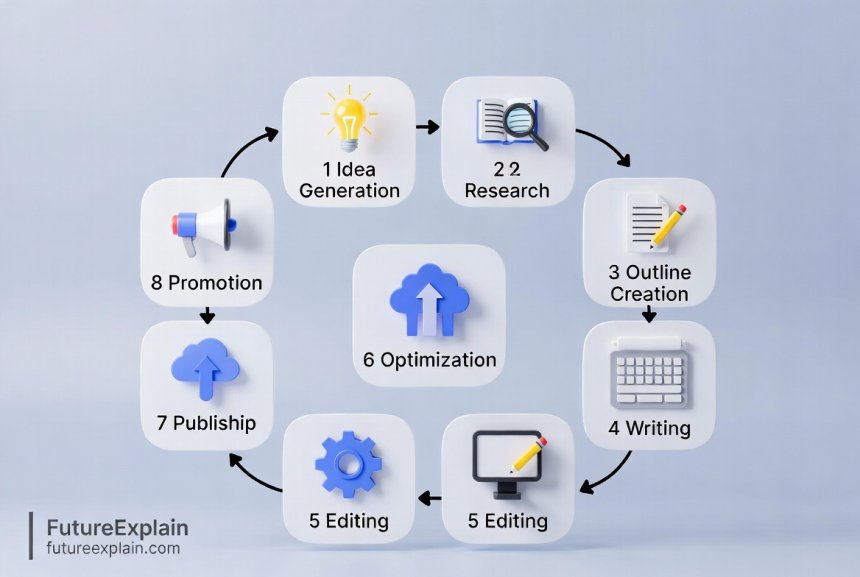
An effective AI workflow follows a structured process. Here's the complete eight-stage workflow we'll explore in detail:
- Idea Generation & Validation
- Research & Data Gathering
- Outline Creation
- Content Writing
- Editing & Refinement
- SEO Optimization
- Formatting & Publishing
- Promotion & Distribution
Stage 1: AI-Powered Idea Generation
Finding fresh, relevant topics is the foundation of successful blogging. AI can transform this from a guessing game into a data-driven process.
Traditional Approach: Brainstorming based on personal experience, following trends, guessing what might resonate.
AI-Enhanced Approach: Using AI tools to analyze search trends, audience questions, competitor gaps, and seasonal patterns.
Tools & Techniques:
- Keyword Research AI: Tools like SEMrush, Ahrefs, or AnswerThePublic that use AI to identify topic opportunities
- Question Analyzers: AI that scans forums (Reddit, Quora), comments, and social media for audience questions
- Trend Predictors: Tools that analyze emerging trends in your niche
- Content Gap Finders: AI that compares your content against competitors to find missing topics
Practical Implementation: Set aside 30 minutes weekly for AI-powered idea generation. Use a combination of tools to generate 10-15 topic ideas, then apply your human judgment to select the 3-5 most promising ones.
Stage 2: Efficient Research with AI
Research is often the most time-consuming part of blogging. AI can accelerate this while improving depth and accuracy.
Traditional Approach: Manual Google searches, reading multiple sources, taking notes, verifying facts.
AI-Enhanced Approach: AI research assistants that gather, summarize, and organize information from multiple sources.
Tools & Techniques:
- Research Assistants: Tools like Consensus or Scite that find and summarize academic papers and studies
- Data Extractors: AI that pulls statistics and facts from reports and databases
- Source Verifiers: Tools that check information credibility across sources
- Note Organizers: AI that structures research notes by topic or relevance
Practical Implementation: Start with a broad research query, let AI gather initial sources, review the summaries, then dive deeper into the most relevant materials. Always verify critical facts from primary sources.
Stage 3: AI-Assisted Outline Creation
A strong outline is the backbone of effective content. AI can help create comprehensive, logical outlines that improve writing flow and SEO.
Traditional Approach: Creating bullet-point outlines based on personal understanding of the topic.
AI-Enhanced Approach: Using AI to analyze top-ranking content structures and suggest optimal outline formats.
Tools & Techniques:
- Outline Generators: AI tools that create hierarchical outlines based on your topic and keywords
- Competitive Analysis: AI that reverse-engineers successful competitor outlines
- Structure Optimizers: Tools that suggest content structures based on reader engagement patterns
- Template Systems: AI that applies proven outline templates to your specific topic
Practical Implementation: Feed your topic and primary keyword to an outline generator. Review and customize the suggested structure based on your unique perspective and audience needs. Aim for outlines with clear hierarchy (H2, H3 headings) that cover the topic comprehensively.
Stage 4: Writing with AI Collaboration
This is where many bloggers feel uncertain. The key is viewing AI as a writing assistant, not a replacement.
Traditional Approach: Writing everything from scratch, struggling with writer's block, inconsistent quality.
AI-Enhanced Approach: Using AI for initial drafts, difficult sections, or expanding on your ideas while maintaining your voice.
Tools & Techniques:
- Writing Assistants: Tools like ChatGPT, Claude, or specialized blogging AI
- Voice Training: AI that learns your writing style from samples
- Section Writers: Tools that help with specific challenging sections (introductions, conclusions, explanations)
- Idea Expanders: AI that takes your bullet points and expands them into paragraphs
Practical Implementation: Start with your outline and write the sections you feel most confident about. Use AI for sections where you're struggling or need additional perspectives. Always edit AI-generated content to inject your personality, experiences, and unique insights.
Stage 5: AI-Enhanced Editing
Editing is where AI truly shines, catching issues human editors might miss while providing objective feedback.
Traditional Approach: Self-editing or hiring human editors, missing subtle issues, inconsistent quality.
AI-Enhanced Approach: Layered editing using multiple AI tools for different aspects (clarity, grammar, style, flow).
Tools & Techniques:
- Grammar & Style Checkers: Tools like Grammarly or ProWritingAid
- Clarity Analyzers: AI that identifies confusing sentences or jargon
- Readability Optimizers: Tools that suggest improvements for different audience levels
- Consistency Checkers: AI that ensures consistent terminology and style throughout
Practical Implementation: Use a three-pass editing system: 1) AI for grammar and basic style, 2) AI for clarity and readability, 3) Your own review for voice and personal touch. This approach catches 90% of issues while preserving your authenticity.
Stage 6: SEO Optimization with AI
Modern SEO is complex, but AI tools can handle the technical aspects while you focus on creating great content.
Traditional Approach: Manual keyword placement, guessing at meta descriptions, basic optimization.
AI-Enhanced Approach: Comprehensive SEO optimization based on current ranking factors and competitor analysis.
Tools & Techniques:
- SEO Analyzers: Tools that evaluate content against hundreds of ranking factors
- Keyword Optimizers: AI that suggests optimal keyword placement and density
- Meta Content Generators: Tools that create effective titles and meta descriptions
- Internal Linking Suggesters: AI that identifies opportunities for internal links within your content
Practical Implementation: After writing and editing, run your content through an SEO analyzer. Implement the high-priority suggestions, but use your judgment—not all AI SEO suggestions align with good writing. Focus on user experience first, SEO second.
Stage 7: Formatting & Publishing Automation
Consistent formatting and timely publishing contribute significantly to reader experience and SEO.
Traditional Approach: Manual formatting in WordPress or other CMS, remembering all style guidelines.
AI-Enhanced Approach: Automated formatting based on templates and style rules, scheduled publishing.
Tools & Techniques:
- Formatting Templates: AI that applies consistent formatting based on your style guide
- Image Optimizers: Tools that resize, compress, and alt-tag images automatically
- Scheduling Systems: AI that suggests optimal publishing times based on audience behavior
- Cross-Platform Formatters: Tools that adapt content for different platforms (blog, email, social)
Practical Implementation: Create formatting templates for different content types (guides, lists, reviews). Use AI to apply these templates consistently. Schedule content for optimal times, but remain flexible for timely topics.
Stage 8: AI-Powered Promotion
Creating great content is only half the battle; promotion is equally important.
Traditional Approach: Manual social sharing, basic email newsletters, hoping content gets discovered.
AI-Enhanced Approach: Strategic promotion based on audience behavior patterns and optimal timing.
Tools & Techniques:
- Social Media Schedulers: AI that determines best posting times and formats
- Email Subject Optimizers: Tools that test and improve email open rates
- Audience Segmenters: AI that identifies which content resonates with different audience segments
- Promotion Amplifiers: Tools that find additional promotion opportunities (forums, communities, influencers)
Practical Implementation: Create a promotion checklist for each piece of content. Use AI to customize promotion for different platforms and audiences. Track what works and refine your approach over time.
Tool Stack Recommendations for Different Bloggers
Your ideal tool stack depends on your blog's niche, volume, and budget. Here are recommendations for different scenarios:
Beginner Blogger (0-10 posts/month, limited budget)
- Free Tools: ChatGPT free tier, Grammarly free, Google Trends
- Low-Cost Tools: Canva for graphics, AnswerThePublic for ideas
- Workflow: Focus on mastering 2-3 tools before expanding
- Estimated Monthly Cost: $0-20
Intermediate Blogger (10-20 posts/month, growing audience)
- Core Tools: ChatGPT Plus, SEMrush or Ahrefs (starter plan), ProWritingAid
- Specialized Tools: SurferSEO or Frase for optimization, Canva Pro
- Workflow: Implement complete 8-stage workflow
- Estimated Monthly Cost: $100-200
Professional Blogger (20+ posts/month, business focus)
- Advanced Tools: Jasper or Copy.ai for writing, MarketMuse for strategy, Clearscope for optimization
- Automation Tools: Zapier for workflow automation, Airtable for content management
- Workflow: Fully automated with human oversight at key stages
- Estimated Monthly Cost: $300-500+
Time Savings Calculations
Let's quantify the time savings from implementing an AI-powered workflow:
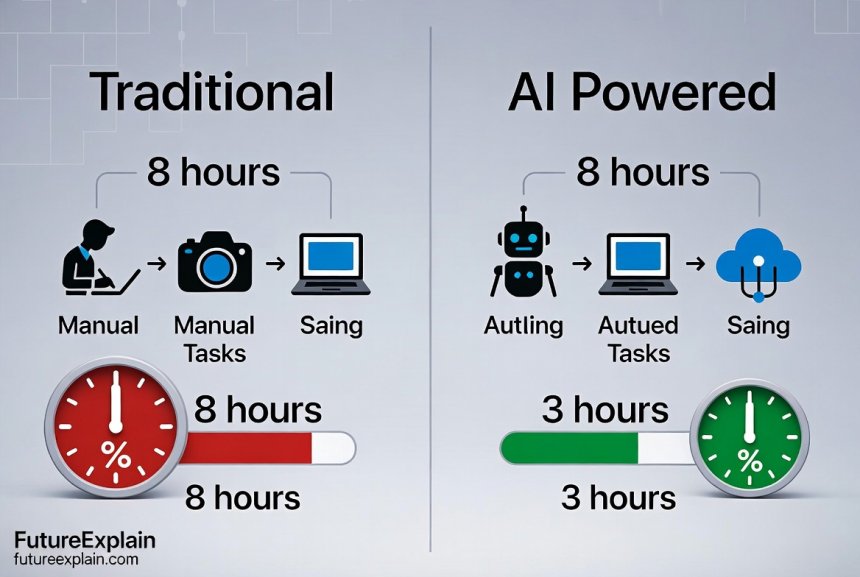
Traditional Workflow (1500-word post):
- Idea generation: 30 minutes
- Research: 90 minutes
- Outline: 30 minutes
- Writing: 120 minutes
- Editing: 60 minutes
- SEO & formatting: 30 minutes
- Promotion: 30 minutes
- Total: 6 hours
AI-Powered Workflow (1500-word post):
- Idea generation: 15 minutes (50% savings)
- Research: 45 minutes (50% savings)
- Outline: 10 minutes (67% savings)
- Writing: 60 minutes (50% savings)
- Editing: 30 minutes (50% savings)
- SEO & formatting: 15 minutes (50% savings)
- Promotion: 20 minutes (33% savings)
- Total: 3 hours 15 minutes (46% time savings)
This means you could theoretically produce nearly twice as much content with the same time investment, or maintain your current output with half the effort.
Maintaining Quality & Authenticity
The biggest concern about AI-powered blogging is losing your unique voice. Here's how to maintain quality:
Voice Preservation Strategies
- Train AI on Your Writing: Provide samples of your best work to help AI learn your style
- Edit for Personality: Always add personal anecdotes, experiences, and opinions
- Use AI for Structure, Not Soul: Let AI handle research and organization, but you provide the heart
- Develop Signature Elements: Create consistent elements that AI can't replicate (personal stories, unique perspectives)
Quality Control Checklist
- Does this sound like me? (Voice check)
- Are my unique insights included? (Value check)
- Is the information accurate? (Fact check)
- Does it serve my audience's needs? (Relevance check)
- Would I publish this under my name with pride? (Pride check)
Common Pitfalls & How to Avoid Them
Based on interviews with successful AI-using bloggers, here are common mistakes and solutions:
Pitfall 1: Over-Reliance on AI
Symptom: Content sounds generic, lacks personality, contains factual errors.
Solution: Use the 70/30 rule—70% AI assistance, 30% human input. Always fact-check and personalize.
Pitfall 2: Inconsistent Workflow
Symptom: Inefficient process, forgetting steps, variable quality.
Solution: Create and follow a standardized workflow checklist for every post.
Pitfall 3: Tool Overload
Symptom: Too many tools, confusing interfaces, wasted money.
Solution: Master 2-3 core tools before adding more. Cancel tools you're not using regularly.
Pitfall 4: SEO Over-Optimization
Symptom: Content reads unnaturally, keyword stuffing, poor user experience.
Solution: Write for humans first, optimize for SEO second. Use AI SEO suggestions as guidelines, not rules.
Workflow Templates for Different Content Types
Different content types benefit from different workflow approaches:
How-To Guide Template
- AI identifies common problems in your niche
- Research current solutions and gaps
- Create step-by-step outline with AI
- Write explanations in your voice
- Use AI for technical details
- Add personal success/failure stories
- Optimize for featured snippets
List Post Template
- AI analyzes popular list formats in your niche
- Research to validate list items
- Create engaging list structure
- Write compelling introductions to each item
- Use AI for consistent formatting
- Add unique commentary for each item
- Optimize for social sharing
Review Post Template
- AI gathers competitor reviews and user feedback
- Research product specifications and updates
- Create balanced review structure
- Write personal experience sections
- Use AI for feature comparisons
- Add unique testing insights
- Optimize for purchase intent keywords
Advanced: Building Your Custom AI Workflow
Once you're comfortable with basic AI tools, consider building a custom workflow:
Step 1: Audit Your Current Process
Track exactly how you create content now. Identify bottlenecks and time sinks.
Step 2: Research AI Solutions
For each bottleneck, research 2-3 AI tools that claim to solve it. Test free trials.
Step 3: Design Integrated Workflow
Map how tools will work together. Consider using low-code automation platforms to connect them.
Step 4: Implement Gradually
Add one tool at a time. Master it before adding the next.
Step 5: Measure & Optimize
Track time savings, quality metrics, and audience engagement. Refine your workflow quarterly.
Ethical Considerations & Best Practices
Using AI responsibly is crucial for long-term success:
Transparency
Consider disclosing AI use to your audience. Many readers appreciate transparency, and it builds trust.
Originality
Ensure your content offers unique value beyond what AI can generate. Your experiences and insights are irreplaceable.
Attribution
When using AI-generated content significantly, some bloggers include a brief note about their process.
Compliance
Stay informed about AI regulations and guidelines in your region and industry.
Getting Started: 30-Day Implementation Plan
Ready to build your AI-powered workflow? Follow this plan:
Week 1: Foundation
- Day 1-2: Audit your current workflow
- Day 3-4: Research and select 2 core AI tools
- Day 5-7: Learn basic functionality of chosen tools
Week 2: Implementation
- Day 8-10: Implement AI in idea generation and research
- Day 11-13: Add AI to outline creation
- Day 14: Create your workflow checklist
Week 3: Expansion
- Day 15-17: Implement AI writing assistance
- Day 18-20: Add AI editing tools
- Day 21: Test complete workflow on one post
Week 4: Optimization
- Day 22-24: Add SEO optimization tools
- Day 25-27: Implement promotion automation
- Day 28-30: Refine workflow based on results
Future Trends in AI Blogging
The AI blogging landscape is evolving rapidly. Watch for these developments:
1. Integrated AI Platforms
All-in-one platforms that handle the entire workflow within a single interface.
2. Voice & Video Integration
AI that converts written content to podcast episodes or video scripts, as discussed in our guide on AI video script generation.
3. Predictive Performance Analytics
AI that predicts content performance before publication based on historical data.
4. Personalized Content at Scale
AI that creates multiple versions of content tailored to different audience segments.
Conclusion
Building an AI-powered content workflow represents a significant evolution in how bloggers create and distribute content. By strategically integrating AI tools into your process, you can reclaim hours each week, improve content quality, and maintain consistency—all while preserving the unique voice that makes your blog special.
Remember that the goal isn't to replace human creativity but to augment it. The most successful AI-powered bloggers view these tools as collaborative partners that handle time-consuming tasks, providing them with more space for strategic thinking, audience engagement, and creative expression.
Start small, experiment thoughtfully, and continuously refine your approach. The bloggers who learn to work effectively with AI today will be best positioned for success in the evolving content landscape of tomorrow.
Further Reading
- AI for Marketing: Content, Personalization, and Analytics - Learn how to apply AI to content strategy
- Prompt Engineering Best Practices for Better Outputs - Master the art of getting great results from AI
- Human plus AI Collaboration: Redesigning Work for Productivity - Explore broader principles of human-AI teamwork
Share
What's Your Reaction?
 Like
1245
Like
1245
 Dislike
21
Dislike
21
 Love
89
Love
89
 Funny
12
Funny
12
 Angry
2
Angry
2
 Sad
1
Sad
1
 Wow
45
Wow
45


















I'd love to see a follow-up article on measuring ROI from AI tools. The time savings are clear, but what about impact on revenue, audience growth, etc.?
For technical bloggers: This workflow works exceptionally well. AI handles the complex research and explanation of technical concepts, freeing me to focus on practical applications and case studies.
The promotion stage advice transformed my social media strategy. Using AI to determine optimal posting times has doubled my engagement rates.
The ethical considerations section is important. I've decided to add a brief disclosure about AI use in my author bio. Readers have actually responded positively to the transparency.
That's a smart approach, Silas. Transparency builds trust. Many successful bloggers are finding that being open about their process actually strengthens their relationship with their audience. How did you phrase your disclosure?
As a food blogger, I was wondering if this applies to niche blogging. The answer is yes! I've adapted the research stage to analyze recipe trends and it's saving me hours each week.
I've been following the 30-day plan and just completed week 2. My content creation time is already down by 30%. The biggest surprise was how much AI helps with idea validation.