
Prompt Engineering Best Practices for Better Outputs
This comprehensive guide to prompt engineering explains how to craft better AI prompts for improved results. Learn fundamental principles like clarity, context, and constraints, plus advanced techniques such as few-shot prompting and chain-of-thought. Discover practical templates for writing, analysis, coding, and creative tasks across ChatGPT, Claude, and Gemini. Understand common mistakes to avoid and how to iteratively refine your prompts. The guide also covers ethical considerations and future trends in prompt engineering, making it essential reading for anyone using AI tools professionally or personally.


Prompt Engineering Best Practices for Better Outputs
Prompt engineering has emerged as one of the most valuable skills in the AI era. As artificial intelligence tools like ChatGPT, Claude, and Gemini become more sophisticated, the quality of your outputs depends increasingly on how well you communicate with these systems. This comprehensive guide will walk you through prompt engineering best practices, providing you with actionable strategies to get better results from any AI tool.
At its core, prompt engineering is the art and science of crafting inputs (prompts) that guide AI systems to produce desired outputs. Unlike traditional programming where you write explicit instructions, prompt engineering involves understanding how AI models interpret language and structuring your requests accordingly. Whether you're a writer seeking better content, a developer looking for optimized code, or a business professional automating tasks, mastering prompt engineering can significantly enhance your productivity and results.
Understanding Why Prompt Engineering Matters
Before diving into techniques, it's important to understand why prompt engineering makes such a difference. Large Language Models (LLMs) are trained on vast amounts of text data and learn patterns in how language works. When you provide a prompt, the AI doesn't "understand" it in the human sense—it predicts what text should follow based on its training. Well-crafted prompts align with these learned patterns, guiding the AI toward more accurate and useful responses.
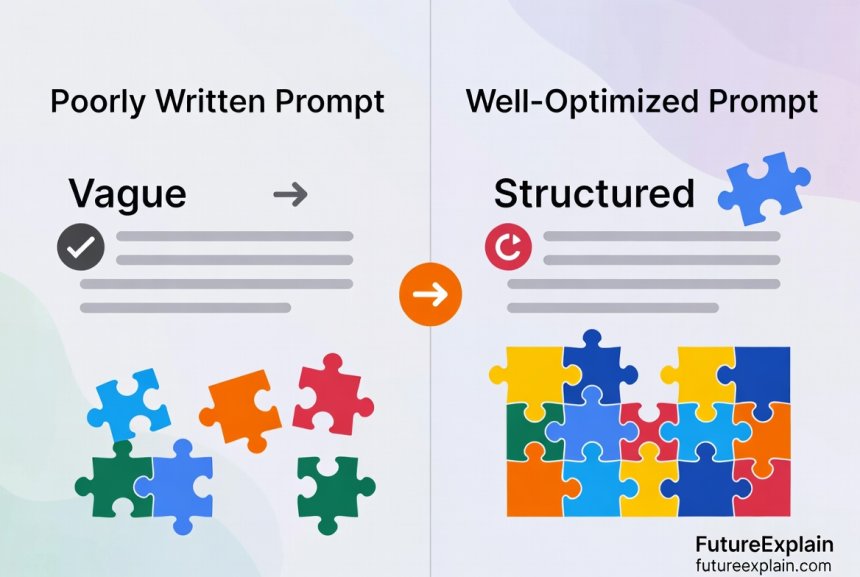
The difference between a vague prompt and a well-engineered one can be dramatic. Consider these examples:
- Vague: "Write about climate change"
- Engineered: "Write a 500-word educational article about climate change for middle school students, focusing on three main causes and practical solutions they can implement in their daily lives. Use simple language and include one engaging example per cause."
The second prompt provides context, audience, length, structure, and style guidance—all elements that help the AI produce exactly what you need. This principle applies across all AI applications, from creative writing to data analysis to code generation.
Fundamental Principles of Effective Prompting
1. Clarity and Specificity
AI models perform best with clear, specific instructions. Vague prompts lead to vague outputs. Instead of "help me with marketing," try "Generate five attention-grabbing headlines for an eco-friendly water bottle targeting environmentally conscious millennials." The more specific you are about what you want, the better the AI can deliver it.
2. Provide Adequate Context
Context helps the AI understand the frame of reference for your request. Are you writing for beginners or experts? Is this for a formal report or casual blog post? What's the goal of the output? Including this information dramatically improves relevance.
3. Use Constraints
Constraints aren't limitations—they're guidance. Specify length, format, tone, perspective, or any other parameters that matter for your use case. For example: "Write in the style of a New York Times technology article, approximately 800 words, with a neutral but engaging tone."
4. Structure Your Prompts Logically
Organize complex prompts with clear sections. Many practitioners use frameworks like:
- Role: "You are an experienced nutritionist..."
- Task: "Create a weekly meal plan for..."
- Constraints: "The plan must be vegetarian, under $75 per week..."
- Format: "Present as a table with columns for day, meal, ingredients..."
This structured approach helps the AI parse and address each requirement systematically.
Advanced Prompt Engineering Techniques
Few-Shot Prompting
Few-shot prompting involves providing examples of what you want. This technique is exceptionally powerful because it shows the AI exactly the format and style you're seeking. For instance:
"Convert these casual notes into professional meeting minutes. Here's an example:
Casual: 'team meeting today, talked about q3 goals, marketing needs more budget, engineering delayed sprint'
Professional: 'Weekly Team Meeting - August 15, 2024
Agenda Items Discussed:
1. Q3 Goals Review - Department heads presented progress...
2. Marketing Budget Request - Marketing team requested additional...
Now convert: 'client call with acme corp, they liked the demo but want pricing by friday, follow up with legal about contract terms'"
This approach works across domains, from email writing to code generation to data formatting.
Chain-of-Thought Prompting
For complex reasoning tasks, asking the AI to "think step by step" can dramatically improve accuracy. This technique, known as chain-of-thought prompting, is particularly useful for mathematical problems, logical reasoning, and multi-step analyses.
Example: "Calculate the total cost for a software project with these parameters: 3 developers at $50/hour, working 6 hours/day for 15 days, plus a project manager at $70/hour for 4 hours/day for 15 days, plus 20% for overhead. Show your calculations step by step before giving the final answer."
Research shows that chain-of-thought prompting can improve performance on complex reasoning tasks by 30-50% compared to direct questioning.
Role-Playing and Personas
Assigning roles to the AI can tailor responses to specific perspectives or expertise areas. Common roles include:
- "You are a patient elementary school teacher explaining photosynthesis"
- "You are a skeptical journalist fact-checking this claim"
- "You are an experienced Python developer reviewing this code"
Role-playing helps set appropriate tone, depth, and perspective for the response.
Iterative Refinement
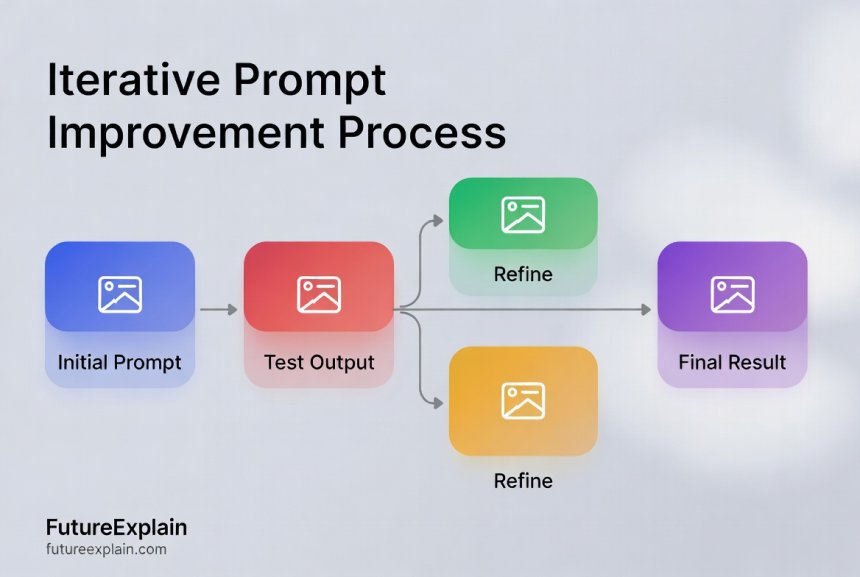
Prompt engineering is rarely a one-shot process. The most effective approach involves:
- Starting with a basic prompt
- Evaluating the output
- Identifying what worked and what didn't
- Refining the prompt based on learnings
- Repeating until satisfied
This iterative process acknowledges that AI interaction is a dialogue, not a monologue. As you learn how a particular model responds to certain phrasings, you can optimize your prompts for that specific system.
Practical Prompt Templates for Common Tasks
Writing and Content Creation
Template: "Write a [type of content] about [topic] for [audience]. The piece should be approximately [length] and achieve [goal]. Use a [tone] tone and include [specific elements]. Structure it with [organization method]."
Example: "Write a blog post about sustainable gardening for urban apartment dwellers. The piece should be approximately 1000 words and inspire readers to start their own indoor herb gardens. Use an encouraging, practical tone and include three beginner-friendly projects with step-by-step instructions. Structure it with an introduction, three main project sections, and a conclusion with resources."
Analysis and Research
Template: "Analyze [text/data] from the perspective of [framework/perspective]. Identify [what to look for] and organize findings by [categories]. Provide [level of detail] with [supporting evidence]. Conclude with [type of conclusion]."
Example: "Analyze these customer feedback comments from the perspective of product improvement opportunities. Identify recurring themes and pain points, and organize findings by feature area (UI, performance, missing features). Provide specific examples with supporting quotes from the feedback. Conclude with three prioritized recommendations for the product team."
Code Generation and Review
Template: "Write [language] code that [function]. Use [libraries/frameworks] and follow [standards/best practices]. Include [specific features] and handle [edge cases]. Add comments explaining [what aspects]."
Example: "Write Python code that connects to a MySQL database, queries a 'users' table for active accounts created in the last 30 days, and exports the results to a CSV file. Use the mysql-connector-python library and follow PEP 8 standards. Include error handling for connection failures and empty results. Add comments explaining the database connection parameters and query logic."
Creative Brainstorming
Template: "Brainstorm [number] ideas for [topic/challenge]. Consider constraints like [constraints]. Generate ideas that are [desirable qualities]. Categorize them by [categories] and evaluate each based on [criteria]."
Example: "Brainstorm 10 ideas for promoting a new eco-friendly lunch container to college students. Consider constraints like limited budget and appeal to environmentally conscious Gen Z. Generate ideas that are creative, shareable, and low-cost. Categorize them by marketing channel (social media, campus events, partnerships) and evaluate each based on estimated reach, cost, and alignment with brand values."
Model-Specific Considerations
ChatGPT (OpenAI)
ChatGPT responds well to detailed, conversational prompts. It handles complex instructions effectively and benefits from examples. Key tips:
- Use the system message feature for overarching instructions: "You are a helpful assistant who explains complex topics simply"
- ChatGPT maintains conversation context well—you can refer back to previous messages
- It's particularly strong at creative tasks and explanation
- Temperature setting (creativity vs. consistency) matters—adjust based on task
Claude (Anthropic)
Claude excels at longer contexts and document analysis. It's particularly good at:
- Processing and analyzing uploaded documents
- Maintaining consistency in longer outputs
- Following complex, multi-part instructions
- Creative writing with specific style constraints
Claude benefits from clear structure and benefits from XML tags for separating instructions from content.
Gemini (Google)
Gemini integrates well with Google's ecosystem and offers strong reasoning capabilities. Consider:
- Using its multimodal capabilities—you can include image references
- Taking advantage of its integration with Google Search for fact-checking
- Its strength in technical and analytical tasks
- The importance of clear, direct language
Common Prompt Engineering Mistakes to Avoid
1. The "Kitchen Sink" Prompt
Throwing every possible instruction into one prompt often confuses the AI. Instead, break complex tasks into logical steps or multiple prompts.
2. Assuming AI Understands Like Humans
AI doesn't understand sarcasm, implied meaning, or cultural references the way humans do. Be explicit about what you want.
3. Neglecting to Test and Iterate
Even well-crafted prompts may need adjustment. Always test with a small sample before committing to a prompt for important work.
4. Overlooking Ethical Implications
Prompts that request harmful content, biased analysis, or unethical actions should be avoided. Responsible prompt engineering considers the potential misuse of outputs.
5. Ignoring Model Limitations
Each AI model has strengths and weaknesses. What works brilliantly in ChatGPT might need adjustment for Claude or Gemini. Learn the nuances of your chosen tool.
Measuring Prompt Effectiveness
How do you know if your prompt engineering is working? Consider these metrics:
- Relevance: Does the output address what you actually needed?
- Accuracy: Is the information correct and well-reasoned?
- Completeness: Does it cover all aspects of your request?
- Efficiency: How many iterations were needed to get a usable result?
- Consistency: Does the same prompt produce similarly good results across multiple runs?
Keep a prompt library of what works well for different tasks. Note which phrasings, structures, and approaches yield the best results for your specific needs.
Ethical Considerations in Prompt Engineering
As prompt engineering becomes more powerful, ethical considerations grow increasingly important. Key principles include:
- Transparency: Be clear when AI has been used to generate content
- Bias Awareness: Understand that AI can amplify biases present in training data
- Privacy: Avoid sharing sensitive personal or proprietary information in prompts
- Attribution: Respect intellectual property and copyright considerations
- Harm Prevention: Craft prompts that encourage helpful, harmless, and honest outputs
Prompt engineers have a responsibility to use these techniques ethically. This includes avoiding prompts designed to generate misinformation, bypass security measures, or create harmful content. Many organizations are developing ethical guidelines for AI prompting—familiarize yourself with these as they evolve.
The Future of Prompt Engineering
Prompt engineering is evolving rapidly. Emerging trends include:
- Automatic Prompt Optimization: AI systems that help optimize your prompts
- Multimodal Prompting: Combining text, images, audio, and video in prompts
- Personalized Prompt Assistants: AI that learns your prompting style and preferences
- Standardized Prompt Languages: Formal languages for expressing prompts more precisely
- Integration with Development Tools: Prompt engineering built directly into IDEs and productivity software
As AI models become more capable, the role of prompt engineering may shift from explicit instruction to more collaborative dialogue. However, the fundamental principles of clear communication and structured thinking will remain valuable regardless of how the technology evolves.
Getting Started with Prompt Engineering
If you're new to prompt engineering, here's a practical starting plan:
- Choose one AI tool to focus on initially (ChatGPT, Claude, or Gemini)
- Start with simple tasks you already do regularly (email drafting, research summaries)
- Apply the fundamental principles of clarity, context, and constraints
- Keep a prompt journal noting what works and what doesn't
- Gradually tackle more complex tasks as your skills improve
- Join prompt engineering communities to learn from others' examples
- Experiment systematically with different approaches to see what yields best results
Remember that prompt engineering is a skill that improves with practice. The most effective prompt engineers are those who approach the process as a learning journey, continuously refining their techniques based on results and new developments in the field.
Conclusion
Prompt engineering represents a fundamental shift in how humans interact with technology. Instead of learning complex software interfaces or programming languages, we're learning to communicate our needs effectively to intelligent systems. The best practices outlined in this guide—clarity, specificity, adequate context, logical structure, and iterative refinement—provide a foundation for getting better results from any AI tool.
As AI continues to advance, prompt engineering skills will become increasingly valuable across professions and personal applications. By investing time in developing these skills now, you're positioning yourself to work more effectively with the AI tools that are transforming how we create, analyze, and solve problems.
The journey to prompt mastery begins with your very next prompt. Start applying these principles today, and you'll soon discover the remarkable difference that thoughtful prompt engineering can make in your AI interactions.
Further Reading
Share
What's Your Reaction?
 Like
342
Like
342
 Dislike
5
Dislike
5
 Love
89
Love
89
 Funny
23
Funny
23
 Angry
2
Angry
2
 Sad
1
Sad
1
 Wow
67
Wow
67


















This article has completely changed how I approach AI tools. Instead of frustration, I now see each interaction as a learning opportunity. The iterative mindset is everything.
I'd love to see more about multimodal prompting. With images becoming more integrated, how do we craft prompts that combine text and visual elements effectively?
The measurement section is underrated. Tracking what works turns prompt engineering from an art into a science. I started keeping metrics and my success rate improved by 40% in a month.
Practical question: How do you organize your successful prompts? I'm building a library but could use tips on categorization and searchability.
Great question, Tatiana! Many people use spreadsheets with columns for: Use Case, Original Prompt, Refined Version, Model Used, Success Rate, and Notes. Some use dedicated tools like Notion or Airtable. The key is tagging by task type (writing, coding, analysis) and including the context that made it successful. We might write a dedicated article on prompt management!
The ethical considerations are so important. I've seen colleagues use prompts to generate misleading marketing copy, and it's concerning. More emphasis on responsible AI use is needed everywhere.
As a beginner, I found this guide incredibly accessible. The before/after examples make the concepts click instantly. Thank you for not assuming prior knowledge!