
AI for Marketing: Content, Personalization, and Analytics
This comprehensive guide explores how artificial intelligence is transforming modern marketing across three key areas: content creation, personalization, and analytics. We break down complex AI concepts into simple, actionable strategies suitable for beginners and small business owners. Learn about practical AI tools that don't require technical expertise, discover step-by-step workflows for implementing AI in your marketing, and understand how to measure ROI from AI investments. We also cover essential ethical considerations and responsible AI usage to ensure your marketing remains compliant and customer-friendly. Whether you're a solo entrepreneur or part of a marketing team, this guide provides the knowledge to leverage AI effectively while avoiding common pitfalls.


AI for Marketing: Content, Personalization, and Analytics
Marketing has always been about connecting with the right audience at the right time with the right message. Today, artificial intelligence is revolutionizing how we accomplish this, making marketing more efficient, personalized, and data-driven than ever before. If you're feeling overwhelmed by the rapid changes in marketing technology, you're not alone. This guide breaks down AI marketing into simple, understandable concepts and provides practical steps you can implement regardless of your technical background.
AI in marketing isn't about replacing human creativity or intuition—it's about augmenting our capabilities. Imagine having an assistant that can analyze thousands of customer interactions in seconds, generate personalized content variations, and predict which marketing strategies will work best. That's what AI brings to the table. From small businesses to large enterprises, marketers are discovering that AI tools can help them work smarter, not just harder.
In this comprehensive guide, we'll explore three core areas where AI is making the biggest impact: content creation, personalization, and analytics. We'll look at real tools you can use today, practical workflows you can implement immediately, and ethical considerations to keep in mind as you adopt these powerful technologies.
Understanding AI in Marketing: Beyond the Hype
Before diving into specific applications, let's clarify what we mean by "AI in marketing." Artificial intelligence in this context refers to systems that can perform tasks typically requiring human intelligence, such as understanding natural language, recognizing patterns in data, and making predictions based on historical information.
Contrary to popular belief, you don't need to be a data scientist to benefit from marketing AI. Many modern AI marketing tools are designed with non-technical users in mind, offering intuitive interfaces that guide you through the process. These tools fall into several categories:
- Content Generation AI: Tools that help create written content, images, videos, or social media posts
- Personalization Engines: Systems that tailor experiences to individual users based on their behavior and preferences
- Predictive Analytics: Platforms that analyze data to forecast trends, customer behavior, and campaign performance
- Conversational AI: Chatbots and virtual assistants that engage with customers in real-time
- Optimization Tools: AI that tests and improves marketing elements like subject lines, ad copy, and landing pages
The key advantage of AI in marketing is scale. Where a human marketer might analyze 100 customer profiles, AI can analyze 100,000. Where a writer might create 10 content variations, AI can generate 1,000. This doesn't make human marketers obsolete—it makes them more strategic and creative by handling repetitive, data-intensive tasks.
AI-Powered Content Creation: Writing with Assistance
Content remains king in digital marketing, but creating high-quality content consistently is challenging. This is where AI content tools shine. These aren't about replacing human writers but augmenting their capabilities and overcoming creative blocks.
How AI Content Tools Work
Most AI writing tools use a technology called Large Language Models (LLMs). These models have been trained on vast amounts of text from the internet, books, and other sources, allowing them to generate human-like text based on the prompts you provide. Think of them as highly advanced autocomplete systems that understand context and can maintain coherent narratives.
The process typically works like this: You provide a prompt ("Write a blog post introduction about sustainable gardening for beginners"), the AI generates content, and you edit and refine the output. The best results come from treating AI as a collaborative partner rather than a replacement for human creativity.
Practical AI Content Tools for Marketers
Here are some accessible AI content tools that don't require technical expertise:
- ChatGPT/GPT-4: Versatile for brainstorming, outlining, drafting, and editing various content types
- Jasper (formerly Jarvis): Specifically designed for marketing copy with templates for ads, emails, and web content
- Copy.ai: Focuses on short-form marketing copy like social media posts and product descriptions
- Canva's AI features: Magic Write for text and Magic Design for visual content creation
- GrammarlyGO: AI writing assistant that helps improve clarity and tone
When using these tools, remember that quality input leads to quality output. The more specific and detailed your prompts, the better the results. Instead of "write about marketing," try "write a 300-word introduction to email marketing automation for small business owners, focusing on time-saving benefits, with a friendly and encouraging tone."
Content Workflow with AI: A Step-by-Step Example
Let's walk through a practical workflow for creating a blog post using AI assistance:
- Research Phase: Use AI to generate topic ideas based on your niche and analyze what competitors are covering
- Outline Creation: Have AI create a detailed outline with main points and subpoints
- Drafting: Generate sections of the post one at a time, providing specific instructions for each
- Editing and Refining: Use AI to improve readability, check grammar, and suggest improvements
- SEO Optimization: Apply AI tools to optimize for search engines without sacrificing readability
- Repurposing: Use AI to create different versions for social media, newsletters, and other channels
This workflow can cut content creation time by 30-50% while maintaining or even improving quality. The human marketer's role shifts from doing all the writing to directing the AI and applying strategic thinking and brand voice consistency.
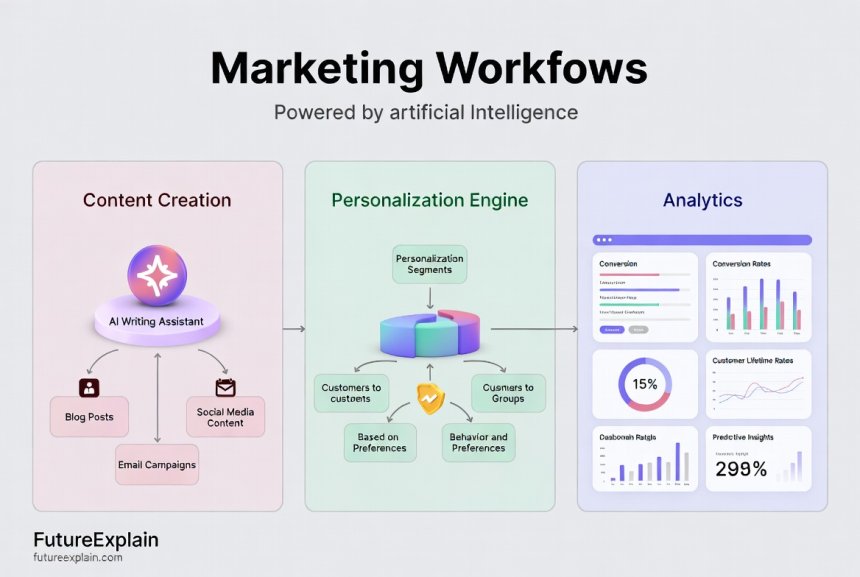
AI-Driven Personalization: The End of One-Size-Fits-All Marketing
Personalization has moved from "nice to have" to essential in modern marketing. Customers now expect brands to understand their individual needs and preferences. AI makes sophisticated personalization accessible to businesses of all sizes.
What is AI Personalization?
AI personalization uses machine learning algorithms to analyze customer data and deliver tailored experiences. This goes beyond simple "Hi [First Name]" emails. True AI personalization can:
- Recommend products based on browsing history and purchase patterns
- Customize website content in real-time based on visitor behavior
- Send personalized email sequences triggered by specific actions
- Adjust pricing or offers based on customer lifetime value predictions
- Create dynamic ad content that resonates with different audience segments
The foundation of effective personalization is data. AI systems need information about customer interactions, preferences, and behaviors to make accurate predictions and recommendations.
Implementing Personalization: Start Small, Scale Smart
For beginners, the key is to start with simple personalization and gradually add complexity. Here's a practical approach:
Phase 1: Basic Segmentation
Use your email marketing platform's built-in segmentation features. Group customers by basic criteria like purchase history, location, or engagement level. Even simple segmentation can improve email open rates by 20-30%.
Phase 2: Behavior-Based Personalization
Implement tools that track website behavior and trigger personalized messages. For example, showing recently viewed products or sending abandoned cart emails. Many e-commerce platforms like Shopify offer built-in tools for this.
Phase 3: Predictive Personalization
This is where AI truly shines. Systems like Dynamic Yield or Adobe Target use machine learning to predict what individual customers want next. They analyze patterns across thousands of users to make increasingly accurate recommendations.
Personalization Tools for Different Budgets
- Free/Beginner: Mailchimp's basic segmentation, HubSpot's free CRM features
- Mid-range: Klaviyo for e-commerce, ConvertKit for creators
- Enterprise: Salesforce Marketing Cloud, Adobe Experience Cloud
- Specialized AI: Dynamic Yield, Optimizely, Personyze
When implementing personalization, always prioritize transparency and respect for privacy. Clearly communicate what data you collect and how it improves the customer experience. Offer easy opt-out options and ensure compliance with regulations like GDPR and CCPA.
AI Analytics: From Data Collection to Actionable Insights
Data is the lifeblood of modern marketing, but many marketers struggle with analysis paralysis—collecting vast amounts of data without clear insights. AI analytics tools help bridge this gap by identifying patterns and opportunities humans might miss.
The Evolution of Marketing Analytics
Marketing analytics has evolved through several stages:
- Descriptive Analytics: What happened? (Traditional reporting)
- Diagnostic Analytics: Why did it happen? (Root cause analysis)
- Predictive Analytics: What will happen? (Forecasting)
- Prescriptive Analytics: What should we do? (Action recommendations)
AI primarily enhances the predictive and prescriptive stages. Instead of just telling you that sales dropped last month, AI can predict when similar drops might occur in the future and suggest specific actions to prevent them.
Key AI Analytics Capabilities for Marketers
Modern AI analytics platforms offer several powerful features:
- Automated Insights: AI scans your data and highlights significant changes, trends, or anomalies without manual analysis
- Natural Language Queries: Ask questions in plain English like "Which marketing channel had the highest ROI last quarter?"
- Predictive Forecasting: Project future performance based on historical data and current trends
- Attribution Modeling: More accurately assign credit to different marketing touchpoints in the customer journey
- Sentiment Analysis: Analyze customer feedback, reviews, and social media to gauge brand sentiment
These capabilities transform analytics from a reactive reporting function to a proactive strategic tool.
Practical Analytics Implementation Guide
Implementing AI analytics doesn't require rebuilding your entire data infrastructure. Here's a practical approach:
Step 1: Audit Your Current Data
Identify what data you're already collecting through your website, CRM, email platform, and social media. Look for gaps in your data collection.
Step 2: Define Key Questions
What do you actually want to know? Common marketing questions include: Which content types drive the most conversions? What's the customer lifetime value by acquisition channel? Which products are often purchased together?
Step 3: Choose Appropriate Tools
Based on your needs and technical capability, select analytics tools. Google Analytics 4 includes basic AI features for free. For more advanced needs, consider platforms like Mixpanel, Amplitude, or Adobe Analytics.
Step 4: Establish Regular Review Processes
AI analytics provides little value if no one acts on the insights. Schedule regular marketing performance reviews where you examine AI-generated insights and make data-driven decisions.

Integrating AI Across Your Marketing Stack
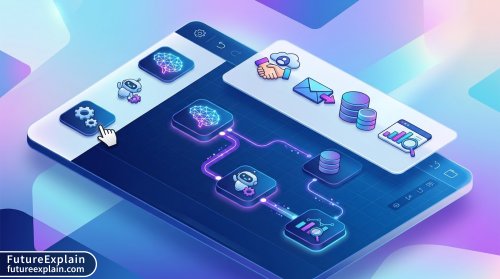
The true power of AI in marketing emerges when you integrate tools across different functions. An integrated AI marketing stack creates a virtuous cycle: better content attracts more visitors, personalization improves engagement, and analytics provides insights to refine both content and personalization.
Building Your AI Marketing Stack
Consider these integration opportunities:
- Content + Analytics: Use analytics to identify high-performing topics, then create content around those topics using AI tools
- Personalization + Content: Create personalized content variations for different audience segments
- Analytics + Personalization: Use behavioral analytics to improve personalization algorithms
- All Three Together: The ultimate integration creates self-optimizing marketing systems that continuously improve based on performance data
Start with simple integrations. For example, connect your email marketing platform to your CRM so personalization data informs your email campaigns. As you become more comfortable, add more connections between systems.
Common Integration Platforms
- Zapier/Make (formerly Integromat): Connect different apps without coding
- Segment/Customer.io: Customer data platforms that unify data from multiple sources
- Native Integrations: Many modern marketing tools offer built-in connections to popular platforms
Remember that integration complexity should match your team's technical capability. A simple, well-executed integration is better than a complex one that no one understands how to use.
Ethical Considerations and Responsible AI Use in Marketing
As AI becomes more powerful in marketing, ethical considerations become increasingly important. Responsible AI use builds trust with customers and avoids potential legal issues.
Key Ethical Principles for AI Marketing
Transparency: Be clear when customers are interacting with AI. If you're using chatbots, identify them as such. If you're personalizing content based on data collection, explain this in your privacy policy.
Privacy Protection: Collect only the data you need, secure it properly, and respect customer preferences about data usage. Implement strong data governance practices and comply with relevant regulations.
Avoiding Bias: AI systems can inadvertently perpetuate biases present in their training data. Regularly audit your AI systems for biased outcomes, particularly in areas like targeted advertising or credit decisions.
Human Oversight: Maintain human review of important AI decisions, especially those affecting customers significantly. AI should augment human judgment, not replace it entirely in sensitive areas.
Accountability: Take responsibility for AI system outcomes. If an AI makes a mistake that affects customers, have processes to address it promptly and fairly.
Practical Ethics Checklist
Before implementing any AI marketing tool, ask these questions:
- Have we clearly communicated to customers how we're using AI?
- Are we collecting and using data in ways customers would reasonably expect?
- Have we tested for potential biases in our AI systems?
- Do we have human oversight processes for important AI decisions?
- Can customers easily opt out of AI-driven personalization if desired?
- Are we complying with all relevant data protection regulations?
Ethical AI use isn't just the right thing to do—it's good business. Customers are increasingly aware of how their data is used and prefer to engage with brands that demonstrate responsible practices.
Measuring ROI: Proving the Value of AI in Marketing
Investing in AI tools requires demonstrating return on investment. Fortunately, AI marketing initiatives often provide clear, measurable benefits.
Key Metrics to Track
When implementing AI in marketing, track these metrics to measure success:
- Content Creation: Time saved per piece, quality scores, engagement metrics
- Personalization: Conversion rate improvements, customer satisfaction scores, repeat purchase rates
- Analytics: Time to insight, forecast accuracy, decision quality improvements
- Overall Business Impact: Revenue attribution, customer lifetime value, marketing efficiency ratios
Establish baseline measurements before implementing AI tools so you can accurately measure improvement. For example, track how long it takes to create a blog post or email campaign before and after introducing AI assistance.
Calculating ROI: A Simple Framework
Use this simple formula to calculate AI marketing ROI:
ROI = (Gains from Investment - Cost of Investment) / Cost of Investment × 100
For example, if an AI tool costs $1,000 per year but helps generate $10,000 in additional revenue, the ROI is 900%.
Consider both quantitative and qualitative benefits. Time savings might not directly generate revenue but allow marketers to focus on higher-value activities. Improved customer satisfaction might lead to better retention and word-of-mouth marketing.
Getting Started: Your AI Marketing Implementation Plan
Ready to start implementing AI in your marketing? Follow this step-by-step plan:
Week 1-2: Education and Assessment
Spend time understanding the AI marketing landscape. Read articles (like our guide on how AI personalization works), watch tutorials, and identify 1-2 areas where AI could have the biggest immediate impact on your marketing.
Week 3-4: Tool Selection and Testing
Choose one AI tool to test. Start with a free trial or freemium version. Focus on mastering this one tool rather than trying multiple tools simultaneously. Document what works and what doesn't.
Month 2: Implementation and Integration
Formally implement your chosen tool into your regular marketing workflows. Train team members if necessary. Look for simple integration opportunities with your existing tools.
Month 3: Evaluation and Scaling
Measure the impact of your AI implementation. Calculate ROI, gather team feedback, and identify what's working well. Based on these insights, decide whether to expand usage of the current tool or add additional AI tools.
Remember that successful AI implementation is a journey, not a one-time event. Start small, learn quickly, and scale what works.
Future Trends: What's Next for AI in Marketing
AI in marketing continues to evolve rapidly. Here are some trends to watch:
- Multimodal AI: Systems that combine text, image, and video understanding for richer marketing experiences
- Voice and Conversational AI: More sophisticated voice assistants and conversational interfaces
- Generative AI Evolution: Even more capable content generation with better brand voice alignment
- Privacy-Preserving AI: Technologies that deliver personalization while protecting user privacy
- AI Governance Tools: Solutions to help ensure ethical and compliant AI usage
Staying informed about these trends will help you prepare for the future of marketing. Consider subscribing to our Future Technology category for regular updates on emerging trends.
Common Pitfalls and How to Avoid Them
As you implement AI in marketing, be aware of these common mistakes:
Over-reliance on AI: AI is a tool, not a replacement for human strategy and creativity. Maintain appropriate human oversight and judgment.
Poor Data Quality: AI systems are only as good as their training data. Ensure you're feeding your AI tools clean, relevant data.
Lack of Clear Goals: Implement AI with specific objectives in mind, not just because it's trendy. What problem are you trying to solve?
Neglecting Training: Ensure your team understands how to use AI tools effectively. Provide training and resources.
Ignoring Ethics: Consider the ethical implications of your AI usage from the beginning, not as an afterthought.
By being aware of these pitfalls, you can navigate the AI marketing landscape more successfully.
Conclusion: The Human-AI Marketing Partnership
AI is transforming marketing, but the most successful approaches combine artificial intelligence with human intelligence. AI excels at processing vast amounts of data, identifying patterns, and automating repetitive tasks. Humans excel at strategy, creativity, empathy, and ethical judgment.
The future of marketing isn't AI replacing marketers—it's marketers who know how to leverage AI becoming more effective than those who don't. By starting with clear goals, choosing appropriate tools, implementing thoughtfully, and maintaining ethical standards, you can harness AI's power to create better marketing experiences for your audience and better results for your business.
Remember that every marketing journey is unique. What works for one business might not work for another. The key is to start somewhere, learn continuously, and adapt based on results. AI in marketing is an exciting frontier, and with the right approach, it can help you achieve marketing success that wasn't previously possible.
Further Reading
- AI in Marketing: Simple Explanation for Beginners - Perfect follow-up for more detailed marketing applications
- AI for Small Businesses: Practical Use Cases - More business-focused AI implementations
- Future of Artificial Intelligence: What to Expect in the Next 5 Years - Broader context for AI's evolution
Share
What's Your Reaction?
 Like
2450
Like
2450
 Dislike
12
Dislike
12
 Love
850
Love
850
 Funny
120
Funny
120
 Angry
8
Angry
8
 Sad
5
Sad
5
 Wow
420
Wow
420














This guide has become our marketing team's playbook for AI adoption. We're referencing it in every planning meeting.
The implementation timeline is realistic. We tried to implement AI marketing in a week and failed. Taking it phase by phase makes sense.
As a content creator worried about AI replacing jobs, this article reassured me. It's about augmentation, not replacement.
The analytics tools comparison helped us choose between Google Analytics 4 and more expensive options. GA4's AI features are surprisingly powerful.
I'd love more examples of AI for local business marketing. National chains get all the attention, but small local businesses need help too.
Excellent point, Coraline! Local businesses can use AI for hyper-local content, personalized offers based on location, and managing local listings. We're planning content specifically for local business AI tools - stay tuned!
The content workflow example cut our blog post creation time in half. We're now publishing twice as much quality content.