
Responsible Data Collection: Consent and Compliance
This comprehensive guide explains responsible data collection practices with a focus on consent mechanisms and regulatory compliance. We cover essential frameworks like GDPR and CCPA, practical implementation strategies for businesses, and ethical considerations for AI data collection. Learn about lawful bases for data processing, consent design patterns, data minimization principles, and building transparent data practices. Whether you're a business owner, developer, or privacy-conscious user, this article provides actionable guidance for collecting data responsibly while maintaining compliance with evolving privacy regulations.


Responsible Data Collection: Consent and Compliance
In today's data-driven world, responsible data collection isn't just a legal requirement—it's a fundamental aspect of building trust with users and creating sustainable AI systems. As artificial intelligence becomes more integrated into our daily lives, how we collect, process, and manage data determines not only regulatory compliance but also ethical standing and user confidence.
This comprehensive guide explores responsible data collection through the lenses of consent mechanisms and regulatory compliance. We'll break down complex legal frameworks into understandable concepts, provide practical implementation guidance, and examine the ethical considerations that should guide every data collection decision. Whether you're a business owner implementing data practices, a developer building AI systems, or a privacy-conscious user, understanding these principles is essential.
Understanding the Foundation: Why Responsible Data Collection Matters
Responsible data collection begins with recognizing that data represents real people with rights, expectations, and vulnerabilities. Every data point collected—from website cookies to AI training datasets—carries ethical implications and legal responsibilities. The consequences of irresponsible data collection can be severe, ranging from regulatory fines reaching millions of dollars to irreversible damage to brand reputation and user trust.
The shift toward responsible data practices represents more than just compliance with new laws. It reflects a broader societal recognition that data collection practices have real-world impacts on privacy, autonomy, and fairness. When done responsibly, data collection enables innovation, personalization, and improved services. When done poorly, it can lead to discrimination, surveillance, and erosion of fundamental rights.
The Business Case for Responsible Data Practices
Beyond legal requirements, responsible data collection offers tangible business benefits. Companies with transparent data practices typically experience:
- Higher user trust and engagement rates
- Reduced regulatory risk and potential fines
- Improved data quality through user cooperation
- Competitive differentiation in privacy-conscious markets
- Long-term sustainability in evolving regulatory landscapes
These benefits become particularly significant for AI systems, where data quality directly impacts model performance and fairness outcomes. Responsible collection practices ensure that training data represents diverse populations accurately, reducing the risk of biased or discriminatory AI outcomes.
Key Legal Frameworks: GDPR, CCPA, and Beyond
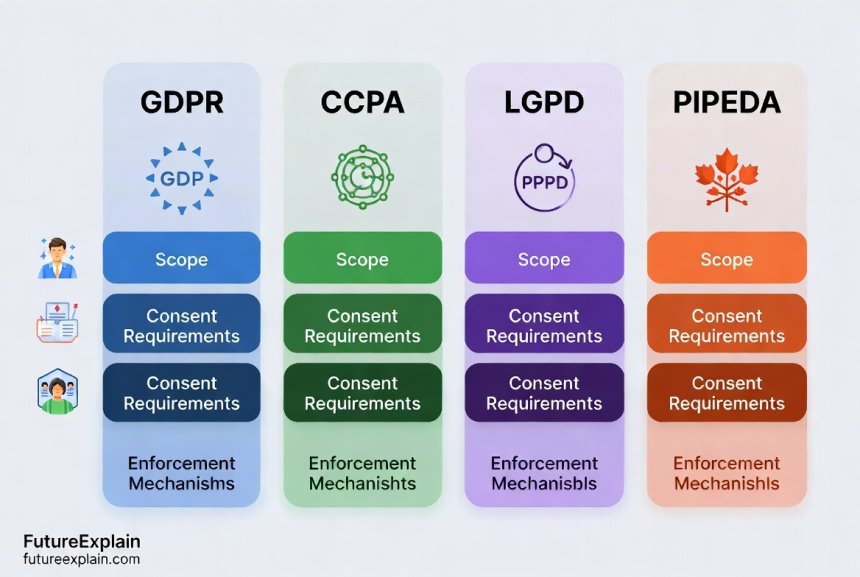
Understanding the regulatory landscape is the first step toward compliant data collection. While laws vary by jurisdiction, several key frameworks have established global standards for responsible data practices.
General Data Protection Regulation (GDPR)
The European Union's GDPR, implemented in 2018, represents one of the most comprehensive data protection frameworks globally. Its principles extend beyond EU borders, affecting any organization processing data of EU citizens. Key requirements for data collection include:
- Lawful Basis Requirement: Every data processing activity must have a valid legal basis, with consent being just one of six possible grounds
- Explicit Consent Standards: Consent must be freely given, specific, informed, and unambiguous
- Right to Withdraw: Users must be able to withdraw consent as easily as they gave it
- Data Minimization: Collect only data that is adequate, relevant, and limited to what's necessary
- Purpose Limitation: Data can only be collected for specified, explicit, and legitimate purposes
GDPR's extraterritorial application means that even companies based outside the EU must comply if they process EU citizens' data. The regulation has inspired similar laws worldwide, making its principles a valuable baseline for global compliance strategies.
California Consumer Privacy Act (CCPA) and CPRA
California's privacy laws, particularly the CCPA and its enhancement through the California Privacy Rights Act (CPRA), establish significant requirements for businesses operating in or targeting California residents. Key aspects include:
- Right to Know: Consumers can request disclosure of what personal information is collected and how it's used
- Right to Delete: Consumers can request deletion of their personal information
- Right to Opt-Out: Consumers can opt out of the sale or sharing of their personal information
- Limits on Sensitive Data: Additional restrictions apply to sensitive personal information
- Non-Discrimination: Businesses cannot discriminate against consumers who exercise their rights
Unlike GDPR's emphasis on consent, CCPA focuses more on transparency and consumer control, though both frameworks share common principles of data minimization and purpose limitation.
Other Significant Frameworks
Various jurisdictions have implemented or are developing their own data protection laws, including:
- Brazil's LGPD: Closely aligned with GDPR principles
- Canada's PIPEDA: Emphasizes consent and accountability
- China's Personal Information Protection Law (PIPL): Comprehensive framework with strict requirements
- India's Digital Personal Data Protection Act: Recently enacted comprehensive legislation
Understanding these diverse frameworks is essential for organizations operating internationally, though focusing on the strictest requirements often provides a reasonable compliance baseline.
Designing Effective Consent Mechanisms
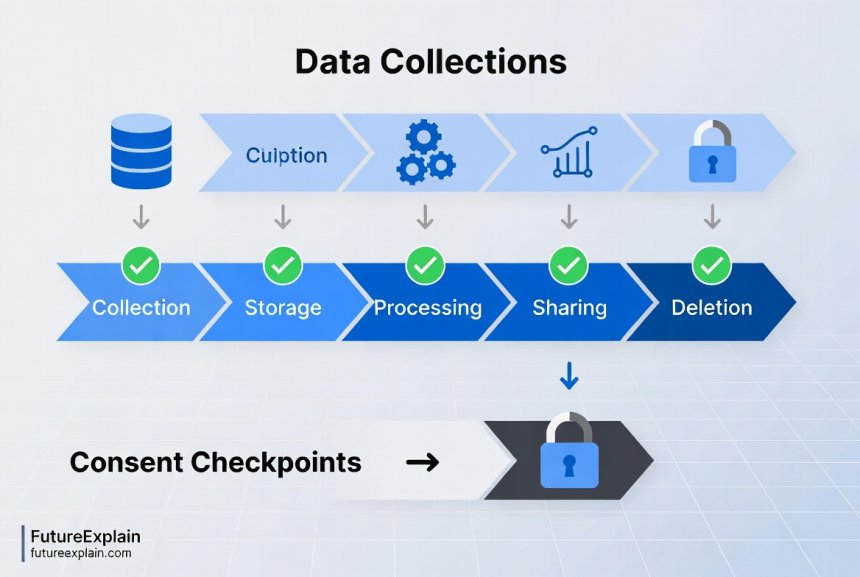
Consent represents more than just a legal checkbox—it's the foundation of ethical data relationships. Well-designed consent mechanisms respect user autonomy while providing the transparency needed for informed decision-making.
Characteristics of Valid Consent
Effective consent mechanisms share several key characteristics:
- Freely Given: Users must have genuine choice without coercion or negative consequences for refusal
- Specific: Consent should be granular rather than bundled
- Informed: Users must understand what they're consenting to
- Unambiguous: Clear affirmative action required (no pre-checked boxes)
- Revocable: Easy withdrawal mechanisms must be provided
These requirements challenge common practices like lengthy terms of service agreements and bundled consent for multiple purposes. Instead, they encourage clear, concise explanations of data practices with specific consent for distinct processing activities.
Consent Design Patterns
Several design patterns have emerged as best practices for obtaining valid consent:
- Layered Notices: High-level summary with option to access detailed information
- Just-in-Time Consent: Requesting consent at the point of data collection
- Granular Controls: Separate toggles for different data processing purposes
- Preference Centers: Centralized dashboard for managing consent preferences
- Periodic Re-consent: Regularly refreshing consent as practices evolve
These patterns balance user experience with compliance requirements, though implementation should always consider the specific context and data sensitivity.
Special Considerations for AI Systems
AI systems introduce unique consent challenges, particularly regarding:
- Secondary Use of Data: Obtaining consent for unforeseen AI applications
- Automated Decision-Making: Informing users about algorithmic processing
- Training Data Collection: Ethical sourcing of AI training datasets
- Model Improvement: Continuous learning systems and ongoing consent
For AI applications, transparency about how data will be used in model training and decision-making becomes particularly important. This might include explaining the role of data in improving AI performance and any human oversight mechanisms in place.
Data Minimization and Purpose Limitation
Two fundamental principles of responsible data collection are data minimization and purpose limitation. These concepts, while simple in theory, require careful implementation in practice.
Implementing Data Minimization
Data minimization involves collecting only the data necessary for specified purposes. Practical implementation strategies include:
- Data Mapping: Documenting all data collection points and their purposes
- Necessity Assessment: Regularly reviewing whether each data element remains necessary
- Default Settings: Implementing privacy-friendly defaults
- Collection Timing: Deferring data collection until absolutely necessary
- Alternative Approaches: Exploring ways to achieve goals with less data
For AI systems, data minimization presents particular challenges, as machine learning often benefits from larger, more diverse datasets. However, techniques like federated learning and synthetic data generation can help balance model performance with privacy considerations.
Purpose Limitation in Practice
Purpose limitation restricts data use to the originally specified purposes. Effective implementation requires:
- Clear Documentation: Explicitly stating purposes at collection point
- Internal Controls: Technical and organizational measures to prevent unauthorized uses
- Change Management: Processes for handling purpose changes
- User Communication: Transparency about purpose evolution
When purposes do need to change—as often happens with AI system development—obtaining renewed consent or establishing new legal bases becomes essential.
Technical Implementation Strategies
Responsible data collection requires both policy development and technical implementation. Several technical approaches can help automate compliance and ensure consistent practices.
Consent Management Platforms (CMPs)
CMPs provide technical infrastructure for managing user consent across digital properties. Key features typically include:
- Centralized consent storage and retrieval
- Integration with marketing and analytics tools
- Consent logging for audit purposes
- Automated preference enforcement
- Multi-jurisdiction compliance support
When selecting or implementing a CMP, considerations should include scalability, integration capabilities, and flexibility to adapt to evolving regulations.
Privacy by Design Architecture
Privacy by Design involves integrating privacy considerations throughout system development. Technical implementations might include:
- Data Classification: Tagging data with sensitivity levels and purposes
- Access Controls: Role-based access to sensitive data
- Encryption: Protecting data at rest and in transit
- Audit Logging: Comprehensive tracking of data access and modifications
- Data Lifecycle Management: Automated retention and deletion policies
These technical controls not only support compliance but also reduce security risks and operational overhead associated with data management.
AI-Specific Technical Considerations
AI systems require additional technical considerations for responsible data collection:
- Data Provenance Tracking: Documenting data sources and transformations
- Bias Detection Tools: Identifying underrepresented groups in training data
- Differential Privacy: Adding noise to protect individual data points
- Federated Learning: Training models without centralizing raw data
- Synthetic Data Generation: Creating artificial datasets that preserve privacy
These techniques, discussed further in our guide to Privacy-Preserving AI, enable AI development while respecting data protection principles.
Building a Compliance Program
Effective compliance requires more than piecemeal implementation—it demands a comprehensive program integrating people, processes, and technology.
Key Program Components
A robust data collection compliance program typically includes:
- Policy Development: Clear, accessible policies covering all data practices
- Training and Awareness: Regular education for all employees handling data
- Risk Assessment: Periodic evaluation of data processing activities
- Vendor Management: Ensuring third-party compliance through contracts and audits
- Incident Response: Preparedness for data breaches or compliance failures
These components create organizational resilience against compliance risks while fostering a culture of responsible data stewardship.
Documentation and Record-Keeping
Comprehensive documentation serves multiple purposes in a compliance program:
- Legal Defense: Evidence of compliance efforts
- Operational Clarity: Clear guidance for employees
- Audit Preparedness: Readiness for regulatory examinations
- Continuous Improvement: Baseline for assessing program effectiveness
Key documents might include Data Protection Impact Assessments (DPIAs), Records of Processing Activities (ROPAs), and consent records demonstrating compliance with specific requirements.
Monitoring and Continuous Improvement
Compliance represents an ongoing commitment rather than a one-time achievement. Effective programs incorporate:
- Regular compliance audits and assessments
- Monitoring of regulatory developments
- Feedback mechanisms from users and stakeholders
- Performance metrics for data protection activities
- Integration with overall risk management frameworks
This continuous improvement approach recognizes that both technology and regulations evolve, requiring adaptive compliance strategies.
Ethical Considerations Beyond Compliance
While legal compliance establishes minimum standards, ethical data collection often requires going beyond what regulations explicitly require.
Power Dynamics and Informed Consent
True informed consent requires addressing power imbalances that might affect decision-making. Considerations include:
- The relative bargaining power between organizations and individuals
- Accessibility of information across literacy and language barriers
- Alternatives available to those who decline data collection
- Long-term implications of data collection decisions
These considerations become particularly important in employment contexts, healthcare settings, or other situations with significant power differentials.
Cultural and Contextual Sensitivity
Data collection practices should respect cultural norms and contextual expectations. This might involve:
- Adapting consent mechanisms to local communication styles
- Recognizing collective decision-making traditions in some cultures
- Considering different privacy expectations across regions and demographics
- Respecting indigenous data sovereignty principles
Global organizations must balance standardized compliance approaches with local adaptations that respect cultural differences.
Future-Proofing Data Practices
Responsible data collection considers not just current uses but potential future implications. This forward-looking approach involves:
- Considering how data might be used with future technologies
- Building flexibility for changing societal expectations
- Designing systems that can accommodate new rights or restrictions
- Engaging with emerging ethical frameworks and standards
This proactive stance helps organizations avoid the pitfalls of designing only for current requirements while neglecting evolving expectations.
Common Challenges and Solutions
Implementing responsible data collection practices presents several common challenges, each with potential solutions.
Challenge: Balancing User Experience with Compliance
Consent mechanisms can disrupt user flows and increase abandonment rates. Solutions include:
- Progressive disclosure of information
- Contextual consent requests at relevant moments
- Designing consent as part of value exchange rather than barrier
- A/B testing different consent approaches to optimize acceptance
Challenge: Managing Multiple Jurisdictional Requirements
Global operations face complex, sometimes conflicting requirements. Strategies include:
- Implementing the strictest requirements as baseline
- Geolocation-based consent variations
- Clear documentation of jurisdictional approaches
- Regular legal review of multi-jurisdiction strategies
Challenge: Legacy System Integration
Existing systems may not support modern consent requirements. Approaches include:
- API-based consent management layer
- Gradual system modernization with privacy requirements
- Temporary manual processes during transition periods
- Consent status indicators across integrated systems
Challenge: Demonstrating Compliance
Proving compliance requires comprehensive documentation. Solutions involve:
- Automated consent logging and reporting
- Regular internal and external audits
- Clear chain of responsibility for compliance activities
- Integration of compliance evidence into normal workflows
Emerging Trends and Future Directions
The landscape of responsible data collection continues to evolve with several significant trends.
Increased Technical Enforcement
Regulators are increasingly expecting technical rather than just policy-based compliance. This includes:
- Machine-readable privacy policies
- Automated consent preference signals (like Global Privacy Control)
- Technical standards for data subject rights automation
- Privacy-enhancing technologies as compliance tools
AI-Specific Regulations
New regulations specifically targeting AI systems are emerging, including:
- Requirements for AI system transparency and explainability
- Specific rules for high-risk AI applications
- Obligations for fundamental rights impact assessments
- Requirements for human oversight of automated systems
Our article on AI Regulation Overview explores these developments in detail.
Consumer Empowerment Tools
Tools empowering individuals to control their data are becoming more sophisticated, including:
- Personal data stores and vaults
- Consent management dashboards across organizations
- Data portability standards and tools
- Privacy-preserving identity management systems
Global Harmonization Efforts
While fragmentation remains, efforts toward global standards are progressing through:
- Mutual recognition agreements between jurisdictions
- International frameworks like the OECD Privacy Guidelines
- Sector-specific global standards
- Cross-border certification schemes
Practical Implementation Checklist
To translate principles into practice, consider this implementation checklist:
Foundation Steps
- Conduct comprehensive data mapping of all collection points
- Identify applicable legal frameworks based on operations and user locations
- Establish lawful basis for each data processing activity
- Develop clear, accessible privacy notices
- Design granular consent mechanisms for consent-based processing
Technical Implementation
- Implement consent management infrastructure
- Establish data classification and tagging systems
- Configure access controls based on data sensitivity
- Implement data retention and deletion automation
- Establish audit logging for data access and modifications
Organizational Processes
- Develop and distribute data protection policies
- Establish training programs for relevant staff
- Create procedures for handling data subject requests
- Develop vendor assessment and management processes
- Establish incident response procedures for data breaches
Ongoing Management
- Schedule regular compliance assessments and audits
- Establish metrics for monitoring program effectiveness
- Create processes for tracking regulatory developments
- Develop feedback mechanisms from users and stakeholders
- Integrate privacy considerations into product development lifecycle
Conclusion: Building Trust Through Responsible Practices
Responsible data collection represents both a legal obligation and a strategic opportunity. In an era of increasing privacy awareness and regulatory scrutiny, organizations that prioritize ethical data practices position themselves for sustainable success. By implementing robust consent mechanisms, respecting data minimization principles, and building comprehensive compliance programs, businesses can navigate complex regulatory landscapes while building the user trust essential for long-term relationships.
The journey toward responsible data collection requires continuous commitment and adaptation. As technologies evolve and societal expectations shift, data practices must remain responsive to both legal requirements and ethical considerations. By embracing this ongoing process, organizations can transform compliance from a burdensome requirement into a competitive advantage and a foundation for trustworthy innovation.
Remember that responsible data collection serves broader goals beyond regulatory compliance—it supports ethical AI development, protects individual rights, and fosters sustainable digital ecosystems. As you implement these practices, consider not just what regulations require but what ethical responsibility demands in our increasingly data-driven world.
Further Reading
Share
What's Your Reaction?
 Like
1420
Like
1420
 Dislike
12
Dislike
12
 Love
310
Love
310
 Funny
45
Funny
45
 Angry
8
Angry
8
 Sad
5
Sad
5
 Wow
210
Wow
210


















The emerging trends section mentions AI-specific regulations. With the EU AI Act coming into force, I'd be interested in a follow-up article about how these new requirements intersect with existing data protection frameworks.
This article does an excellent job of connecting data collection practices to broader AI ethics. Responsible data collection isn't just about compliance—it's about building trustworthy AI systems from the ground up.
The section on cultural and contextual sensitivity is often overlooked. We operate in multiple Asian markets and had to completely rethink our consent approaches based on local communication styles and privacy expectations.
I wish I had this guide when we implemented our data practices last year. We learned many of these lessons the hard way through trial and error. The clear frameworks and checklists would have saved us significant time and rework.
As someone who's been through regulatory audits, I can confirm this article captures the key areas regulators focus on. Documentation, consent mechanisms, and data minimization are always top of their checklist.
The balance between AI innovation and privacy protection is a constant tension in our research lab. This article provides a balanced perspective that acknowledges both the value of data for AI and the importance of protecting individual rights.