
Evaluating AI Vendors: Questions to Ask Before You Buy
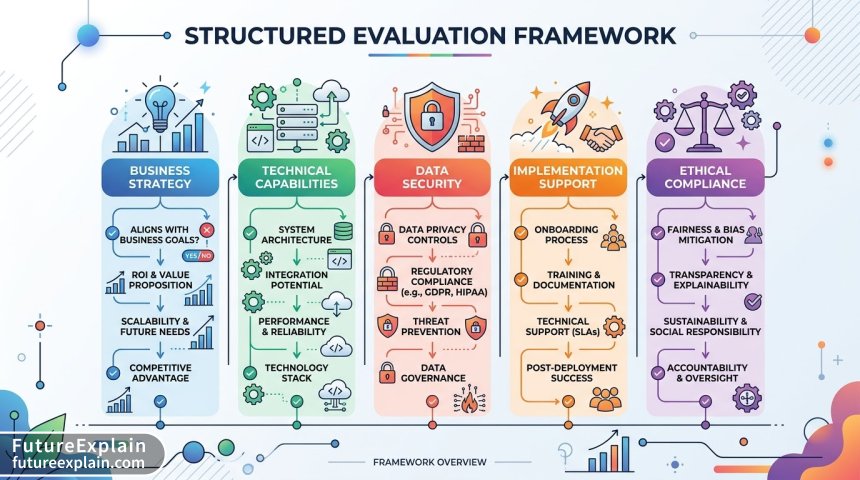
Choosing the right AI vendor is a critical decision that impacts your business operations, data security, and long-term success. This comprehensive guide provides a structured framework for evaluating AI vendors across five key dimensions: business alignment and strategy, technical capabilities and architecture, data security and privacy, implementation and support, and ethical compliance. You'll discover 50+ essential questions to ask vendors, learn how to assess total cost of ownership, understand red flags to watch for, and get practical tips for comparing multiple vendors. Whether you're a small business owner, IT manager, or department head, this guide will help you make informed decisions, avoid common pitfalls, and build successful AI partnerships that drive real business value while minimizing risks and ensuring compliance with evolving regulations.


Introduction: The Critical Importance of AI Vendor Evaluation
In today's rapidly evolving AI landscape, choosing the right vendor is one of the most significant technology decisions your organization will make. Unlike traditional software purchases, AI solutions involve complex considerations around data handling, model performance, ethical implications, and ongoing learning requirements. A poor vendor choice can lead to wasted investments, security vulnerabilities, compliance issues, and operational disruptions that can take years to recover from.
According to recent industry analysis, organizations that implement structured vendor evaluation processes experience 40% higher success rates in their AI initiatives and 35% lower total cost of ownership over three years. This guide provides a comprehensive framework for evaluating AI vendors, ensuring you ask the right questions, avoid common pitfalls, and make informed decisions aligned with your business objectives.
Section 1: Business Alignment and Strategic Fit
Before diving into technical specifications, start with strategic alignment. The most technically advanced AI solution is worthless if it doesn't solve your specific business problems or align with your organizational capabilities.
1.1 Understanding Your Business Needs
Begin by clearly defining what you need the AI solution to accomplish. Are you looking to automate customer service, enhance data analysis, improve operational efficiency, or create new products? Document your specific use cases, success metrics, and integration requirements before engaging with vendors.
1.2 Strategic Partnership Questions
- How does your solution align with our specific business objectives and use cases?
- What is your company's vision and roadmap for the next 3-5 years?
- How do you measure and report on the business value delivered to clients?
- What is your typical customer profile, and can you provide references from similar organizations?
- How do you handle changes in our business requirements over time?
1.3 Financial Considerations
Beyond the sticker price, understand the total cost of ownership. Consider implementation costs, training expenses, integration requirements, ongoing maintenance, and potential scaling costs. Ask about pricing models: subscription-based, usage-based, or hybrid approaches.
Total Cost of Ownership Framework: Calculate not just licensing fees but also implementation costs (typically 1.5-2x license cost), annual maintenance (15-25% of license), training expenses, integration development, data migration, and potential customization. Factor in opportunity costs of internal resources dedicated to the project.
Section 2: Technical Capabilities and Architecture
Technical evaluation requires understanding both current capabilities and future scalability. Focus on architecture, performance, integration capabilities, and technical support.
2.1 Core Technical Questions
- What AI models and algorithms power your solution, and how frequently are they updated?
- What are the system's accuracy rates, and how are they measured and validated?
- What computational infrastructure is required, and what are the latency expectations?
- How does the system handle edge cases and unexpected inputs?
- What are the API capabilities and documentation quality?
2.2 Integration and Compatibility
Ask detailed questions about integration with your existing technology stack. Request API documentation, review available connectors, and understand data flow requirements. Consider future integration needs as your technology ecosystem evolves.
2.3 Performance and Scalability
Evaluate performance under expected load conditions. Ask about uptime guarantees, disaster recovery procedures, and scaling capabilities. Request performance benchmarks from similar deployment scenarios.
Section 3: Data Security, Privacy, and Governance
Data considerations are particularly critical for AI solutions, which often require extensive training data and continuous learning from operational data.
3.1 Data Handling Questions
- Where is our data stored, processed, and backed up?
- What encryption standards are applied to data at rest and in transit?
- How is data segregation maintained between different clients?
- What are your data retention and deletion policies?
- How do you handle data sovereignty and cross-border data transfer requirements?
3.2 Security Compliance
Verify compliance with relevant standards: SOC 2, ISO 27001, GDPR, HIPAA (if applicable), and industry-specific regulations. Request recent audit reports and security certifications.
3.3 Incident Response
Understand the vendor's incident response procedures, notification timelines, and remediation commitments. Ask about past security incidents and how they were handled.
Section 4: Implementation, Support, and Operations
The implementation phase often determines project success. Evaluate the vendor's support structure, training offerings, and operational procedures.
4.1 Implementation Questions
- What is your typical implementation timeline and methodology?
- What resources (internal and external) are required for successful implementation?
- How do you handle data migration and system integration?
- What training and documentation do you provide?
- How do you manage change and user adoption?
4.2 Support and Maintenance
Evaluate support availability (24/7, business hours), response time commitments, escalation procedures, and support channels. Ask about typical resolution times for different severity levels.
4.3 Ongoing Operations
Understand monitoring capabilities, alerting systems, performance reporting, and maintenance windows. Ask about planned downtime frequency and notification procedures.
Section 5: Ethical Compliance and Responsible AI
AI systems carry unique ethical considerations. Responsible vendors should have clear policies and procedures addressing bias, fairness, transparency, and accountability.
5.1 Ethical Framework Questions
- What ethical principles guide your AI development and deployment?
- How do you identify and mitigate bias in your models?
- What explainability and interpretability features does your system provide?
- How do you ensure fairness across different demographic groups?
- What human oversight and control mechanisms are in place?
5.2 Transparency and Accountability
Request documentation on model development, training data sources, validation methodologies, and performance limitations. Understand how the vendor handles model drift and degradation over time.
Section 6: Vendor Viability and Partnership Considerations
Evaluate the vendor as a potential long-term partner. Consider financial stability, market position, client relationships, and cultural fit.
6.1 Company Stability Questions
- How long has your company been in business, and what is your financial status?
- Who are your key investors or parent company?
- What is your customer retention rate and typical contract length?
- How many similar implementations have you completed?
- What is your roadmap for future development?
6.2 Cultural and Partnership Fit
Assess communication styles, responsiveness during the sales process, and willingness to customize or adapt. Consider whether the vendor treats you as a transaction or a partnership.
Section 7: The Evaluation Process and Decision Framework
Create a structured evaluation process that includes multiple stakeholders from business, IT, security, compliance, and end-user groups.
7.1 Evaluation Timeline and Steps
Allocate 4-8 weeks for thorough evaluation. Include discovery sessions, technical deep dives, security reviews, reference checks, proof of concept (if applicable), and contract negotiation.
7.2 Scoring and Comparison Framework
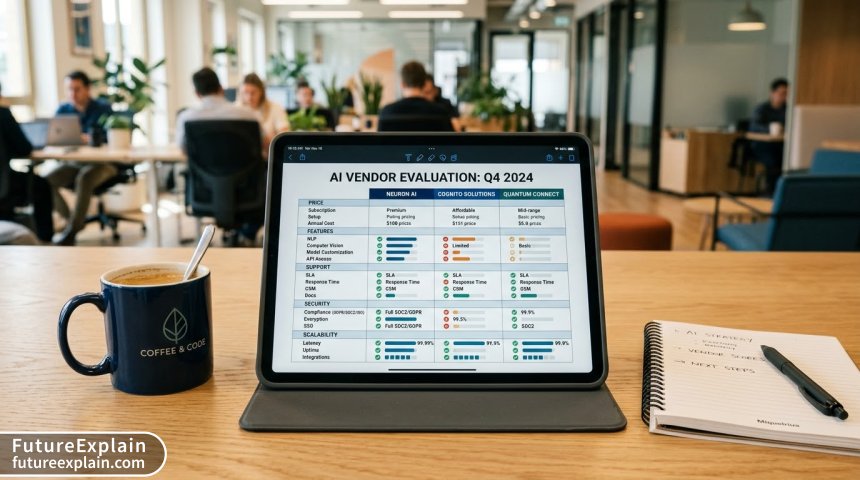
Create a weighted scoring matrix based on your organization's priorities. Assign weights to different categories (e.g., Business Fit: 30%, Technical Capabilities: 25%, Security: 20%, Support: 15%, Cost: 10%). Score each vendor objectively against defined criteria.
7.3 Proof of Concept Guidelines
If conducting a POC, define clear success criteria, timeline, scope, and evaluation methodology. Ensure the POC tests real-world scenarios with your actual data and workflows.
Section 8: Red Flags and Warning Signs
Be alert to warning signs that indicate potential problems:
- Vague or evasive answers to specific technical questions
- Lack of transparency about pricing or contract terms
- Poor documentation or unwillingness to share security certifications
- High customer churn rates or negative reference feedback
- Over-reliance on a few key personnel without knowledge sharing
- Unrealistic implementation timelines or resource requirements
- Resistance to custom contract terms or service level agreements
Section 9: Negotiation and Contract Considerations
The contract formalizes your partnership and protects your interests. Pay attention to key clauses beyond standard terms and conditions.
9.1 Critical Contract Elements
- Service Level Agreements (SLAs) with clear metrics and remedies
- Data ownership and usage rights provisions
- Security and compliance obligations
- Change management and upgrade procedures
- Exit strategy and data transition requirements
- Limitation of liability and indemnification clauses
- Dispute resolution mechanisms
Section 10: Implementation Success Factors
Successful implementation begins with thorough evaluation but continues through careful planning and execution.
10.1 Post-Selection Planning
Create a detailed implementation plan with clear milestones, responsibilities, and success criteria. Establish governance structures and communication protocols with the vendor.
10.2 Relationship Management
Designate relationship owners, establish regular review meetings, and create feedback mechanisms. Monitor performance against agreed metrics and address issues proactively.
Conclusion: Building Successful AI Partnerships
Evaluating AI vendors requires a balanced approach considering technical capabilities, business alignment, security requirements, ethical considerations, and partnership potential. By asking the right questions and following a structured evaluation process, you can select vendors that not only provide effective solutions but also become valuable long-term partners in your AI journey.
Remember that the cheapest or most feature-rich solution isn't always the best fit. Consider total cost of ownership, implementation complexity, support quality, and strategic alignment. Invest time in thorough evaluation—the upfront effort will pay dividends in successful implementation, optimal performance, and sustainable business value.
As AI technology continues to evolve, maintain ongoing evaluation of your vendor relationships. Regular reviews ensure continued alignment with your business needs and technology strategy, allowing you to adapt to changing requirements and leverage new capabilities as they emerge.
Visuals Produced by AI
Further Reading
Share
What's Your Reaction?
 Like
1532
Like
1532
 Dislike
18
Dislike
18
 Love
245
Love
245
 Funny
12
Funny
12
 Angry
5
Angry
5
 Sad
3
Sad
3
 Wow
187
Wow
187
















This should be mandatory reading for anyone involved in technology procurement. The comprehensive approach prevents so many common pitfalls. I've bookmarked this for all future vendor evaluations.
How do you recommend handling vendor comparisons when features seem similar? We're evaluating three vendors who all claim similar capabilities, and the decision is becoming difficult.
Alex, when features are similar, we focus on: 1) Support quality (try their support during evaluation), 2) Implementation approach, 3) Cultural fit with our team, 4) Contract flexibility, 5) Roadmap alignment. Sometimes the 'soft' factors make the difference when tech is comparable.
Section 2.3 on performance under load is critical. We tested a vendor's demo environment (which worked perfectly) but didn't ask about production performance. The system slowed to a crawl when we rolled out to all employees. Now we always request load test results.
The ethical framework questions helped us avoid a vendor whose bias mitigation was just 'we remove gender/race from training data.' They couldn't explain how they handled other bias sources. Your questions exposed the superficial approach.
This guide is comprehensive but quite detailed. For smaller projects with limited budget, which sections would you prioritize if we can't do the full 8-week evaluation?
Good question, Li. For smaller projects: 1) Prioritize Section 3 (Data Security) - non-negotiable, 2) Focus on key questions from Sections 1 and 4, 3) Do reference checks (part of Section 6), 4) Ensure clear SLAs in contract (Section 9). Even with limited time, security and clear expectations are essential.
I appreciate the emphasis on vendor viability in Section 6. We chose a startup with amazing tech last year, but they got acquired and the product roadmap changed completely. Now we always check financial stability and acquisition history.