Robotics & Perception: How Robots See and Act (Beginner)
This beginner-friendly guide demystifies how robots perceive and interact with the world. We start by explaining the core challenge: robots lack innate understanding. We then break down the 'sense-think-act' loop, detailing the hardware robots use to see (cameras, LiDAR, ultrasonic sensors) and feel (force/tactile sensors). The article dives into how software, particularly computer vision and machine learning, processes this raw sensor data into meaningful information—recognizing objects, estimating depth, and mapping surroundings. We explain critical concepts like sensor fusion, simultaneous localization and mapping (SLAM), and path planning. Real-world examples from autonomous vacuums to self-driving cars illustrate these principles in action. Finally, we discuss current limitations, ethical considerations, and the exciting future where improved perception will enable robots to work alongside us more safely and effectively in homes, hospitals, and factories.
Introduction: The Robot's Dilemma
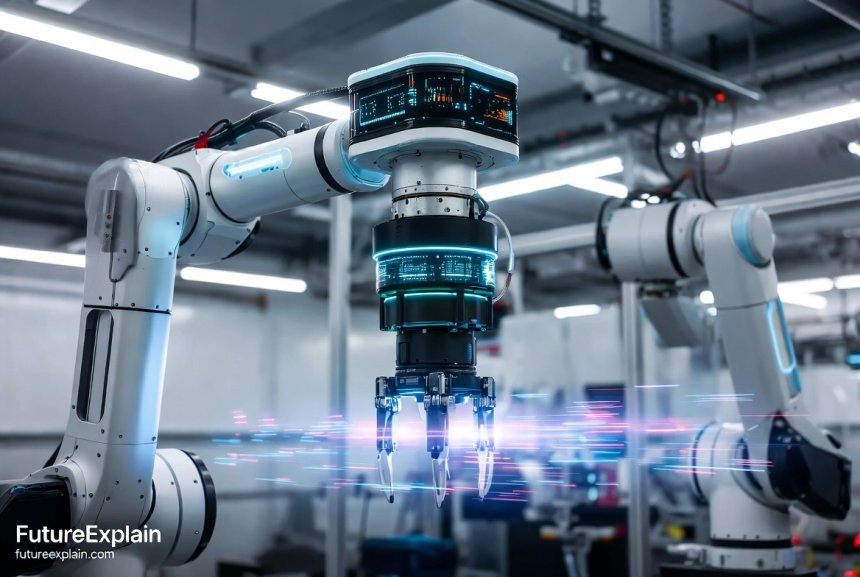
Imagine asking a friend to pass you a cup from a cluttered table. For them, it's trivial. Their eyes scan the scene, instantly identifying the cup among books and keys, their brain calculates the distance and a safe path for their arm, and their muscles execute a smooth grasp. For a robot, this simple task is a monumental challenge of perception and action. Robots inhabit the same physical world we do, but they experience it as a flood of meaningless data—pixels, distance points, voltage readings. The field of robotics perception is the science and engineering of bridging that gap, transforming raw sensor data into understanding, and using that understanding to act purposefully and safely.
This guide is for beginners. We will unpack how robots "see" and "act," moving beyond science fiction to the real, often messy, technology powering everything from your roomba to advanced manufacturing arms and autonomous vehicles. We'll explore the sensors that act as robotic eyes and ears, the algorithms that serve as their brain, and the actuators that function as their muscles. By the end, you'll have a clear mental model of the "sense-think-act" loop that is fundamental to all intelligent machines.
The Core Loop: Sense, Think, Act
Every robot, no matter how simple or complex, operates on a continuous cycle known as the Sense-Think-Act loop (sometimes called Perceive-Plan-Act).
- Sense: The robot gathers data about itself and its environment using sensors. This is its perception phase.
- Think: The robot processes this sensor data. It identifies objects, maps its location, assesses its state, and decides what to do next. This involves algorithms from machine learning and traditional programming.
- Act: The robot carries out its decision by moving its wheels, turning a joint, or activating a gripper using motors and actuators.
The speed and sophistication of this loop define a robot's capabilities. A simple line-following robot senses reflected light, thinks "turn left," and acts by adjusting motor power. A self-driving car fuses billions of data points from cameras and LiDAR in milliseconds, thinks "merge into lane," and acts by steering and accelerating.
Visuals Produced by AI
How Robots Sense: The Hardware of Perception
Robots use a suite of sensors to create a digital understanding of the world. No single sensor is perfect; each has strengths and weaknesses, so robots often use many in combination, a process called sensor fusion.
Vision Sensors: The Robot's Eyes
Cameras are the most intuitive sensors, providing rich 2D image data similar to human sight.
- 2D Cameras: Standard RGB cameras capture color and texture. They're cheap and good for identifying objects, reading text, or detecting colors.
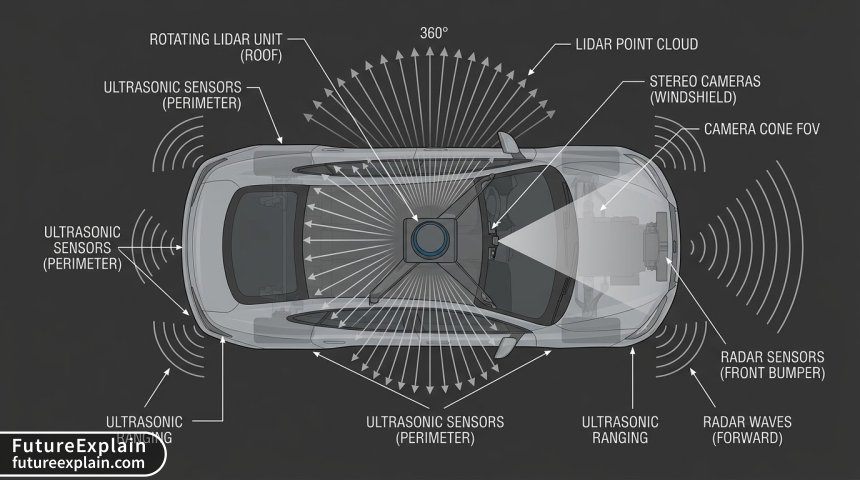
- Stereo Cameras: Two cameras spaced apart, like human eyes, capture two slightly different images. By comparing these images, software can calculate depth, creating a 3D understanding of the scene.
- Depth Cameras: Sensors like Microsoft's Kinect or Intel's RealSense use infrared light patterns or time-of-flight measurements to directly produce a "depth map"—an image where each pixel value represents distance, not color.
Limitations: Cameras struggle with poor lighting, glare, and visually "featureless" environments (like a blank white wall). They also provide massive amounts of data that require significant processing power.
LiDAR: Painting the World with Lasers
Light Detection and Ranging (LiDAR) sensors actively measure distance by firing rapid pulses of laser light and timing how long they take to bounce back. A rotating LiDAR unit can create a highly accurate 3D "point cloud" map of the environment around it. This is crucial for autonomous vehicles to understand road geometry and the position of other objects, regardless of light conditions.
Limitations: Traditional LiDAR is expensive, can be affected by heavy rain or fog, and creates sparse data compared to a camera image.
Radar and Sonar/Ultrasonic Sensors
These sensors use radio waves (Radar) or sound waves (Sonar/Ultrasonic) to measure distance and speed. They are robust in bad weather and excellent at detecting how fast an object is moving relative to the sensor (using the Doppler effect). Your car's adaptive cruise control likely uses radar. Ultrasonic sensors, common on parking aids and robotic vacuums, are great for short-range obstacle detection.
Limitations: They typically provide lower-resolution data than LiDAR or cameras and can't easily identify what an object is.
Proprioceptive Sensors: The Robot's Sense of Self
Perception isn't just about the external world; robots must also sense their own state. Proprioceptive sensors provide this internal awareness.
- Encoders: Attached to motor shafts, they measure how much a joint has rotated or a wheel has turned, telling the robot its own movements.
- Inertial Measurement Units (IMUs): Combines accelerometers (measuring acceleration) and gyroscopes (measuring rotation) to track the robot's orientation, tilt, and movement through space.
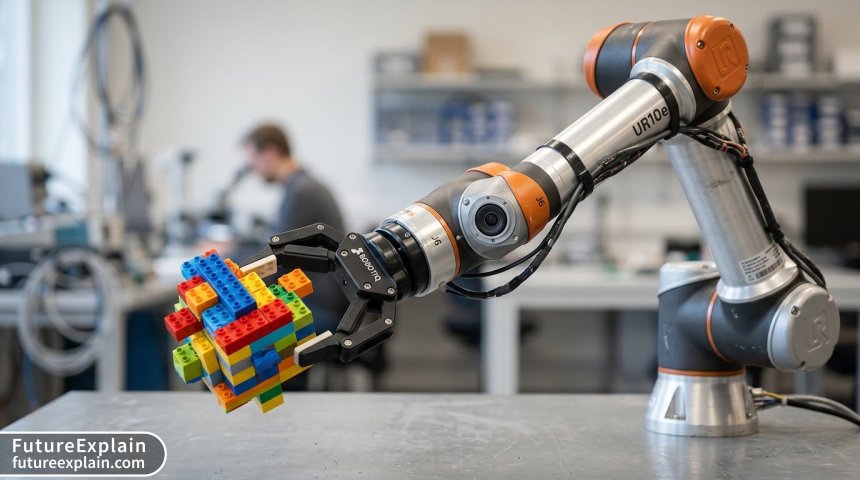
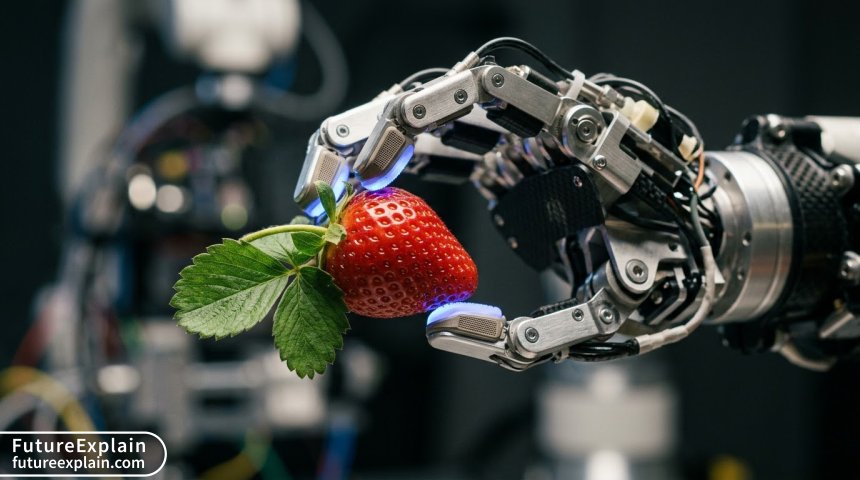
- Force-Torque Sensors: Placed in a robot's wrist or foot, they measure the forces and torques being applied. This lets a robot perform delicate tasks like inserting a peg or feeling if it's pushing against something.
From Data to Understanding: The Software of Perception
Raw sensor data is just numbers. The "think" phase converts this into actionable knowledge. This is where AI and computer vision come into play.
Computer Vision: Making Sense of Pixels
Computer vision algorithms extract information from visual data. Key tasks include:
- Object Detection & Recognition: Is there a cup in this image? Where is it? What type of cup is it? This is often done using deep learning models like Convolutional Neural Networks (CNNs), which learn hierarchical features from vast amounts of labeled image data.
- Semantic Segmentation: Classifying every single pixel in an image (e.g., sky, road, car, pedestrian). This is vital for self-driving cars to understand drivable space.
- Optical Flow: Determining how pixels move from one video frame to the next, helping estimate the robot's own motion or the movement of other objects.
Localization and Mapping: "Where am I?" and "What's around me?"
For a robot to move, it needs a map and it needs to know where it is on that map. This is the challenge of Simultaneous Localization and Mapping (SLAM). SLAM algorithms process data from cameras, LiDAR, and IMUs in real-time to concurrently build a map of an unknown environment and track the robot's position within it. It's like drawing a map of a dark room while keeping track of your own footsteps. Modern approaches, like visual SLAM (vSLAM), use camera images as the primary sensor, extracting key visual landmarks to build the map.
Sensor Fusion: The Whole is Greater
Cameras provide rich detail but no inherent scale or distance in 2D. LiDAR provides precise 3D geometry but poor object identification. An IMU tracks motion but drifts over time. Sensor fusion algorithms, like the Kalman Filter, combine these disparate, noisy data streams to produce a single, more accurate, and reliable estimate of the world state. For example, fusing camera-based object detection with LiDAR-based distance measurement tells the robot "there is a pedestrian 5.2 meters ahead."
From Understanding to Action: Planning and Control
Once the robot has a model of the world and its place in it, it must decide how to act. This involves planning and control.
- Path Planning: Given a goal (e.g., "move to the kitchen"), the planner calculates a safe and efficient sequence of motions from the current location, avoiding obstacles. Algorithms like A* (A-star) or rapidly-exploring random trees (RRT) are commonly used.
- Motion Control: This is the low-level execution. The control system takes the planned path and calculates the exact forces, torques, and motor commands needed to make the robot's physical body follow it, compensating for friction, inertia, and unexpected disturbances.
Visuals Produced by AI
Real-World Examples
Let's see the sense-think-act loop in practice.
Autonomous Vacuum (e.g., Roomba): Senses via bump sensors, cliff sensors, and wheel encoders. Thinks with a simple algorithm (e.g., spiral pattern, random bounce, or modern ones using vSLAM for systematic cleaning). Acts by driving its wheels. Higher-end models use cameras to recognize objects like cords or pet waste.
Warehouse Picking Robot: Senses a bin of mixed items with a 3D camera. Thinks using a vision system to identify and locate a specific item, then plans a collision-free path for its arm. Acts by moving its arm and using a vacuum or gripper to pick the item. This is a form of intelligent automation.
Self-Driving Car: The pinnacle of integrated perception. It senses with a massive array of cameras, LiDAR, radar, and ultrasonic sensors. It thinks by fusing this data to create a 360-degree, dynamic model of all road users, traffic lights, and lane markings, then plans a safe trajectory. It acts by controlling steering, throttle, and brake actuators.
Challenges and The Future of Robot Perception
Despite advances, robot perception is far from solved.
- Robustness: Systems must work reliably in snow, rain, fog, against blinding sun, or in dynamic, unpredictable human environments.
- Interpretation & Common Sense: A robot might see a plastic bag blowing across the road but lack the "common sense" to know it's not a solid obstacle. Bridging the gap between perception and true understanding is an ongoing research area tied to AI agent development.
- Data & Computation: Processing high-resolution sensor data in real-time requires immense computing power, challenging for small or low-power robots. This drives innovation in edge AI and specialized chips.
- Ethics & Safety: As robots make more autonomous decisions based on their perception, ensuring those decisions are safe, unbiased, and accountable is critical, a topic we cover in AI ethics.
The future is multimodal and embodied. Future robots will combine sight, sound, and sophisticated touch (multimodal AI) for a richer perception. They will also learn not just from data, but from interacting with the world—dropping an object teaches about weight and fragility. As perception improves, robots will move from controlled factories into our everyday lives, requiring them to be more adaptable, safe, and ultimately, more perceptive partners.
Further Reading
Introduction: The Robot's Dilemma
Imagine asking a friend to pass you a cup from a cluttered table. For them, it's trivial. Their eyes scan the scene, instantly identifying the cup among books and keys, their brain calculates the distance and a safe path for their arm, and their muscles execute a smooth grasp. For a robot, this simple task is a monumental challenge of perception and action. Robots inhabit the same physical world we do, but they experience it as a flood of meaningless data—pixels, distance points, voltage readings. The field of robotics perception is the science and engineering of bridging that gap, transforming raw sensor data into understanding, and using that understanding to act purposefully and safely.
This guide is for beginners. We will unpack how robots "see" and "act," moving beyond science fiction to the real, often messy, technology powering everything from your roomba to advanced manufacturing arms and autonomous vehicles. We'll explore the sensors that act as robotic eyes and ears, the algorithms that serve as their brain, and the actuators that function as their muscles. By the end, you'll have a clear mental model of the "sense-think-act" loop that is fundamental to all intelligent machines.
The Core Loop: Sense, Think, Act
Every robot, no matter how simple or complex, operates on a continuous cycle known as the Sense-Think-Act loop (sometimes called Perceive-Plan-Act).
- Sense: The robot gathers data about itself and its environment using sensors. This is its perception phase.
- Think: The robot processes this sensor data. It identifies objects, maps its location, assesses its state, and decides what to do next. This involves algorithms from machine learning and traditional programming.
- Act: The robot carries out its decision by moving its wheels, turning a joint, or activating a gripper using motors and actuators.
The speed and sophistication of this loop define a robot's capabilities. A simple line-following robot senses reflected light, thinks "turn left," and acts by adjusting motor power. A self-driving car fuses billions of data points from cameras and LiDAR in milliseconds, thinks "merge into lane," and acts by steering and accelerating.
Visuals Produced by AI
How Robots Sense: The Hardware of Perception
Robots use a suite of sensors to create a digital understanding of the world. No single sensor is perfect; each has strengths and weaknesses, so robots often use many in combination, a process called sensor fusion.
Vision Sensors: The Robot's Eyes
Cameras are the most intuitive sensors, providing rich 2D image data similar to human sight.
- 2D Cameras: Standard RGB cameras capture color and texture. They're cheap and good for identifying objects, reading text, or detecting colors.
- Stereo Cameras: Two cameras spaced apart, like human eyes, capture two slightly different images. By comparing these images, software can calculate depth, creating a 3D understanding of the scene.
- Depth Cameras: Sensors like Microsoft's Kinect or Intel's RealSense use infrared light patterns or time-of-flight measurements to directly produce a "depth map"—an image where each pixel value represents distance, not color.
Limitations: Cameras struggle with poor lighting, glare, and visually "featureless" environments (like a blank white wall). They also provide massive amounts of data that require significant processing power.
LiDAR: Painting the World with Lasers
Light Detection and Ranging (LiDAR) sensors actively measure distance by firing rapid pulses of laser light and timing how long they take to bounce back. A rotating LiDAR unit can create a highly accurate 3D "point cloud" map of the environment around it. This is crucial for autonomous vehicles to understand road geometry and the position of other objects, regardless of light conditions.
Limitations: Traditional LiDAR is expensive, can be affected by heavy rain or fog, and creates sparse data compared to a camera image.
Radar and Sonar/Ultrasonic Sensors
These sensors use radio waves (Radar) or sound waves (Sonar/Ultrasonic) to measure distance and speed. They are robust in bad weather and excellent at detecting how fast an object is moving relative to the sensor (using the Doppler effect). Your car's adaptive cruise control likely uses radar. Ultrasonic sensors, common on parking aids and robotic vacuums, are great for short-range obstacle detection.
Limitations: They typically provide lower-resolution data than LiDAR or cameras and can't easily identify what an object is.
Proprioceptive Sensors: The Robot's Sense of Self
Perception isn't just about the external world; robots must also sense their own state. Proprioceptive sensors provide this internal awareness.
- Encoders: Attached to motor shafts, they measure how much a joint has rotated or a wheel has turned, telling the robot its own movements.
- Inertial Measurement Units (IMUs): Combines accelerometers (measuring acceleration) and gyroscopes (measuring rotation) to track the robot's orientation, tilt, and movement through space.
- Force-Torque Sensors: Placed in a robot's wrist or foot, they measure the forces and torques being applied. This lets a robot perform delicate tasks like inserting a peg or feeling if it's pushing against something.
From Data to Understanding: The Software of Perception
Raw sensor data is just numbers. The "think" phase converts this into actionable knowledge. This is where AI and computer vision come into play.
Computer Vision: Making Sense of Pixels
Computer vision algorithms extract information from visual data. Key tasks include:
- Object Detection & Recognition: Is there a cup in this image? Where is it? What type of cup is it? This is often done using deep learning models like Convolutional Neural Networks (CNNs), which learn hierarchical features from vast amounts of labeled image data.
- Semantic Segmentation: Classifying every single pixel in an image (e.g., sky, road, car, pedestrian). This is vital for self-driving cars to understand drivable space.
- Optical Flow: Determining how pixels move from one video frame to the next, helping estimate the robot's own motion or the movement of other objects.
Localization and Mapping: "Where am I?" and "What's around me?"
For a robot to move, it needs a map and it needs to know where it is on that map. This is the challenge of Simultaneous Localization and Mapping (SLAM). SLAM algorithms process data from cameras, LiDAR, and IMUs in real-time to concurrently build a map of an unknown environment and track the robot's position within it. It's like drawing a map of a dark room while keeping track of your own footsteps. Modern approaches, like visual SLAM (vSLAM), use camera images as the primary sensor, extracting key visual landmarks to build the map.
Sensor Fusion: The Whole is Greater
Cameras provide rich detail but no inherent scale or distance in 2D. LiDAR provides precise 3D geometry but poor object identification. An IMU tracks motion but drifts over time. Sensor fusion algorithms, like the Kalman Filter, combine these disparate, noisy data streams to produce a single, more accurate, and reliable estimate of the world state. For example, fusing camera-based object detection with LiDAR-based distance measurement tells the robot "there is a pedestrian 5.2 meters ahead."
From Understanding to Action: Planning and Control
Once the robot has a model of the world and its place in it, it must decide how to act. This involves planning and control.
- Path Planning: Given a goal (e.g., "move to the kitchen"), the planner calculates a safe and efficient sequence of motions from the current location, avoiding obstacles. Algorithms like A* (A-star) or rapidly-exploring random trees (RRT) are commonly used.
- Motion Control: This is the low-level execution. The control system takes the planned path and calculates the exact forces, torques, and motor commands needed to make the robot's physical body follow it, compensating for friction, inertia, and unexpected disturbances.
Visuals Produced by AI
Real-World Examples
Let's see the sense-think-act loop in practice.
Autonomous Vacuum (e.g., Roomba): Senses via bump sensors, cliff sensors, and wheel encoders. Thinks with a simple algorithm (e.g., spiral pattern, random bounce, or modern ones using vSLAM for systematic cleaning). Acts by driving its wheels. Higher-end models use cameras to recognize objects like cords or pet waste.
Warehouse Picking Robot: Senses a bin of mixed items with a 3D camera. Thinks using a vision system to identify and locate a specific item, then plans a collision-free path for its arm. Acts by moving its arm and using a vacuum or gripper to pick the item. This is a form of intelligent automation.
Self-Driving Car: The pinnacle of integrated perception. It senses with a massive array of cameras, LiDAR, radar, and ultrasonic sensors. It thinks by fusing this data to create a 360-degree, dynamic model of all road users, traffic lights, and lane markings, then plans a safe trajectory. It acts by controlling steering, throttle, and brake actuators.
Challenges and The Future of Robot Perception
Despite advances, robot perception is far from solved.
- Robustness: Systems must work reliably in snow, rain, fog, against blinding sun, or in dynamic, unpredictable human environments.
- Interpretation & Common Sense: A robot might see a plastic bag blowing across the road but lack the "common sense" to know it's not a solid obstacle. Bridging the gap between perception and true understanding is an ongoing research area tied to AI agent development.
- Data & Computation: Processing high-resolution sensor data in real-time requires immense computing power, challenging for small or low-power robots. This drives innovation in edge AI and specialized chips.
- Ethics & Safety: As robots make more autonomous decisions based on their perception, ensuring those decisions are safe, unbiased, and accountable is critical, a topic we cover in AI ethics.
The future is multimodal and embodied. Future robots will combine sight, sound, and sophisticated touch (multimodal AI) for a richer perception. They will also learn not just from data, but from interacting with the world—dropping an object teaches about weight and fragility. As perception improves, robots will move from controlled factories into our everyday lives, requiring them to be more adaptable, safe, and ultimately, more perceptive partners.