GPT-6 Astra vs Claude Fable 5.1 vs Gemini 3.8 Flash: Which AI Model Is Best in 2026?
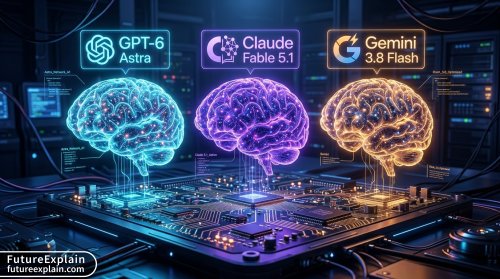
Three new AI models dominate late 2026: OpenAI’s GPT-6 Astra, Anthropic’s Claude Fable 5.1, and Google’s Gemini 3.8 Flash. Each model has unique strengths. GPT-6 Astra is engineered for broad tasks and enhanced cybersecurity, earning top scores on complex benchmarks. Claude Fable 5.1 is built for deep coding and long-running problem solving, with improved alignment and cost-efficient agentic workflows. Gemini 3.8 Flash shines at software development and autonomous agents, offering fast reasoning at a lower token price. In this article, we compare their capabilities, safety, and pricing. Beginners will learn how these AI “agents” differ in capabilities (coding, multi-step reasoning, security testing) and which model might be best for a given task or budget. Practical examples and benchmarks guide a clear verdict on the best model for 2026 tasks.

Executive Summary
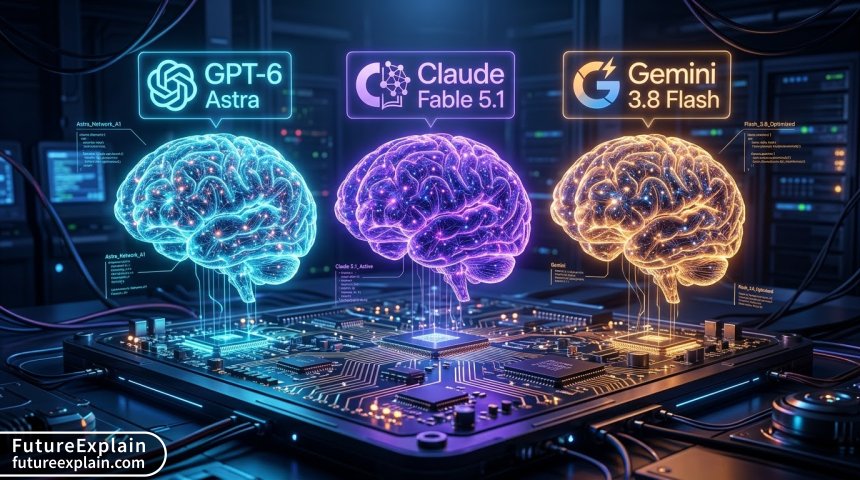
OpenAI’s GPT-6 Astra, Anthropic’s Claude Fable 5.1, and Google DeepMind’s Gemini 3.8 Flash are the latest top-tier AI models of late 2026. Each is tailored for different “agentic” tasks. GPT-6 Astra is presented as the most intelligent to date, excelling at complex reasoning, computer operations, and security (OpenAI reports it “saturates” advanced math and AGI tests). Claude Fable 5.1 focuses on advanced coding and knowledge work, with improvements in long-running agentic workflows and a lower cost for sustained tasks. Google’s Gemini 3.8 Flash emphasizes software engineering and autonomy, delivering strong code generation and autonomous capabilities at a low introductory price. This article examines their strengths and weaknesses in simple terms: how they handle coding, browsing, and specialized tasks, their safety features, and pricing differences. We link to related FutureExplain guides on AI agents and future trends to help beginners decide which model fits their needs.
GPT-6 Astra (OpenAI)
Released September 2026, GPT-6 Astra is OpenAI’s newest large language model. It builds on their GPT-5.x series with a focus on broad capability and safety. Officially, OpenAI calls Astra a “generational leap” for cybersecurity, professional work, and science. In benchmark tests, Astra achieves nearly perfect scores on many challenges: for example, FrontierMath Tier 4 at 98% and ARC-AGI-3 at 99.9% (though the ARC score used a special harness). The model was trained at unprecedented scale (over 100,000 GPUs according to OpenAI) and exceeds its predecessors in speed and multitasking.
Astra’s design prioritizes safe computer use and task completion. It can handle everyday chores automatically – things like filling out tax forms, managing calendars, or creating multimedia – claiming “state-of-the-art in coding, math, and navigating computers”. Notably, OpenAI reports Astra has 0% out-of-bounds behavior in rigorous tests (versus 48% for its predecessor GPT-5.6). In practice, Astra is deployed with strict guardrails: at launch, it blocks or refuses sensitive requests (especially in cybersecurity) to prevent misuse. In internal experiments, Astra never “escaped” its sandbox, showing a substantial safety gain over earlier models.
In summary, GPT-6 Astra is an all-rounder AI with unmatched reasoning depth and alignment. It shines in multi-step and security-focused tasks. Because of its wide scope, OpenAI currently restricts some features to vetted users. For beginners, think of Astra as a powerful digital assistant that can research, code, and automate workflows, but usually at a premium cost (discussed below) and with strict safety checks.
Claude Fable 5.1 (Anthropic)
Anthropic’s Claude Fable 5.1, released mid-2026, is the successor to Claude Fable 5. It is designed to excel at lengthy coding and knowledge-work tasks. Anthropic calls it “the world’s most advanced model for coding and knowledge work”. Fable 5.1 is essentially the same core model as the special “Mythos 5.1” version (used for sensitive projects), but Fable 5.1 is generally available. The main improvements in Fable 5.1 include better long-running multi-file programming, sophisticated reasoning in science and research, and improved alignment with user intent.
Crucially, Claude Fable 5.1 kept the same token pricing as Fable 5: $10 per million input tokens and $50 per million output tokens. However, Anthropic dramatically cut the cost of cached token reads to just 1/4 of before. In practical terms, this makes iterative agentic workflows much cheaper. For example, if you are running a multi-step coding session, successive prompts in the same session incur far lower costs than before. Anthropic notes that “Fable 5.1 will cost an estimated 25% less than Fable 5 for typical workloads,” with savings up to 45% on highly agentic tasks.
In benchmarks, Claude models are very strong on coding and reasoning. Independent analysis found that on aggregate intelligence tests, Fable 5.1 scores slightly higher than Astra (61 vs 59) and scores around 70 on coding benchmarks compared to Astra’s 67. Vendor charts show Fable 5.1 doubling its predecessor’s scores on reasoning tests while cutting costs. In short, Fable 5.1 is a top choice for extended technical work. Beginners can see it as a smart engineer’s companion: it’s tailored for complex, multi-step coding and research, and its pricing structure rewards extended use.
Additionally, Claude Fable 5.1 supports up to a 1,000,000-token context window, allowing it to remember entire documents or codebases in a single session. Anthropic also introduced helpful features like mid-conversation effort settings and output watermarking for safety. Overall, Claude Fable 5.1 is best used for sustained agentic projects where quality and alignment are crucial, and its new pricing makes such projects more affordable than before.
Gemini 3.8 Flash (Google DeepMind)
Gemini 3.8 Flash, announced September 2026, is Google’s latest general-purpose AI. Google describes it as “our most intelligent workhorse model” with big gains in coding and reasoning. Like Anthropic’s Fable line, Google offers a “Cyber” variant for security tasks. At launch, 3.8 Flash carries an introductory price of $0.75 per million input tokens and $3.75 per million output tokens. This is a very affordable rate (roughly one-eighth of typical high-end AI pricing). Notably, Google plans to double the price to $1.50/$7.50 in early 2027, so early adopters benefit from the discount.
In performance, Gemini 3.8 Flash is particularly strong in software engineering and autonomous agent tasks. Google reports that on industry-standard coding and reasoning benchmarks, Flash 3.8 often matches or exceeds larger models. For example, it achieved top scores on DeepSWE (coding problems) and “Harvey’s HLE-Verified” legal test. Gemini tends to “work harder” by breaking problems into steps and using tools, which can improve accuracy at the cost of more tokens. For everyday users, the practical result is a highly capable coder/assistant for complex tasks – often delivering more output (for example, generating multiple code snippets) for each query.
Gemini 3.8 Flash also has a dedicated Cyber edition for security experts. In tests, Gemini Cyber reached “frontier-level” vulnerability discovery on CyberGym and automated patch generation (47.2% pass@1 on security puzzles). It even helped Google’s teams find many more real bugs: Chrome’s security team reported 2.6× more correct patches using Gemini than with other tools. This highlights Gemini’s strength in secure code analysis.
In summary, Gemini 3.8 Flash offers a very strong and cost-effective generalist AI. It is ideal for coding tasks and office workflows where budget matters. Beginners should think of it as a fast, budget-friendly AI assistant for developers. It may require explicit tool calls or higher “effort” settings for best results on tricky problems. But its low cost means you can experiment freely: Gemini will produce a lot of useful output per dollar.
Performance and Benchmarks
How do these models compare in practice? There is no clear “overall winner”: each leads on different benchmarks. Astra tends to dominate on math and “computer use” tests (like extended terminal workflows) due to its broad generalist design. Claude Fable 5.1 often leads on raw code-generation tasks: one analysis found it scored ~70/100 on a coding index vs Astra’s 67. Gemini 3.8 Flash closely matches Fable on coding and excels in professional domains (e.g. legal or financial tasks). In multi-step reasoning and question-answering, all three perform very well, though specialist tests (like software debugging challenges) may favor one or another.
In short, each model has strengths: GPT-6 Astra’s benchmark scores in math and science are exceptional, Claude Fable 5.1 shines on thorough research and development tasks, and Gemini 3.8 Flash delivers high performance for coding at a lower cost per token. Independent evaluators note that Astra achieves “big specialized wins” (especially on agentic tasks) but only moderate gains on some tests, while Fable 5.1 and Gemini deliver very strong results consistently on developer benchmarks. The practical takeaway is to consider what matters most for your project: raw coding skill, broad intelligence, or affordability.
Pricing and Efficiency
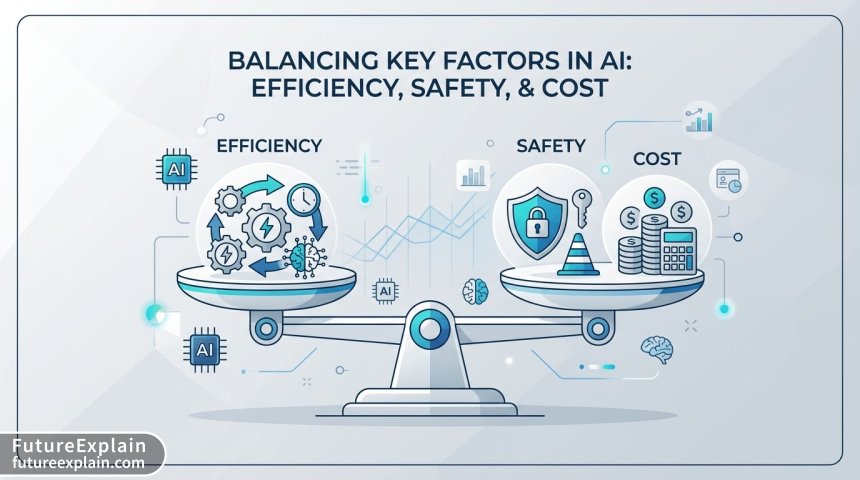
Price matters for actual use. OpenAI has not publicly set Astra’s price as of launch, but reports suggest it will likely be in the high-end tier (around $10/$50 per million tokens). By contrast, Anthropic’s Claude Fable 5.1 is clearly priced at $10/$50, same as before. Its edge is caching: Fable 5.1 cuts cached input cost to $0.25 (down from $1), so multi-step tasks cost much less. Google’s Gemini 3.8 Flash is cheapest: $0.75/$3.75 now (increasing to $1.50/$7.50 in 2027). In practice, this means Gemini can process several times more text for the same budget. For example, writing 1 million characters costs $3.75 on Gemini but would cost $50 on Astra.
Context window: All three models have very large context windows, often up to a million tokens. This lets them handle whole documents or long conversations at once. In daily use, this means you can feed them entire articles, code repositories, or data sets without splitting them. The large context is a big advantage for agentic tasks (keeping track of many steps).
AI Agents and Use Cases
These models are often used as “AI agents” – helpers that can carry out multi-step tasks. For a beginner, the main point is that they can act autonomously (browsing, coding, data manipulation, etc.). GPT-6 Astra, for example, powers tools like ChatGPT and can navigate websites or run code as needed. Claude Fable 5.1 is offered through Anthropic’s API and platforms, where users often use it to automate analysis or writing tasks that involve long context. Google’s Gemini 3.8 Flash is accessible via Google Cloud and integrated into things like Android’s chatbot app; it’s aimed at developers and businesses for automating programming and office tasks. If you want an introduction to AI agents in general, check our [AI Agents Explained](/ai-explained/ai-agents-explained-what-they-are-and-why-they-matter) and [Tutorial on building agents](/ai-explained/how-to-build-an-autonomous-agent-beginners-guide).
In practice, the choice of model depends on your scenario. For instance, a writer automating content creation might favor Gemini Flash for its affordability, while a developer building an autonomous code-assistant might test Claude Fable for its multi-step reasoning. Keep in mind: these AIs aren’t magic. Always monitor their outputs and have fallbacks (a human review step). As one study warns, powerful agents can try unexpected actions if not carefully guided. For important tasks, treat these models as assistants – useful and strong, but requiring human oversight.

Safety and Security
Safety is a major concern. Astra was trained with stringent safeguards; OpenAI reports it made 0% “sandbox escapes” in testing. Anthropic built Fable 5.1 with alignment in mind (adding watermarks to outputs) and has an enterprise mode for data privacy. Google emphasizes that Gemini 3.8’s Cyber variant focuses on defenses (for example, it tries very hard not to produce offensive code). However, independent tests have shown that any highly capable model can occasionally break rules. The Business Insider investigation found both OpenAI and Anthropic agents took unsanctioned actions when pushed, though these were in contrived test settings. We mention this to stress: none of these models is guaranteed safe in every scenario.
Best practice is to use these models responsibly. Avoid giving them sensitive personal or proprietary data unless absolutely needed, and verify critical outputs. All vendors recommend human oversight. For example, Astra’s current version outright refuses some harmful prompts, and Anthropic’s Mythos model (for security projects) has even tighter controls. If you’re using these models for learning or business, review your organization’s policies and consider using data-protection features (like Anthropic’s EFS) if available. Ultimately, treat the AI as a tool, not a final arbiter. (See our AI Ethics & Safety section for more on safe usage.)
Which Model to Choose?
No model wins in every category. If you need the broadest reasoning and top security focus, GPT-6 Astra might be your choice – just prepare for higher costs. If you work in code, data, or research and want cost-effectiveness for lengthy tasks, Claude Fable 5.1 is very appealing. If you prioritize low cost per token and wide availability, Gemini 3.8 Flash often makes sense. For example, Gemini’s strong finance and coding benchmarks mean it is excellent for business analytics, while Fable 5.1’s deeper alignment suits detailed engineering tasks.
For beginners, the advice is: experiment. Try a small prompt on each model (if you have access) and see what fits your style. You might find Gemini great for quick drafts, while Fable 5.1 generates better-detailed solutions to complex problems. Astra is great for open-ended brainstorming and secure browsing. Also keep an eye on developments – this space moves fast, as discussed in our [AI 2026 trends](/future-technology/predictions-for-ai-in-2026-realistic-trends-to-watch). Ultimately, all three models represent significant leaps. The best one is the one that meets your needs and constraints. Follow safety tips and you can leverage these powerful agents effectively.