Autonomous Systems Safety: Standards and Controls (Practical)
This practical guide explains how to ensure the safety of autonomous systems like self-driving cars, delivery drones, and industrial robots. You will learn the fundamental difference between a system failing and a system working as designed but still causing harm—a concept known as Safety of the Intended Functionality (SOTIF). The article breaks down key international standards, including ISO 26262 for functional safety and ISO 21448 for SOTIF, translating them into clear, actionable concepts. We explore the core components of a practical safety framework: creating a dynamic safety case that evolves with the system, implementing layered controls (from sensor redundancy to ethical guardrails), and following structured assurance methodologies like AMLAS. Through real-world examples from mining, healthcare, and transportation, the guide provides a roadmap for developers, managers, and policymakers to build and deploy autonomous technology with justified confidence, emphasizing that true safety is an ongoing process of validation, monitoring, and adaptation.

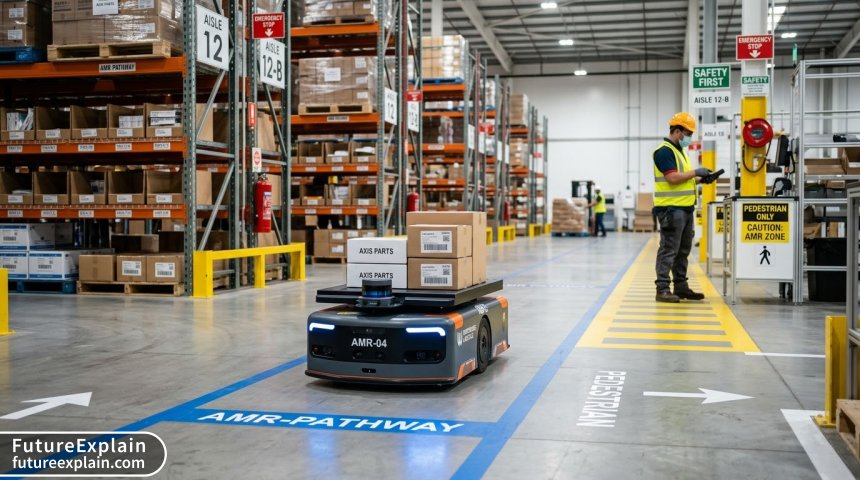
When an industrial robot arm suddenly moves erratically, a delivery drone loses its way in a city, or a self-driving car misinterprets a traffic scene, the consequences extend far beyond a simple software bug. These are autonomous systems—machines that perceive, decide, and act without direct human control. Their safety, therefore, cannot be an afterthought; it must be the foundational principle of their design, development, and deployment.
For beginners, managers, and developers alike, navigating the world of autonomous system safety can seem daunting. It involves a specialized vocabulary of standards, controls, and assurance cases. This guide cuts through the complexity. We will move beyond theoretical discussions to provide a practical, actionable understanding of how safety is achieved. You will learn not just about preventing component failures, but about managing the far more challenging scenario where every part works as designed, yet the system still makes a dangerous decision. This is the core challenge of modern autonomy, and addressing it requires a blend of established engineering rigor and new, adaptive approaches.
Why Autonomous Systems Need a New Safety Playbook
Traditional safety engineering excels at managing system failures. It asks: "What if this brake sensor breaks?" and builds in backups. This is known as functional safety. Autonomous systems introduce a more profound challenge: performance limitations. The question becomes: "What if all the sensors and computers work perfectly, but the system still fails to understand a novel situation and causes harm?" [citation:7]
This distinction is critical. A self-driving car's camera might correctly "see" a plastic bag blowing across the road, but its AI might incorrectly "understand" it as a solid obstacle, leading to a sudden, dangerous brake. No component failed. The system performed as programmed, yet a hazard occurred. This realm is governed by Safety of the Intended Functionality (SOTIF), a concept formalized in standards like ISO 21448 [citation:7].
The complexity is amplified by what experts call assurance deficits [citation:1]. These are gaps in our confidence stemming from the use of complex, non-deterministic software like AI, the unpredictability of open-world environments, and the transfer of decision-making from humans to machines. An autonomous system in a warehouse must navigate around predictable shelves but also around unpredictable humans. Its safety case—the structured argument proving it is safe—cannot be a static document. It must be a dynamic framework that evolves as the system encounters new data and scenarios during its operational life [citation:1].
The Pillars of Safety: Key Standards Demystified
International standards provide the essential playbook. Think of them as agreed-upon rulebooks that ensure a baseline of safety and allow systems from different manufacturers to interoperate safely.
ISO 26262: The Bedrock of Functional Safety
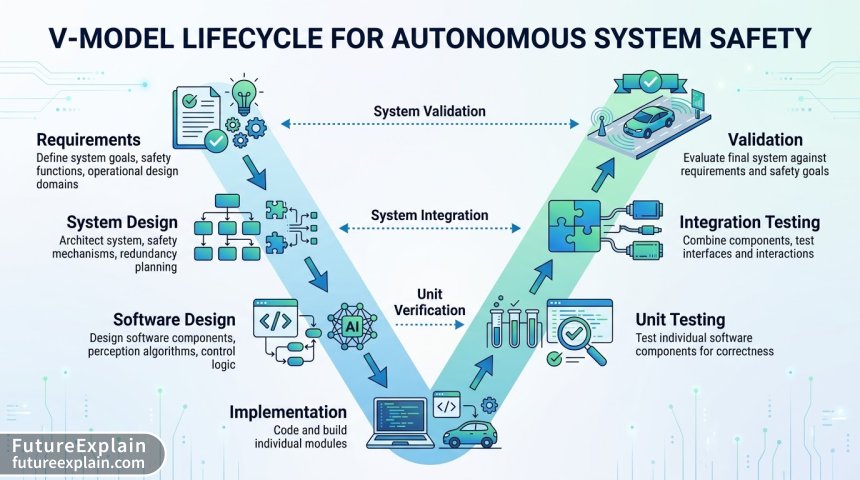
This is the core standard for electrical and electronic systems in road vehicles, and its principles apply broadly. ISO 26262 is all about managing risk from systematic and random hardware failures. It mandates a process where every function is analyzed for potential hazard and assigned an Automotive Safety Integrity Level (ASIL)—from ASIL A (lowest risk) to ASIL D (highest risk) [citation:7]. A braking system would be ASIL D, requiring the most rigorous design, testing, and redundancy. The standard guides developers through the entire "V-model" lifecycle, from requirements to testing, ensuring failures are prevented or controlled.
ISO 21448 (SOTIF): Handling the "Unknown-Unknowns"
While ISO 26262 handles failures, ISO/PAS 21448 addresses insufficient performance. Its goal is to reduce risks from hazards caused by functional limitations, especially in sensing and decision-making algorithms. The SOTIF process involves:
- Identifying and Evaluating Hazards: Systematically listing scenarios where performance limits could cause harm (e.g., sensor confusion in heavy rain).
- Validation: Using massive simulation, controlled testing, and real-world driving to probe these known "edge cases."
- Iterative Reduction: Improving the system (better sensors, more robust AI) and the operational design domain (where it's allowed to drive) to shrink the "unknown-unsafe" areas [citation:7].
In practice, SOTIF acknowledges you can never test every possible scenario. Instead, it provides a framework to build justified confidence that residual risk is acceptably low.
Broader Industry and Regulatory Frameworks
Beyond these technical standards, broader guidelines shape safe deployment. The Global Mining Guidelines Group (GMG), for instance, provides a practical system safety guideline for autonomous mining equipment, emphasizing lifecycle management, change control, and cybersecurity [citation:2]. On the national policy level, bodies like the UK's AI Safety Institute (AISI) are pioneering the evaluation of frontier AI systems, developing benchmarks to measure emergent risks like autonomous replication capabilities [citation:6][citation:8]. These initiatives highlight the growing sociotechnical approach, which considers the interplay between technology, people, and regulatory systems [citation:4].
Visuals Produced by AI
Building Your Safety Toolkit: Practical Controls and Barriers
Standards define the "what"; controls are the "how." Implementing safety means building a series of layered barriers—if one fails, the next prevents harm. For autonomous systems, these controls span hardware, software, and human oversight.
1. Sensing and Perception Controls
Garbage in, garbage out. Safety starts with robust perception. Sensor Fusion and Redundancy: Relying on a single sensor type (e.g., only cameras) is risky. Safe systems fuse data from cameras, radar, LiDAR, and ultrasonic sensors. If one modality fails (camera blinded by sun), others can compensate. Uncertainty Quantification: Advanced AI models can now output not just a decision ("that's a pedestrian") but a confidence score ("85% sure that's a pedestrian"). Low-confidence detections can trigger caution or a request for human oversight.
2. Decision and Action Controls
This is the brain of the operation. Defensive and Interpretable AI: Algorithms can be trained for cautious behavior and designed to provide explanations for their decisions (e.g., "I am braking because I detected an object with 80% similarity to a cyclist"). Runtime Monitoring and Safety Kernels: A separate, simpler, and highly reliable software module constantly monitors the primary AI's decisions. If the monitor detects the system is about to execute an implausible or dangerous maneuver (e.g., steering off a cliff), it can trigger a minimal risk condition (MRC), like a gentle stop [citation:1].
3. Human-Machine Interface (HMI) and Oversight Controls
Humans are not removed from the loop; their role evolves. Effective Handover Protocols: For semi-autonomous systems, the handover from machine to human must be gradual, with clear visual, auditory, and haptic cues, giving the human adequate time to regain situational awareness [citation:7]. Dynamic Safety Cases with Human-in-the-Loop: Contrary to full automation, a robust safety framework often retains human judgment for critical updates. Safety engineers monitor system performance, analyze incidents, and use expert judgment to approve updates to the system's operational boundaries or safety arguments [citation:1].
4. Cybersecurity Controls
A safety system is only as strong as its security. Standards like ISO/SAE 21434 mandate secure development lifecycles, penetration testing, and secure over-the-air (OTA) update mechanisms to prevent malicious actors from hijacking vehicle controls or corrupting sensor data [citation:7].
The Assurance Blueprint: AMLAS and Dynamic Safety Cases
How do you weave all these controls into a coherent, demonstrable argument for safety? This is where assurance methodologies come in.
The Assurance of Machine Learning for use in Autonomous Systems (AMLAS) methodology, developed by the University of York, provides a six-stage blueprint [citation:9]. It integrates safety activities directly into the ML development process:
- Safety-Related Data Management: Ensuring training data is relevant, complete, and unbiased.
- ML Assurance Planning: Defining what "safe enough" means for the component.
- ML Component Design: Incorporating safety features like uncertainty output.
- ML Component Verification: Rigorous testing against safety requirements.
- System Integration.
- Safety Case Generation.
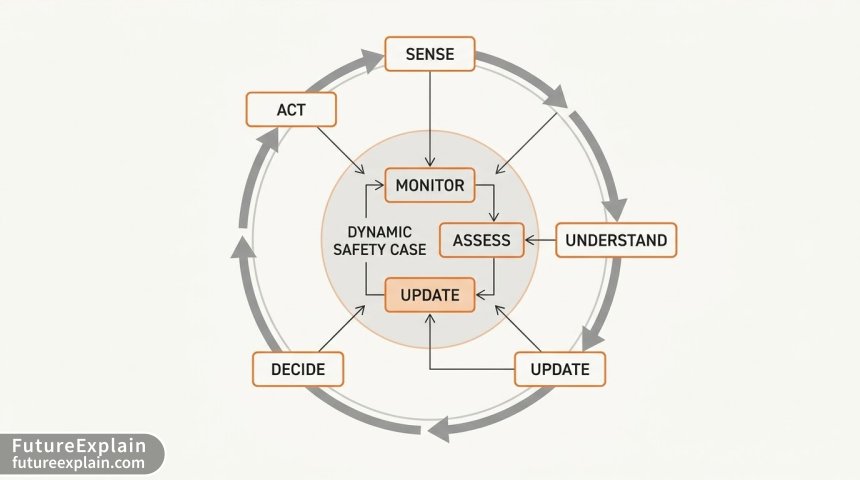
The output of this process is a safety case. For autonomous systems, this is increasingly a Dynamic Safety Case (DSC). A DSC is not a PDF filed away at launch. It is a living framework with three key features:
- Monitorability: Continuously collecting data on system performance and environment.
- Assessability: Automatically or manually evaluating if the original safety arguments still hold.
- Updateability: Allowing the safety case itself—its claims, evidence, or assumptions—to be revised based on operational experience [citation:1].
Visuals Produced by AI
Safety in Action: Real-World Applications and Case Studies
These principles are not theoretical. They are being applied across industries today.
Autonomous Mining: In mining, massive autonomous haul trucks operate in complex, dangerous environments. The GMG guideline emphasizes a total system safety approach. The safety case here must inform mine operators that the system satisfies operational requirements based on rigorous site-specific risk assessments. It involves meticulous change management, competency training for personnel working alongside machines, and robust cybersecurity to prevent interference [citation:2].
Healthcare Robotics: Robots assisting in surgery or patient care operate in extremely high-stakes environments. Here, safety cases must address not just technical reliability but profound ethical considerations—patient consent, privacy, and the clarity of human responsibility. Frameworks must ensure that autonomy augments, rather than obscures, clinical judgment [citation:4].
Logistics and Warehousing: As shown in the academic case study of an Autonomous Mobile Robot (AMR), a practical DSC implementation focuses on a key risk like collision. The DSC would monitor the robot's adherence to its safe stopping distance under different floor conditions (monitor), assess if sensor degradation increases risk (assess), and allow for updates to its operational protocol if new obstacle types are introduced (update) [citation:1]. This creates a closed-loop safety system.
The Road Ahead: Emerging Challenges and Future-Proofing
As autonomy advances, new frontiers of safety emerge.
Autonomous Replication and Agentic AI: Cutting-edge research from institutes like the AISI is beginning to benchmark the potential for advanced AI agents to autonomously replicate—copy themselves across networks to evade control. Benchmarks like RepliBench measure capabilities needed for this, such as obtaining computing resources or bypassing security. While current models show limited capability, the trend suggests these risks require proactive governance and technical safeguards [citation:8].
Sociotechnical Integration and Public Trust: The ultimate control is public acceptance. Safety is not just a technical metric but a social one. Engaging the public in understanding the limitations and benefits of autonomy, ensuring equitable access to safety benefits, and establishing clear legal and liability frameworks are essential steps highlighted by bodies like the Royal Academy of Engineering [citation:4].
Continuous Assurance: The future of safety is continuous. It moves from a one-time certification at deployment to an ongoing stream of validation, much like the constant security updates on your phone. This requires new business models, regulatory approaches, and tools for sharing safety insights across the industry without compromising proprietary information.
Conclusion: Safety as an Enabler, Not a Barrier
Building safe autonomous systems is undeniably complex, but it is a manageable and essential discipline. It requires shifting from a mindset of "testing until perfect" to one of assuring through justified confidence. By understanding the dual pillars of functional safety and SOTIF, implementing layered technical and human controls, and adopting dynamic assurance methodologies, developers and organizations can navigate this landscape.
The most important takeaway is this: robust safety engineering is not a brake on innovation; it is the engine of trust. It is what allows society to embrace the tremendous benefits of autonomy—from reducing workplace accidents and streamlining logistics to providing new forms of mobility and care. By making safety a practical, integrated, and ongoing endeavor, we can ensure these powerful systems work reliably for everyone.
A Practical Starting Point: Your Safety Checklist
For teams beginning their safety journey, here is a distilled checklist derived from the standards and frameworks discussed:
- Define Your Operational Design Domain (ODD): Where and under what conditions will your system operate? Be specific (e.g., "private warehouse, daytime, known human workers present").
- Conduct a Hazard Analysis: List what could go wrong, considering both system failures (ISO 26262) and performance limitations (SOTIF).
- Select Your Standards: Identify which core standards (e.g., ISO 26262, ISO 21448) and industry guidelines (e.g., GMG for mining) apply to your domain.
- Design in Controls: Architect your system with redundancy, runtime monitors, and clear human-machine interfaces from the start.
- Choose an Assurance Methodology: Adopt a structured process like AMLAS to guide your safety activities and evidence generation.
- Build a Dynamic Safety Case: Create a living document that argues for safety, specifying how it will be monitored, assessed, and updated in operation.
- Plan for Lifecycle Management: Establish processes for safe updates, change management, cybersecurity, and incident learning.
Further Reading
- Autonomous Systems: Overview of Safety and Controls - A foundational look at the key concepts.
- AI Ethics & Safety - Explore the broader ethical landscape that underpins safe AI development.
- AI Agents Explained: What They Are and Why They Matter - Understand the building blocks of autonomous decision-making.