AI-Powered Personal Assistants: Privacy-first Designs
This comprehensive guide explores privacy-first design principles for AI-powered personal assistants. We break down practical implementation strategies including on-device processing, federated learning, differential privacy, and data minimization techniques. The article provides a tiered privacy framework, cost-benefit analysis of different approaches, and real-world deployment examples. Learn how to balance functionality with privacy protection, implement privacy by design from the ground up, and navigate regulatory requirements while creating useful AI assistants that users can trust with their personal data.

Introduction: The Privacy Paradox in AI Assistants
AI-powered personal assistants have become ubiquitous in our daily lives, from scheduling appointments and answering questions to controlling smart home devices and managing our digital interactions. However, this convenience comes with a significant privacy trade-off. Traditional AI assistants typically collect, transmit, and store vast amounts of personal data on remote servers, creating potential vulnerabilities and raising serious privacy concerns.
The fundamental challenge lies in the inherent tension between functionality and privacy. More data generally means better, more personalized assistance, but it also means greater privacy risks. As noted in Mozilla's Privacy Not Included guide, many popular AI assistants have concerning privacy practices, with data collection policies that are often opaque to users. This article addresses this critical challenge by exploring privacy-first design principles that allow developers to create AI assistants that respect user privacy while maintaining useful functionality.
Privacy-first design isn't just about adding security features as an afterthought—it's about fundamentally rethinking how AI assistants are architected from the ground up. This approach prioritizes data minimization, user control, and transparent data practices while still delivering valuable assistance. As we'll explore, modern privacy-preserving technologies make it increasingly feasible to build powerful AI assistants that don't compromise user privacy.
Understanding the Privacy Risks in Traditional AI Assistants
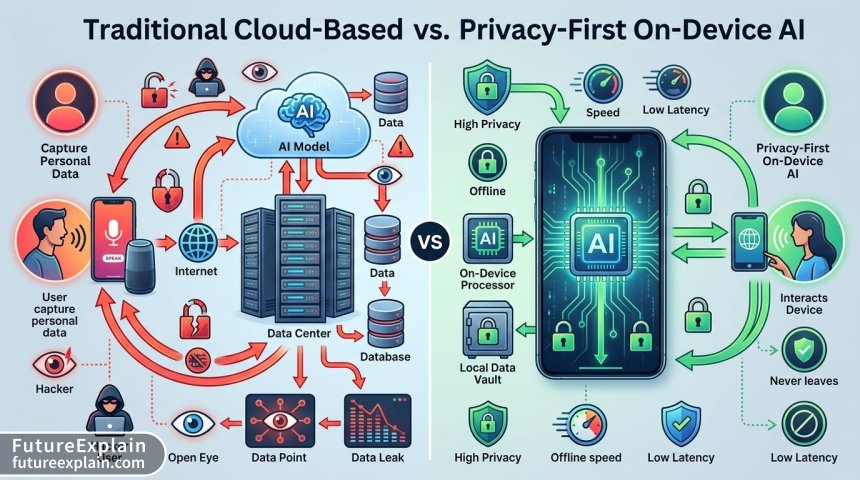
Before diving into privacy-first solutions, it's essential to understand the specific privacy risks associated with conventional AI assistant architectures. Most traditional assistants operate on a cloud-centric model where:
- Voice and text data are transmitted to remote servers for processing
- Personal preferences and habits are stored in centralized databases
- Location data and device information are continuously collected
- Conversation histories are retained for model improvement
- Third-party integrations create additional data sharing points
This centralized approach creates several vulnerabilities. First, it creates single points of failure—if the central server is breached, vast amounts of personal data are exposed. Second, it enables surveillance and profiling, as companies (and potentially governments) can access detailed profiles of users' lives. Third, it often lacks meaningful user control—once data is collected, users have limited ability to control how it's used or delete it permanently.
The Electronic Frontier Foundation (EFF) has documented cases where voice assistant recordings were accessed by employees for quality control, sometimes without proper anonymization. Similarly, research from Brave Browser has shown how voice data can be used to infer sensitive information like health conditions, emotional states, and personal relationships, even when the assistant isn't explicitly discussing these topics.
Core Privacy-First Design Principles
Privacy-first design for AI assistants is built on several foundational principles that guide technical decisions at every level of development. These principles, adapted from frameworks like Privacy by Design and the EU's General Data Protection Regulation (GDPR), provide a roadmap for creating assistants that respect user autonomy and data protection.
1. Data Minimization
Data minimization means collecting only the data absolutely necessary for the assistant to function and only for as long as needed. This principle challenges the common industry practice of "collect everything, figure out use cases later." For AI assistants, this means:
- Processing voice commands locally when possible instead of transmitting audio to servers
- Deleting temporary processing data immediately after use
- Using synthetic or anonymized data for model training when real personal data isn't essential
- Implementing automatic data expiration policies
Apple's approach with Siri provides a good example of data minimization in practice. Since 2021, Apple has processed many Siri requests directly on devices using on-device speech recognition, only sending data to servers when necessary for complex queries. This significantly reduces the amount of personal data leaving users' devices.
2. Purpose Limitation
Purpose limitation ensures that collected data is used only for the specific purposes users consented to. For AI assistants, this means being transparent about data usage and avoiding function creep—where data collected for one purpose is later used for unrelated purposes. Implementation strategies include:
- Clear, granular consent mechanisms for different assistant functions
- Technical enforcement of usage boundaries (data can't be accessed by unrelated system components)
- Regular audits of data usage against stated purposes
- User-accessible logs showing how their data has been used
3. User Control and Transparency
Privacy-first assistants empower users with meaningful control over their data. This goes beyond simple privacy settings to include:
- Easy-to-understand privacy dashboards showing what data is collected
- One-click data export and deletion tools
- Transparent explanations of how data improves assistant functionality
- Options to use the assistant in different privacy modes (from maximum functionality to maximum privacy)
4. Security by Design
Security isn't an add-on feature but is integrated throughout the assistant's architecture. This includes:
- End-to-end encryption for any data that must be transmitted
- Secure enclaves for on-device data processing
- Regular security audits and penetration testing
- Defense-in-depth strategies with multiple security layers
A Four-Tier Privacy Framework for AI Assistants
Not all applications require the same level of privacy protection. A practical approach is to implement a tiered privacy framework that allows users (or developers) to choose the appropriate balance between functionality and privacy. Here's a four-tier framework that ranges from basic privacy measures to maximum protection.
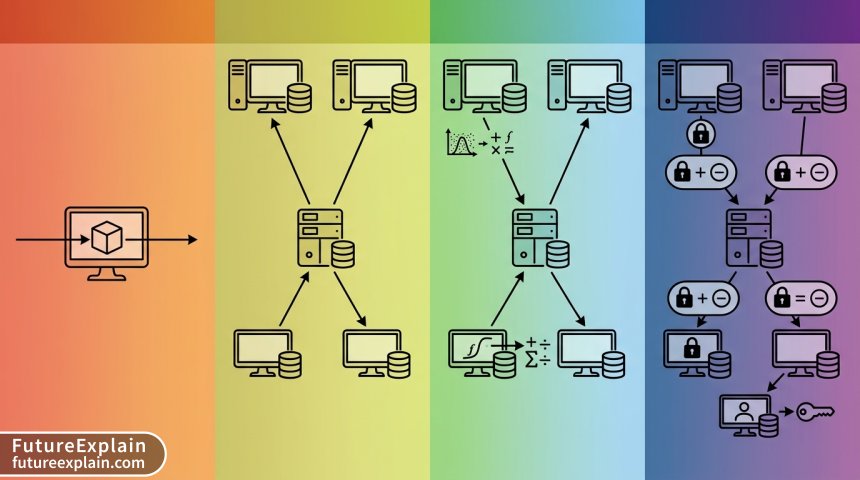
Tier 1: Bronze (Basic Privacy Protection)
Bronze level represents the minimum acceptable privacy standard, suitable for non-sensitive applications or when balancing cost constraints. Features include:
- Encrypted data transmission to servers
- Clear privacy policy and data retention limits
- Basic user controls for data deletion
- Server-side anonymization of stored data
- Regular security updates
This tier is appropriate for entertainment-focused assistants or applications where users aren't sharing sensitive information. Most commercial assistants from 2020-2023 operated at approximately this level.
Tier 2: Silver (Enhanced Privacy)
Silver level adds significant privacy protections while maintaining good functionality. This includes:
- On-device processing for common commands
- Differential privacy for aggregated learning
- Federated learning for model improvements without raw data collection
- Advanced user privacy dashboard
- Optional end-to-end encrypted cloud backup
Implementing Silver tier requires careful architecture planning. Start by identifying which assistant functions can run entirely on-device. Speech-to-text for common commands, basic calendar management, and local device control are good candidates. For functions requiring cloud processing, implement differential privacy—a technique that adds mathematical noise to data so individuals can't be identified while still allowing useful aggregate analysis. Google's Gboard keyboard uses differential privacy to learn popular emoji combinations without accessing individual users' messages.
Tier 3: Gold (Strong Privacy)
Gold level provides strong privacy guarantees suitable for handling sensitive information. Features include:
- Majority of processing happens on-device
- Federated learning as the primary model improvement method
- Zero-knowledge architecture for cloud services
- User-controlled data sharing with third parties
- Open-source core components for transparency verification
At this level, the assistant should be able to handle most personal tasks without sending identifiable data to servers. Mycroft AI's open-source assistant and some enterprise-focused solutions operate at this level. The key challenge is maintaining good performance with limited cloud resources, which requires efficient on-device models and smart data partitioning.
Tier 4: Platinum (Maximum Privacy)
Platinum level represents the highest practical privacy standard, suitable for applications handling extremely sensitive data (medical, financial, legal). Features include:
- 100% on-device processing with no data transmission
- Local-only model personalization
- Hardware security modules for key management
- Air-gapped optional mode
- Verifiable privacy guarantees through external audits
This tier is technically challenging and may limit some advanced functionalities, but it's essential for certain use cases. Apple's Neural Engine and Google's Tensor Processing Units enable more complex on-device processing, making Platinum-level assistants increasingly feasible.
Key Privacy-Preserving Technologies for AI Assistants
Several emerging technologies make privacy-first AI assistants practical. Understanding these technologies is essential for implementing the privacy tiers discussed above.
1. On-Device Processing
On-device processing keeps data local to the user's device, eliminating transmission risks entirely. Modern mobile devices and dedicated AI chips (like Apple's Neural Engine or Google's Tensor Processing Unit) now have sufficient power to run complex AI models locally.
Implementation considerations:
- Model Optimization: Use techniques like quantization, pruning, and knowledge distillation to create smaller, faster models that maintain accuracy
- Hardware Acceleration: Leverage device-specific AI accelerators for efficient processing
- Edge-Cloud Hybrid: For complex queries, use secure enclaves or homomorphic encryption to process data without revealing it
Apple's Core ML and Google's ML Kit provide frameworks for deploying on-device machine learning models. For voice assistants specifically, Mozilla's DeepSpeech and Coqui's STT offer open-source speech-to-text engines that can run locally.
2. Federated Learning
Federated learning allows AI models to improve without centralizing user data. Instead of sending data to a server, the model travels to the data—models are trained locally on devices, and only model updates (not raw data) are aggregated.
For AI assistants, federated learning can be used to:
- Improve voice recognition accuracy based on local usage patterns
- Personalize responses without exposing conversation history
- Learn new vocabulary or phrases from multiple users while protecting individual data
Google's Gboard uses federated learning to improve next-word prediction without reading individual messages. The key challenge is ensuring that model updates themselves don't reveal sensitive information—techniques like secure aggregation and differential privacy can address this.
3. Differential Privacy
Differential privacy adds carefully calibrated mathematical noise to data or model updates, making it statistically impossible to identify individuals while still allowing useful aggregate analysis. It provides quantifiable privacy guarantees expressed as epsilon (ε) values, with lower epsilon meaning stronger privacy.
In AI assistant design, differential privacy can be applied to:
- Aggregated usage statistics for feature improvement
- Federated learning updates to prevent data leakage
- Anonymized voice data for accent or dialect recognition
Apple uses differential privacy in iOS to collect usage data for Siri improvement while protecting individual privacy. The company publishes technical papers detailing their implementation, providing a valuable reference for other developers.
4. Homomorphic Encryption
Homomorphic encryption allows computations to be performed on encrypted data without decrypting it first. While computationally intensive, it enables truly private cloud processing for tasks that can't be performed on-device.
For resource-intensive AI assistant functions, homomorphic encryption enables:
- Complex natural language understanding on encrypted queries
- Private search across encrypted personal data
- Secure collaboration between different privacy-preserving services
While still emerging for production use, libraries like Microsoft SEAL and OpenFHE are making homomorphic encryption more accessible. For now, it's best suited for specific high-value functions rather than entire assistant systems.
5. Secure Multi-Party Computation (MPC)
MPC allows multiple parties to jointly compute a function over their inputs while keeping those inputs private. For AI assistants, this enables privacy-preserving integrations with third-party services.
Practical applications include:
- Checking calendar availability across different services without revealing details
- Finding optimal meeting times without exposing individual schedules
- Aggregating preferences from multiple users for group decisions
Practical Implementation Guide
Moving from theory to practice, here's a step-by-step guide to implementing privacy-first AI assistants.
Step 1: Privacy Impact Assessment
Before writing any code, conduct a thorough privacy impact assessment:
- Data Inventory: List all data the assistant will potentially access
- Data Flow Mapping: Document how data moves through the system
- Risk Identification: Identify potential privacy risks at each stage
- Mitigation Planning: Determine appropriate privacy technologies for each risk
- Regulatory Analysis: Identify applicable regulations (GDPR, CCPA, etc.) and requirements
Step 2: Architecture Design
Design your architecture with privacy as a first-class requirement:
- Data Minimization Architecture: Design components to process data as locally as possible
- Privacy Zones: Define clear boundaries between components with different privacy requirements
- Fallback Mechanisms: Plan for graceful degradation when privacy-preserving techniques aren't available
- Monitoring Infrastructure: Build in privacy metrics and audit trails from the start
Step 3: Technology Selection
Choose technologies that support your privacy goals:
- On-Device Frameworks: TensorFlow Lite, Core ML, ONNX Runtime
- Federated Learning: TensorFlow Federated, PySyft, Flower
- Encryption Libraries: Microsoft SEAL, OpenFHE, Libsodium
- Privacy Analysis Tools: IBM's Differential Privacy Library, Google's Privacy-on-Beam
Step 4: Development Practices
Implement privacy-aware development practices:
- Privacy-First Testing: Include privacy tests in your test suite
- Code Reviews: Include privacy considerations in code review checklists
- Documentation: Document privacy guarantees and limitations clearly
- Continuous Privacy Validation: Automate privacy checks in your CI/CD pipeline
Step 5: Deployment and Monitoring
Deploy with ongoing privacy monitoring:
- Privacy Metrics: Track metrics like data minimization efficiency and user privacy settings adoption
- Incident Response: Have a plan for privacy incidents
- User Feedback: Regularly collect feedback on privacy features
- Compliance Audits: Schedule regular privacy compliance audits
Cost-Benefit Analysis of Privacy Technologies
Privacy technologies involve trade-offs in cost, performance, and functionality. Here's a practical analysis to help make informed decisions.
Performance Impact
Different privacy technologies have varying performance impacts:
- On-Device Processing: Reduces latency for common tasks but may limit model complexity
- Federated Learning: Increases training time but eliminates data transmission costs
- Homomorphic Encryption: Significant computational overhead (100-1000x slower)
- Differential Privacy: Minimal performance impact during inference, moderate impact during training
Development and Maintenance Costs
Privacy technologies also affect development complexity:
- On-Device Models: Higher initial development cost for model optimization
- Federated Learning: Complex orchestration but reduces data infrastructure costs
- Encryption Technologies: Specialized expertise required
- Privacy Audits: Ongoing compliance costs
Business Value Considerations
Beyond compliance, privacy-first design offers business benefits:
- User Trust: Privacy features can be a competitive differentiator
- Reduced Liability: Less data collected means less risk in case of breaches
- Regulatory Advantage: Easier compliance with evolving regulations
- Market Access: Privacy features may be required for certain markets or enterprise customers
Real-World Case Studies
Case Study 1: Mycroft AI's Open Source Assistant
Mycroft AI has built an open-source voice assistant focused on privacy. Key privacy features include:
- Entirely local processing by default
- Open-source code for transparency
- User-controlled data sharing
- No voice data storage
Results: Mycroft has attracted privacy-conscious users but faces challenges with functionality parity compared to cloud-based assistants. The case demonstrates the functionality trade-offs of strong privacy guarantees.
Case Study 2: Apple's On-Device Siri Processing
Apple has progressively moved Siri processing to devices:
- On-device speech recognition for many commands
- Differential privacy for learning
- Limited data retention policies
- Transparent privacy nutrition labels
Results: Apple maintains relatively strong privacy while offering competitive functionality. The approach shows that large-scale privacy-first design is feasible with sufficient resources.
Case Study 3: DuckDuckGo's Privacy-First AI Chat
DuckDuckGo's AI chat implements several privacy features:
- Anonymous usage by default
- No conversation storage
- No personalization based on history
- Transparent about limitations
Results: The service appeals to privacy-focused users but lacks the personalization of mainstream assistants. It demonstrates a viable market segment for privacy-first AI.
Regulatory Landscape and Compliance
Privacy-first AI assistants must navigate complex regulatory requirements. Key regulations include:
GDPR (European Union)
- Requires data minimization and purpose limitation
- Mandates user consent for data processing
- Gives users rights to access, correct, and delete their data
- Requires privacy by design and by default
CCPA/CPRA (California)
- Similar to GDPR with some differences in implementation
- Includes right to opt out of data sharing
- Requires transparency about data practices
AI Act (European Union, forthcoming)
- Classifies AI assistants as high-risk in certain contexts
- Requires transparency about AI use
- Mandates human oversight for certain functions
Practical Compliance Strategies
- Implement data protection impact assessments (DPIAs)
- Maintain records of processing activities
- Appoint a data protection officer if required
- Implement privacy by design from the start
Future Trends in Privacy-First AI Assistants
The field of privacy-preserving AI is rapidly evolving. Key trends to watch include:
1. Hardware Advances
Specialized privacy-preserving hardware, like confidential computing chips and secure enclaves, will make privacy technologies more efficient and accessible.
2. Standardization Efforts
Industry standards for privacy-preserving AI will emerge, similar to TLS for encryption, making implementation easier and more interoperable.
3. Regulatory Evolution
Regulations will increasingly mandate privacy by design, pushing more developers toward privacy-first approaches.
4. User Demand
Growing privacy awareness among users will create market pressure for privacy-first alternatives to mainstream assistants.
5. Technical Breakthroughs
Advances in fields like fully homomorphic encryption and secure multi-party computation will reduce performance penalties.
Conclusion: Building Trust Through Privacy-First Design
Privacy-first design for AI-powered personal assistants represents both an ethical imperative and a competitive opportunity. By prioritizing user privacy from the initial design stages, developers can create assistants that users trust with their most personal information. The technologies and frameworks discussed—from on-device processing and federated learning to differential privacy and beyond—make privacy-first design increasingly practical.
The journey toward truly private AI assistants is ongoing, with technical, regulatory, and market forces all pushing in the same direction. Developers who embrace privacy-first principles now will be well-positioned for the future, building not just functional tools but trustworthy digital companions that respect user autonomy and protect personal data.
As AI becomes more integrated into our daily lives, the assistants that succeed will be those that offer not just intelligence, but integrity—assistants that help without hovering, that learn without intruding, and that empower without exposing. Privacy-first design is the path to creating such assistants, and the technical foundation for this future is being built today.
Visuals Produced by AI
Further Reading
Share
What's Your Reaction?
 Like
0
Like
0
 Dislike
0
Dislike
0
 Love
0
Love
0
 Funny
0
Funny
0
 Angry
0
Angry
0
 Sad
0
Sad
0
 Wow
0
Wow
0