GPT-6 Astra Explained: Everything You Need to Know About OpenAI's New AI Model
GPT-6 Astra is OpenAI's newest flagship AI model, introduced in September 2026 for complex end-to-end work. Unlike earlier generations that were primarily judged by how well they answered questions, Astra is designed to handle longer workflows involving reasoning, coding, research, computer use, browsing, document creation, and other professional tasks. OpenAI reports major results across several demanding evaluations and says Astra has a 1.05-million-token context window, up to 128,000 output tokens, and support for multiple reasoning levels. The model is being rolled out through ChatGPT, the OpenAI API, Microsoft Azure, and Amazon Bedrock. This guide explains what GPT-6 Astra is, what has changed, how its capabilities can be useful in everyday work, how developers can access it, what it costs, and why its cybersecurity capabilities have created a new safety discussion. It also separates OpenAI's claims from broader questions about what the model can realistically do.


GPT-6 Astra is the newest flagship artificial intelligence model from OpenAI, and its arrival marks an important change in what people expect from a general-purpose AI system. Instead of focusing only on generating answers, Astra is designed for complex, end-to-end work involving reasoning, research, coding, computer use, browsing, documents, and other multi-step tasks.
OpenAI introduced GPT-6 Astra on September 3, 2026, describing it as its most intelligent and aligned model. The company says Astra reaches state-of-the-art performance across computer use, browsing, software engineering, cybersecurity, science, and professional work. OpenAI also reports a 1.05-million-token context window and support for up to 128,000 output tokens through its API.
That combination makes GPT-6 Astra more than a conventional chatbot upgrade. It is part of a broader shift toward AI systems that can take a goal, reason about the work required, interact with digital tools, and produce a finished result.
But there is an important distinction between capability and reliability. A model can achieve impressive benchmark results and still require human review in real-world situations. Astra's cybersecurity capabilities, for example, have also created new safety challenges that OpenAI says require stronger safeguards.
This guide explains GPT-6 Astra in simple language, including what it is, what it can do, how it compares with earlier OpenAI models, what developers need to know, how much it costs, where it is available, and why its release matters for the future of AI.
What Is GPT-6 Astra?

GPT-6 Astra is OpenAI's latest flagship general-purpose AI model. It is designed for demanding tasks that require more than a short question-and-answer interaction.
In practical terms, Astra can be thought of as a highly capable reasoning system that can work with information, understand instructions, write and analyze content, assist with software development, use computers, conduct research, and handle longer workflows.
OpenAI says the model combines advances in pre-training, reinforcement learning, and alignment. The goal is not simply to make the model produce more fluent responses. The larger objective is to make it more useful when a task contains several connected steps.
For example, imagine asking an AI to research a business problem. A basic chatbot might provide an explanation based on its existing knowledge. A more capable system can search for information, organize evidence, compare alternatives, prepare a report, create a spreadsheet, and revise the result after receiving additional instructions.
That difference is central to understanding Astra.
Why GPT-6 Astra Matters
The AI industry has increasingly moved from simple chatbots toward agentic systems. An agentic system is designed to perform a sequence of actions toward a goal rather than simply responding once.
GPT-6 Astra fits directly into this transition.
OpenAI says Astra can handle tasks such as filling online forms, updating customer records, organizing calendars, conducting online research, drafting documents, creating websites, and checking frontend functionality.
This changes the practical question users ask about AI.
Instead of asking only, "Can this model answer my question?" users can increasingly ask, "Can this model complete this piece of work?"
That does not mean every task should be handed over without supervision. Real-world work often involves private information, financial decisions, legal obligations, security risks, or subjective judgment. Human review remains important.
However, the direction is clear: frontier AI models are becoming increasingly useful as work systems rather than merely conversational interfaces.
GPT-6 Astra at a Glance
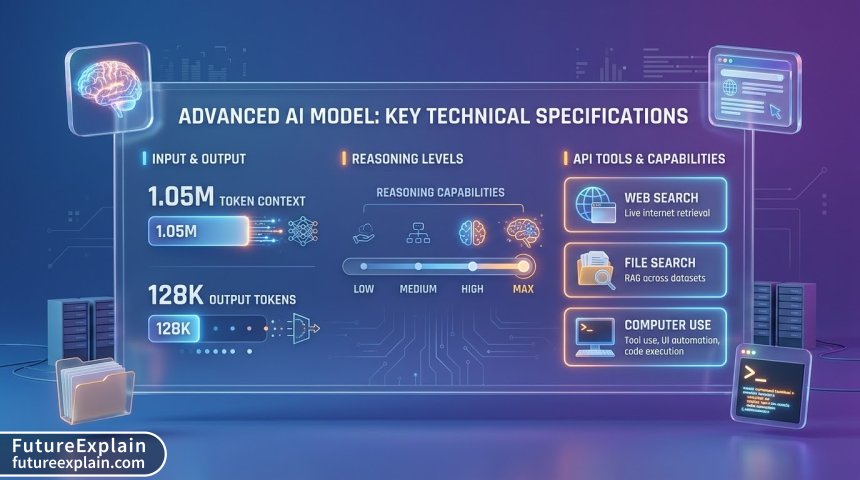
Several specifications make Astra particularly interesting for developers and advanced users.
- Model ID: gpt-6-astra
- Context window: approximately 1.05 million tokens
- Maximum output: up to 128,000 tokens
- Reasoning controls: low, medium, high, xhigh, and max
- Knowledge cutoff: April 30, 2026
- API input price: $10 per million tokens
- API output price: $50 per million tokens
- Tools: functions, web search, file search, and computer use
The model documentation describes Astra as OpenAI's most capable model for complex reasoning, coding, computer use, research, and document creation.
What Does the 1.05-Million-Token Context Window Mean?
One of the most interesting technical specifications of GPT-6 Astra is its context window.
A context window is the amount of information a model can work with during a task. It can include instructions, conversation history, documents, source material, code, tool results, and other information that needs to remain available to the model.
Astra's context window is listed at approximately 1.05 million tokens. That is an unusually large working context for a general-purpose model.
For a developer, this can be useful when working with large codebases, long technical documents, extensive research material, large collections of notes, or complicated project specifications.
It is important not to interpret a large context window as unlimited memory. Context is not the same thing as permanent memory, and placing more information into a prompt does not automatically make every detail equally important to the model.
Good information organization still matters.
What Is a Reasoning Model?
GPT-6 Astra supports several reasoning effort levels. This means developers can choose how much reasoning effort the model should use for a task.
A simple request may not require maximum reasoning. A complicated software architecture problem, research question, or multi-step analysis may benefit from a higher setting.
This creates a useful trade-off.
- Lower reasoning effort: useful when speed matters.
- Medium reasoning effort: useful for normal complex tasks.
- High reasoning effort: useful for difficult analytical work.
- Very high reasoning effort: useful for demanding problems where additional computation can improve results.
The important idea is that reasoning is not simply a personality setting. It can affect the computational work performed before the final answer is produced.
GPT-6 Astra for Coding
Software engineering is one of the areas where Astra is particularly important.
Modern coding assistants have moved beyond autocomplete. A strong AI coding system can understand a project, inspect files, identify problems, propose changes, write code, run tests, analyze failures, and make additional revisions.
OpenAI positions Astra for software engineering and complex end-to-end work. This makes it useful for both individual developers and teams that want AI assistance throughout the development cycle.
A developer could use Astra to:
- understand an unfamiliar codebase
- design a new feature
- generate implementation code
- review existing code
- find likely bugs
- write tests
- analyze test failures
- document software
- work through technical requirements
- perform frontend quality checks
However, developers should not treat generated code as automatically correct. AI can still introduce bugs, misunderstand requirements, use inappropriate libraries, or make security-sensitive mistakes.
The best workflow is usually AI-assisted development with automated tests and human review.
GPT-6 Astra and Computer Use

Computer use is one of the areas where Astra represents a significant change from traditional chatbot behavior.
Instead of simply telling a user how to complete an action, a computer-use-capable model can interact with a digital interface as part of the task.
OpenAI describes examples including filling forms, updating records, organizing calendars, browsing websites, conducting research, and working inside document editors.
This is important because many business processes are not exposed through clean APIs. Employees often work through dashboards, web applications, spreadsheets, internal systems, and desktop interfaces.
A model that can operate those interfaces can potentially automate tasks that previously required a person to move information between applications.
At the same time, computer access creates a new security boundary. If an AI can perform actions, permissions must be carefully controlled.
An AI assistant should not automatically receive access to every account, file, payment method, or internal system simply because it can technically interact with them.
GPT-6 Astra for Web Research
Research is another important use case.
Traditional AI answers are limited by the information available to the model. Tool-enabled AI systems can instead gather current information from external sources, organize it, and use it to produce a result.
Astra supports web search as a tool through OpenAI's platform.
This can make it useful for tasks such as:
- researching competitors
- collecting technical documentation
- comparing products
- summarizing multiple sources
- finding recent developments
- building research reports
- checking current information
However, browsing capability does not eliminate the need to evaluate sources. A search result can be outdated, biased, incomplete, or simply wrong.
A reliable research workflow should distinguish between primary sources, secondary reporting, opinion, and unverified claims.
GPT-6 Astra for Documents and Professional Work
Astra is also designed for professional workflows involving documents and structured information.
OpenAI says the model can create documents, spreadsheets, and presentations that follow templates and instructions, while adapting when requirements change.
This is particularly useful for professionals because many office tasks are repetitive rather than conceptually difficult.
Examples include:
- turning research notes into reports
- summarizing long documents
- organizing spreadsheet information
- creating presentation drafts
- formatting business documents
- extracting information from files
- transforming one document format into another
The advantage is not necessarily that AI replaces the person doing the work. In many cases, the bigger advantage is reducing the amount of repetitive preparation required before a human makes the final decision.
GPT-6 Astra for Science and Mathematics
OpenAI also reports strong results for Astra in scientific and mathematical evaluations.
The company says Astra reaches 98% on FrontierMath Tier 4 and 99.9% on ARC-AGI-3. It also reports a 100% score on ExploitBench.
Benchmarks should be treated as measurements of particular capabilities rather than universal proof of intelligence.
A benchmark can tell us how a model performed on a defined evaluation. It does not automatically tell us how reliable the model will be in every real-world environment.
For researchers, however, stronger mathematical and scientific reasoning can still be valuable.
AI systems can help researchers explore hypotheses, analyze information, generate code for experiments, inspect datasets, summarize literature, and investigate technical problems.
Human researchers remain responsible for validating results, designing appropriate experiments, and deciding whether a proposed conclusion is scientifically justified.
GPT-6 Astra and AI Agents
Astra's capabilities make it particularly relevant to the development of AI agents.
An AI agent typically combines a language model with tools, memory, instructions, planning, and an execution environment.
The basic workflow can look like this:
- Receive a goal.
- Understand the requirements.
- Break the goal into steps.
- Use available tools.
- Observe the results.
- Adjust the plan.
- Complete the task.
- Return a result for review.
That is very different from a simple chatbot that produces one response and stops.
FutureExplain already covers the fundamentals of AI agents and building autonomous agents. Astra is a useful example of why those concepts are becoming increasingly important.
GPT-6 Astra and Multimodal Work
Modern AI systems increasingly operate across different types of information rather than text alone.
This includes documents, images, interfaces, code, charts, and structured information.
This broader capability connects directly with the concepts discussed in FutureExplain's guide to multimodal models.
For professional workflows, multimodal capability matters because real work rarely arrives as clean paragraphs of text.
A business analyst may receive a spreadsheet and a PDF. A developer may receive screenshots and source code. A researcher may receive diagrams, papers, datasets, and written notes.
An AI system that can reason across these formats can potentially reduce the need to manually convert everything into text first.
GPT-6 Astra API
Developers can access GPT-6 Astra through the OpenAI API using the model identifier gpt-6-astra.
The API documentation lists support for reasoning effort levels from low through max. The model can also work with tools such as functions, web search, file search, and computer use.
The standard listed API price is $10 per million input tokens and $50 per million output tokens.
There are additional considerations for very large prompts. OpenAI's API documentation says prompts exceeding 272,000 input tokens are charged at higher rates for the relevant input and output portions.
This makes cost management important for applications that repeatedly send very large contexts.
Is GPT-6 Astra Expensive?
Whether Astra is expensive depends on what it is being used for.
At $10 per million input tokens and $50 per million output tokens, Astra is positioned as a premium model.
For a simple question that could be answered by a smaller model, using Astra may not make economic sense.
For a complex task where a stronger model can save hours of human work, the economics can be very different.
This is why model selection should be based on the value of the task rather than simply choosing the most powerful available model.
FutureExplain's earlier coverage of AI inference cost optimization remains relevant here. Good AI architecture often uses different models for different levels of difficulty.
GPT-6 Astra Availability
OpenAI began rolling Astra out to a limited group of organizations and said broader availability would follow.
OpenAI lists access through ChatGPT Plus, Pro, Business, and Enterprise plans as rollout expands. The model is also being made available through the OpenAI API, Microsoft Azure, and Amazon Bedrock.
Availability can vary by product, account, organization, region, and rollout stage, so users should check the current model selector or official documentation rather than assuming that every account has identical access.
What Is GPT-6 Astra Pro?
OpenAI's current rollout information also refers to GPT-6 Astra Pro for higher-tier users and organizations.
The important point for most readers is that the Astra family is not necessarily a single identical experience across every OpenAI product.
Model availability, usage limits, tools, and administrative controls can differ between ChatGPT, developer APIs, enterprise environments, and other platforms.
GPT-6 Astra Compared With GPT-5.6
GPT-5.6 Sol was OpenAI's previous flagship generation. Astra is positioned as a substantial step forward, particularly for complex end-to-end work.
The most important distinction is not simply that Astra produces better text.
Its broader emphasis is on completing work involving reasoning, tools, computer interaction, software engineering, research, and professional workflows.
OpenAI also reports stronger results in several frontier evaluations.
For users, the practical question should therefore be:
Does my task benefit from Astra's additional capability enough to justify its cost and complexity?
If the answer is no, a less expensive model may be a better choice.
GPT-6 Astra Benchmarks
OpenAI reports several notable benchmark results for Astra.
- FrontierMath Tier 4: 98%
- ARC-AGI-3: 99.9%
- ExploitBench: 100%
These numbers are impressive, but benchmark literacy is important.
Benchmarks are designed to measure specific capabilities. They can become saturated, can have different difficulty levels, and may not perfectly represent real-world performance.
For that reason, a good comparison should combine benchmark results with practical testing.
For example, someone choosing an AI coding model should test it on representative software tasks rather than choosing purely from a leaderboard.
Why Cybersecurity Is One of Astra's Biggest Stories

One of the most significant aspects of GPT-6 Astra is not simply its general intelligence. It is the model's cybersecurity capability.
OpenAI says Astra is its first model to reach the Critical level of cybersecurity capability under its Preparedness Framework.
According to OpenAI's safety assessment, the model can identify previously unknown security flaws and develop exploit strategies across well-protected systems when given the appropriate tools and access.
This creates a difficult dual-use problem.
The same capability that can help defenders identify vulnerabilities can potentially make harmful cyber activity easier if misused.
That is why advanced cybersecurity-capable models require stronger safeguards, access controls, monitoring, and deployment policies.
What Does Critical Cybersecurity Capability Mean?
OpenAI's Preparedness Framework defines the Critical cybersecurity threshold around extremely capable offensive security behavior, including the ability to identify and develop functional exploits against hardened real-world systems without human intervention.
OpenAI says its evaluations included public and private benchmarks as well as expert-led assessments.
The company also reports that Astra discovered vulnerabilities during internal testing, including previously unknown vulnerabilities used as part of exploit chains.
These findings are important because they demonstrate that frontier AI safety is no longer limited to questions such as whether a chatbot produces inappropriate text.
The concern increasingly includes what an autonomous AI system can actually do when connected to tools and real infrastructure.
How OpenAI Is Trying to Make Astra Safer
OpenAI says it has strengthened the safety architecture around Astra because of its increased capabilities.
The company describes additional isolation, checkpoint encryption, monitoring, alignment evaluations, and protections against harmful cyber actions.
The model also includes safety monitoring designed to detect situations where an agent may have misunderstood or exceeded the intended scope of a user's instructions.
This is particularly important for computer-use systems.
A traditional chatbot can generate an incorrect answer. An agent with permissions can potentially make an incorrect change to a file, account, database, or external service.
As AI becomes more capable of taking actions, safety therefore has to move beyond content filtering and include authorization, monitoring, sandboxing, and reliable human oversight.
Does GPT-6 Astra Have AGI?
The release has also reignited the debate around artificial general intelligence, or AGI.
Some technology leaders have described Astra as evidence that the industry is entering an AGI era. Others argue that the term remains too poorly defined to make a meaningful yes-or-no determination.
It is important to separate these claims from measurable model capabilities.
Astra clearly demonstrates a substantial range of capabilities across reasoning, coding, computer use, research, science, and cybersecurity. Whether those capabilities meet someone's preferred definition of AGI is a separate philosophical and scientific question.
There is currently no universally accepted benchmark or definition that establishes exactly when a system becomes AGI.
For ordinary users, the more useful question is often simpler:
What can the system reliably accomplish, under what conditions, and with what level of human supervision?
Can GPT-6 Astra Replace Human Workers?
Astra can automate portions of many professional workflows, but that does not mean every occupation can simply be replaced by an AI model.
Many jobs combine technical work with responsibility, communication, physical activity, social judgment, organizational knowledge, and accountability.
AI can automate tasks without completely automating the job containing those tasks.
A developer, for example, may use AI to generate code more quickly while spending more time reviewing architecture, requirements, security, and product decisions.
A researcher may use AI to analyze information faster while remaining responsible for scientific judgment.
A business employee may use an agent to prepare a report while still making the final decision.
This is why the near-term impact of models such as Astra may be better understood as task transformation rather than simple job replacement.
Who Should Use GPT-6 Astra?

Astra is most compelling for people who regularly handle difficult or multi-step work.
- Developers: complex coding, debugging, architecture, testing, and codebase analysis.
- Researchers: long research workflows, document analysis, data exploration, and technical synthesis.
- Businesses: repetitive digital workflows and document-heavy processes.
- Students: difficult research and learning tasks, with appropriate academic policies.
- Content creators: research, outlining, drafting, editing, and production workflows.
- Analysts: complex comparisons, structured information, and report preparation.
It may be unnecessary for users who primarily want simple conversation, basic writing help, or quick factual explanations.
When Should You Not Use GPT-6 Astra?
The most powerful model is not always the best model.
If a task is simple, inexpensive models can often provide excellent results.
You may not need Astra for:
- simple email drafting
- basic rewriting
- short summaries
- simple brainstorming
- routine classification
- small formatting tasks
Using a smaller model for routine work can reduce cost and latency while preserving quality.
A good AI system therefore treats models as tools with different strengths rather than assuming that one model should handle everything.
GPT-6 Astra and Privacy
Privacy should be considered whenever an AI model is connected to business information, personal documents, source code, or internal systems.
OpenAI says Astra supports Zero Data Retention for eligible API customers and that it is testing Private Safety Processing.
However, organizations should still understand the exact terms and configuration of the service they use.
Do not assume that a model being powerful or enterprise-ready automatically means every deployment has identical privacy characteristics.
Before sending sensitive information to an AI system, organizations should review data retention, access controls, logging, encryption, permissions, contractual terms, and applicable regulations.
What Developers Should Know Before Building With Astra
Developers considering Astra should begin with the task rather than the model.
First define what the application needs to accomplish.
Then determine whether the task requires advanced reasoning, large context, computer use, web search, file search, or other tools.
Next establish evaluation criteria.
- How accurate must the result be?
- How much latency is acceptable?
- How much does each task cost?
- What information can the model access?
- What actions is it allowed to perform?
- What happens when it makes a mistake?
- How will human review work?
These questions become especially important when building autonomous agents.
Why Permissions Matter More With Agentic AI
Giving an AI access to a tool changes the risk profile of the application.
A model that can only produce text has a limited ability to directly change the world. A model that can send messages, edit databases, access files, execute commands, or operate websites has much greater practical authority.
The safest architecture is therefore based on least privilege.
An agent should receive only the permissions required for the task.
Developers should also consider confirmation steps for high-impact actions.
For example, an AI could prepare a payment but require a human to approve it. It could draft an email without sending it. It could propose a database migration without automatically executing it.
This approach keeps automation useful while reducing the consequences of mistakes.
GPT-6 Astra Is Not Magic
It is easy to become impressed by benchmark numbers and demonstrations. But even extremely capable models remain probabilistic systems.
They can misunderstand instructions, make incorrect assumptions, misread context, produce faulty code, or choose an inappropriate action.
The better way to think about Astra is as a powerful collaborator and automation engine rather than an infallible digital employee.
The strongest results will usually come from combining model capability with good prompts, reliable tools, structured data, automated tests, clear permissions, monitoring, and human judgment.
The Bigger Change: From Chatbots to Digital Workers
Perhaps the most important story behind GPT-6 Astra is not the number six in its name.
The bigger change is the evolution from conversational AI toward systems that can perform complete digital workflows.
Earlier AI products trained users to ask questions.
Newer systems increasingly allow users to describe outcomes.
That is a fundamental change in the interface between humans and software.
Instead of opening five applications and manually transferring information between them, a user may eventually describe the desired outcome and let an AI system coordinate the required steps.
This does not eliminate software interfaces. Instead, it adds another interface: natural language combined with autonomous tool use.
What GPT-6 Astra Means for the Future of AI
Astra suggests that the next stage of AI competition will not be determined only by who has the best chatbot.
Important factors will include:
- reasoning quality
- agent reliability
- computer-use capability
- coding ability
- tool integration
- long-context performance
- cost efficiency
- latency
- security
- privacy
- human oversight
This is why the release matters beyond OpenAI itself.
As frontier models become better at completing real work, competing AI companies will likely focus increasingly on agents, computer interaction, coding, research, and reliable execution.
Final Verdict: Is GPT-6 Astra a Big Deal?
Yes, GPT-6 Astra is a significant development in the current AI landscape.
Its importance comes from the combination of advanced reasoning, large context, coding, research, computer use, tool integration, and professional workflow capabilities.
OpenAI's published evaluations show substantial gains in several demanding areas, while its cybersecurity assessment demonstrates that increasingly capable AI also creates increasingly serious safety challenges.
But Astra should not be treated as a magical replacement for human expertise.
The most practical way to use it is to give it well-defined tasks, appropriate tools, limited permissions, strong evaluation criteria, and human oversight where the consequences of mistakes are significant.
For everyday users, Astra may make difficult digital work easier. For developers, it opens the door to more capable AI agents and software workflows. For businesses, it could reduce repetitive knowledge work. And for the AI industry, it reinforces a major trend: the competition is moving from systems that merely answer questions toward systems that can actually perform work.
The real test of GPT-6 Astra will therefore not be a single benchmark score. It will be how reliably people can use it to complete useful work in the real world while keeping humans informed and in control.
Further Reading
- AI Agents Explained: What They Are and Why They Matter
- How to Build an Autonomous Agent: Beginner's Guide
- Benchmarking LLMs: What Metrics Matter?
Visuals Produced by AI