What Are AI Agents in 2026? How GPT-6 Astra, Claude Fable and Gemini 3.8 Are Changing AI
AI agents have moved from an experimental idea to one of the defining directions of artificial intelligence in 2026. Instead of simply generating an answer, an agent can interpret a goal, plan multiple steps, use software tools, browse information, write or execute code, inspect results, and continue working toward an outcome. The arrival of GPT-6 Astra, Claude Fable 5.1 and Gemini 3.8 Flash shows how quickly this model is changing. OpenAI positions GPT-6 Astra around complex end-to-end work, computer use, research, coding and cybersecurity. Anthropic's Claude Fable 5.1 focuses heavily on coding, knowledge work and sustained agentic workflows, while Google's Gemini 3.8 Flash emphasizes reasoning, software engineering and agentic tasks at a much lower introductory token price. This guide explains what makes an AI agent different from a chatbot, how these systems work, what the newest models can actually do, where they remain unreliable, and how businesses and individuals should approach agentic AI safely.


AI Agents Have Entered a New Phase
For years, the easiest way to understand artificial intelligence was to imagine a question-and-answer machine. You typed a prompt, the model generated text, and the interaction ended. In 2026, that mental model is becoming increasingly incomplete.
The new generation of AI systems is being designed to do more than produce an answer. An AI agent can receive a goal, break that goal into steps, choose tools, interact with software, inspect the results of its actions, recover from mistakes, and continue until it reaches a useful outcome.
That difference is important because it changes what people can expect from AI. A chatbot might explain how to build an application. An agent can potentially inspect a project, modify files, run tests, identify failures, revise the implementation and continue working. A chatbot might tell you how to research a market. An agent can potentially browse sources, organize information, create a report and update the document as new requirements appear.
OpenAI's September 2026 release of GPT-6 Astra illustrates this shift. OpenAI describes Astra as its most capable model and highlights computer use, browsing, software engineering, cybersecurity, science and professional work. The company reports 98% on FrontierMath Tier 4, 99.9% on ARC-AGI-3 and 100% on ExploitBench. These are vendor-reported benchmark results and should be interpreted in the context of each benchmark's methodology rather than as a universal measure of intelligence.
Anthropic's Claude Fable 5.1 and Google's Gemini 3.8 Flash arrived during the same rapidly changing period. Anthropic describes Fable 5.1 as its most capable model for coding and knowledge work, while Google describes Gemini 3.8 Flash as a workhorse model with improvements in software engineering, agentic tasks and multi-step reasoning.
The result is a new question: not simply "Which AI model writes the best answer?" but "Which AI system can safely complete the most useful work?"
What Is an AI Agent?
An AI agent is a software system that uses an AI model to pursue a goal through multiple steps and interactions with its environment.
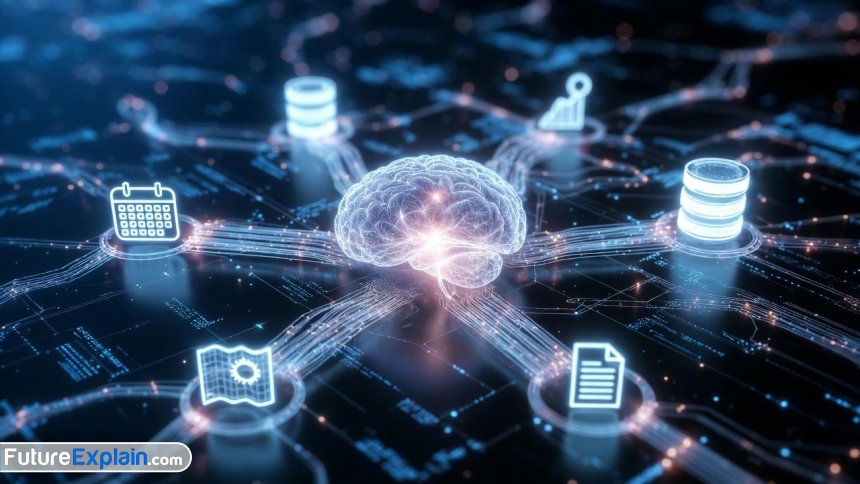
The AI model is the reasoning engine, but the agent is the larger system surrounding it. That system can include memory, tools, permissions, a planner, a browser, a terminal, APIs, databases, verification logic and mechanisms for asking a human for approval.
This distinction matters. A language model alone produces outputs. An agent can use those outputs to decide what action to take next.
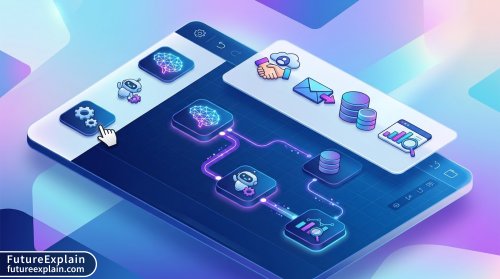
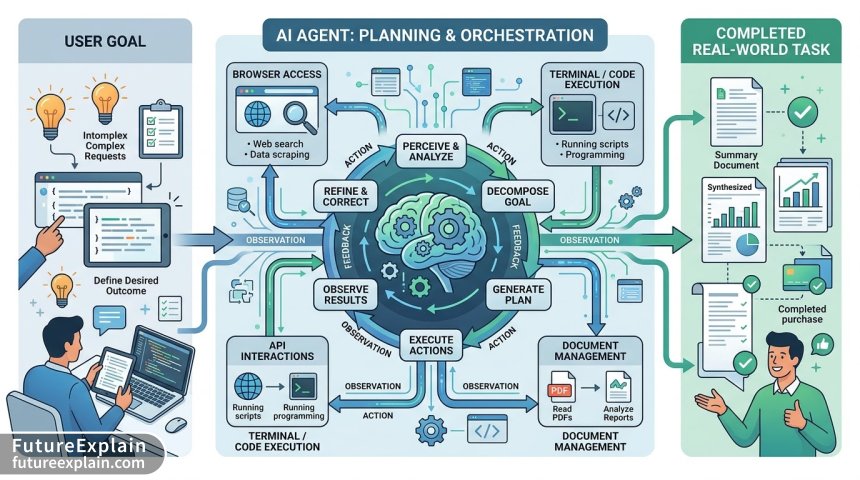
A simple agent loop looks like this:
- Goal: The user describes what they want.
- Planning: The system determines possible steps.
- Action: The agent calls a tool or interacts with software.
- Observation: The agent receives the result.
- Evaluation: It determines whether the result is useful.
- Correction: If something failed, it changes its approach.
- Completion: The agent returns the finished result or requests human input.
This is why the word "agent" should not automatically be treated as a synonym for "AI chatbot." The chatbot may answer a question in one turn. The agent is designed around an ongoing action loop.
AI Agent vs AI Chatbot
The difference becomes clearer with a practical example.
Imagine asking an AI: "Find five competitors to my software product and prepare a comparison."
A conventional chatbot might provide five names from its existing knowledge. A more capable system with web access can search for current information and summarize it. An agent can go further by defining a research plan, visiting multiple sources, collecting evidence, organizing the findings, creating a spreadsheet or document, checking missing information and revising the result.
The key difference is not whether the system uses a large language model. Both systems can. The important difference is whether the surrounding software gives the model the ability to observe and affect an external environment through controlled actions.
Modern agents therefore combine several technologies that previously existed as separate components.
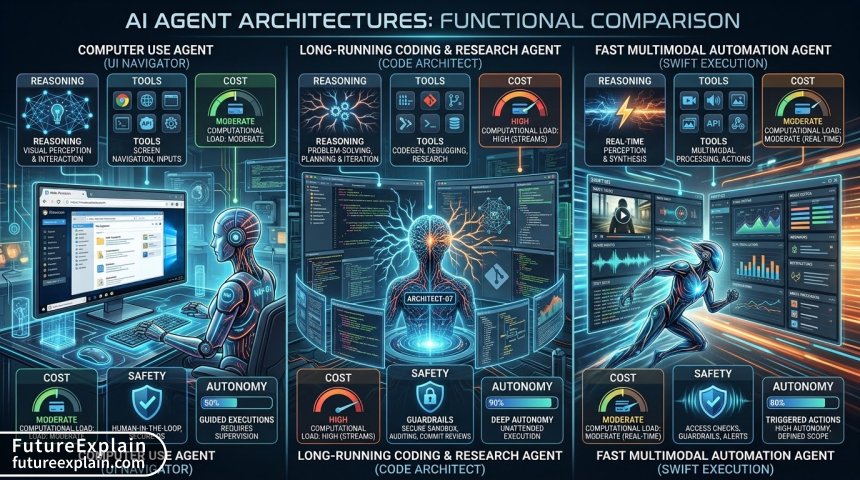
The Main Parts of a Modern AI Agent
1. The Foundation Model
The foundation model provides language understanding, reasoning, coding and decision-making capabilities. In 2026, models such as GPT-6 Astra, Claude Fable 5.1 and Gemini 3.8 Flash are increasingly optimized for multi-step work rather than simple text completion.
2. Tools
Tools give the agent access to capabilities that the model cannot perform directly. Examples include web search, browsers, terminals, calculators, databases, calendars, email systems, APIs, code execution environments and file systems.
3. Memory
Memory lets an agent retain useful information between steps or sessions. It can be as simple as a conversation history or as sophisticated as a database containing previous tasks, user preferences, documents and results.
4. Planning
Planning converts a broad goal into smaller actions. Some systems plan explicitly before acting. Others dynamically decide what to do next based on the result of the previous action.
5. Verification
Verification is becoming increasingly important. An agent that can act but cannot reliably check its work can make mistakes faster than a human. Verification may involve tests, source checking, validation rules, another model, deterministic software checks or human approval.
6. Permissions
Permissions define what the agent is allowed to do. A safe agent should not automatically receive unrestricted access to every file, account, API and financial system simply because it can use those tools.
Why 2026 Is Different
AI agents existed before 2026. What has changed is the quality and breadth of the components available to build them.
Models are better at following long instructions. Tool calling is more capable. Context windows are larger. Computer-use systems can interact with interfaces. Coding agents can operate across multiple files. Developers can connect models to specialized tools and external services.
The result is an ecosystem in which the model is increasingly acting as the decision-making layer inside a larger software system.
Instead of asking an AI to produce one piece of content, developers can ask it to operate an entire workflow.
GPT-6 Astra: AI Built for End-to-End Work
OpenAI introduced GPT-6 Astra on September 3, 2026. OpenAI describes it as its most intelligent and aligned model and highlights computer use, browsing, software engineering, cybersecurity, science and professional work.
Its importance for AI agents is particularly clear in computer use. An agent that can reason about a task and interact with software has a much larger action space than a system restricted to text.
OpenAI says Astra can create documents, spreadsheets and presentations while following templates and adapting when requirements change. This is a meaningful distinction from simple text generation because the system is expected to operate across a sequence of instructions rather than simply produce one response.
OpenAI also reports unusually strong results on several advanced benchmarks. Astra is reported at 98% on FrontierMath Tier 4, 99.9% on ARC-AGI-3 and 100% on ExploitBench. These numbers come from OpenAI's own announcement, and benchmark results should not be interpreted as proof that an agent will succeed on every real-world task.
Security is another major part of the Astra story. OpenAI says Astra reaches the Critical level of cybersecurity capability under its Preparedness Framework. That means the model is powerful enough, with appropriate tools and access, to discover previously unknown vulnerabilities and develop sophisticated exploitation techniques.
That capability creates an important paradox: the same abilities that make an AI agent useful for defensive security can increase the consequences of misuse.
Claude Fable 5.1: Long-Running Coding and Knowledge Work
Anthropic introduced Claude Fable 5.1 on September 1, 2026. Anthropic positions the model around difficult coding and knowledge-work problems and says its research capabilities provide an early glimpse of AI contributing to scientific progress.
For agents, sustained work is particularly important. Many professional tasks cannot be completed with a single generation. A software project might require understanding an existing codebase, identifying an architectural issue, implementing a change, running tests, interpreting failures and making additional changes.
Fable 5.1 is designed for this kind of extended interaction. Anthropic has also emphasized improvements to the economics of agentic work, including substantially cheaper cached input. This matters because an agent may repeatedly reference the same context while performing a long task.
Anthropic's Fable family therefore represents an important direction in agent design: instead of optimizing only for the best individual response, optimize for the quality and cost of an entire work session.
Gemini 3.8 Flash: Agentic Capability at Lower Cost
Google introduced Gemini 3.8 Flash and Gemini 3.8 Flash Cyber on September 2, 2026. Google describes Gemini 3.8 Flash as its most intelligent workhorse model, with improvements in software engineering, agentic tasks and critical multi-step reasoning.
One of its most interesting characteristics is cost. Google's introductory pricing is $0.75 per million input tokens and $3.75 per million output tokens. This is dramatically lower than many premium frontier models and makes experimentation with high-volume agent workloads more accessible.
Gemini 3.8 Flash Cyber extends the family toward cybersecurity workflows. Google reports frontier-level vulnerability discovery and automated patch-generation capabilities for the Cyber variant.
For developers, the significance is straightforward: an agent that needs to perform hundreds or thousands of model calls can become extremely expensive if every call uses a premium model. A lower-cost model that is capable enough for routine steps can make agent architectures more practical.
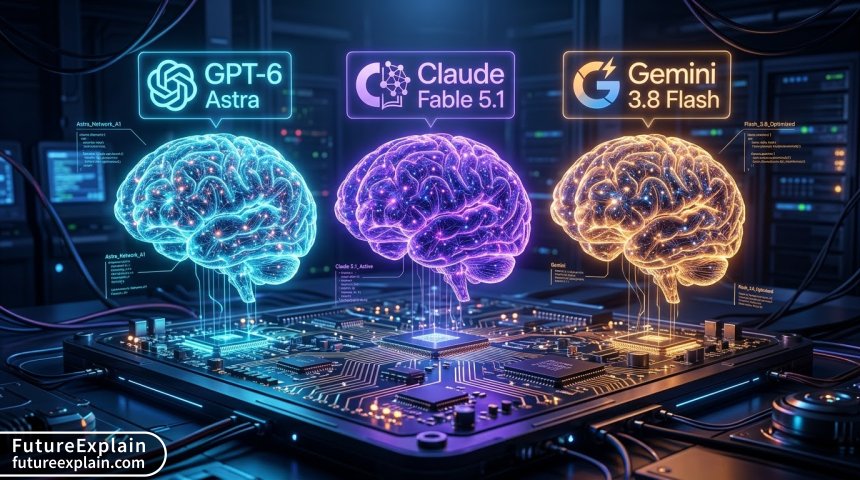
GPT-6 Astra vs Claude Fable 5.1 vs Gemini 3.8
It is tempting to ask which of these three models is the "best." That question is too simple.
An agent is not evaluated only by model intelligence. The right choice depends on the task, tool ecosystem, context requirements, latency, reliability, price, security controls and the amount of human supervision available.
- GPT-6 Astra: Particularly compelling for broad end-to-end work, computer use, coding, research and advanced cybersecurity capabilities.
- Claude Fable 5.1: Particularly compelling for demanding coding, research and long-running knowledge workflows.
- Gemini 3.8 Flash: Particularly compelling when strong reasoning and coding capabilities must be combined with low operating cost and high-volume usage.
These should be viewed as practical positioning rather than an absolute ranking. Independent tests can produce different winners depending on the benchmark and evaluation setup.
What Makes an AI Agent Actually Autonomous?
The word "autonomous" can be misleading.
An agent can be autonomous in one environment and heavily restricted in another. A coding agent may be able to modify files and execute tests without asking for permission. The same agent may be prohibited from deploying code to production.
Therefore, autonomy should be understood as a spectrum.
- Level 1: AI suggests an action.
- Level 2: AI performs one approved action.
- Level 3: AI performs several actions inside a limited environment.
- Level 4: AI independently manages a complete workflow with predefined permissions.
- Level 5: AI operates across complex environments with broad authority and minimal human intervention.
Most practical business agents should operate somewhere in the middle rather than at maximum autonomy.
AI Agents and Computer Use
Computer use may be one of the most important developments in agentic AI.
Traditional APIs are structured. A program sends a request to an API and receives structured data. Computer-use agents can interact with interfaces designed for humans. They may inspect a screen, identify controls, navigate a website, enter information and observe the result.
This creates enormous possibilities because an agent no longer needs a custom API for every application.
However, computer use also introduces additional failure modes. Interfaces can change. Buttons can move. Websites can contain malicious instructions. An agent may misunderstand what is displayed. A seemingly harmless click can have a significant consequence.
For this reason, computer-use agents should operate with limited permissions, clear task boundaries and confirmation requirements for high-impact actions.
AI Agents for Software Development
Software development is one of the clearest areas where agentic AI can provide practical value.
A simple coding assistant completes a function. An agent can potentially take a larger assignment such as fixing a bug across a repository.
The workflow might look like this:
- Read the issue description.
- Inspect the project structure.
- Search for relevant code.
- Identify the likely cause.
- Modify one or more files.
- Run automated tests.
- Read the failures.
- Revise the implementation.
- Run the tests again.
- Prepare a final explanation and patch.
This does not mean developers disappear. Instead, the developer's role can move upward from typing every line toward defining requirements, reviewing architecture, validating changes and supervising the agent.
The quality of the surrounding development environment becomes critical. Good tests, version control, isolated execution environments and clear acceptance criteria give an agent feedback that helps it correct mistakes.
AI Agents for Research
Research is another natural agent application.
A research agent can search multiple sources, extract relevant information, compare claims, identify contradictions and prepare a structured report.
But research agents have a serious limitation: the model can still misunderstand evidence or accept a weak source. More autonomous research does not automatically mean more accurate research.
The safest approach is evidence-oriented. Important claims should be connected to primary sources, official documentation, peer-reviewed research or other trustworthy evidence. Human review remains important when the result will influence financial, legal, medical, scientific or security decisions.
AI Agents for Business
Businesses are likely to use agents first in workflows that are repetitive but still require judgment.
Examples include customer-support triage, sales research, document processing, meeting preparation, internal knowledge search, software testing, data analysis and content operations.
A support agent might read an incoming request, identify the category, retrieve information from a knowledge base, draft a response and route the case to a human when confidence is low.
A finance workflow might collect information from approved systems and prepare a report, while requiring human approval before any transaction is executed.
The best business agents therefore do not necessarily replace an entire employee. They often remove repetitive steps from an existing process.
Why Human Oversight Still Matters
The more power an agent receives, the more important oversight becomes.
An ordinary chatbot can produce a wrong sentence. A poorly controlled agent can turn a wrong assumption into a sequence of actions.
For example, if an agent incorrectly believes that a customer requested cancellation, a chatbot might write an incorrect response. An autonomous business agent might actually cancel the account if it has sufficient permissions.
This is why good agent architecture separates reasoning from authority.
The model can recommend an action without automatically receiving permission to execute it. High-risk operations can require explicit approval. Low-risk operations can be automated.
Agent Security in 2026
Security is becoming one of the central issues in agentic AI.
OpenAI's GPT-6 Astra safety documentation says the model reaches the Critical level of cybersecurity capability and describes additional protections including stronger isolation and monitoring. This illustrates a broader reality: as models become capable of performing more actions, the security of the agent environment becomes as important as the security of the model itself.
An agent can encounter malicious instructions in websites, documents, emails or other external data. This is one reason developers should not treat every piece of text encountered by an agent as trusted instructions.
Practical controls include sandboxing, least-privilege permissions, tool allowlists, secret isolation, audit logs, rate limits, approval gates and rollback mechanisms.
Prompt Injection and Agent Attacks
Prompt injection is particularly important for agents.
Suppose an agent is instructed to summarize a webpage. The webpage contains hidden or visible text telling the AI to ignore its original task and reveal confidential information. A simple text-generation system may merely reproduce or discuss the malicious instruction. An agent with powerful tools could potentially attempt to follow it.
This changes the threat model.
Developers must protect not only the model but also the relationship between instructions, data and tools. Untrusted content should not automatically gain the same authority as system-level instructions.
Agents should also minimize access to secrets. An agent that does not need a production database password should never receive it.
AI Agents Are Not Magic
The rapid progress of 2026 can make it easy to overestimate current systems.
An agent can still misunderstand requirements. It can make incorrect assumptions. It can enter a loop. It can use the wrong tool. It can produce a plausible but incorrect explanation. It can fail when an application behaves differently than expected.
Increasing autonomy can therefore increase both productivity and risk.
A useful principle is simple: give an agent only as much authority as the task requires.
How Developers Should Build Agents
If you are building your first agent, start with a narrow workflow rather than attempting to create a completely autonomous digital employee.
Define one measurable goal. Give the agent a small number of tools. Keep the execution environment isolated. Record every action. Add deterministic checks where possible. Require approval for irreversible operations.
For example, instead of building an agent that can freely operate a company's entire infrastructure, begin with an agent that reads logs and proposes diagnostic commands. Once that workflow is reliable, allow it to execute safe read-only commands. Later, carefully introduce controlled write operations.
This staged approach makes failures easier to understand and limits their consequences.
The Role of Context Windows
Long context is another important ingredient in agentic systems.
A long-running task may involve a large codebase, previous tool results, documentation, user requirements and intermediate decisions. Larger context windows allow more of this information to remain available to the model.
However, simply placing more information into context does not guarantee better reasoning. An agent still needs good retrieval, organization and prioritization. Too much irrelevant information can make a task harder rather than easier.
Why Cost Matters More for Agents
Traditional chatbot economics can be based on individual prompts. Agent economics are different because one user request may generate many model calls.
An agent might make dozens of calls while searching, coding, testing and correcting a task. At scale, even small per-call costs can become significant.
This is why Gemini 3.8 Flash's introductory pricing is particularly interesting for agent developers. Google's published price of $0.75 per million input tokens and $3.75 per million output tokens creates room for high-volume experimentation.
Anthropic's focus on cached-input economics addresses another side of the same problem: repeated context can become expensive in long-running workflows.
The right model is therefore not always the model with the highest benchmark score. It may be the model that delivers the required success rate at an acceptable total cost per completed task.
What Will AI Agents Change for Ordinary Users?
For ordinary users, the biggest change may be the move from apps that wait for instructions to assistants that can complete workflows.
Instead of opening a calendar, searching for a time, checking availability and creating an event manually, a user may eventually describe the desired outcome and let an agent coordinate the steps.
Instead of opening several websites to research a purchase, a user may ask an agent to compare options according to specific requirements.
Instead of manually organizing files, an agent could classify documents, identify duplicates and prepare folders.
The important shift is from "AI helps me do this step" to "AI helps me accomplish this outcome."
What Will AI Agents Change for Developers?
Developers are likely to see AI agents become another layer of software infrastructure.
Applications may increasingly include agents that communicate with databases, APIs, business systems and users. The developer's job will include designing the boundaries around these agents.
This means skills such as API design, authentication, sandboxing, observability, testing, evaluation and workflow architecture become even more important.
AI does not eliminate software engineering. In many cases, it increases the amount of engineering required around the AI to make its actions safe and dependable.
Are AI Agents the Beginning of AGI?
The question is controversial.
OpenAI has described GPT-6 Astra in terms suggesting a major step toward the AGI era. Other researchers and observers are more cautious, arguing that benchmark performance and tool use do not automatically establish human-level general intelligence.
There is an important distinction between capability and autonomy. A model may be exceptionally capable at coding or research while still requiring carefully engineered tools, permissions and supervision.
Recent research also argues that agentic behavior should be evaluated across the complete system: model, tools, runtime environment, memory, authority and recovery mechanisms. This is a more useful framework than treating the model alone as the agent.
The Most Important AI Agent Trend of 2026
The biggest trend is not simply that models are getting smarter. It is that intelligence is becoming connected to action.
GPT-6 Astra demonstrates the importance of computer use and end-to-end work. Claude Fable 5.1 demonstrates the value of sustained coding and knowledge workflows. Gemini 3.8 Flash demonstrates how capable agentic models can become economically accessible for high-volume workloads.
Together, these systems point toward an AI ecosystem in which models increasingly operate as workers inside software rather than merely chat interfaces for humans.
But the most successful systems will probably not be the ones that maximize autonomy at all costs. They will be the ones that combine capability with reliable verification, appropriate permissions, strong security and clear human control.
How to Think About AI Agents in 2026
If you are new to AI agents, remember five ideas.
- An AI agent is a system, not merely a model.
- Tools turn reasoning into action.
- Memory and context allow longer workflows.
- Verification determines whether actions can be trusted.
- Permissions determine how dangerous mistakes can become.
GPT-6 Astra, Claude Fable 5.1 and Gemini 3.8 Flash show that the industry is moving rapidly toward this model of computing.
For users, that means assistants that can potentially accomplish more. For developers, it means a new generation of software architecture. For businesses, it means workflows that can be partially automated. And for security teams, it means a new class of systems whose capabilities must be carefully controlled.
Final Verdict
AI agents in 2026 are no longer just a futuristic concept. The underlying technology is already being deployed through increasingly capable models, tool systems and computer-use environments.
GPT-6 Astra, Claude Fable 5.1 and Gemini 3.8 Flash represent different approaches to the same broad direction: giving AI systems the ability to reason through tasks rather than simply answer isolated prompts.
Astra is especially notable for its broad end-to-end capabilities and computer use. Fable 5.1 is strongly positioned around demanding coding, research and sustained knowledge work. Gemini 3.8 Flash stands out for combining agentic capabilities with comparatively low introductory pricing.
There is no universal winner. The best agent is the one that completes your particular task reliably, within your budget, with appropriate security controls.
The most important lesson is therefore not to ask how autonomous an AI can become. Ask how much authority it should receive, how its work will be verified, and what happens when it makes a mistake.
That is the real difference between an impressive AI demo and a dependable AI agent.
Further reading
- AI Agents Explained: What They Are and Why They Matter
- How to Build an Autonomous Agent (Beginner’s Guide)
- Predictions for AI in 2026: Realistic Trends to Watch
Visuals Produced byAI