State of Open-Source Models: Communities, Licenses, and Trust
This article provides a clear, beginner-friendly overview of the open-source AI model landscape in 2025. It breaks down the three pillars of the ecosystem: the vibrant communities building models (featuring a tier list of key players), the crucial but often confusing world of software licenses (from permissive MIT to protective copyleft), and the emerging frameworks for establishing trust through model cards, safety testing, and responsible governance. You will learn why 2025 was a turning point with the rise of reasoning models like DeepSeek R1, how to navigate licensing to avoid legal pitfalls, and discover practical steps for running models locally and contributing to the community, regardless of your technical background.


If you’ve been curious about open-source AI but felt overwhelmed by the speed of change, you’re not alone. The year 2025 has been a whirlwind, transforming open-source models from capable alternatives into genuine powerhouses that rival the best proprietary systems [citation:1]. This shift isn't just about raw performance; it's about a fundamental change in who controls AI and how it's built.
This article cuts through the noise to explain the three pillars that define today's open-source AI ecosystem: the Communities of people and organizations building the future, the LicensesTrust in these powerful tools. Whether you're a developer, a business owner, or simply an enthusiast, understanding this landscape is key to navigating the AI-driven future responsibly.
The 2025 Landscape: A Turning Point for Open Models
For years, the narrative was that open-source models lagged behind their closed-source counterparts from companies like OpenAI and Google. In 2025, that narrative was definitively rewritten. A convergence of technical breakthroughs and strategic openness created a new, vibrant, and highly competitive field.
The catalyst was the January 2025 release of DeepSeek-R1, an open-weight model that demonstrated "reasoning" capabilities comparable to the best proprietary models at the time [citation:5]. More than its performance, its release under a permissive MIT license sent a shockwave through the industry, encouraging other labs to open their most advanced work [citation:6]. This "DeepSeek moment" validated that high-value AI could be developed and shared openly, empowering everyone from hobbyists running models on a home computer to large enterprises needing sovereign, on-premise deployments [citation:1].
Simultaneously, the sheer volume of activity exploded. On platforms like Hugging Face, an estimated 1,000 to 2,000 models are uploaded every day [citation:6]. This isn't just noise; it represents a global, decentralized engine of innovation. As one analysis noted, AI has now surpassed Cloud Native as the most influential technology domain in terms of developer collaboration on GitHub [citation:8]. The ecosystem has moved from a few dominant players to a rich, multi-polar world with leaders emerging from North America, Europe, and especially Asia.
Pillar 1: The Communities Building the Future
The heart of open-source AI is its people. The community is not a monolith but a dynamic, global network of researchers, developers, companies, and users. We can map this ecosystem by looking at the key organizations and the collaborative patterns they create.
The Tier List: Who's Who in 2025
Based on their influence, model quality, and community impact in 2025, organizations can be grouped into tiers [citation:6]:
- Frontier: These are the labs pushing the absolute boundaries of what's possible. This tier includes DeepSeek (for pioneering reasoning models), Qwen (from Alibaba, for its comprehensive family of models across sizes and modalities), and Moonshot AI (creator of the Kimi model) [citation:1][citation:6].
- Close Competitors: Organizations producing exceptionally strong models that are widely used. Examples are Zhipu AI (GLM models) and Minimax [citation:6].
- Noteworthy: Established players and research labs with significant contributions. This broad group includes Meta (Llama), Google (Gemma), Mistral AI, IBM, NVIDIA, and several leading Chinese tech firms [citation:6].
- Specialists: Entities that dominate a specific niche. This includes OpenAI (with its surprise GPT-OSS release for agentic workflows), Ai2 (for unparalleled research transparency), and teams like Moondream (leading in vision models) [citation:1][citation:6].
What's striking is the geographic shift. Chinese labs have moved from being niche players to leading the frontier in both model capability and adoption rates. Data from The ATOM Project showed that total model downloads switched from being US-dominant to China-dominant during 2025 [citation:1].
Collaboration and the "Hackathon" Culture
The pace is breakneck. Developers now operate as "super individuals," rapidly building open-source projects around trending topics [citation:8]. When a new closed-source product like Devin (an AI software engineer) goes viral, high-quality open-source clones like OpenDevin can appear within weeks [citation:8]. This culture is a double-edged sword: it drives incredible speed and democratization, but it also leads to project "graveyards" where once-popular tools are abandoned just as quickly as they arose [citation:8]. For users, this means being mindful of a project's activity and maintenance status, not just its initial star count on GitHub.
This community is also solving real-world problems. Open models are crucial for enterprise use cases in regulated sectors like finance and healthcare, where data must stay on-premise due to residency laws [citation:1]. Communities form around tools that enable these deployments, such as the inference server vLLM (a top open-source project by contributors in 2025) and orchestration frameworks like LangChain [citation:1][citation:8].
Technical Deep Dive: RLVR and GRPO - The Engines of 2025
A major community achievement in 2025 was the widespread adoption of new training techniques. If you hear experts talk about models "reasoning," they're often referring to breakthroughs like Reinforcement Learning from Verifiable Rewards (RLVR) and the GRPO algorithm [citation:5][citation:10].
In simple terms: earlier methods taught models based on human-written examples or human feedback on preferences. RLVR instead lets the model learn by practicing in environments with automatically scored outcomes, like solving math puzzles or coding challenges where a correct answer can be verified by a computer [citation:10]. By optimizing for these verifiable rewards, the model spontaneously learns to "show its work"—breaking problems into steps, trying different approaches, and recovering from errors in a way that looks strikingly like human reasoning [citation:5][citation:10]. This technique proved to be a highly efficient way to boost capability, defining much of the year's progress [citation:5].
Pillar 2: Navigating the World of Licenses
A model's license is its rulebook. It determines what you can and cannot do with the software. Ignoring licenses is one of the biggest risks for businesses and developers diving into open-source AI.
Permissive vs. Copyleft: The Fundamental Divide
All OSI-approved open-source licenses grant the freedom to use, study, modify, and share the software. They split into two philosophical families [citation:9]:
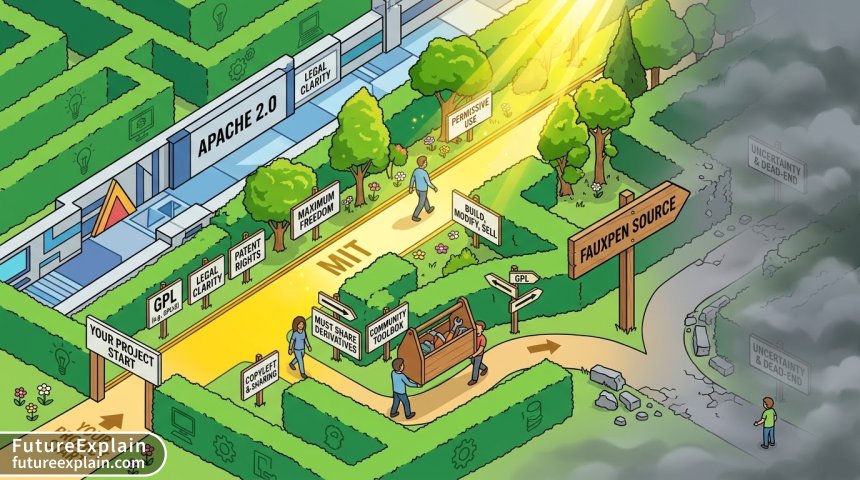
- Permissive Licenses: These are business-friendly and maximally flexible. They let you use the code almost any way you want, including in proprietary, closed-source products. The main requirements are typically to include the original copyright notice and license text.
- MIT License: The most popular, known for its simplicity (about 200 words). It's a great default choice for most projects but doesn't explicitly address patent rights [citation:2][citation:9].
- Apache License 2.0: The second most popular. Similar to MIT but longer, with an explicit grant of patent rights from contributors, offering better legal protection for users [citation:2][citation:9].
- BSD Licenses: Come in 2-clause and 3-clause variants, similar in spirit to MIT [citation:2].
- Copyleft Licenses: These prioritize keeping derivative work open and freely available. They require that if you distribute a modified version of the software, you must do so under the same open-source license.
- GNU GPL (v2/v3): The classic "strong" copyleft license. If you use GPL-licensed code in your project and distribute it, your entire project may need to be released under GPL. Used famously by the Linux kernel (GPLv2) [citation:9].
- GNU AGPL v3: A variant designed for software as a service (SaaS). It requires offering source code even to users who interact with the software over a network, closing a loophole in the standard GPL [citation:9].
For AI models, permissive licenses like MIT and Apache 2.0 are overwhelmingly common because they encourage broad adoption and integration. The release of DeepSeek-R1 under MIT was seen as a major gesture of openness [citation:6].
Compliance and the Rise of "Fauxpen Source"
Using an open-source model responsibly means understanding its license's "conditions." For a permissive license, this is usually just attribution. For a copyleft license, it can mean carefully managing how you integrate and distribute the model to comply with sharing requirements.
A significant 2025 trend is "fauxpen source" or "source-available" licensing [citation:7]. Some companies, seeking to protect commercial interests, have moved projects from true open-source licenses to terms that are more restrictive. These licenses may allow viewing and personal use of the source code but prohibit commercial use without a paid license or restrict competition [citation:7].
Why this matters: Relying on a "fauxpen" project can lead to vendor lock-in or sudden licensing changes. The community often responds by creating true open-source forks, as seen with Elasticsearch/OpenSearch and Redis/Valkey [citation:7]. When evaluating a model or tool, always check its official license—don't assume "open source" on the website means it's under an OSI-approved license.
Pillar 3: Building and Earning Trust
Powerful, freely available models raise critical questions about safety, bias, and reliability. Trust isn't automatic; it's built through transparency, rigorous evaluation, and responsible practices.
Model Cards and Documentation
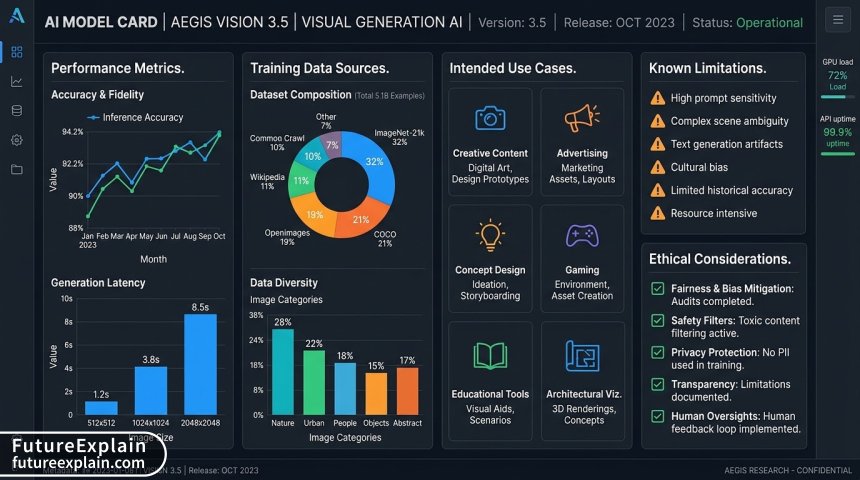
The cornerstone of a trustworthy model is a Model Card. Think of it as a nutrition label or spec sheet for AI. A good model card should clearly state [citation:1]:
- Intended Use: What the model is and is not designed for.
- Training Data: High-level description of the data sources, with attention to potential biases.
- Performance Metrics: How it scores on relevant benchmarks, with clear explanations of their limitations.
- Known Limitations & Risks: An honest discussion of failure modes, potential for harmful outputs, or contexts where it performs poorly.
- Ethical Considerations: Steps taken to mitigate bias, along with any remaining concerns.
In 2025, leading labs have embraced model cards. IBM's Granite models, for example, even pursued ISO 42001 certification for responsible AI management systems [citation:1]. For users, always seek out this documentation. A model without a detailed model card should be used with extreme caution.
Safety, Evaluation, and the "Jagged Intelligence" Problem
Andrej Karpathy aptly described modern LLMs as having "jagged intelligence" [citation:10]. They can be geniuses in one domain (like solving complex logic puzzles) and bafflingly poor in another (like basic common sense). This makes traditional benchmark scores incomplete measures of trust.
Why? Because benchmarks are often "verifiable environments" that models can be specifically optimized for during training (a process sometimes called "benchmaxxing") [citation:10]. A model that aces all benchmarks might still fail unpredictably in real-world use.
Therefore, building trust requires:
- Beyond Benchmarks: Conduct your own evaluation on tasks relevant to your use case. Use the model in a controlled sandbox environment first.
- Testing for Failure: Actively try to "break" it with edge cases, adversarial prompts, or out-of-domain requests to understand its limits.
- Guardrails and Monitoring: Implement software guardrails to filter harmful outputs and continuously monitor the model's performance in production. Open-source tools for evaluation and red-teaming are increasingly available.
A Practical Guide: Your First Steps
Feeling inspired to get involved? Here’s how you can start engaging with the open-source AI ecosystem, regardless of your technical skill level.
For Beginners: Running Your First Local Model
You don't need a data center to experiment. Tools like Ollama make it simple to run models on your own laptop. With a single command in your terminal (e.g., ollama run llama3.2), you can download and start chatting with a model locally, with no data leaving your computer [citation:1]. This is perfect for private experimentation and learning. Start with smaller, efficient models like a 7B parameter version to ensure it runs smoothly on your hardware.
For Practitioners: Choosing the Right Model
Follow this decision framework:
- Define Your Need: Is it creative writing, code generation, data analysis, or a specialized task? Match the model to the job.
- Check the License: Can you use it for your intended purpose (commercial, personal, modification)? Does it impose conditions you can comply with?
- Assess Resource Requirements: Do you have the GPU memory to run it? Use resources like Artificial Analysis to compare not just performance, but also inference speed and cost [citation:1].
- Read the Model Card: Verify its capabilities and limitations align with your needs and risk tolerance.
- Test Extensively: Before any deployment, run your own pilot on a representative sample of your tasks.
Contributing to the Community
You don't have to train a multi-billion parameter model to contribute. You can:
- Improve Documentation: Translate model cards, write beginner tutorials, or clarify installation steps.
- Participate in Evaluation: Use platforms like LMSys Chatbot Arena to vote on model outputs, contributing to crowd-sourced rankings [citation:1].
- Support Open Projects: Financially support underfunded but critical open-source projects. As noted in 2025, many essential projects are maintained by overworked volunteers [citation:7].
- Share Your Work: If you fine-tune a model for a specific task (like summarizing legal documents), consider sharing the adapter weights or your methodology with the community.
Looking Ahead: The Road to 2026
The momentum from 2025 shows no signs of slowing. We can expect the focus on reasoning capabilities and agentic AI (AIs that can use tools and take multi-step actions) to intensify [citation:5]. The open-source community will likely lead in making these advanced capabilities accessible and customizable. Debates around licensing, especially for AI-specific components like weights and training data, will become more nuanced. Most importantly, as models grow more capable, the community's focus on robust evaluation, safety alignment, and clear governance will be the true foundation for long-term, trustworthy innovation.
The state of open-source AI in 2025 is one of empowered, decentralized creation. By understanding the communities driving it, the licenses that guide it, and the practices that build trust, you can confidently participate in and shape this exciting future.
Further Reading on FutureExplain
- AI Agents Explained: What They Are and Why They Matter - Understand the agentic AI workflows that open models are powering.
- Open-Source LLMs Compared: Which to Use and When - A deeper look at comparing model capabilities and fit.
- Model Cards & Responsible Documentation: A Template - A practical guide to creating transparent model documentation.