
Model Cards and Responsible Model Documentation
Model cards are standardized documentation for AI models that provide transparency about their capabilities, limitations, and appropriate use cases. This comprehensive guide explains why responsible model documentation matters, walks through creating effective model cards step-by-step, and covers practical implementation for businesses and developers. Learn about the key components of model cards, regulatory requirements, common pitfalls to avoid, and tools that can help automate documentation. Whether you're deploying AI in your business or evaluating third-party models, understanding model documentation is essential for ethical and effective AI implementation.


Model Cards and Responsible Model Documentation: A Complete Beginner's Guide
When you buy a new appliance, you expect to find a manual that explains how to use it safely, what its limitations are, and what maintenance it requires. Artificial intelligence models need similar documentation—and that's where model cards come in. In this comprehensive guide, we'll explore what model cards are, why they're essential for responsible AI, and how to create effective documentation that builds trust and ensures safe deployment.
Model cards are standardized documentation for AI models that provide transparency about their capabilities, limitations, and appropriate use cases. Think of them as nutrition labels for AI—they give users the essential information needed to make informed decisions about whether and how to use a particular model. As AI becomes more integrated into our daily lives and business operations, proper documentation isn't just good practice—it's becoming a regulatory requirement and ethical imperative.
What Are Model Cards and Why Do They Matter?
The concept of model cards was introduced in a 2019 research paper by Mitchell and colleagues titled "Model Cards for Model Reporting." The researchers recognized that as machine learning models were increasingly deployed in real-world applications, there was a critical lack of standardized documentation that would help users understand what these models could and couldn't do.
Imagine trying to use a facial recognition system without knowing whether it was tested on people with different skin tones, or deploying a loan approval model without understanding what factors it considers. This lack of transparency can lead to serious consequences, including biased outcomes, safety risks, and loss of public trust. Model cards address this problem by providing a structured way to document essential information about AI models.
The Real-World Impact of Missing Documentation
Several high-profile cases highlight why model documentation matters. In healthcare, AI models for medical diagnosis have sometimes been deployed without adequate documentation about their training data or limitations, potentially leading to incorrect diagnoses. In hiring, resume screening algorithms have shown bias against certain demographics when their documentation didn't adequately explain how they were tested for fairness.
Proper documentation helps prevent these issues by:
- Ensuring users understand model limitations
- Facilitating proper deployment decisions
- Enabling fairness and bias evaluation
- Supporting regulatory compliance
- Building trust with stakeholders

Key Components of a Model Card
A well-structured model card typically includes several essential sections. While specific implementations may vary, most comprehensive model cards contain the following components:
1. Model Details
This section provides basic information about the model, including its name, version, developers, and release date. It should also include the model type (classification, regression, etc.), architecture details, and any relevant technical specifications.
2. Intended Use
Clearly describing what the model is designed to do—and just as importantly, what it's NOT designed to do—is crucial. This section should specify the intended use cases, target users, and any constraints on deployment contexts.
3. Training Data
Transparency about training data is essential for understanding potential biases and limitations. This section should describe the datasets used for training, including their sources, sizes, and any preprocessing steps. It should also note any known limitations or gaps in the training data.
4. Evaluation Results
Performance metrics presented clearly and honestly help users understand how well the model works. This includes standard metrics like accuracy, precision, and recall, as well as more specific metrics relevant to the application domain.
5. Ethical Considerations and Limitations
Perhaps the most important section, this outlines known limitations, potential biases, fairness considerations, and ethical concerns. It should be honest about what the model struggles with and under what conditions it might fail.
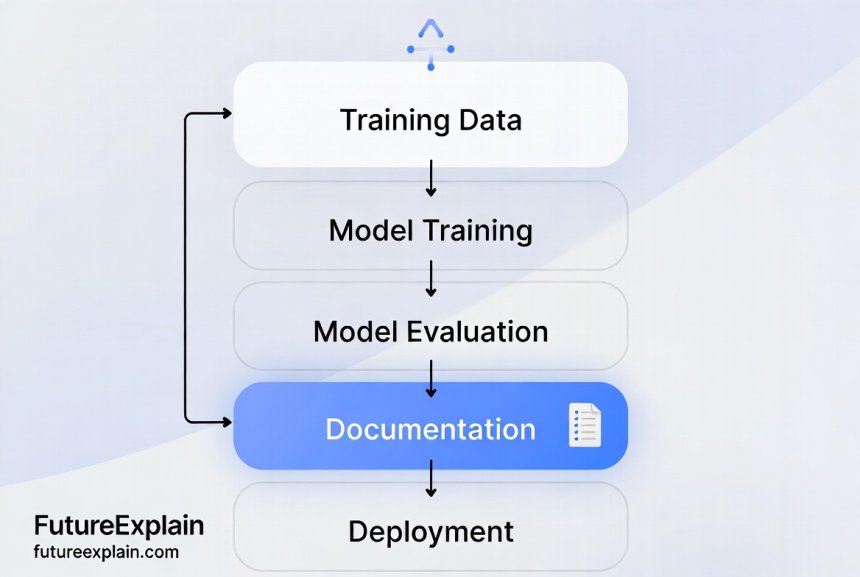
Step-by-Step Guide to Creating Your First Model Card
Creating a model card doesn't need to be overwhelming. Follow this step-by-step process to develop comprehensive documentation for your AI model:
Step 1: Start Early in the Development Process
Documentation shouldn't be an afterthought. Begin thinking about your model card from the early stages of model development. As you make decisions about data collection, feature engineering, and evaluation metrics, document these choices along the way.
Step 2: Use a Standardized Template
Several organizations provide model card templates that you can adapt. Hugging Face, for example, has a widely-used template for natural language processing models. Using a standardized format makes your documentation more accessible and comparable with other models.
Step 3: Collect Comprehensive Information
Gather all relevant information about your model, including:
- Technical specifications and architecture details
- Training dataset characteristics and preprocessing steps
- Evaluation methodology and results
- Testing on diverse subgroups and edge cases
- Performance under different conditions
Step 4: Conduct Bias and Fairness Assessments
Test your model on diverse subgroups to identify potential biases. Document any disparities in performance across different demographic groups, geographical regions, or other relevant categories. Be transparent about both the assessment methods and the results.
Step 5: Write Clear, Accessible Descriptions
Avoid overly technical jargon when possible. Remember that your audience may include non-technical stakeholders like business managers, regulatory officials, or end-users. Use clear language and provide explanations for technical terms when necessary.
Step 6: Review and Validate
Have your model card reviewed by people with different perspectives—technical experts, domain specialists, ethicists, and potential users. Their feedback can help identify missing information or unclear explanations.
Regulatory Requirements and Compliance
As AI regulation evolves globally, model documentation is increasingly becoming a legal requirement rather than just best practice. Understanding these requirements is essential for any organization deploying AI systems.
The EU AI Act and Documentation Requirements
The European Union's AI Act, expected to be fully implemented in the coming years, includes specific requirements for documentation of high-risk AI systems. These requirements include:
- Technical documentation demonstrating compliance with requirements
- Records of the development process
- Information for users about capabilities and limitations
- Human oversight measures
- Accuracy, robustness, and cybersecurity assessments
Industry Standards and Frameworks
Beyond legal requirements, several industry standards and frameworks emphasize the importance of model documentation:
- ISO/IEC standards for AI system life cycle processes
- NIST AI Risk Management Framework
- IEEE standards for ethically aligned design
- Industry-specific guidelines in healthcare, finance, and other sectors
Common Challenges and How to Overcome Them
Creating effective model documentation comes with several challenges. Here's how to address the most common ones:
Challenge 1: Balancing Transparency with Intellectual Property Concerns
Some organizations worry that detailed documentation might reveal proprietary information. The key is to focus on documenting what users need to know to use the model safely and effectively, without revealing trade secrets about the underlying algorithms.
Challenge 2: Technical Complexity
Some models are extremely complex, making comprehensive documentation challenging. In these cases, focus on documenting the aspects that matter most for users—how to use the model correctly, what its limitations are, and what conditions might cause it to fail.
Challenge 3: Keeping Documentation Current
Models are often updated and retrained, and documentation can quickly become outdated. Establish processes to update model cards whenever significant changes are made to the model or its deployment context.
Tools and Platforms for Model Documentation
Several tools can help automate and streamline the model documentation process:
1. Hugging Face Model Cards
Hugging Face has built model card functionality directly into its platform. When you upload a model to Hugging Face, you can create a model card using their template, which includes sections for intended uses, limitations, and bias evaluation.
2. MLflow Model Registry
MLflow provides tools for tracking experiments and managing models, including documentation features. You can attach descriptions, tags, and other metadata to models in the registry.
3. Weights & Biases
This platform for machine learning experiment tracking includes features for documenting models and their performance. You can link documentation to specific model versions and track changes over time.
4. Custom Documentation Solutions
For organizations with specific needs, custom documentation systems can be built using tools like Sphinx, MkDocs, or other documentation generators. These can be integrated into your machine learning pipeline to automatically generate documentation from code comments and metadata.
Best Practices for Responsible Documentation
Based on industry experience and research, here are key best practices for creating effective model documentation:
1. Be Honest About Limitations
Documentation that glosses over limitations or failures does more harm than good. Be candid about what your model struggles with, and provide clear guidance on how to recognize and handle these situations.
2. Use Multiple Evaluation Perspectives
Don't rely solely on aggregate performance metrics. Evaluate how your model performs across different subgroups, in different contexts, and on edge cases. Document these varied perspectives to give users a complete picture.
3. Make Documentation Accessible
Consider your audience's needs. Technical teams might need detailed architecture information, while business users need clear explanations of capabilities and limitations. Consider creating different versions or sections for different audiences.
4. Link Documentation to Model Versions
Each version of your model should have its own documentation. This ensures that users always have information that matches the specific model they're using.
5. Include Real-World Testing Results
If possible, include results from testing in real-world conditions, not just on benchmark datasets. This provides more relevant information about how the model will perform in practice.
Case Studies: The Impact of Good (and Bad) Documentation
Let's examine some real-world examples that demonstrate the importance of model documentation:
Case Study 1: Healthcare Diagnosis AI
A hospital system implemented an AI tool to help radiologists detect certain conditions in medical images. The model card included detailed information about the training data (which was primarily from urban hospitals), performance across different patient demographics, and specific conditions where the model had lower accuracy. This transparency allowed radiologists to use the tool more effectively, knowing when to rely on it and when to exercise additional caution.
Case Study 2: Credit Scoring Algorithm
A financial institution developed a new credit scoring model but didn't create comprehensive documentation. When regulators asked about potential biases, the team struggled to provide evidence of fairness testing. This led to delays in deployment and additional scrutiny. After creating a proper model card that documented fairness assessments across demographic groups, they were able to address regulatory concerns and deploy the model with confidence.
Case Study 3: Chatbot Deployment
A company deployed a customer service chatbot without adequate documentation about its limitations. When the chatbot gave incorrect information in certain situations, customer satisfaction dropped, and the company faced criticism. After creating a model card that clearly outlined what the chatbot could and couldn't do—and training customer service representatives accordingly—they were able to manage expectations and use the tool more effectively.
Implementing Model Documentation in Your Organization
Whether you're a small startup or a large enterprise, here's how to implement model documentation practices:
For Small Teams and Startups
Start simple but start early. Even basic documentation is better than none. Use available templates and focus on the most critical information: what your model does, what data it was trained on, its main limitations, and how to use it correctly.
For Medium-Sized Organizations
Establish documentation as a required part of your machine learning development process. Create standardized templates and checklists. Train your team on documentation best practices and make it part of your review processes.
For Large Enterprises
Implement comprehensive documentation frameworks integrated with your model development and deployment pipelines. Consider automated documentation tools and establish governance processes to ensure quality and compliance. Create specialized roles or teams focused on responsible AI and documentation.
The Future of Model Documentation
As AI continues to evolve, so too will approaches to model documentation. Several trends are likely to shape the future:
1. Increased Standardization
Expect more industry-wide standards for model documentation, driven by regulatory requirements and industry best practices. These standards will make it easier to compare models and ensure comprehensive documentation.
2. Automated Documentation Tools
Tools that automatically generate documentation from model code, training data, and evaluation results will become more sophisticated, reducing the manual effort required while increasing consistency.
3. Interactive Documentation
Future model documentation may include interactive elements that allow users to explore how the model performs under different conditions or on specific examples.
4. Integration with Model Monitoring
Documentation will increasingly be linked to real-time model monitoring, with performance and fairness metrics updated based on production data.
Getting Started Today
Ready to start creating better model documentation? Here are immediate steps you can take:
- Review any existing AI models in your organization and assess their documentation
- Choose a template that fits your needs (Hugging Face provides a good starting point)
- Pick one model and create a comprehensive model card for it
- Gather feedback from different stakeholders on the documentation
- Establish documentation as a standard part of your development process
Remember, the goal of model documentation isn't to create perfect documents but to provide the information users need to make informed decisions about AI systems. Start where you are, improve as you learn, and prioritize transparency and responsibility in your AI development.
Further Reading
If you found this guide helpful, you might also want to explore these related topics:
- Ethical AI Explained: Why Fairness and Bias Matter - Learn more about the ethical considerations that model documentation helps address
- Managing Model Bias: Techniques and Checklists - Practical approaches to identifying and addressing bias in AI models
- AI Ethics & Safety - Explore our complete section on ethical AI development and deployment
Share
What's Your Reaction?
 Like
1420
Like
1420
 Dislike
15
Dislike
15
 Love
320
Love
320
 Funny
45
Funny
45
 Angry
8
Angry
8
 Sad
12
Sad
12
 Wow
210
Wow
210















Documentation has improved our model review processes significantly. We catch issues earlier now.
The step-by-step guide is exactly what we needed. Breaking it down into manageable steps makes it less overwhelming.
We're implementing the suggestions in this article. Started with our highest-risk models first.
The balance between transparency and IP protection is a real challenge. The article's suggestions are practical and reasonable.
As a compliance officer, this article gives me the vocabulary and framework to have better conversations with our technical teams about AI documentation.
The future trends about interactive documentation and integration with monitoring are exciting. Looking forward to those developments.