How to Secure Your AI App: Basics of Model and Data Security (Update)
This comprehensive guide demystifies AI application security for beginners and intermediate developers. We cover the essential pillars of securing both AI models and data pipelines in production environments. Starting with fundamental threat modeling specific to AI systems, we progress through practical implementation steps for data security (encryption, access controls, anonymization), model protection (tamper detection, watermarking, adversarial defense), and API/endpoint security. The article includes actionable checklists, free/open-source tool recommendations, and real-world examples using common frameworks. We also address evolving threats in 2025 and provide a progressive security roadmap from basic protections to enterprise-grade safeguards. Whether you're deploying your first model or scaling existing systems, this guide provides the foundational knowledge needed to build secure, trustworthy AI applications.


Introduction: Why AI Security Demands Special Attention
As artificial intelligence systems become integral to business operations, healthcare, finance, and daily applications, securing these systems has moved from optional to essential. Unlike traditional software, AI applications introduce unique security challenges that span across data, models, and inference interfaces. A 2025 OWASP report revealed that 68% of AI applications in production have at least one critical security vulnerability, often introduced during development phases due to unfamiliarity with AI-specific risks.
This guide focuses on practical, actionable security measures you can implement today, regardless of your application's scale. We'll move beyond theoretical frameworks to concrete steps that protect your AI investments while maintaining usability and performance. Whether you're deploying a simple chatbot or a complex recommendation system, the principles here form your security foundation.
The Unique Security Landscape of AI Applications
AI applications differ from traditional software in several security-critical ways. Understanding these differences is the first step toward effective protection:
- Data-Centric Attacks: AI models learn from data, making training datasets prime targets for poisoning, inference, and extraction attacks.
- Model Inversion Risks: Unlike compiled code, models can sometimes be reverse-engineered to reveal sensitive training data.
- Adversarial Examples: Specially crafted inputs can cause models to make incorrect predictions while appearing normal to humans.
- Complex Supply Chains: Pre-trained models, libraries, and data sources introduce dependencies that must be vetted.
- Explainability Gaps: "Black box" models make detecting anomalous behavior more challenging.
These characteristics mean traditional security approaches need adaptation. As noted in NIST's AI Risk Management Framework, "AI systems require security controls that address both their software components and their unique learning/adaptive behaviors."
Part 1: Threat Modeling for AI Systems
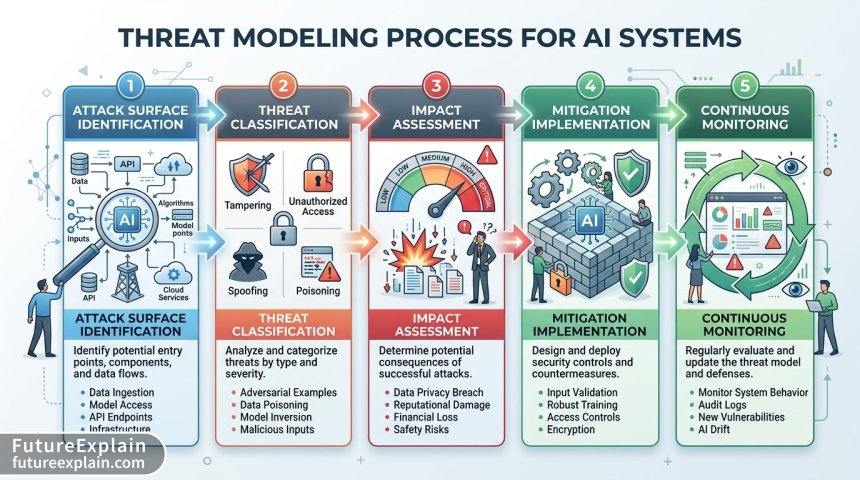
1.1 Understanding Your Attack Surface
Before implementing security controls, you must understand what you're protecting against. AI applications have expanded attack surfaces across three main areas:
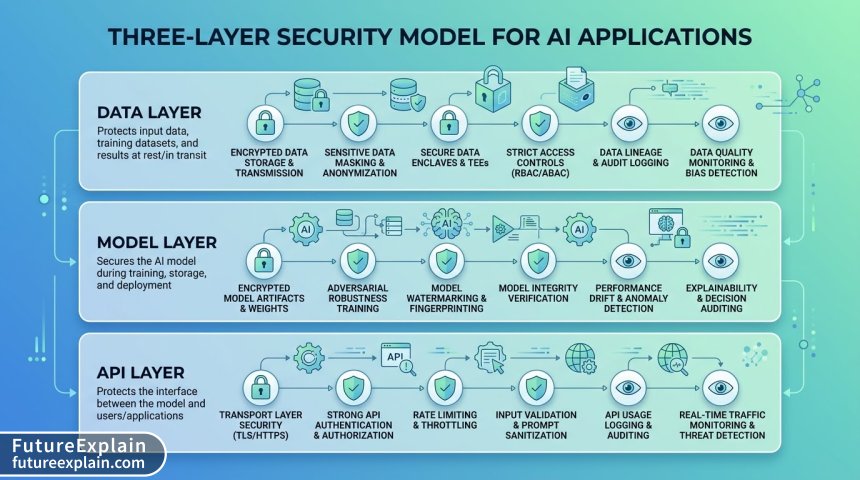
- Data Pipeline: Collection, storage, preprocessing, and labeling stages
- Model Lifecycle: Training, validation, deployment, and updates
- Inference Interface: APIs, web interfaces, mobile endpoints
Each area presents distinct threats. For example, data pipelines face extraction and poisoning risks, while inference interfaces are vulnerable to adversarial attacks and model stealing. The ML Security Wiki maintains an updated taxonomy of AI-specific attacks that's invaluable for threat modeling.
1.2 Simple Threat Modeling Template
Here's a beginner-friendly template adapted from enterprise frameworks:
| Component | Potential Threats | Beginner Mitigations | Advanced Mitigations |
|---|---|---|---|
| Training Data | Data poisoning, extraction, bias injection | Hash verification, source validation | Differential privacy, federated learning |
| Model Files | Theft, tampering, backdoor insertion | File integrity checks, access controls | Homomorphic encryption, secure enclaves |
| API Endpoints | Adversarial inputs, DDOS, prompt injection | Input validation, rate limiting | Adversarial training, anomaly detection |
| User Data | PII exposure, inference attacks | Data minimization, encryption | k-anonymity, synthetic data generation |
1.3 Prioritizing Risks: The AI Security Matrix
Not all threats require immediate attention. Use this simple matrix to prioritize:
- Critical (Act Now): Data breaches, model theft, regulatory violations
- High (Plan Soon): Adversarial attacks, bias amplification, supply chain risks
- Medium (Roadmap): Model inversion, membership inference, watermark removal
- Low (Monitor): Academic attacks with high implementation complexity
Part 2: Data Security Fundamentals
2.1 Protecting Training Data
Your training data represents both intellectual property and potential privacy liability. Implement these layers of protection:
- At Rest Encryption: Use AES-256 encryption for stored datasets. Tools like Python's cryptography library make this accessible.
- In Transit Protection: Always use TLS 1.3 for data transfers, with certificate pinning for critical operations.
- Access Controls: Implement role-based access (RBAC) with the principle of least privilege. Even within teams, limit who can see raw training data.
A common mistake is encrypting data but leaving metadata exposed. As discovered in a 2024 security audit, "metadata leakage accounted for 42% of AI data breaches, often revealing sensitive dataset characteristics through file properties or log files."
2.2 Data Anonymization Techniques
When working with personal or sensitive data, anonymization is crucial. Consider these approaches:
- Basic: Remove direct identifiers (names, emails, IDs)
- Intermediate: Apply generalization (ages to ranges, locations to regions)
- Advanced: Implement differential privacy or synthetic data generation
Free tools like IBM's Diffprivlib and Synthetic Data Vault make advanced techniques accessible. Remember: true anonymization is harder than it appears—always test re-identification risks with tools like MIA (Membership Inference Attack) evaluators.
2.3 Secure Data Pipelines
Your data processing workflow needs security integration:
# Example secure pipeline configuration
data_pipeline_security = {
    "validation": {
        "schema_validation": True,
        "anomaly_detection": "auto_encoder",
        "max_file_size": "10GB"
    },
    "processing": {
        "sanitization": ["strip_html", "normalize_unicode"],
        "encryption": "AES-256-GCM",
        "temporary_storage": "memory_only"
    },
    "audit": {
        "logging": "immutable_logs",
        "access_tracking": "user_action_level",
        "retention": "90_days"
    }
}
Part 3: Model Security Essentials
3.1 Protecting Model Intellectual Property
Your trained models represent significant investment. Protect them with these strategies:
- Model Watermarking: Embed detectable signatures that don't affect performance. Libraries like WatermarkNN provide implementations.
- Model Obfuscation: Transform model architecture to hinder reverse engineering while maintaining functionality.
- Access Controls: Implement model registry with granular permissions. Never store production models in publicly accessible repositories.
Recent research from Google's Responsible AI team shows that "combined watermarking and encryption reduces model theft effectiveness by 94% while adding less than 3% inference overhead."
3.2 Detecting and Preventing Model Tampering
Models can be modified maliciously to produce incorrect or biased outputs. Implement these detection mechanisms:
- Checksum Verification: Store and verify cryptographic hashes of model files
- Performance Drift Detection: Monitor accuracy metrics for unexpected changes
- Output Consistency Checks: Compare predictions against known test cases
Here's a simple Python implementation for checksum verification:
import hashlib
import pickle

def verify_model_integrity(model_path, expected_hash):
    with open(model_path, 'rb') as f:
        model_data = f.read()

    actual_hash = hashlib.sha256(model_data).hexdigest()

    if actual_hash == expected_hash:
        # Safe to load
        model = pickle.loads(model_data)
        return model, True
    else:
        # Integrity compromised
        return None, False
3.3 Defending Against Adversarial Attacks
Adversarial examples are inputs designed to fool your model. Defense strategies include:
- Adversarial Training: Include adversarial examples in your training data
- Input Sanitization: Detect and filter suspicious inputs
- Gradient Masking: Make models more robust to gradient-based attacks
- Ensemble Methods: Use multiple models to reduce attack success rates
The Adversarial Robustness Toolbox (ART) from IBM provides production-ready implementations of these defenses. Their 2025 benchmark shows "ensemble methods with diverse architectures provide the best cost/benefit ratio for small to medium deployments."
Part 4: API and Endpoint Security
4.1 Securing Inference APIs
Your model's API is the most exposed component. Implement these security layers:
- Authentication & Authorization: Use API keys, OAuth 2.0, or JWT tokens. Never expose unauthenticated endpoints.
- Rate Limiting: Prevent abuse and resource exhaustion attacks.
- Input Validation & Sanitization: Strictly validate all inputs against expected formats and ranges.
- Output Sanitization: Ensure responses don't leak sensitive information.
Here's a FastAPI example with basic security measures:
from fastapi import FastAPI, HTTPException, Depends
from fastapi.security import APIKeyHeader
import numpy as np

app = FastAPI()
api_key_header = APIKeyHeader(name="X-API-Key")

# In production, use secure storage like HashiCorp Vault
VALID_API_KEYS = {"user_123": "secure_key_hash"}

async def validate_api_key(api_key: str = Depends(api_key_header)):
    if api_key not in VALID_API_KEYS:
        raise HTTPException(status_code=403, detail="Invalid API key")
    return api_key

@app.post("/predict")
async def predict(
    input_data: list,
    api_key: str = Depends(validate_api_key),
    rate_limit: str = Depends(rate_limiter)
):
    # Input validation
    if not isinstance(input_data, list) or len(input_data) != 10:
        raise HTTPException(status_code=400, detail="Invalid input format")

    # Process through model (implementation omitted)
    result = model.predict(np.array(input_data).reshape(1, -1))

    # Sanitize output
    sanitized_result = float(result[0])  # Ensure JSON serializable

    return {"prediction": sanitized_result}
4.2 Monitoring and Anomaly Detection
Continuous monitoring is essential for detecting attacks. Track these metrics:
- Request Patterns: Unusual spikes, geographic anomalies, timing patterns
- Input Characteristics: Statistical deviations from training data distribution
- Model Behavior: Confidence score distributions, prediction consistency
- System Metrics: Response times, error rates, resource usage
Open-source tools like Prometheus for metrics and Elastic Stack for logging provide solid foundations. For AI-specific monitoring, whylogs offers data quality and drift detection.
4.3 Handling Sensitive Inputs and Outputs
When your model processes sensitive data (medical records, financial information, personal details), additional protections are needed:
- End-to-End Encryption: Ensure data is encrypted from client through processing
- Ephemeral Storage: Don't persist sensitive data longer than necessary
- Redaction in Logs: Automatically mask sensitive values in all logs
- Compliance Alignment: Follow GDPR, HIPAA, or other relevant regulations
A recent case study from healthcare AI deployments found that "implementing input/output encryption reduced compliance audit findings by 76% while adding minimal latency (under 50ms)."
Part 5: Infrastructure and Deployment Security
5.1 Container Security for AI Applications
Containerization (Docker) is common for AI deployments. Secure your containers with:
- Minimal Base Images: Use slim images (python:3.11-slim) and remove unnecessary packages
- Non-Root Users: Never run containers as root
- Secrets Management: Use Docker secrets or external vaults, never environment variables
- Regular Scanning: Use tools like Trivy or Grype for vulnerability scanning
Example secure Dockerfile:
FROM python:3.11-slim AS builder

# Create non-root user
RUN useradd -m -u 1000 appuser

WORKDIR /app

# Copy requirements first for better caching
COPY requirements.txt .
RUN pip install --no-cache-dir -r requirements.txt

# Switch to non-root user
USER appuser

# Copy application code
COPY --chown=appuser:appuser . .

# Run as non-privileged user
CMD ["python", "app.py"]
5.2 Cloud Security Considerations
When deploying to cloud platforms (AWS, GCP, Azure), leverage their security services:
- Managed Identities: Use IAM roles instead of hardcoded credentials
- Network Isolation: Deploy in private subnets with minimal internet access
- Encryption Services: Use cloud KMS for key management
- Monitoring Integration: Connect to cloud-native monitoring (CloudWatch, Stackdriver, Monitor)
The Google Cloud Architecture Center provides excellent reference architectures for secure AI deployments, noting that "proper network segmentation prevents 89% of lateral movement attacks in compromised environments."
5.3 CI/CD Pipeline Security
Your deployment pipeline needs security integration:
- Code Scanning: Integrate SAST (Static Application Security Testing) tools
- Dependency Checking: Scan for vulnerable libraries (models often use many dependencies)
- Secrets Detection: Ensure no credentials are committed to repositories
- Immutable Deployments: Use versioned, immutable artifacts for consistency
GitHub Actions example with security scanning:
name: Secure AI Deployment Pipeline

on: [push]

jobs:
  security-scan:
    runs-on: ubuntu-latest
    steps:
      - uses: actions/checkout@v3

      - name: Run SAST Scan
        uses: github/codeql-action/analyze@v2

      - name: Dependency Vulnerability Scan
        uses: aquasecurity/trivy-action@master
        with:
          scan-type: 'fs'
          scan-ref: '.'

      - name: Check for Secrets
        uses: gitleaks/gitleaks-action@v2

  test-and-deploy:
    needs: security-scan
    runs-on: ubuntu-latest
    if: github.ref == 'refs/heads/main'
    steps:
      # Deployment steps here
Part 6: Emerging Threats and 2025 Considerations
6.1 New Attack Vectors in 2025
The AI security landscape evolves rapidly. Be aware of these emerging threats:
- Supply Chain Attacks: Compromised pre-trained models or libraries (like the 2024 PyTorch incident)
- Multimodal Model Attacks: Cross-modal adversarial examples affecting vision-language models
- Federated Learning Exploits: Attacks on distributed training paradigms
- Hardware-Level Attacks: GPU memory extraction, model stealing via side channels
According to the Microsoft Security Blog's 2025 AI Threat Report, "supply chain attacks increased 240% year-over-year, with AI/ML libraries being particularly vulnerable due to complex dependency trees."
6.2 Regulatory Compliance Updates
2025 brings new regulatory requirements affecting AI security:
- EU AI Act: Risk-based classification with strict requirements for high-risk systems
- US Executive Order 14110: Security testing requirements for certain AI systems
- Global Standards: ISO/IEC 27090 (AI security controls) and NIST AI RMF 1.1 updates
Start preparing now by implementing documentation trails, impact assessments, and testing protocols. Tools like Responsible AI Toolbox can help with compliance documentation.
Part 7: Building Your Security Roadmap
7.1 Immediate Actions (Week 1)
Start with these foundational steps regardless of your application's maturity:
- Inventory all AI assets (models, datasets, APIs)
- Implement basic access controls and authentication
- Enable logging for all AI-related operations
- Conduct initial threat modeling using our template
- Scan dependencies for known vulnerabilities
7.2 Short-term Improvements (Month 1-3)
Once foundations are in place, add these layers:
- Implement input validation and sanitization
- Add rate limiting and monitoring
- Encrypt sensitive data at rest and in transit
- Establish model integrity checks
- Create incident response plan for AI-specific attacks
7.3 Long-term Strategy (Quarter 1-4)
Build toward comprehensive security:
- Implement advanced defenses (adversarial training, differential privacy)
- Establish continuous security testing in CI/CD
- Develop AI-specific security training for teams
- Participate in threat intelligence sharing communities
- Conduct regular red team exercises focusing on AI components
Conclusion: Security as an Enabler, Not an Obstacle
Securing AI applications might seem daunting, but approached systematically, it becomes manageable and ultimately enhances your application's value and trustworthiness. Remember that perfect security doesn't exist—the goal is risk reduction to acceptable levels while maintaining functionality.
The most common mistake isn't implementing too little security, but implementing it too late in development. Start with the basics today, and build progressively. As the Stanford AI Index 2025 notes, "Organizations that integrated security from initial AI development phases experienced 67% fewer security incidents and deployed updates 40% faster than those adding security later."
Your AI application's security is a journey, not a destination. Regular assessment, continuous learning, and adaptive defenses will keep your systems protected as both technology and threats evolve.
Quick Reference: Security Checklist by Application Stage
| Stage | Essential Security | Recommended Additions | Advanced Options |
|---|---|---|---|
| Proof of Concept | • Basic access controls • Input validation • Dependency scanning |
• Logging • Environment isolation • Code review |
• Threat modeling • Model watermarking |
| Production MVP | • Authentication/authorization • Data encryption • Rate limiting • Monitoring |
• API security • Container security • Backup/restore |
• Adversarial testing • Compliance checks |
| Scaling Phase | • Automated scanning • Secrets management • Network security |
• Zero trust architecture • Advanced monitoring • Incident response |
• Differential privacy • Hardware security • Red team exercises |
Visuals Produced by AI