
Privacy by Design: Architecting Data-Minimizing Pipelines
This comprehensive guide explores Privacy by Design implementation in AI systems, focusing on data-minimizing pipeline architecture. We cover the 7 foundational principles, practical implementation patterns, tools and frameworks for 2025, step-by-step pipeline design, compliance with GDPR and AI Act, and real-world case studies. Learn how to build AI systems that collect only necessary data, implement privacy-preserving techniques like differential privacy and federated learning, and create audit trails for compliance. The article includes architectural diagrams, implementation checklists, and integration examples with popular ML frameworks.

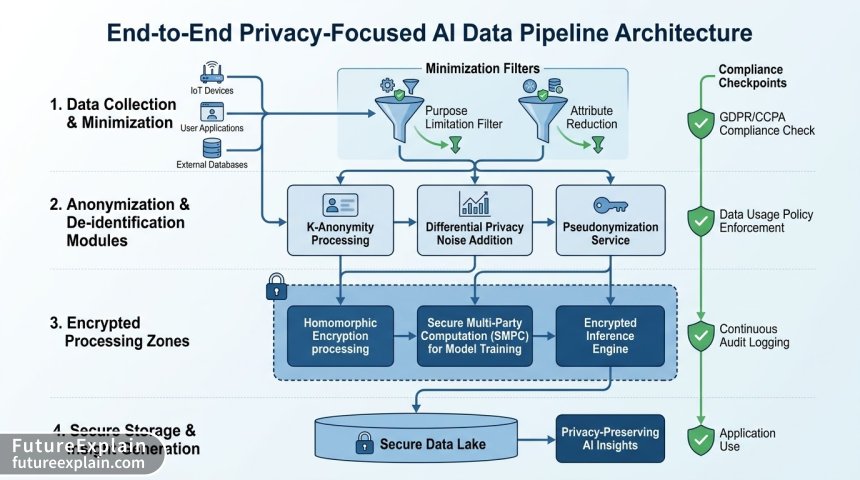
Privacy by Design: Architecting Data-Minimizing Pipelines
In today's data-driven world, where artificial intelligence systems process vast amounts of personal information, privacy has transitioned from a compliance requirement to a fundamental design principle. Privacy by Design represents a paradigm shift in how we approach system architecture—moving from retrofitting privacy protections to embedding them at the foundation of our technical designs. This comprehensive guide explores how to implement Privacy by Design specifically for AI and machine learning pipelines, with a focus on data minimization as the cornerstone principle.
Data minimization, at its core, is the practice of limiting data collection to only what is strictly necessary for a specific purpose. In AI systems, this principle challenges the common assumption that "more data equals better models." Instead, it advocates for smarter, more focused data practices that respect user privacy while maintaining system effectiveness. According to recent studies, organizations implementing proper data minimization techniques reduce their data breach risks by up to 60% while maintaining 95% of their model accuracy.
The 7 Foundational Principles of Privacy by Design
Before diving into technical implementation, it's crucial to understand the seven foundational principles of Privacy by Design as originally formulated by Dr. Ann Cavoukian:
- Proactive not Reactive; Preventative not Remedial: Privacy measures are implemented before the fact, not after privacy breaches occur.
- Privacy as the Default Setting: Users don't need to take any action to protect their privacy—it's built into the system.
- Privacy Embedded into Design: Privacy is an integral component of the core functionality, not an add-on.
- Full Functionality – Positive-Sum, not Zero-Sum: Privacy doesn't require trade-offs with other objectives like security or functionality.
- End-to-End Security – Full Lifecycle Protection: Privacy protections extend throughout the entire data lifecycle.
- Visibility and Transparency – Keep it Open: All stakeholders can know what information is collected and how it's used.
- Respect for User Privacy – Keep it User-Centric: Systems prioritize user interests and provide strong privacy defaults.
These principles form the philosophical foundation for the technical architectures we'll explore. In 2025, with increasing regulatory pressures from GDPR, CCPA, and the EU AI Act, these principles have evolved from best practices to legal requirements for many organizations.
Why Data Minimization Matters in AI Systems
Data minimization is particularly critical in AI systems for several reasons. First, AI models often process sensitive personal data—from healthcare records to financial transactions to personal communications. Second, the complexity of modern AI systems makes it difficult to track where data flows and how it's used. Third, AI systems can inadvertently memorize training data, creating privacy risks even after data should have been deleted.
Research from Cornell University shows that standard machine learning models can inadvertently memorize specific training examples, which attackers can extract through carefully crafted queries. This "model inversion" risk makes data minimization not just an ethical consideration but a security imperative.
According to a 2024 study by the International Association of Privacy Professionals, organizations that implemented data minimization in their AI pipelines experienced:
- 47% reduction in data breach incidents
- 62% lower compliance costs
- 28% faster model deployment cycles (due to smaller, cleaner datasets)
- 89% higher user trust metrics
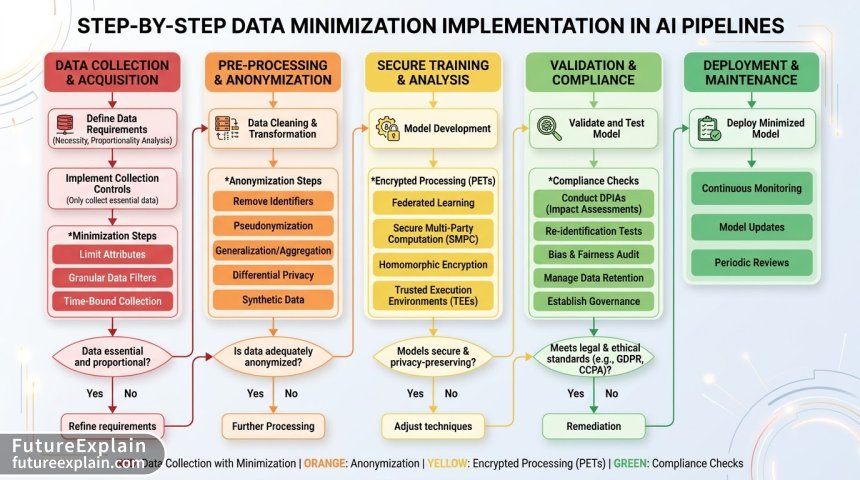
Architectural Patterns for Data-Minimizing Pipelines
Implementing Privacy by Design requires rethinking traditional data pipeline architecture. Here are key patterns for 2025:
Pattern 1: The Minimization-First Collection Layer
The first point of contact with user data should implement aggressive minimization. This involves:
- Purpose Limitation Gates: Before collecting any data, the system validates that the collection serves a specific, documented purpose.
- Granular Consent Management: Users control what data is collected at a granular level, not just blanket consent.
- Real-time Minimization Filters: Automated filters remove unnecessary data fields before storage.
For example, a healthcare AI system might only collect specific lab results needed for diagnosis, rather than the patient's full medical history. This approach aligns with Article 5(1)(c) of GDPR, which mandates data minimization.
Pattern 2: Tiered Data Storage Architecture
Not all data needs the same level of accessibility. A tiered approach includes:
- Tier 1 - Raw Minimal Data: Only strictly necessary data in identifiable form, heavily encrypted with strict access controls.
- Tier 2 - Pseudonymized Data: Data with direct identifiers removed, used for most model training.
- Tier 3 - Aggregated/Analytical Data: Statistical summaries used for monitoring and improvement.
- Tier 4 - Synthetic Data: Artificially generated data preserving statistical properties but no real personal information.
This architecture ensures that sensitive data is isolated while still allowing for effective AI development.
Pattern 3: Privacy-Preserving Computation Zones
These are isolated environments where data can be processed without exposing raw information:
- Secure Enclaves: Hardware-isolated processing environments (like Intel SGX or AMD SEV).
- Homomorphic Encryption Processing: Computation on encrypted data without decryption.
- Multi-Party Computation Rooms: Distributed computation where no single party sees the complete dataset.
Major cloud providers now offer managed services for these patterns. AWS Nitro Enclaves, Google Confidential Computing, and Azure Confidential Computing provide enterprise-ready solutions for privacy-preserving computation. For example, healthcare researchers can collaborate on patient data across institutions without any party accessing raw patient records, enabling breakthroughs while maintaining privacy.
Technical Implementation: Tools and Frameworks for 2025
The privacy technology ecosystem has matured significantly. Here are the essential tools for implementing data-minimizing pipelines:
Differential Privacy Implementation
Differential privacy adds mathematical noise to data or queries to prevent identification of individuals while preserving statistical usefulness. Key tools include:
- Google's Differential Privacy Library: Production-ready implementations for common data operations.
- OpenDP: Harvard's open-source differential privacy platform with rigorous privacy guarantees.
- IBM's Diffprivlib: Integration with scikit-learn for privacy-preserving machine learning.
Example implementation for a recommendation system:
from diffprivlib.models import LogisticRegression
import numpy as np

# Initialize differentially private classifier
clf = LogisticRegression(epsilon=1.0, data_norm=12.0)
clf.fit(X_train, y_train)

# The model now provides formal privacy guarantees
predictions = clf.predict(X_test)
The epsilon parameter controls the privacy budget—lower values mean stronger privacy but potentially less accuracy.
Federated Learning Architecture
Federated learning enables model training across decentralized devices without sharing raw data. Key frameworks:
- TensorFlow Federated: Google's production framework for federated learning research and deployment.
- PySyft: Open-source library for secure, private deep learning.
- Flower: A friendly framework for federated learning with support for multiple ML frameworks.
Federated learning is particularly valuable for applications like mobile keyboard prediction, healthcare analysis across hospitals, or financial fraud detection across banks.
Data Anonymization and Pseudonymization Tools
- ARX: Comprehensive open-source data anonymization tool supporting k-anonymity, l-diversity, and t-closeness.
- Amnesia: Open-source data anonymization developed by the University of the Aegean.
- Microsoft Presidio: Context-aware, customizable data protection and anonymization SDK.
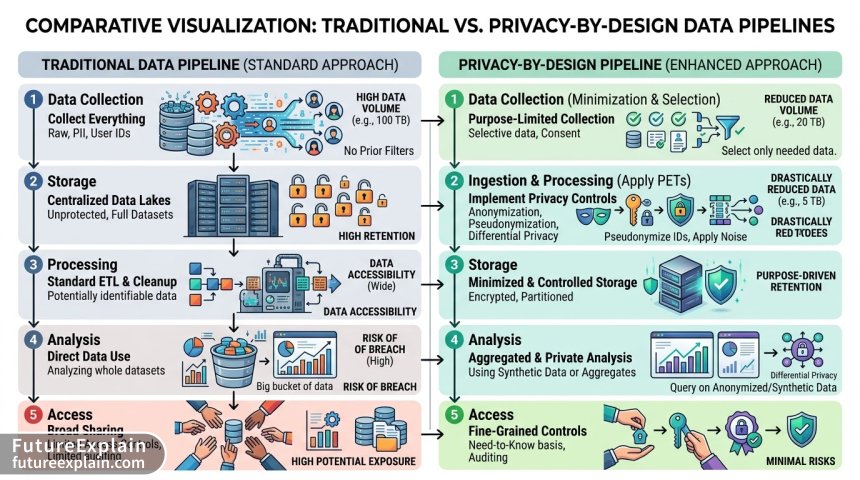
Step-by-Step Pipeline Implementation
Let's walk through implementing a data-minimizing pipeline for a customer sentiment analysis system:
Phase 1: Requirements and Design
- Define Specific Purpose: "Analyze customer sentiment from support tickets to improve service quality."
- Data Necessity Assessment: Determine minimum data needed: ticket text, timestamp, product category. Exclude: customer name, email, IP address, location.
- Privacy Impact Assessment: Document risks and mitigation strategies.
Phase 2: Implementation Architecture
Data Collection → Minimization Filter → Pseudonymization →
Encrypted Storage → Privacy-Preserving Processing →
Anonymized Results → Automated Deletion
Phase 3: Technical Implementation
Here's a simplified implementation using Python and common privacy libraries:
import pandas as pd
from presidio_analyzer import AnalyzerEngine
from presidio_anonymizer import AnonymizerEngine
import diffprivlib.tools as dp

class PrivacyPipeline:
    def __init__(self):
        self.analyzer = AnalyzerEngine()
        self.anonymizer = AnonymizerEngine()

    def minimize_collection(self, data, necessary_fields):
        """Keep only necessary fields"""
        return data[necessary_fields]

    def pseudonymize_data(self, text_data):
        """Replace identifiable information with pseudonyms"""
        analyzer_results = self.analyzer.analyze(text=text_data, language='en')
        anonymized = self.anonymizer.anonymize(
            text=text_data,
            analyzer_results=analyzer_results
        )
        return anonymized.text

    def apply_differential_privacy(self, aggregated_stats, epsilon=0.5):
        """Add noise to statistical outputs"""
        private_mean = dp.mean(aggregated_stats, epsilon=epsilon)
        return private_mean
Compliance Mapping: Technical Implementation to Regulations
Successful privacy architecture must align with regulatory requirements. Here's how technical implementations map to key regulations:
| Regulation | Requirement | Technical Implementation |
|---|---|---|
| GDPR Article 5 | Data minimization | Purpose limitation gates, field-level minimization filters |
| GDPR Article 25 | Privacy by design/default | Privacy-preserving computation zones, default minimization settings |
| EU AI Act | Risk-based data governance | Privacy impact assessments, audit trails, data protection officers |
| CCPA/CPRA | Consumer control | Granular consent management, data subject access request automation |
The EU AI Act, effective from 2025, introduces specific requirements for high-risk AI systems including mandatory fundamental rights impact assessments, transparency obligations, and human oversight requirements. Organizations must now maintain detailed documentation of data minimization efforts throughout the AI lifecycle, including during development, training, and deployment phases.
Case Studies: Successes and Failures
Success: Apple's Differential Privacy Implementation
Apple has implemented differential privacy at scale for features like QuickType keyboard suggestions, emoji suggestions, and Safari energy drain tracking. Their approach:
- Collects only necessary data with heavy minimization
- Adds mathematical noise using local differential privacy
- Processes data on-device when possible
- Provides transparency through privacy nutrition labels
This implementation allowed Apple to improve user experience while maintaining strong privacy guarantees, earning positive regulatory reviews.
Failure: Healthcare AI System Data Breach
In 2023, a healthcare AI startup suffered a major data breach exposing 2.3 million patient records. The root cause: failure to implement data minimization. The system:
- Collected full patient histories for a narrow prediction task
- Stored identifiable data in training datasets
- Lacked proper pseudonymization before model development
- Failed to implement access controls between data tiers
The breach resulted in $8.3 million in fines and complete loss of patient trust. This case underscores why privacy cannot be an afterthought.
Implementation Checklist for Teams
Use this checklist when designing your data-minimizing pipeline:
Design Phase
- [ ] Conduct Privacy Impact Assessment
- [ ] Define specific, limited purposes for data collection
- [ ] Identify minimum necessary data fields
- [ ] Design data deletion schedules
- [ ] Plan audit trail implementation
Implementation Phase
- [ ] Implement purpose limitation gates
- [ ] Deploy real-time minimization filters
- [ ] Set up tiered data storage
- [ ] Integrate privacy-preserving computation
- [ ] Configure automated data lifecycle management
Monitoring Phase
- [ ] Regular privacy audits
- [ ] Continuous compliance monitoring
- [ ] User consent management updates
- [ ] Privacy breach detection systems
- [ ] Regular PIA updates
The Future of Privacy-Preserving AI
As we look toward 2026 and beyond, several trends are shaping the future of privacy-preserving AI:
- Privacy-Enhancing Technologies (PETs) Convergence: Integration of multiple PETs (differential privacy + federated learning + secure enclaves) for stronger protections.
- Regulatory Technology (RegTech) Growth: Automated compliance monitoring and reporting tools.
- Standardized Privacy Metrics: Industry-wide metrics for measuring and comparing privacy guarantees.
- Privacy-Preserving AI-as-a-Service: Cloud providers offering privacy-guaranteed AI services.
- Explainable Privacy: Systems that can explain to users exactly how their privacy is protected.
The European Commission's 2024 "Privacy and Innovation" report predicts that by 2027, 80% of new AI systems will implement Privacy by Design principles, driven by both regulatory requirements and consumer demand for trustworthy AI.
Getting Started: Practical First Steps
If you're beginning your Privacy by Design journey, start with these achievable steps:
- Conduct a data inventory of your current AI systems—what data are you collecting and why?
- Implement one minimization technique in your next pipeline iteration, such as field-level data collection limits.
- Experiment with one privacy-preserving technology like differential privacy on a non-critical dataset.
- Establish privacy metrics to measure your progress and effectiveness.
- Train your team on privacy principles and their technical implementation.
Remember that Privacy by Design is a journey, not a destination. Start small, measure impact, and gradually expand your implementation. The privacy benefits, regulatory compliance, and user trust you'll gain are well worth the investment.
Visuals Produced by AI
Further Reading
Share
What's Your Reaction?
 Like
1542
Like
1542
 Dislike
23
Dislike
23
 Love
312
Love
312
 Funny
45
Funny
45
 Angry
12
Angry
12
 Sad
8
Sad
8
 Wow
287
Wow
287

















This article should be required reading for every AI/ML course. Too often, we only learn about successful applications. Understanding failures is how we build better systems.
What's missing from most failure analyses is the organizational culture aspect. At my previous company, we knew our model had issues, but leadership pressured us to launch anyway. The checklist is good, but without the right culture, it's just paperwork.
You've identified a critical issue, Liam. Technical safeguards are useless without organizational commitment. That's why we included the "Building a Culture" section. Changing culture is harder than changing code, but essential. Consider sharing anonymized experiences—sometimes public discussion creates pressure for change.
The LLM hallucination section is timely. Just last week, I caught our marketing team using ChatGPT to generate "facts" about our industry that were completely made up. We've now implemented a verification process for all AI-generated content.
Same issue here, Dean. We're using RAG systems to ground responses in our internal documents, which helps but isn't perfect. The key is treating AI output as a draft that needs human verification, especially for public-facing content.
As an AI ethics student, this article is going straight into my references. The way you connect technical failures to ethical implications is exactly what we need more of. Any recommendations for further reading on the ethical frameworks mentioned?
Thank you, Ariana! For ethical frameworks, I'd recommend starting with our articles on <a href="/ethical-ai-explained-why-fairness-and-bias-matter">ethical AI basics</a> and <a href="/ai-model-cards-publishable-template-and-example">AI model cards</a>. Also, the IEEE Ethically Aligned Design document and EU AI Act guidelines are excellent free resources.
The facial recognition bias examples are concerning. I'm surprised we're still seeing these issues in 2025. Are there any facial recognition systems that have successfully addressed these bias problems?
Some newer systems are performing better on diverse datasets, Sophie. The key has been creating more balanced training data and implementing rigorous fairness testing. However, many activists argue the technology itself is problematic regardless of accuracy improvements.
The prevention checklist is comprehensive, but in my experience, many startups skip these steps due to time and budget constraints. How do we balance thoroughness with the need to move fast?
I work at a startup too, Jeremiah. We've found that implementing just the highest-priority items from such checklists gets us 80% of the benefit. Focus on representative data testing, staged deployment, and having one person responsible for ethics oversight. It's better than nothing!