Enterprise AI Adoption: Roadmap for Mid-Sized Companies
This comprehensive guide provides mid-sized companies (100-1000 employees, $50M-$500M revenue) with a practical 6-phase roadmap for AI adoption. We cover everything from initial assessment and team building to vendor selection, implementation, and scaling. Unlike enterprise-focused guides, this roadmap addresses the unique constraints and opportunities of mid-market organizations, including budget limitations, limited IT resources, and the need for rapid ROI. You'll get actionable templates, phase-by-phase checklists, real-world case studies, and strategies for building AI literacy across your organization while managing change effectively.


Enterprise AI Adoption: Roadmap for Mid-Sized Companies
Mid-sized companies—typically those with 100-1,000 employees and $50M-$500M in revenue—face unique challenges when adopting artificial intelligence. Unlike startups that can build AI-first cultures or large enterprises with dedicated AI budgets and teams, mid-market organizations must navigate resource constraints, existing legacy systems, and the need for rapid, measurable ROI. This comprehensive guide provides a practical, phased roadmap specifically designed for mid-sized companies looking to harness AI's transformative potential without enterprise-scale resources.
The journey to AI adoption isn't about chasing the latest technology trends; it's about strategically implementing intelligent solutions that solve real business problems, improve efficiency, and create competitive advantages. According to McKinsey's 2024 AI adoption survey, while 72% of large enterprises have implemented AI in at least one business function, only 38% of mid-sized companies have done the same—not because of lack of interest, but due to unclear implementation paths and resource constraints.
Understanding the Mid-Sized Company Context
Before diving into the roadmap, it's crucial to understand what makes mid-sized companies different in their AI adoption journey. These organizations typically have:
- Limited dedicated IT/AI teams: Unlike enterprises with entire AI departments, mid-sized companies often have IT teams focused on maintaining existing systems
- Budget constraints: AI initiatives compete with other business priorities for limited capital
- Existing legacy systems: Many operate with older software that wasn't designed for AI integration
- Faster decision cycles: They can implement changes more quickly than large corporations but need to see results faster
- Cross-functional teams: Employees often wear multiple hats, requiring different change management approaches
These factors significantly influence how mid-sized companies should approach AI adoption. The most successful implementations start not with technology, but with clear business objectives and organizational readiness assessments.
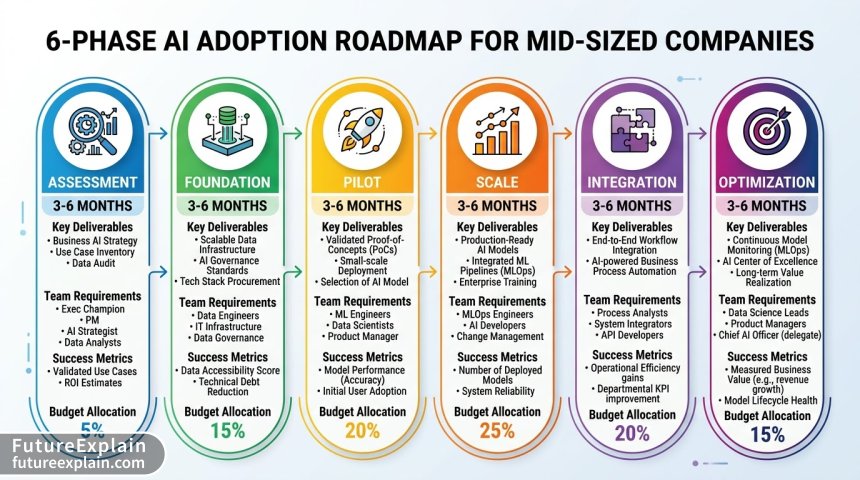
Phase 1: Assessment & Strategy Development (Months 1-3)
The foundation of successful AI adoption is understanding your starting point and defining clear objectives. This phase involves organizational assessment, opportunity identification, and strategic planning.
1.1 Organizational Readiness Assessment
Begin by evaluating your company's current state across five key dimensions:
- Technical Infrastructure: Assess your current systems, data architecture, and integration capabilities. Do you have APIs? Is your data centralized or siloed?
- Data Maturity: Evaluate data quality, accessibility, and governance. According to Gartner research, 60% of mid-market AI projects fail due to poor data quality.
- Skills & Talent: Inventory existing AI-relevant skills in your organization. You don't need PhD data scientists—look for employees with analytical thinking, process optimization experience, and curiosity about technology.
- Leadership Alignment: Ensure executive buy-in and understanding of AI's potential and limitations. This is crucial for securing budget and organizational support.
- Cultural Readiness: Assess employee attitudes toward technology adoption and change. Resistance to change is a primary barrier in mid-sized organizations.
1.2 Business Opportunity Identification
Identify where AI can deliver the most value for your specific business. Focus on areas with:
- High-volume, repetitive tasks that consume employee time
- Data-rich processes with clear patterns and decision points
- Customer pain points that could be addressed with personalization or automation
- Competitive gaps where AI could create differentiation
Common high-impact areas for mid-sized companies include:
- Customer service automation and chatbot implementation
- Sales forecasting and lead scoring
- Marketing personalization and content generation
- Supply chain optimization and inventory management
- Financial process automation and fraud detection
- HR recruiting and employee onboarding
1.3 Developing the AI Strategy Document
Create a concise (5-10 page) AI strategy document that includes:
- Business objectives and key results (OKRs) for AI adoption
- Prioritized use cases with estimated ROI projections
- Resource requirements (budget, team, technology)
- Timeline with milestones and success metrics
- Risk assessment and mitigation strategies
- Governance framework for ethical AI use
This document becomes your north star throughout the adoption journey and should be reviewed quarterly.
Visuals Produced by AI
Phase 2: Foundation Building (Months 3-6)
With strategy in place, focus on building the foundational elements necessary for AI implementation. This phase often requires the most upfront investment but prevents costly mistakes later.
2.1 Team Formation & Skill Development
Most mid-sized companies can't hire dedicated AI teams, but you can build a cross-functional AI task force. This team should include:
- Executive Sponsor: C-level leader who champions the initiative
- Project Manager: Coordinates implementation and tracks progress
- Business Process Experts: Employees who deeply understand target processes
- IT Representative: Ensures technical compatibility and security
- Data Analyst: Works with data preparation and quality assessment
For skill development, consider:
- Online AI literacy courses for the broader organization (Coursera, Udacity, LinkedIn Learning)
- Targeted technical training for the core team (data analysis, prompt engineering, API integration)
- External workshops or consultants for specific skill gaps
2.2 Data Preparation & Infrastructure
Data is the fuel for AI systems. Focus on:
- Data Consolidation: Bring relevant data sources into centralized, accessible locations
- Data Cleaning: Address missing values, inconsistencies, and formatting issues
- Data Governance: Establish policies for data quality, security, and privacy
- Infrastructure Assessment: Determine if your current systems can support AI workloads or if cloud solutions are needed
For mid-sized companies, cloud-based AI platforms often provide the most cost-effective starting point, offering scalability without large upfront infrastructure investments.
2.3 Vendor Selection & Tool Evaluation
Choosing the right tools is critical. Evaluate options based on:
- Total Cost of Ownership: Include implementation, training, and ongoing costs
- Ease of Integration: Compatibility with existing systems
- Scalability: Ability to grow with your needs
- Vendor Support: Quality of documentation, training, and technical support
- Security & Compliance: Data protection measures and regulatory compliance
Consider a mixed approach: using established enterprise platforms for core functions (like Microsoft Azure AI or Google Cloud AI) alongside specialized tools for specific use cases.
Phase 3: Pilot Implementation (Months 6-9)
The pilot phase tests your strategy with minimal risk. Choose one high-impact, manageable use case to implement and learn from.
3.1 Selecting the Right Pilot Project
Ideal pilot projects have:
- Clear, measurable success metrics
- Contained scope that doesn't require enterprise-wide changes
- Strong executive sponsorship and engaged stakeholders
- Available, quality data
- Potential for quick wins (3-6 month timeline)
Example pilot projects for mid-sized companies:
- AI-powered customer support chatbot for a specific product line
- Automated invoice processing and accounts payable
- Predictive maintenance for manufacturing equipment
- Personalized email marketing campaigns
- Document classification and retrieval system
3.2 Implementation Approach
Adopt an agile methodology for pilot implementation:
- Week 1-2: Detailed requirements gathering and process mapping
- Week 3-6: Solution development and integration
- Week 7-8: Testing and refinement with actual users
- Week 9-12: Deployment and monitoring
Maintain a "fail fast, learn faster" mentality. Document every challenge and solution for future scaling.
3.3 Success Measurement & Learning
Define success metrics before implementation begins. Common metrics include:
- Time savings (hours reduced per task)
- Cost reduction (dollars saved)
- Quality improvement (error rate reduction)
- Employee satisfaction (adoption rates, feedback)
- Customer impact (response time, satisfaction scores)
After the pilot, conduct a thorough retrospective to identify what worked, what didn't, and what should be adjusted before scaling.
Phase 4: Scaling & Integration (Months 9-18)
Successful pilots create momentum for broader implementation. This phase focuses on scaling proven solutions across the organization.
4.1 Developing a Scaling Framework
Create a repeatable process for implementing AI solutions based on pilot learnings. Your framework should include:
- Standardized project initiation templates
- Consistent success metrics and reporting
- Repeatable implementation checklists
- Knowledge transfer processes between projects
- Governance structures for ongoing management
4.2 Change Management for Broader Adoption
As AI expands beyond pilot teams, change management becomes critical. Key strategies include:
- Communication Plan: Regular updates about AI initiatives, benefits, and impacts
- Training Programs: Role-specific training for affected employees
- Incentive Alignment: Connect AI adoption to performance metrics and recognition
- Support Systems: Help desks, documentation, and peer support networks
Remember that mid-sized companies often have closer employee relationships than large enterprises—leverage this for peer-led adoption.
4.3 Integration with Existing Systems
Ensure new AI solutions work seamlessly with existing business systems:
- API integrations between AI tools and core business applications
- Single sign-on for user accessibility
- Unified data flows to prevent new silos
- Consistent user experiences across systems

Visuals Produced by AI
Phase 5: Optimization & Maturity (Months 18-24)
With AI solutions deployed, focus shifts to optimization, improvement, and building sustainable capabilities.
5.1 Performance Monitoring & Continuous Improvement
Establish ongoing monitoring of AI systems:
- Regular performance reviews against success metrics
- User feedback collection and incorporation
- Model retraining and updating as data patterns change
- Cost optimization (monitoring cloud spend, license utilization)
5.2 Building Internal AI Capabilities
Reduce dependency on external vendors by developing internal skills:
- Create AI centers of excellence within business units
- Establish mentoring programs between technical and business teams
- Develop career paths for AI-related roles
- Create internal communities of practice for knowledge sharing
5.3 Evolving Governance & Ethics
As AI use expands, formalize governance structures:
- AI ethics committee with cross-functional representation
- Bias detection and mitigation processes
- Transparency guidelines for AI-assisted decisions
- Regular audits of AI systems for fairness and compliance
Phase 6: Innovation & Transformation (Month 24+)
The final phase shifts from implementing AI to being transformed by it—using AI to enable new business models and competitive advantages.
6.1 AI-Driven Business Model Innovation
Explore how AI can enable fundamentally new ways of creating value:
- Product personalization at scale
- Predictive services and proactive customer engagement
- New data-driven revenue streams
- Automated partnerships and ecosystem integrations
6.2 Continuous Learning & Adaptation
AI technology evolves rapidly. Maintain competitive advantage through:
- Regular technology assessments and trend monitoring
- Experimentation with emerging AI capabilities
- Strategic partnerships with AI vendors and research institutions
- Participation in industry AI communities and consortia
Budgeting for Mid-Sized Company AI Adoption
Budget constraints are a primary concern for mid-sized companies. A realistic budget allocation might look like:
- Year 1 (Phases 1-3): $100,000-$300,000 (strategy, pilot, initial tools)
- Year 2 (Phases 4-5): $200,000-$500,000 (scaling, additional use cases)
- Year 3+ (Phase 6): $300,000+ (innovation, advanced capabilities)
Budget breakdown typically includes:
- 40-50% for technology (software licenses, cloud services, integration)
- 30-40% for people (training, external expertise, internal time allocation)
- 10-20% for change management and ongoing operations
Consider phased funding tied to milestone achievements rather than allocating the entire budget upfront.
Common Pitfalls and How to Avoid Them
Based on mid-market implementation experiences, watch for these common challenges:
- Pitfall 1: Starting with technology instead of business problems
- Solution: Always begin with clear business objectives and use cases
- Pitfall 2: Underestimating data preparation requirements
- Solution: Allocate sufficient time and resources for data cleaning and integration
- Pitfall 3: Neglecting change management
- Solution: Treat AI adoption as organizational change, not just technology implementation
- Pitfall 4: Scaling too quickly without proper foundations
- Solution: Prove value with pilots before attempting enterprise-wide deployment
- Pitfall 5: Lack of ongoing governance
- Solution: Establish clear ownership and regular review processes from the start
Case Study: Manufacturing Company (450 employees, $120M revenue)
A mid-sized industrial manufacturer successfully implemented AI across their operations using this roadmap:
- Phase 1: Identified predictive maintenance and quality control as priority use cases
- Phase 2: Built a cross-functional team with operations, IT, and quality control representatives
- Phase 3: Piloted predictive maintenance on one production line, reducing downtime by 35%
- Phase 4: Scaled to all production lines and added quality inspection AI
- Phase 5: Optimized models and integrated with ERP system
- Results: 22% reduction in maintenance costs, 15% improvement in product quality, 18-month ROI
Getting Started: Your First 90-Day Action Plan
If you're ready to begin your AI adoption journey, here's a practical 90-day plan:
Days 1-30: Assessment & Education
- Form a core AI exploration team (3-5 people)
- Conduct initial organizational readiness assessment
- Identify 3-5 potential AI use cases
- Complete basic AI literacy training for leadership team
Days 31-60: Strategy Development
- Select primary pilot use case based on impact and feasibility
- Develop detailed business case with ROI projections
- Identify required resources and create initial budget
- Begin data assessment for pilot project
Days 61-90: Pilot Preparation
- Finalize pilot project scope and success metrics
- Select and procure necessary tools/technology
- Develop detailed implementation plan
- Secure formal approval and funding for pilot
Conclusion: The Mid-Sized Advantage
Mid-sized companies actually have significant advantages in AI adoption compared to larger enterprises. Their smaller size allows for faster decision-making, more agile implementation, and closer alignment between technology and business needs. By following a structured roadmap tailored to their specific context—focusing on clear business value, starting with manageable pilots, and building capabilities incrementally—mid-sized companies can successfully adopt AI without enterprise-scale resources.
The key is recognizing that AI adoption is a journey, not a destination. It requires ongoing commitment, learning, and adaptation. But for mid-sized companies willing to make that commitment, AI offers unprecedented opportunities to compete more effectively, serve customers better, and build sustainable competitive advantages in an increasingly digital world.