
Multilingual Models: Translating and Localizing Content
This comprehensive guide explores multilingual AI models that enable seamless translation and localization of content across languages. We explain how these models work, compare major platforms like Google Translate API, Amazon Translate, and OpenAI's multilingual capabilities, and provide practical workflows for businesses and content creators. Learn about the challenges of cultural adaptation, quality evaluation methods, and cost-effective strategies for implementing multilingual AI solutions. Whether you're expanding globally or making content accessible to diverse audiences, this guide offers actionable insights and best practices for effective cross-lingual communication in the AI era.


Introduction: The Global Language Challenge in the AI Era
In today's interconnected world, the ability to communicate across language barriers is no longer a luxury—it's a necessity. For businesses expanding globally, educators reaching diverse students, and content creators building international audiences, multilingual capabilities have become essential. Traditional translation methods, while valuable, often struggle with scale, speed, and contextual nuance. Enter multilingual AI models: sophisticated artificial intelligence systems designed to understand, translate, and generate content across dozens—sometimes hundreds—of languages.
Multilingual models represent one of the most transformative applications of modern AI. Unlike single-language models that must be trained separately for each language, multilingual systems learn patterns across multiple languages simultaneously. This cross-lingual understanding allows them to transfer knowledge from resource-rich languages (like English or Chinese) to less-resourced ones (like Swahili or Icelandic). The implications are profound: content that was previously inaccessible to non-native speakers can now be translated almost instantaneously, while businesses can localize their products and services with unprecedented efficiency.
This comprehensive guide will walk you through everything you need to know about multilingual AI models. We'll explore how these systems work under the hood, examine the leading platforms and tools available today, and provide practical strategies for implementing multilingual capabilities in your projects. Whether you're a business owner looking to expand internationally, a content creator seeking wider reach, or simply curious about how AI is breaking down language barriers, this article will give you the knowledge and tools to navigate the multilingual AI landscape confidently.
Understanding Multilingual Models: Beyond Simple Translation
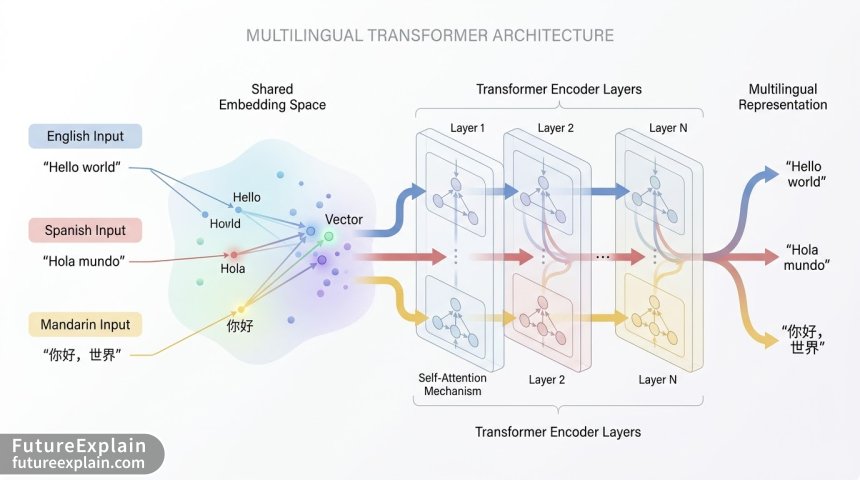
At their core, multilingual models are artificial intelligence systems trained on text data from multiple languages. But they're much more than just sophisticated translation tools. These models develop what researchers call a "shared embedding space"—a mathematical representation where words and phrases with similar meanings from different languages are positioned close together, regardless of the actual language.
This shared representation is achieved through several key techniques. Cross-lingual pre-training involves training models on parallel corpora (texts that are translations of each other) or even monolingual data from multiple languages. During this process, the model learns to recognize that certain patterns in one language correspond to specific patterns in another. For example, it might learn that the English phrase "I am hungry" and the Spanish "Tengo hambre" convey the same basic meaning, even though the literal word-by-word translation differs.
Another crucial concept is zero-shot transfer learning. This allows a model trained on certain language pairs to perform reasonably well on language pairs it has never explicitly seen during training. How is this possible? Because the model has learned abstract linguistic patterns that transcend specific languages. It understands grammatical structures, semantic relationships, and contextual cues that apply across human languages generally, not just within one language specifically.
Modern multilingual models typically fall into several categories. Massively multilingual models like Meta's NLLB (No Language Left Behind) support hundreds of languages but may sacrifice some quality for breadth. High-resource multilingual models focus on 20-50 major languages with extensive training data for each. Specialized multilingual models are fine-tuned for specific domains like legal documents, medical literature, or technical manuals. Understanding these categories helps you choose the right tool for your specific needs.
How Multilingual AI Models Actually Work
The technical foundation of most modern multilingual models is the transformer architecture, the same breakthrough that powers models like GPT-4 and BERT. However, multilingual implementations add several crucial modifications to handle multiple languages effectively.
First, let's consider the input processing. When you feed text in any language into a multilingual model, it goes through a shared tokenizer that breaks the text into subword units. Unlike single-language tokenizers that might use language-specific rules, multilingual tokenizers are designed to handle characters and patterns from multiple writing systems. Some models use sentence-piece tokenization that works across scripts, while others employ byte-pair encoding that's inherently language-agnostic.
The real magic happens in the shared encoder layers. As text embeddings flow through these layers, the model learns to map semantically similar concepts to similar positions in vector space, regardless of language. Research has shown that these models spontaneously develop language-agnostic representations of certain concepts. For instance, the vector representation for "dog" in English ends up surprisingly close to "perro" in Spanish and "狗" in Chinese, even though the model wasn't explicitly trained to align these specific words.
Training methodology varies between models. Some use parallel corpus training with explicitly aligned translations. Others employ monolingual training with language identification, where the model learns from massive amounts of text in each language separately, with only a language tag to indicate the source. The most sophisticated approaches combine both methods, along with techniques like translation language modeling and back-translation to strengthen cross-lingual understanding.
One particularly innovative approach is multilingual masked language modeling. During training, the model is shown text with certain words masked out (similar to the game Mad Libs). But here's the twist: sometimes the surrounding context is in one language, while the masked word needs to be predicted in another. This forces the model to develop truly language-agnostic understanding of concepts and contexts.
Major Multilingual Models and Platforms: A Comparative Analysis
The multilingual AI landscape has evolved rapidly, with several major players offering distinct approaches and capabilities. Understanding the strengths and limitations of each platform is crucial for making informed decisions about which solution fits your needs.
Comparison of Leading Multilingual AI Platforms
Let's examine the key players in the multilingual AI space:
Google Translate API & AutoML Translation: Google's solutions benefit from decades of translation research and massive datasets. The standard Translate API supports over 100 languages with consistent quality for major language pairs. AutoML Translation allows custom model training for domain-specific needs but requires substantial training data. Google's strength lies in its balanced quality across many languages and seamless integration with other Google Cloud services. However, costs can escalate quickly for high-volume usage, and there's limited transparency about model updates.
Amazon Translate: AWS's offering emphasizes enterprise integration and custom terminology support. It excels at handling technical and business content with consistent terminology management. Amazon Translate supports 75+ languages and offers active custom translation for continuous improvement. The pay-as-you-go pricing is predictable, and integration with other AWS services is seamless. The main limitation is that quality for less common language pairs can lag behind Google's offerings.
Microsoft Azure Translator: Part of Microsoft's Cognitive Services, Azure Translator emphasizes developer-friendly implementation with extensive documentation and SDKs. It supports 100+ languages and offers document translation for entire files. The Custom Translator feature allows fine-tuning on specific domains. Microsoft's particular strength is in business application integration, especially with Office 365 and Dynamics. However, the quality variance between language pairs is more pronounced than with Google.
OpenAI's Multilingual Capabilities: While not exclusively a translation tool, GPT-4 and subsequent models demonstrate impressive multilingual understanding and generation. The strength here is contextual adaptation and handling of nuanced language. OpenAI models can translate while preserving tone, style, and cultural references better than dedicated translation systems in some cases. The limitation is cost (token-based pricing can be expensive for long documents) and occasional hallucinations in less common languages.
Meta's NLLB (No Language Left Behind): This open-source model represents a major commitment to language inclusivity, supporting 200 languages including many low-resource ones. The open weights allow deployment flexibility and cost control. NLLB excels at languages underserved by commercial platforms. However, quality for major languages may not match commercial offerings, and implementation requires more technical expertise.
Hugging Face Transformers: The open-source ecosystem offers numerous multilingual models like mBERT, XLM-R, and mT5. These provide maximum flexibility and cost control (especially for self-hosting) but require significant technical expertise for fine-tuning and deployment. The community-driven nature means rapid innovation but variable quality assurance.
The Localization Process: Beyond Word-for-Word Translation
True localization goes far beyond direct translation—it involves adapting content to resonate with specific cultural contexts while maintaining the original intent and impact. This process requires understanding not just language, but cultural norms, values, humor, taboos, and local references.
The localization workflow typically follows several stages. First comes content analysis, where you identify which elements need adaptation. Text obviously needs translation, but what about images containing text? What about colors that have different cultural associations? What about measurement units, date formats, or currency references? A comprehensive content audit ensures nothing gets missed.
Next is translation with context. This is where multilingual AI shows its value, but human oversight remains crucial. The best practice is to use AI for initial translation, then have native speakers review for cultural appropriateness. Some elements simply don't translate directly—idioms, jokes, cultural references, and brand voice nuances often require creative adaptation rather than literal translation.
The third stage is cultural adaptation. This might involve changing images to feature people from the target culture, modifying examples to use locally relevant scenarios, or adjusting humor to match local sensibilities. Some cultures prefer direct communication while others value indirectness. Some prioritize individual achievement while others emphasize community. These cultural dimensions must inform your localization strategy.
Finally, quality assurance ensures the localized content works correctly in its new context. This includes functional testing (do all links work?), linguistic validation (is the translation accurate and natural?), and cultural verification (is the content appropriate and effective?). Many organizations use a combination of automated checks (for consistency and basic errors) and human review (for nuance and cultural fit).
Practical Implementation: Building Your Multilingual Workflow
Implementing multilingual capabilities requires careful planning and the right tool selection. Here's a step-by-step approach to building an effective multilingual workflow, whether you're translating website content, marketing materials, product documentation, or internal communications.
Step 1: Assess Your Needs and Resources
Begin by answering key questions: Which languages do you need to support? What's your content volume and update frequency? What's your budget? Do you have in-house native speakers for quality review? What level of quality is acceptable for your use case? A small business expanding to one new market has very different needs than a multinational corporation operating in dozens of countries.
Step 2: Choose Your Technology Stack
Based on your assessment, select appropriate tools. For many organizations, a hybrid approach works best: using cloud APIs for general content, custom-trained models for domain-specific terminology, and human review for high-stakes content. Consider factors like API reliability, cost predictability, data privacy requirements, and integration capabilities with your existing systems.
Step 3: Establish Quality Standards
Define what "good enough" means for your context. For casual internal communications, 90% accuracy might be acceptable. For legal documents or customer-facing marketing, you'll need near-perfect quality. Establish evaluation metrics that matter for your use case—this might include accuracy scores, reader comprehension tests, or conversion rates for translated marketing content.
Step 4: Implement the Translation Pipeline
Build automated workflows where possible. For example, when a new blog post is published in English, automatically generate translations for your target languages, then route them to human reviewers. Use translation memory systems to ensure consistency across documents and over time. Implement glossary management to handle specialized terminology consistently.
Step 5: Continuous Improvement Loop
Multilingual AI isn't a set-it-and-forget-it solution. Establish processes for collecting feedback on translation quality, identifying recurring issues, and updating your models or glossaries accordingly. Monitor which content performs well in different markets and adapt your localization strategy based on what you learn.

Quality Evaluation: How to Measure Translation Success
Evaluating translation quality is more complex than checking if words are translated correctly. Different use cases require different evaluation approaches, and understanding these distinctions is crucial for effective multilingual implementation.
Automated Metrics provide quick, objective measurements but have limitations. BLEU (Bilingual Evaluation Understudy) scores compare machine translations to human reference translations, measuring n-gram overlap. TER (Translation Edit Rate) calculates how many edits are needed to make the machine translation match a human reference. chrF++ focuses on character n-grams and works better for languages with rich morphology. While these metrics are useful for comparing systems or tracking improvements over time, they don't capture fluency, cultural appropriateness, or reader comprehension.
Human Evaluation remains the gold standard for high-stakes content. Common approaches include adequacy evaluation (does the translation convey the same information as the source?) and fluency evaluation (does the translation read naturally in the target language?). For marketing or creative content, you might also evaluate style preservation, emotional impact, or persuasive effectiveness. Human evaluation is time-consuming and expensive but essential for content where nuances matter.
Task-Based Evaluation measures how well translations enable specific actions. For instruction manuals, does the translated version allow users to complete tasks correctly? For customer support content, do translated FAQs resolve user issues? For e-commerce product descriptions, do translations drive purchases? This approach connects translation quality directly to business outcomes.
Reader Comprehension Testing is particularly valuable for educational or informational content. You can measure how well readers understand the translated material through quizzes, summaries, or application exercises. This approach reveals whether translations are not just accurate but also clear and accessible to the target audience.
Most organizations use a combination of these methods: automated metrics for routine monitoring, spot human checks for quality assurance, and periodic comprehensive evaluations for critical content. The key is aligning your evaluation strategy with your content's purpose and your quality requirements.
Cost Considerations and Optimization Strategies
Multilingual capabilities represent a significant investment, but strategic planning can optimize costs while maintaining quality. Understanding the various cost components and trade-offs is essential for budget-conscious implementation.
Pricing Models vary across providers. Most cloud translation services charge per character translated, with volume discounts available. Some offer monthly subscriptions with usage caps. OpenAI and similar LLM providers charge per token (roughly 4 characters for English), which can be more expensive for long documents but potentially more cost-effective for complex translations requiring deep contextual understanding. Open-source models have no per-use fees but require infrastructure and expertise to deploy and maintain.
Major Cost Drivers include translation volume (character count), language pairs (some language combinations cost more), content complexity (technical or creative content may require more expensive models or human review), and required speed (real-time translation typically costs more than batch processing). Additional costs can include custom model training, glossary management, quality assurance, and integration development.
Optimization Strategies can significantly reduce costs without compromising quality. Translation memory systems reuse previously translated segments, reducing volume. Selective human review focuses expensive human attention where it matters most. Tiered quality approaches use different methods for different content types—automated translation for internal communications, AI with light review for blog posts, and full human translation for marketing campaigns. Caching strategies store frequently accessed translations to avoid reprocessing.
ROI Considerations should factor in both costs and benefits. While multilingual capabilities require investment, they can drive revenue growth through market expansion, improve customer satisfaction with localized support, enhance employee productivity with translated internal resources, and strengthen brand perception through culturally appropriate communication. Many organizations find that even basic multilingual capabilities deliver substantial value relative to their cost.
Challenges and Limitations of Current Multilingual AI
Despite impressive advances, multilingual AI systems still face significant challenges that users should understand when implementing these technologies.
Language Imbalance remains a fundamental issue. While major languages like English, Chinese, and Spanish benefit from massive training datasets, many languages—especially indigenous and minority languages—have limited digital resources. This creates what researchers call the "digital language divide," where AI works well for some languages but poorly or not at all for others. Even within supported languages, quality can vary dramatically based on available training data.
Cultural Nuance and Context challenge even the most advanced systems. Language is deeply intertwined with culture, and words or phrases that are neutral in one context can be offensive in another. Humor, sarcasm, and indirect communication often don't translate well. Local references, historical context, and social norms may be completely missed by AI systems trained primarily on textual patterns without cultural understanding.
Domain Specialization presents another hurdle. General multilingual models may struggle with specialized terminology in fields like medicine, law, or engineering. While custom training can help, it requires domain-specific parallel data that may not exist for less common languages. This creates particular challenges for organizations operating in technical fields across multiple markets.
Bias and Representation issues can propagate through multilingual systems. If training data overrepresents certain dialects, demographics, or cultural perspectives, the resulting models may perform better for those groups while marginalizing others. For example, a model trained primarily on formal written text may struggle with colloquial speech or regional dialects.
Evaluation Difficulties compound these challenges. Standard evaluation metrics often fail to capture cultural appropriateness, stylistic quality, or practical effectiveness. Human evaluation is expensive and subjective. This makes it difficult to objectively compare systems or track improvements over time, especially for less common languages where qualified evaluators may be scarce.
Future Trends in Multilingual AI
The field of multilingual AI continues to evolve rapidly, with several promising trends that will shape the coming years.
Improved Low-Resource Language Support is a major focus area. Techniques like few-shot learning, transfer learning from related languages, and unsupervised pre-training on monolingual data are making it possible to build reasonable quality systems for languages with limited parallel data. Community-driven efforts to collect and annotate data for underserved languages are also gaining momentum.
Multimodal Multilingual Models represent another frontier. Systems that understand not just text but also images, audio, and video in multiple languages will enable richer cross-lingual experiences. Imagine pointing your phone at a restaurant menu in a foreign language and seeing not just translated text but explanations of dishes with cultural context.
Real-Time Adaptive Translation is becoming more sophisticated. Systems that learn from user corrections, adapt to individual communication styles, and incorporate real-world context (location, time, user history) will provide more personalized and effective multilingual experiences.
Ethical and Inclusive Development is receiving increased attention. Researchers and developers are focusing on fairness audits, bias mitigation, and inclusive design principles to ensure multilingual AI benefits all language communities rather than exacerbating existing inequalities.
Specialized Vertical Solutions are emerging for specific industries. Rather than general-purpose translation, we're seeing models fine-tuned for healthcare communication, legal documentation, educational content, and technical support. These domain-specific models promise higher accuracy for professional use cases.
Getting Started: Practical First Steps
If you're ready to implement multilingual capabilities, here are concrete steps to begin your journey effectively.
Start Small with High-Impact Content. Don't try to translate everything at once. Identify content that will deliver the most value when localized—perhaps your product's key features, top support articles, or main marketing messages. This allows you to learn and refine your approach before scaling.
Leverage Existing Tools. Begin with user-friendly platforms like Google Translate API or Azure Translator rather than building custom solutions. These services offer generous free tiers or low-cost entry points for experimentation. Use their built-in features like glossary management and batch processing.
Establish Quality Baselines. Before implementing any system, manually translate a sample of your content and evaluate its effectiveness. This gives you a baseline against which to compare AI translations. Document what works and what doesn't in your specific context.
Build Human-in-the-Loop Processes. Even if you plan to rely heavily on AI, establish workflows for human review, especially for critical content. Identify native speakers or professional translators who can provide quality assurance. Consider their feedback as valuable training data for improving your systems.
Monitor and Iterate. Track key metrics like translation cost, quality scores, user engagement with translated content, and business outcomes. Use these insights to refine your approach, adjusting which content you translate, which tools you use, and how much human review you apply.
Plan for Growth. As you gain experience, develop a roadmap for expanding your multilingual capabilities. This might include adding languages, translating more content types, implementing more sophisticated quality assurance, or building custom models for your specific domain.
Conclusion: The Multilingual Future is Here
Multilingual AI models represent one of the most democratizing forces in technology today. By breaking down language barriers, they're making information, opportunities, and connections accessible to broader audiences than ever before. While current systems aren't perfect and human oversight remains essential for many applications, the pace of improvement is remarkable.
The key to successful implementation lies in understanding both the capabilities and limitations of these technologies. By selecting appropriate tools for your specific needs, establishing effective workflows that combine AI efficiency with human judgment, and continuously evaluating and improving your approach, you can leverage multilingual AI to expand your reach, improve your communications, and connect with global audiences in meaningful ways.
As these technologies continue to evolve, they'll become increasingly seamless and integrated into our daily tools and workflows. The organizations that learn to leverage them effectively today will be best positioned to thrive in tomorrow's interconnected global landscape. Whether you're translating a single document or building comprehensive multilingual capabilities across your organization, the journey begins with understanding the possibilities—and that's exactly what we've explored together in this guide.
Visuals Produced by AI