Monetizing AI Skills: Services, Courses, and Micro-SaaS
This guide provides a clear, practical framework for generating income from AI knowledge. We explore three accessible pathways: offering AI-powered freelance services, creating and selling educational courses, and building a focused micro-SaaS application. For each path, you''ll find a breakdown of required skills, potential earnings, and step-by-step starting points. The article demystifies the process, helping you assess which model aligns with your expertise, goals, and available time. Learn how to package your skills into valuable services, leverage no-code tools to build software, and create educational content that establishes your authority. Whether you seek a side income or a full-time venture, this guide offers the actionable steps to begin your monetization journey responsibly and effectively.


Artificial intelligence has moved from a futuristic concept to a practical, everyday tool. This shift has created a significant opportunity: you can turn your understanding of AI into a sustainable income. You don't need to be a PhD researcher or a Silicon Valley engineer. Whether you've become adept at using AI writing tools, understand how to fine-tune a chatbot for customer service, or can explain machine learning concepts clearly, your knowledge has value.
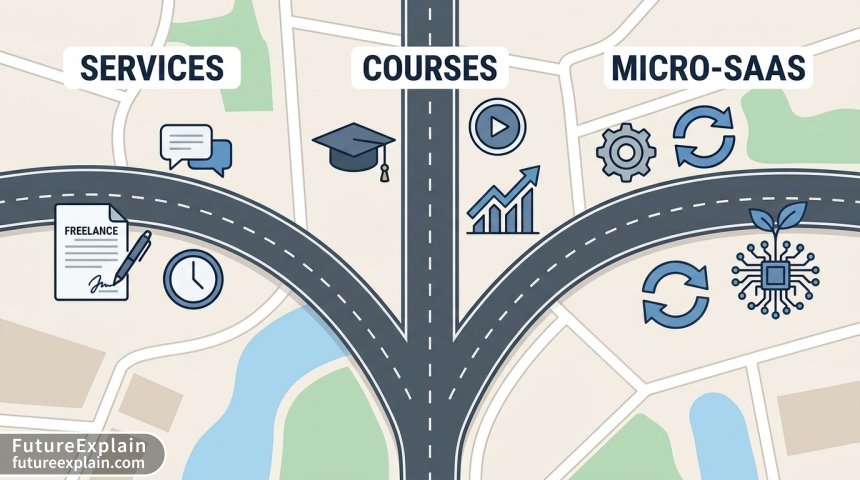
This guide breaks down three proven pathways to monetize AI skills: services, courses, and micro-SaaS. We'll explore what each path entails, the skills you need to start, realistic income potential, and concrete first steps. The goal is not to promise overnight riches but to provide a clear, responsible map for building income streams that leverage your unique expertise in the AI era.
Path 1: AI-Powered Services (Trading Time for Money)
This is the most direct way to start. You use your AI skills to solve specific problems for clients, typically as a freelancer or consultant. This path is ideal if you enjoy hands-on work, direct client interaction, and can deliver clear, tangible results.
What You Can Offer
The key is to combine your AI tool proficiency with an existing professional domain. You're not just an "AI expert"; you're a marketer who uses AI, a writer who uses AI, a business analyst who uses AI. Here are high-demand service areas:
- Content Creation & Copywriting: Use tools like ChatGPT and Jasper to produce blog posts, social media content, email sequences, and ad copy at scale. The value isn't just in generation, but in strategy, editing, and ensuring the output aligns with brand voice[citation:9].
- Operational Automation: Help small businesses automate repetitive tasks. This could involve setting up AI-powered customer support triage, creating systems for processing invoices or documents, or building simple data sorting workflows with no-code tools.
- Specialized Analysis: Offer services like AI-powered SEO keyword research and content gap analysis[citation:6], social media sentiment tracking, or basic market research summaries using AI to process large amounts of information quickly.
Visuals Produced by AI
Getting Started and Finding Clients
Begin by defining your specific service offering. "AI Services" is too vague. Instead, try "I create 30 SEO-optimized blog posts per month for B2B tech companies using AI-assisted writing and human editing."
- Platforms: Start on freelance marketplaces like Upwork or Fiverr. Create a profile that highlights specific outcomes, not just tools used[citation:9]. As you build a portfolio, you can move to direct client outreach through LinkedIn or your network.
- Portfolio Over Credentials: Your best asset is examples of work. Do a few pro-bono or heavily discounted projects for nonprofits or local businesses to build case studies. Show "before and after" scenarios.
- Pricing: Initially, charge by the project (e.g., $500 for a content calendar and 10 posts). As you standardize your process, you can move to retainer models (e.g., $1500/month for ongoing content and strategy).
The Reality: This path provides quickest-to-revenue but scales linearly with your time. The long-term goal is often to productize your service (create a standard package) or use this experience to identify problems worth solving with software (Path 3).
Path 2: Creating and Selling Educational Content
If you enjoy teaching and explaining complex topics in simple terms, packaging your knowledge into courses, guides, or workshops can be powerful. This builds authority and can generate passive income.
Identifying Your Teachable Niche
The most successful courses solve a specific, painful problem for a well-defined audience. Don't create "The Complete Guide to AI." Instead, focus on something like "AI for Non-Technical Startup Founders," "Midjourney Mastery for Interior Designers," or "Automating Bookkeeping for E-commerce Sellers with AI."
- Leverage Your Journey: What did you recently struggle to learn? Your learning process is the perfect blueprint for a course. The AI training platform space is growing, with platforms aiming to bridge the skills gap through hands-on courses[citation:7].
- Content Formats: Courses can be video-based (on Udemy, Teachable), written (e-books, PDF guides), or interactive (cohort-based workshops). A popular hybrid model is a free webinar that leads to a paid detailed course.
From Idea to Launch
You can use AI to help create the course itself, from outlining to generating examples, but the core value comes from your curated expertise and structure.
- Validate First: Before filming 50 videos, write the core outline and test it. Offer a free 1-hour workshop on the topic. Gauge interest, see what questions people ask, and use that feedback to shape the paid product.
- Choose the Right Platform: Use platforms like Thinkific, Podia, or Kajabi for full control and branding. Alternatively, publish on established marketplaces like Udemy or Coursera for built-in audience access but less revenue per sale and control. There are courses specifically teaching how to monetize with ChatGPT, covering everything from freelancing to digital product creation[citation:9].
- Marketing is Key: Your course won't sell itself. Use content marketing—write blog posts, record YouTube tutorials, and be active on social media discussing your niche topic. Give away valuable free information to build trust and an email list.
The Reality: Creating a quality course requires significant upfront work with no guaranteed return. However, a successful course can generate income for years with minimal upkeep. It's a powerful way to build your personal brand as an expert.
Path 3: Building a Micro-SaaS (Software as a Service)
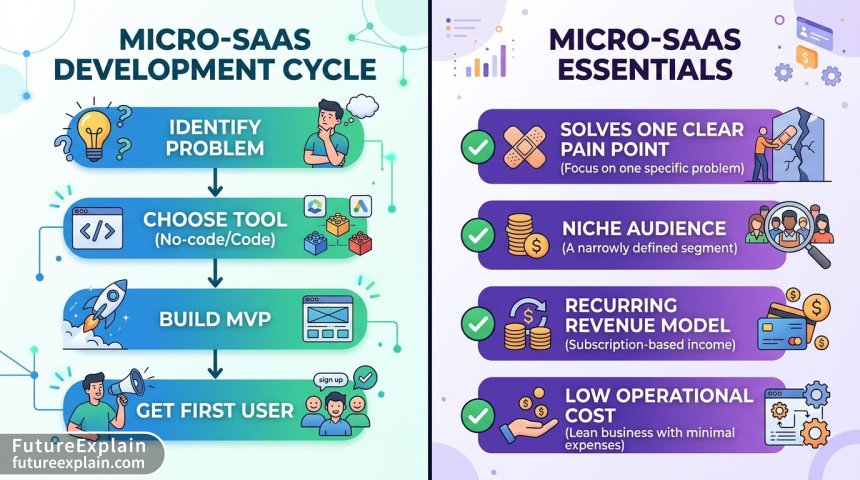
This is the most scalable path. A Micro-SaaS is a small, focused software application that solves one specific problem for a niche audience, often run by a solo founder or a very small team[citation:5]. Instead of trading hours for dollars, you build a "digital asset" that customers subscribe to monthly.
The Micro-SaaS Mindset: Niche and Focus
The power of micro-SaaS lies in its specificity. You're not building the next Salesforce. You're building "the best scheduling tool for dance instructors" or "an AI-powered compliance tracker for small accounting firms." This focus means less competition, clearer marketing, and a product that deeply resonates with its users[citation:2].
Successful micro-SaaS ideas often emerge from personal frustration or direct experience in an industry. They combine AI-powered automation with a clear, industry-specific need[citation:2].
Visuals Produced by AI
From Idea to First Paying Customer
The journey involves distinct phases:
- Idea Validation: Talk to at least 10-15 potential users in your target niche. Don't ask "Would you use this?" Ask about their current workflow, pain points, and what they pay for existing solutions. The goal is to find a problem people are already spending time or money on.
- Choosing Your Tech Stack: You no longer need to be a full-stack coding expert.
- No-Code/Low-Code: Platforms like Bubble, Adalo, or Softr allow you to build functional web apps visually. Tools like Anything provide frameworks to build specific types of SaaS (like analytics dashboards or meeting summarizers) by describing them[citation:6].
- Stacks for Developers: If you code, frameworks like Python with Streamlit allow rapid development of data-focused apps[citation:1]. The key is to use tools that let you build and iterate quickly.
- Building the MVP (Minimum Viable Product): Build the absolute smallest version of your product that solves the core problem. For a meeting summarizer SaaS, the MVP might just be an upload page that returns a transcript and summary—no teams, no integrations, no custom branding. The story of building a monetized micro-SaaS in a short timeframe emphasizes starting before overthinking and understanding the user's real needs[citation:4].
- Monetization & Pricing: Micro-SaaS typically uses subscription pricing (SaaS). Start with simple tiers (e.g., Basic $19/mo, Pro $49/mo). Offering a free trial is more effective than a free plan. Integrate payment processing from day one with Stripe or Paddle.
Choosing Your Monetization Platform
Once your app is built, you need a way to handle distribution, payments, and updates. The platform you choose impacts your revenue control and technical workload[citation:3].
For non-coders, no-code platforms like Estha allow for creating and monetizing AI apps through managed subscriptions and distribution[citation:3]. For developers who build with APIs, platforms provide different trade-offs:
- OpenAI API/Custom Build: High control and flexibility, but you handle all infrastructure, payment, and marketing yourself[citation:3].
- Marketplaces (like PromptIntellect): Lower barrier to entry and built-in distribution, but you share revenue and have less control over pricing and customer relationships[citation:8].
- Cloud Platforms (AWS Bedrock): Strong for enterprise-grade applications needing security and integration, but comes with higher technical complexity[citation:3].
The best choice depends on your technical skills and desire to manage business operations versus purely focusing on the product.
Comparing the Three Paths: Which Is Right for You?
Choosing a path depends on your skills, goals, and risk tolerance.
- AI Services (Freelancing)
- Best for: Quickest start, direct feedback, lower risk.
- Income Model: Linear (time-based). Scales with team.
- Key Skill: Client communication, reliable execution.
- First Step: Define one service and create a portfolio case.
- AI Courses (Education)
- Best for: Subject matter experts, teachers, building authority.
- Income Model: Passive potential after upfront work.
- Key Skill: Curriculum design and marketing.
- First Step: Validate a course topic with a free webinar or lead magnet.
- Micro-SaaS (Product)
- Best for: Problem-solvers, builders, seeking scalability.
- Income Model: Recurring revenue, high scalability.
- Key Skill: Product thinking, user empathy, basic tech understanding.
- First Step: Deeply interview potential users about a specific pain point.
It's also possible to combine paths. Many successful micro-SaaS founders started by offering a service, identified a repetitive problem, and then built a product to solve it. Similarly, creating a course can be a great way to build an audience before launching a SaaS product.
Essential Tools and Habits for Success
Regardless of the path, certain tools and mindsets will increase your chances of success.
- Start Small and Iterate: Don't try to build the perfect service, course, or app on day one. Launch a simple version, get feedback, and improve. The story of a founder building a micro-SaaS in 7 days highlights the importance of action over perfection[citation:4].
- Leverage the Modern AI Stack: Use affordable AI tools to automate your own work. For instance, use Notion AI for documentation, Jasper for marketing copy, and Zapier to connect workflows[citation:10]. This lets a small team operate efficiently.
- Focus on Marketing from Day One: Your product or service needs an audience. Start a blog, a LinkedIn presence, or an email list related to your niche. Share your journey and insights. Content marketing is often the most cost-effective channel for solo founders.
- Prioritize Customer Value: Constantly ask: "Is this feature/service/lesson providing real value?" Success comes from solving a problem so well that people are happy to pay for it.
Conclusion: Your Journey from Skills to Income
Monetizing your AI skills is more accessible today than ever before, thanks to no-code tools, global marketplaces, and powerful, affordable AI APIs. The journey begins with an honest assessment of your current skills and interests. Do you love hands-on client work? Start with services. Do you geek out on a specific topic and love to teach? Explore courses. Are you obsessed with solving a particular efficiency problem? Consider the micro-SaaS route.
There is no single "right" way. The most important step is the first one: define a small, manageable project related to one of these paths and execute it. You'll learn more from that first client, first course student, or first beta tester than from any guide. Use your AI skills not just as the product, but as an accelerator for your own business-building process. The future belongs to those who can effectively apply AI, and building a business around that application is one of the most rewarding ways to do it.