
AI in Marketing: Personalization, Privacy, and ROI
This comprehensive guide explores how artificial intelligence is revolutionizing marketing in 2025, focusing on three critical pillars: hyper-personalization, privacy compliance, and ROI measurement. We examine practical AI applications for customer segmentation, dynamic content generation, and predictive analytics while addressing GDPR, CCPA, and emerging privacy regulations. The article provides actionable frameworks for implementing consent-based personalization, measuring marketing ROI with AI-powered attribution models, and balancing personalization with privacy. With real-world examples and industry benchmarks, you'll learn how to leverage AI marketing tools responsibly while achieving measurable business outcomes. We also discuss ethical considerations, future trends, and practical implementation checklists for businesses of all sizes.


The AI Marketing Revolution: Beyond Hype to Practical Value
The marketing landscape has undergone a seismic shift since artificial intelligence transitioned from experimental technology to core business infrastructure. According to recent industry analysis, 78% of marketing leaders now report using AI in at least one major campaign component, up from just 32% in 2022. This rapid adoption reflects AI's tangible impact on marketing efficiency, personalization capabilities, and return on investment. However, as capabilities expand, so do the complexities—particularly around privacy compliance and ethical considerations.
This comprehensive guide explores the interconnected pillars of modern AI-driven marketing: sophisticated personalization, robust privacy protection, and measurable ROI. We'll move beyond theoretical discussions to provide actionable frameworks, implementation roadmaps, and industry benchmarks that work in today's regulatory environment. Whether you're a small business owner, marketing professional, or technology decision-maker, understanding this triad is essential for competitive marketing in 2025 and beyond.
Understanding AI's Role in Modern Marketing
Before diving into specific applications, it's crucial to understand what AI marketing actually means in practice. Contrary to common misconceptions, AI in marketing isn't about replacing human creativity with algorithms. Rather, it's about augmenting human capabilities with intelligent systems that can process data at scales impossible for human teams, identify patterns invisible to the naked eye, and execute repetitive tasks with perfect consistency.
The evolution has been remarkable. Early AI marketing tools focused primarily on basic segmentation and simple automation. Today's solutions encompass everything from predictive customer lifetime value calculations to real-time content optimization across dozens of channels simultaneously. The fundamentals of automation provide the foundation, but AI adds layers of intelligence and adaptability that transform static automation into dynamic, learning systems.
The Three Generations of Marketing Technology
- First Generation (2000-2010): Manual analytics and basic segmentation tools
- Second Generation (2011-2020): Marketing automation platforms with rule-based workflows
- Third Generation (2021-present): AI-native platforms with predictive capabilities and autonomous optimization
The shift to third-generation marketing technology represents more than incremental improvement—it's a fundamental change in how marketing operates. Instead of marketers telling systems what to do based on historical data, AI systems can now predict what will work best and implement those strategies autonomously, within parameters set by human teams.
The Personalization Paradox: More Data, More Expectations
Personalization has evolved from "nice-to-have" to non-negotiable. Research consistently shows that personalized experiences drive higher engagement, conversion rates, and customer loyalty. A 2024 study by the Marketing AI Institute found that properly implemented personalization can increase revenue by 15-20% across retail sectors. However, the definition of "good personalization" has changed dramatically.
From Basic to Hyper-Personalization
Early personalization efforts focused largely on inserting a customer's name into emails or showing recently viewed products. Today's AI enables hyper-personalization that accounts for hundreds of variables in real-time:
- Contextual Personalization: Adjusting messaging based on time of day, location, device, and even weather conditions
- Behavioral Prediction: Anticipating customer needs before they explicitly express them
- Emotional Intelligence: Analyzing sentiment in customer interactions to tailor responses
- Cross-Channel Consistency: Maintaining personalized experiences across email, web, mobile, and physical touchpoints
The most sophisticated systems now implement what's called "next-best-action" marketing, where AI algorithms determine the optimal communication for each customer at any given moment, considering their entire interaction history, current context, and predicted future behavior.
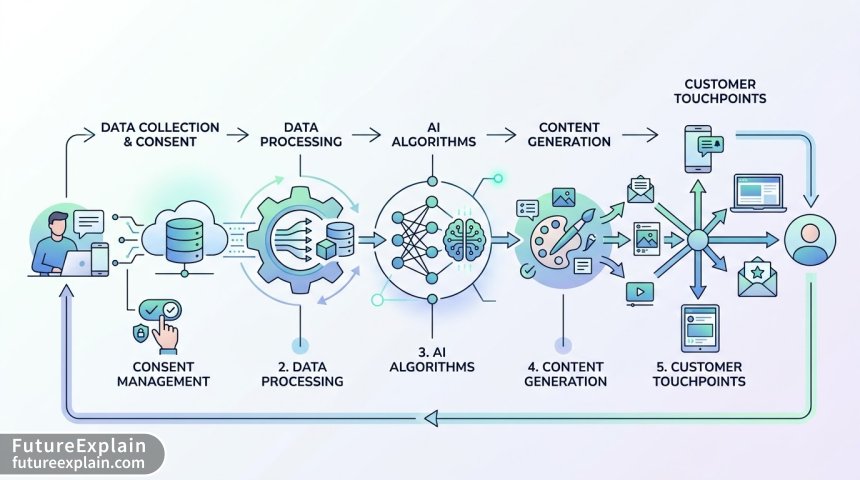
Real-World Examples of AI-Driven Personalization
Consider these implementations from leading companies:
- Stitch Fix: Their AI stylists analyze customer preferences, purchase history, and feedback to create personalized clothing selections, achieving 86% customer retention rates
- Netflix: Beyond just recommendations, their AI personalizes thumbnail images based on individual viewing history, increasing click-through rates by 20-30%
- Amazon: Their "anticipatory shipping" patent describes systems that begin shipping products before customers order them, based on predictive algorithms
- Spotify: Daily Mix and Discover Weekly playlists use collaborative filtering and natural language processing to create hyper-personalized music experiences
These examples demonstrate that effective personalization isn't just about recommending products—it's about creating entirely personalized experiences that feel bespoke to each individual.
The Privacy Imperative: Regulations and Customer Expectations
As personalization capabilities have expanded, so have privacy concerns and regulations. The tension between these two forces represents one of marketing's most significant challenges in 2025. Customers increasingly demand both highly personalized experiences and ironclad privacy protections—seemingly contradictory expectations that AI must help reconcile.
The Global Regulatory Landscape
Marketing teams must navigate an increasingly complex web of privacy regulations:
- GDPR (EU): Requires explicit consent for data processing and gives individuals rights over their data
- CCPA/CPRA (California): Provides similar rights with some differences in implementation
- LGPD (Brazil): South America's comprehensive data protection law
- PIPL (China): China's personal information protection law with strict requirements
- Emerging Regulations: Dozens of other countries developing or implementing similar frameworks
These regulations aren't just legal requirements—they've fundamentally changed customer expectations. Today's consumers are more aware of their data rights and more selective about what information they share. Successful marketing in this environment requires what privacy experts call "privacy by design," where privacy considerations are integrated into marketing systems from the ground up, not added as an afterthought.
Consent Management in the AI Era
Effective consent management has become a strategic capability rather than just a compliance requirement. Modern systems must:
- Capture granular consent for different types of data processing
- Maintain comprehensive audit trails of consent changes
- Respect withdrawal of consent across all systems instantly
- Enable preference centers where customers control their experience
AI plays a crucial role in making consent management practical at scale. Natural language processing can analyze privacy policies and match them to consent requirements, while machine learning can identify patterns in consent preferences to optimize request timing and presentation.
The ROI Equation: Measuring What Matters
Despite AI's potential, marketing investments must demonstrate clear return on investment. The challenge lies in accurately measuring AI's impact amidst complex, multi-touch customer journeys. Traditional attribution models often fail to capture AI's full value, particularly for brand building and customer experience improvements.
Beyond Last-Click Attribution
Last-click attribution, which gives all credit to the final touchpoint before conversion, severely underrepresents AI marketing's value. Modern approaches include:
- Multi-Touch Attribution (MTA): Distributing credit across multiple touchpoints using algorithmic models
- Marketing Mix Modeling (MMM): Statistical analysis of historical data to estimate impact of different marketing activities
- Unified Measurement: Combining MTA and MMM for comprehensive visibility
AI enhances all these approaches by processing massive datasets to identify true causal relationships rather than just correlations. Advanced systems can now run thousands of simulated marketing scenarios to determine optimal budget allocation across channels and tactics.
Calculating AI Marketing ROI: A Practical Framework
To calculate ROI for AI marketing investments, consider this comprehensive framework:
- Direct Revenue Impact: Increased conversion rates, average order values, and customer lifetime value
- Efficiency Gains: Reduced manual work, faster campaign execution, lower cost per acquisition
- Strategic Value: Improved customer insights, competitive advantage, brand equity enhancement
- Risk Mitigation: Reduced compliance violations, better fraud detection, improved crisis response
Industry benchmarks from 2024 show that well-implemented AI marketing systems typically achieve:
- 15-35% increase in marketing ROI
- 20-40% reduction in customer acquisition costs
- 10-25% improvement in customer retention rates
- 30-50% reduction in time spent on manual reporting and optimization

Implementing AI Marketing: A Step-by-Step Guide
Transitioning to AI-driven marketing requires careful planning and execution. Here's a practical implementation roadmap:
Phase 1: Foundation and Assessment (Weeks 1-4)
Begin with a comprehensive assessment of your current capabilities:
- Audit existing data quality, accessibility, and governance
- Evaluate current marketing technology stack for AI compatibility
- Identify 2-3 high-impact, manageable use cases to start
- Assess team skills and identify training needs
- Review privacy compliance status and gaps
This phase should conclude with a clear business case and implementation plan approved by key stakeholders.
Phase 2: Pilot Implementation (Weeks 5-12)
Select one use case for pilot implementation. Ideal pilot projects have:
- Clear success metrics
- Controlled scope
- Strong executive sponsorship
- Cross-functional team participation
Common successful pilot projects include personalized email subject line optimization, dynamic website content, or AI-powered ad bidding.
Phase 3: Scale and Integration (Months 4-9)
Based on pilot learnings, expand AI implementation across additional use cases and integrate with core marketing systems. This phase typically involves:
- Implementing enterprise AI marketing platform
- Developing comprehensive data governance framework
- Creating Center of Excellence for AI marketing
- Establishing ongoing measurement and optimization processes
Phase 4: Optimization and Innovation (Ongoing)
Continuous improvement becomes the norm, with regular reviews of AI performance, exploration of new capabilities, and refinement of strategies based on results.
Ethical Considerations in AI Marketing
As AI capabilities expand, ethical considerations become increasingly important. Responsible AI marketing requires attention to several key areas:
Avoiding Algorithmic Bias
AI systems can inadvertently perpetuate or amplify existing biases in training data. Marketing teams must implement bias testing and mitigation strategies, particularly for:
- Credit and pricing algorithms
- Product recommendations
- Audience segmentation
- Content personalization
Regular audits of AI outputs for fairness across demographic groups are essential for ethical marketing practices.
Transparency and Explainability
Customers increasingly want to understand why they're seeing specific marketing messages. Implementing explainable AI (XAI) techniques helps build trust by providing understandable reasons for personalized recommendations and targeting decisions.
Psychological Well-being Considerations
Highly persuasive AI systems raise questions about manipulation and consumer autonomy. Ethical frameworks should include considerations of:
- Appropriate persuasion boundaries
- Vulnerable audience protections
- Addictive pattern prevention
- Mental health impacts of constant personalization
These considerations aren't just ethical imperatives—they're increasingly becoming regulatory requirements and brand differentiators in competitive markets.
Future Trends: What's Next for AI in Marketing
The evolution of AI marketing continues at a rapid pace. Several emerging trends will shape the landscape through 2026 and beyond:
Generative AI Integration
While early generative AI focused on content creation, the next wave integrates generation with personalization and optimization. Systems will create not just content, but entire personalized experiences in real-time based on individual customer contexts.
Privacy-Enhancing Technologies (PETs)
New technologies enable personalization without compromising privacy:
- Federated Learning: Training AI models on decentralized data without moving sensitive information
- Differential Privacy: Adding statistical noise to protect individual data points while preserving aggregate insights
- Homomorphic Encryption: Processing encrypted data without decryption
These technologies, explored in our guide to privacy-preserving AI, will become increasingly important as privacy regulations tighten.
Voice and Conversational AI
As voice interfaces and conversational AI mature, marketing will expand beyond visual channels to include voice-based personalization and interaction. This requires different approaches to measurement and optimization.
AI-Driven Creativity
AI will increasingly collaborate with human creatives, suggesting concepts, variations, and optimizations based on performance data and creative principles. This represents a shift from AI as pure automation to AI as creative partner.
Practical Implementation Checklist
For teams ready to implement AI marketing, here's a concise checklist:
- Data Foundation: Ensure clean, accessible, well-governed data
- Clear Objectives: Define specific business goals and success metrics
- Technology Selection: Choose platforms aligned with use cases and team capabilities
- Privacy Compliance: Implement consent management and data protection measures
- Team Training: Upskill marketing teams on AI concepts and tools
- Pilot Program: Start small with controlled, measurable pilot
- Measurement Framework: Establish comprehensive ROI tracking from day one
- Ethical Guidelines: Develop and implement responsible AI policies
- Iterative Approach: Plan for continuous testing, learning, and optimization
- Stakeholder Communication: Maintain clear communication with leadership and cross-functional teams
Conclusion: Balancing the Triad for Sustainable Success
The future of marketing lies in mastering the delicate balance between personalization, privacy, and ROI. As AI capabilities advance, the most successful organizations will be those that view these elements not as trade-offs but as interconnected components of customer-centric marketing.
Personalization without privacy consideration risks regulatory penalties and customer distrust. Privacy without personalization may ensure compliance but fails to deliver customer value. Neither matters without clear ROI measurement to justify continued investment. The organizations that thrive will be those that implement AI marketing systems designed from the ground up to optimize all three dimensions simultaneously.
The journey to AI-driven marketing excellence is iterative and ongoing. Start with a clear strategy, build on solid foundations, measure relentlessly, and evolve as technologies and regulations change. The rewards—increased efficiency, deeper customer relationships, and sustainable competitive advantage—are well worth the investment.
Visuals Produced by AI
Further Reading
Share
What's Your Reaction?
 Like
1420
Like
1420
 Dislike
35
Dislike
35
 Love
420
Love
420
 Funny
85
Funny
85
 Angry
12
Angry
12
 Sad
8
Sad
8
 Wow
310
Wow
310


















For those in regulated industries (healthcare, finance), how do you balance personalization with compliance requirements that restrict data usage? Our legal team often blocks promising AI initiatives.
Great comprehensive overview. I'd add that change management is often the biggest hurdle - getting marketing teams comfortable with AI-driven decisions versus human intuition. We invested heavily in training and transparent reporting to build trust in the systems.
The ROI benchmarks seem optimistic. We implemented AI marketing automation last year and saw only 8% improvement initially. It took 9 months to reach 22% improvement as the system learned and we refined our approach. Setting realistic timeframes is crucial.
The article mentions voice and conversational AI but doesn't explore measurement challenges. We've implemented voice commerce and struggle with attribution since many purchases happen days after voice interactions. Any frameworks for measuring voice channel impact?
Voice attribution is indeed challenging, Fatima. Some approaches we've seen work: using unique promotional codes mentioned in voice interactions, asking customers in follow-up surveys, or implementing voice-specific UTM parameters for web traffic from voice devices. It's still an evolving measurement area.
In Eastern Europe, we're seeing different privacy expectations than described here. Customers are more willing to share data for personalized experiences but expect transparency about how it's used. Cultural differences in privacy attitudes deserve more attention.
That's an important point, Olga. We operate globally and see significant regional variations. In Asia, for example, privacy expectations differ even between countries like Japan and South Korea. One-size-fits-all approaches fail.
Privacy-enhancing technologies like federated learning sound promising but seem technically complex. Are there turnkey solutions available yet, or are we still in early adoption phase?