How to Build an AI Side Project: MVP to First Users
This comprehensive guide walks you through building an AI side project from initial idea to Minimum Viable Product (MVP) and acquiring your first users. We cover both no-code and technical approaches suitable for beginners, with 2025-specific tool recommendations. Learn how to validate your idea, choose the right development path, build your MVP efficiently, and implement effective user acquisition strategies. Includes real-world examples, cost considerations, and common pitfalls to avoid based on current AI development practices.


Building an AI side project has never been more accessible than in 2025. With the proliferation of no-code tools, affordable APIs, and pre-trained models, you can transform an idea into a working product and find your first users without quitting your day job or raising venture capital. This guide provides a comprehensive, step-by-step approach to navigating the entire journey—from that initial spark of inspiration to delivering value to real users.
Whether you're a developer looking to apply your skills to a passion project, a business professional wanting to solve a specific problem with AI, or a complete beginner curious about the space, this guide will give you a realistic roadmap. We'll cover multiple pathways tailored to different skill levels, discuss 2025-specific tools and costs, and provide practical strategies for user acquisition that go beyond the generic "build it and they will come" advice.
Why Build an AI Side Project in 2025?
The landscape for AI development has matured significantly. What once required PhD-level expertise and massive computing resources can now often be accomplished with API calls and clever prompting. The barriers to entry have lowered, but the opportunities haven't diminished—they've evolved. Side projects offer unique advantages: they allow for experimentation without the pressure of immediate monetization, provide hands-on learning with emerging technologies, and can evolve into sustainable businesses or valuable portfolio pieces.
According to analysis of successful AI projects launched in 2024-2025, several patterns emerge: successful projects tend to solve specific, well-defined problems rather than offering generic AI capabilities; they often combine multiple AI tools rather than relying on a single model; and they prioritize user experience and reliability over technical sophistication.
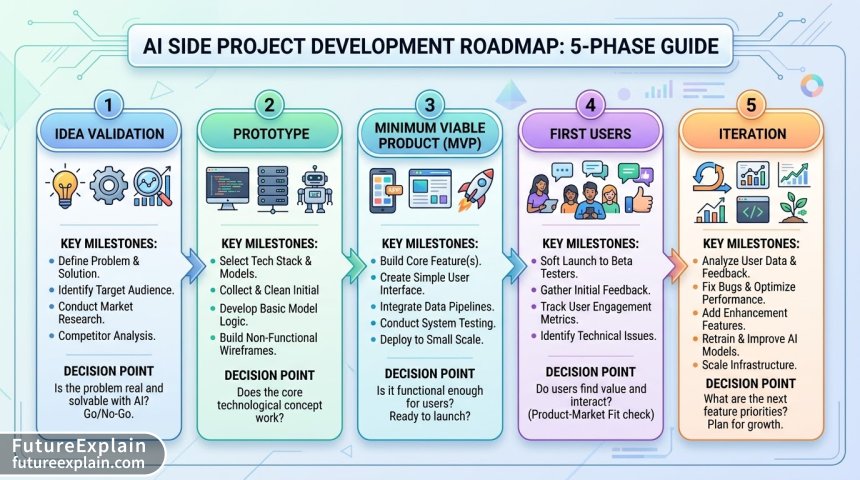
Phase 1: Idea Validation and Problem Definition
Before writing a single line of code or configuring any no-code tool, you need to validate your idea. The most common mistake in side projects is building something nobody wants. Validation doesn't require complex market research—it requires honest conversations and simple experiments.
Identifying Real Problems
Start with problems you personally experience or observe in your work, hobbies, or community. The best AI side projects often emerge from genuine frustration or inefficiency. Ask yourself: Is this a problem people would pay (with money or time) to solve? Is it a frequent enough occurrence to matter? Does AI genuinely offer a better solution than existing approaches?
Consider these successful AI side project categories from 2024-2025:
- Productivity enhancers: Tools that automate specific, repetitive tasks in workflows
- Content transformation: Applications that reformat or adapt content between mediums
- Decision support: Systems that help users make better choices with data analysis
- Personalization engines: Tools that tailor experiences or content to individual preferences
- Educational aids: Applications that provide personalized learning or explanation
The "Pre-MVP" Validation Techniques
Instead of building immediately, try these low-effort validation methods:
- Manual solution simulation: Can you solve the problem manually for a few people? This tests whether the problem is real and whether your solution approach works.
- Landing page test: Create a simple landing page describing your solution and measure interest through email signups or waitlist registration.
- Community engagement: Share your idea in relevant communities (Reddit, Discord, specialized forums) and gauge interest and feedback.
- Competitor analysis: Are there similar solutions? If yes, can you identify their weaknesses or underserved niches? If no, is there a reason why?
An emerging trend in 2025 is "paper prototyping" for AI projects—creating detailed workflow diagrams that show exactly how the AI would interact with users and data before any implementation begins.
Phase 2: Choosing Your Development Pathway
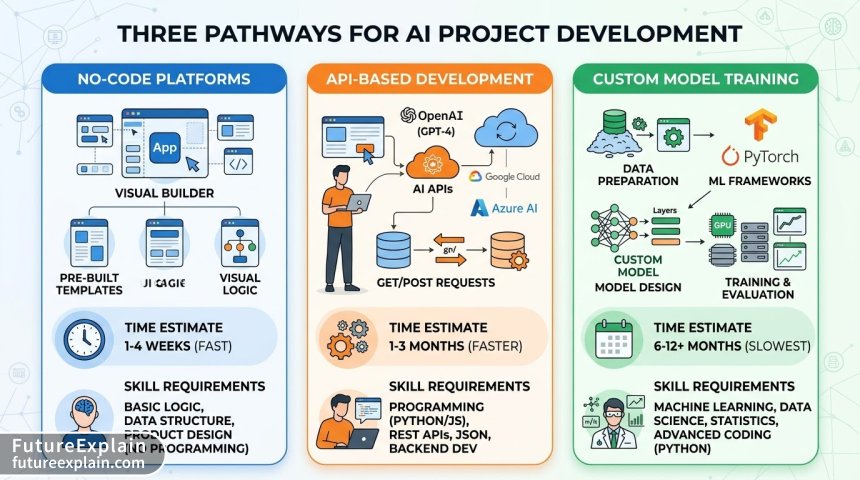
Once you have a validated idea, you need to choose how to build it. Your choice should balance your skills, the project's requirements, and your available time. Here are the three main pathways in 2025:
Pathway 1: No-Code/Low-Code Platforms
No-code AI platforms have matured dramatically. They're no longer just for simple chatbots—you can build surprisingly sophisticated applications. Key 2025 platforms include:
- Bubble with AI plugin ecosystem
- Glide for data-driven applications
- Softr + Airtable combinations
- Zapier/Make for workflow automation
- Voiceflow for voice/conversational interfaces
Best for: Non-technical founders, rapid prototyping, projects where the unique value is in the workflow rather than the AI model itself.
Limitations: Less control over performance, potential vendor lock-in, scaling costs can become high.
Pathway 2: API-Based Development
This approach uses existing AI APIs (OpenAI, Anthropic, Google, etc.) with custom front-end and business logic. You're essentially "orchestrating" AI capabilities rather than building the AI itself.
- Front-end frameworks: Next.js, React, Vue with AI SDKs
- Back-end options: Node.js, Python (FastAPI), or serverless functions
- AI orchestration: LangChain, LlamaIndex, or custom implementations
Best for: Developers who want maximum flexibility, projects needing custom user experiences, applications requiring integration with existing systems.
Limitations: Requires programming knowledge, API costs can be unpredictable, dependency on external AI providers.
Pathway 3: Custom Model Development
For problems where existing models don't suffice, you might need fine-tuning or custom model development. This has become more accessible with platforms like:
- Replicate for model hosting and fine-tuning
- Hugging Face Spaces and Inference Endpoints
- RunPod / Lambda Labs for GPU access
- Modal for serverless GPU functions
Best for: Unique problems requiring specialized models, data-sensitive applications, when cost control at scale is critical.
Limitations: Highest technical barrier, longer development time, infrastructure management overhead.
Visuals Produced by AI
Phase 3: Building Your Minimum Viable Product (MVP)
The MVP should deliver just enough value to test your core hypothesis with real users. In AI projects, this often means starting with a narrow, well-defined use case rather than a broad application.
Defining MVP Scope
Your MVP should answer one critical question: "Do people want this solution?" Not "Is this technically perfect?" Common MVP scope mistakes in AI projects include:
- Trying to handle every edge case before launch
- Building elaborate admin dashboards before having users
- Optimizing for scale before validating demand
- Adding multiple AI features instead of perfecting one
A better approach: Identify the single most important user action or outcome, and build just enough to enable that. For example, if you're building an AI writing assistant, your MVP might handle only one type of document well, rather than attempting to handle all document types.
Technical Architecture Considerations
Even simple AI projects need thoughtful architecture decisions:
- Data flow: How does user input reach the AI, and how are results returned?
- Prompt engineering: Often more important than model choice for MVP success
- Error handling: AI models can fail in unpredictable ways—plan for graceful degradation
- Cost management: Implement usage limits and monitoring from day one
- Privacy and compliance: Especially important if handling user data
An effective pattern in 2025 is the "human in the loop" MVP—designing your initial system to require human review or intervention for complex cases, then gradually automating as you learn.
Development Workflow Example
Here's a typical 4-week MVP development timeline for an API-based project:
- Week 1: Set up basic front-end with input/output interface. Implement simple API integration.
- Week 2: Add core business logic and prompt engineering. Implement basic error handling.
- Week 3: Add user accounts and data persistence. Implement usage tracking.
- Week 4: Testing, polish, and deployment. Prepare user onboarding materials.
Remember: Your first version will be imperfect. The goal is learning, not perfection.
Phase 4: Getting Your First 100 Users
User acquisition is where many technically excellent projects fail. Having a great product doesn't guarantee users will find it. Here are proven strategies for 2025:
Leverage Existing Communities
Don't build your own community from scratch—join existing ones where your target users already gather:
- Reddit communities (subreddits) related to your problem domain
- Discord/Slack groups for professionals in relevant fields
- LinkedIn groups and industry-specific forums
- Product Hunt for tech-savvy early adopters
The key is providing value first. Don't just drop your link—participate in discussions, answer questions, and when relevant, mention how your project addresses specific problems being discussed.
The "Manual Onboarding" Strategy
For your first 10-20 users, consider offering personalized onboarding. This might seem inefficient, but it provides invaluable feedback and creates passionate early advocates. Reach out directly to potential users you've identified through:
- Personal and professional networks
- Social media conversations about the problem you're solving
- Comments on related articles or videos
- People who signed up for your waitlist during validation
Offer to walk them through using your tool, observe their experience, and incorporate their feedback immediately. This hands-on approach often reveals usability issues and feature requests you wouldn't discover otherwise.
Content Creation and Demonstration
Create content that demonstrates your project's value:
- Short video demos showing real use cases
- Case studies of how specific users benefited
- Twitter/LinkedIn threads explaining your approach and lessons learned
- Blog posts about the problem domain, not just your solution
Content that educates or entertains tends to perform better than pure promotional content. Consider creating "behind the scenes" content about building an AI project—this attracts both potential users and fellow builders who can provide technical feedback.
Visuals Produced by AI
Partnerships and Integrations
Look for complementary tools or services that your target users already use. Can you integrate with them? Even simple integrations (like a Chrome extension for a web app, or a Zapier integration) can dramatically increase discoverability and utility.
Consider reaching out to:
- Newsletter writers in your domain for potential mentions
- YouTube creators who might demo your tool
- Open source projects that solve adjacent problems
- Established companies with non-competing offerings
Phase 5: Iteration Based on User Feedback
Your first users will provide the most valuable feedback you'll ever receive. The key is systematically collecting and acting on it.
Feedback Collection Methods
- In-app feedback widgets: Simple "Was this helpful?" prompts or feature request forms
- User interviews: Regular 15-30 minute calls with active users
- Usage analytics: Track where users succeed and where they drop off
- Community building: Create a Discord server or forum for users to discuss
Prioritize feedback that:
- Comes from your most engaged users
- Points to obstacles preventing users from getting value
- Is mentioned by multiple users independently
- Aligns with your long-term vision for the product
The Iteration Cycle
Establish a regular rhythm for updates. For side projects, this might be bi-weekly or monthly rather than daily. Each cycle should include:
- Review feedback and analytics from the previous period
- Plan small, testable improvements (not major rewrites)
- Implement and deploy changes
- Communicate updates to users
- Measure impact of changes
This iterative approach reduces risk and ensures you're always moving in a direction validated by real users.
Common Pitfalls and How to Avoid Them
Based on analysis of hundreds of AI side projects launched in 2024-2025, here are the most common failure points:
Technical Pitfalls
- Underestimating API costs: Implement usage limits and monitoring from day one. Consider caching strategies for common queries.
- Ignoring latency: Users expect near-instant responses from AI tools. Optimize for speed, even if it means slightly less accurate results.
- Poor error handling: AI models fail in unexpected ways. Design graceful fallbacks and clear error messages.
- Neglecting data privacy: Be transparent about data usage. Consider local processing options for sensitive data.
Product/Market Pitfalls
- Building for technical showcase rather than user need: Regularly ask "Would someone pay for this?"
- Chasing too many use cases: Depth beats breadth for early products.
- Ignoring user onboarding: Assume users won't read documentation—build intuitive experiences.
- Falling in love with your solution: Be willing to pivot based on user feedback.
Monetization Considerations
While not all side projects need immediate monetization, having a plan is wise. Current successful models in 2025 include:
- Freemium with usage limits: Free tier for light use, paid for heavier usage
- Subscription models: Monthly/annual access to premium features
- Pay-per-use: Particularly suitable for variable-cost AI operations
- One-time purchase: For tools with predictable, consistent usage patterns
- API access: If your project creates unique AI capabilities
The key is aligning your pricing with user value and your costs. Monitor your unit economics carefully—AI API costs can quickly erode margins if not managed.
Tools and Resources for 2025
Here's a curated list of tools specifically useful for AI side projects in 2025:
Development & Deployment
- Vercel / Netlify: Front-end deployment with serverless functions
- Railway / Fly.io: Full-stack app hosting with simple pricing
- Supabase: Backend-as-a-service with database, auth, and storage
- Cloudflare Workers: Edge computing for low-latency AI applications
AI-Specific Tools
- OpenAI API: Still the most comprehensive for text generation
- Anthropic Claude API: Excellent for longer context and complex reasoning
- Groq: Ultra-fast inference for certain model types
- Together AI: Access to multiple open-source models
- Replicate: Easy deployment of custom models
Monitoring & Analytics
- PostHog: Product analytics with session recording
- Logflare: Log management for serverless applications
- Better Stack: Monitoring and status pages
- Axiom: Observability platform for modern applications
Case Study: Building "AI Content Planner" in 8 Weeks
To illustrate the process, let's examine a real (anonymized) example of an AI side project built in early 2025:
The Problem: Content creators struggle to consistently generate ideas and maintain editorial calendars.
The Solution: An AI tool that suggests content ideas based on a creator's niche and past performance, then helps structure those ideas into publishable outlines.
Development Pathway: API-based (Next.js frontend, Python FastAPI backend, OpenAI + Claude APIs)
Timeline:
- Week 1-2: Basic Next.js UI with text input/output, simple OpenAI integration
- Week 3-4: Added user accounts (Supabase), content history, improved prompting
- Week 5-6: Added calendar view, export functionality, Claude integration for better outlining
- Week 7-8: Polish, testing, deployment, and initial user onboarding
User Acquisition: Started with manual outreach to 15 content creators on Twitter/LinkedIn. Offered free lifetime access in exchange for detailed feedback. This generated 8 active users who provided crucial insights.
Key Learning: Users cared less about the AI's "creativity" and more about consistency and workflow integration. The pivot from "generate amazing ideas" to "reliable idea generation that fits my existing workflow" was crucial.
Current Status: 3 months post-launch: 87 active users, 14 paying subscribers. Monthly revenue covers API costs with modest surplus. Development continues with 2-week iteration cycles.
When to Continue vs. When to Pivot
Not every side project should become a full-time business. Regular evaluation helps decide whether to continue investing time. Consider continuing if:
- Users are consistently getting value (measured by retention and feedback)
- You're learning valuable skills through the process
- The project aligns with your long-term interests or career goals
- Growth (even if slow) is consistent and organic
Consider pivoting or pausing if:
- After 3 months, you have fewer than 10 active users despite acquisition efforts
- The technical debt is overwhelming relative to user value
- Your interests have shifted significantly
- Maintenance has become burdensome without corresponding satisfaction
Remember: A "failed" side project still represents valuable learning. The skills, network, and insights gained often lead to better subsequent projects.
Conclusion: Start Small, Learn Fast
Building an AI side project in 2025 offers unprecedented opportunities for learning, creativity, and potential impact. The key is starting with a well-defined problem, choosing an appropriate development pathway for your skills, building the smallest possible MVP, and engaging with real users from the beginning.
The most successful AI side projects aren't necessarily the most technically sophisticated—they're the ones that solve real problems for real people. By focusing on user value over technical novelty, maintaining a sustainable pace, and embracing iteration based on feedback, you increase your chances of building something that matters.
Your journey won't be linear. You'll encounter technical challenges, user feedback that contradicts your assumptions, and moments of frustration. But you'll also experience the unique satisfaction of seeing people use something you built to solve their problems. That experience—regardless of eventual scale—is what makes side projects worthwhile.
Further Reading:
- No-Code AI Product Ideas You Can Build This Month (2025)
- Monetizing AI Skills: Services, Courses, and Micro-SaaS
- Launching an AI Side Project: Minimal Viable Product (MVP)
Ready to begin? Pick one small problem, choose your pathway, and start building. The AI tools are waiting—your users are waiting. What will you create?