Ethics of AI-Generated Media: Copyright, Attribution, and Fair Use
This comprehensive guide explores the complex ethical and legal landscape of AI-generated media in 2025. We examine who owns AI-created content under different jurisdictions, when and how to attribute AI contributions, and what constitutes fair use of training data. Through real-world case studies and practical frameworks, you'll learn how to navigate copyright registration for AI-assisted works, implement ethical attribution practices, assess fair use risks, and protect your creative projects legally. We provide actionable guidelines for content creators, businesses, and developers working with generative AI tools while addressing the ethical considerations of AI in creative industries.


The rapid evolution of generative AI has created a complex ethical and legal landscape that challenges traditional understandings of copyright, attribution, and fair use. As AI systems like DALL-E 3, Midjourney, Stable Diffusion, and ChatGPT produce increasingly sophisticated media, creators, businesses, and legal systems grapple with fundamental questions: Who owns AI-generated content? When must you attribute AI contributions? What constitutes fair use of copyrighted material in training datasets? This comprehensive guide examines these critical issues through the lens of 2025's evolving legal frameworks and ethical standards.
The Copyright Conundrum: Who Owns AI-Generated Content?
The question of copyright ownership for AI-generated works represents one of the most contentious areas in intellectual property law today. Traditional copyright doctrine requires "human authorship" for protection, but AI systems blur this boundary, creating outputs that may have minimal direct human input.
Current Legal Frameworks Around the World
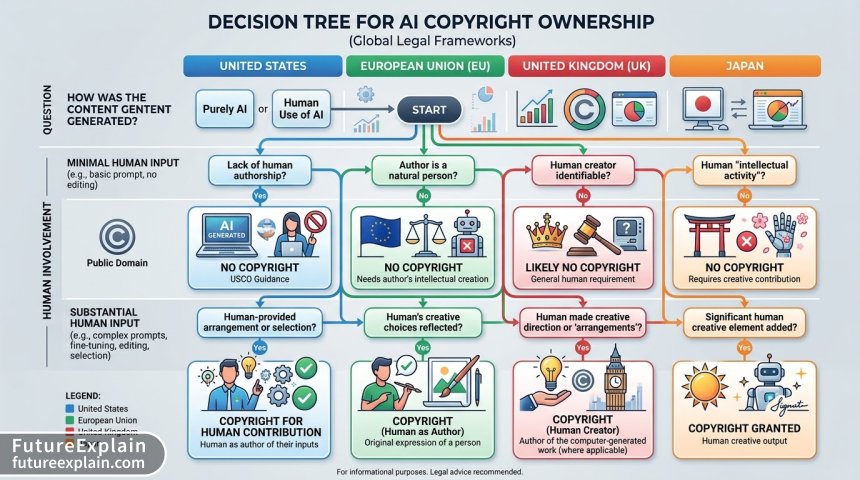
Different jurisdictions have taken varied approaches to AI copyright:
- United States: The U.S. Copyright Office maintains that works created solely by machines without human creative input cannot be copyrighted. However, the "Zarya of the Dawn" case established that AI-assisted works with sufficient human creativity can receive protection. The Copyright Office's 2023 guidance clarified that AI-generated elements must be disclaimed, while human-authored elements can be protected.
- European Union: The EU's AI Act (2024) doesn't directly address copyright ownership but requires transparency about AI-generated content. Individual member states interpret existing copyright law differently, with some countries considering protection for computer-generated works under specific circumstances.
- United Kingdom: The UK's Copyright, Designs and Patents Act 1988 specifically protects computer-generated works for 50 years, with authorship attributed to "the person by whom the arrangements necessary for the creation of the work are undertaken."
- Japan: Japan's 2024 copyright amendments created a new category for AI-generated works with limited protection, focusing on preventing unfair competition rather than granting full copyright.
The "Human Authorship" Requirement
The bedrock principle of copyright law in most jurisdictions is human creativity. As stated by the U.S. Copyright Office, copyright protects "original works of authorship fixed in any tangible medium of expression." The term "authorship" implies human creation. This principle was tested in cases like Naruto v. Slater (the "monkey selfie" case), where courts ruled that non-human creators cannot own copyrights.
For AI-generated content, the key question becomes: How much human input is necessary to constitute authorship? Legal experts generally agree on a continuum:
- AI-Generated: Minimal human input (e.g., single prompt) → No copyright protection
- AI-Assisted: Significant human creative direction → Partial protection
- Human-Created with AI Tools: Substantial human creative control → Full protection
Attribution Ethics: Giving Credit Where It's Due
Even when copyright doesn't apply, ethical attribution remains crucial for transparency and trust in AI-generated media. Proper attribution serves multiple purposes: it informs audiences about the media's origins, respects the labor of AI developers and trainers, and maintains intellectual honesty.
When Attribution Is Required
Attribution requirements vary by context:
- Academic and Journalistic Contexts: Most publications require disclosure of AI use in content creation
- Commercial Works: While not always legally required, ethical best practices suggest disclosure when AI plays a substantial role
- Creative Commons Licensed Works: Some CC licenses require attribution of all contributors, potentially including AI systems
- Platform Requirements: Many social media platforms and content hosting services are implementing AI disclosure policies
Effective Attribution Methods
Best practices for AI attribution include:
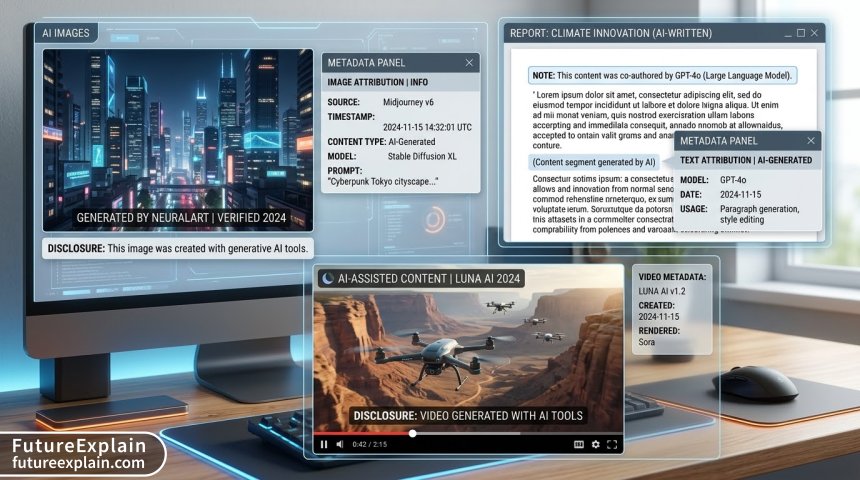
- Clear Labeling: Using phrases like "AI-generated," "AI-assisted," or "Created with [AI tool name]"
- Metadata Embedding: Adding EXIF or XMP metadata that documents AI involvement
- Watermarking: Some AI tools automatically embed subtle watermarks (though these can be removed)
- Accompanying Statements: Providing detailed creation process descriptions for significant works
The Fair Use Doctrine and AI Training Data
The use of copyrighted material to train AI models represents one of the most significant legal battlegrounds in generative AI. The fair use doctrine, which allows limited use of copyrighted material without permission for purposes like criticism, comment, news reporting, teaching, scholarship, or research, is central to this debate.
The Four Factors of Fair Use Analysis
U.S. courts evaluate fair use claims using four factors, which apply to AI training:
- Purpose and Character of Use: Is the use transformative? AI training typically transforms data into model weights and capabilities, which courts have increasingly recognized as transformative.
- Nature of Copyrighted Work: Factual works receive less protection than creative ones. Many training datasets include both types.
- Amount and Substantiality Used: Using entire works may weigh against fair use, though for training purposes, complete access is often necessary.
- Effect on Market Value: Does the AI use compete with or substitute for the original work? This factor is particularly contentious in ongoing lawsuits.
Landmark Cases Shaping Fair Use for AI
Several key cases are defining the boundaries of fair use for AI training:
- Authors Guild v. Google (2015): Established that mass digitization for search purposes constituted fair use, setting precedent for large-scale data processing.
- Andy Warhol Foundation v. Goldsmith (2023): Clarified transformative use requirements, impacting how courts view AI transformations of existing works.
- Getty Images v. Stability AI (ongoing): Directly addresses whether using copyrighted images for AI training constitutes infringement or fair use.
- Andersen et al. v. Stability AI et al. (class action): Represents artists' claims that their works were used without permission for training.
Practical Guidelines for Content Creators
Navigating the ethical and legal landscape requires practical strategies. Here's a framework for responsible AI media creation:
Copyright Registration for AI-Assisted Works
When registering copyright for works involving AI:
- Disclose AI Involvement: The U.S. Copyright Office requires disclosure of AI-generated elements
- Describe Human Contributions: Clearly articulate your creative input, such as prompt engineering, iterative refinement, selection, arrangement, or post-processing
- Submit Creation Records: Include documentation of your creative process, including prompts, intermediate results, and edits
- Consider Partial Registration: You may register only the human-authored elements if AI and human contributions are separable
Risk Assessment Framework
Evaluate your AI media projects using this risk assessment framework:
- Source Material Risk: Are you using potentially infringing training data or source images?
- Output Similarity Risk: Does the output substantially resemble protected works?
- Commercial Impact Risk: Could your work harm the market for original works?
- Jurisdictional Risk: Which legal frameworks apply to your distribution?
- Reputational Risk: How will audiences perceive your use of AI?
Ethical Considerations Beyond Legal Requirements
Legal compliance represents only the minimum standard. Ethical AI media creation involves additional considerations:
Transparency and Honesty
Beyond legal requirements, ethical creators should consider:
- Audience Expectations: Are you misleading audiences about human versus AI creation?
- Industry Norms: What are the emerging standards in your creative field?
- Cultural Context: Different communities have different expectations about AI disclosure
Economic Impacts on Creators
The ethical dimensions extend to economic considerations:
- Labor Displacement: How does your use of AI affect human creative jobs?
- Value Distribution: Are you fairly compensating human creators whose work contributed to training?
- Market Dynamics: How does AI-generated content affect market opportunities for human creators?
Emerging Solutions and Best Practices
The industry is developing new approaches to address these challenges:
Technical Solutions
- Content Provenance Standards: Initiatives like the Coalition for Content Provenance and Authenticity (C2PA) are developing technical standards for tracking content origins
- Watermarking and Fingerprinting: Advanced techniques for identifying AI-generated content
- Opt-Out Mechanisms: Tools allowing creators to exclude their works from training datasets
Legal and Contractual Protections
- Licensing Agreements: Clear terms of service for AI tools that address copyright issues
- Indemnification Clauses: Protection against infringement claims when using AI services
- Custom Training: Using licensed or self-generated training data to avoid infringement risks
Industry Self-Regulation
- Ethical Guidelines: Industry associations developing best practice standards
- Certification Programs: Third-party verification of ethical AI practices
- Transparency Reports: Companies disclosing their training data sources and methodologies
Future Directions and Recommendations
As AI technology continues to evolve, so too must our ethical and legal frameworks. Looking ahead to 2026 and beyond:
Policy Recommendations
- International Harmonization: Need for more consistent approaches across jurisdictions
- Graduated Protection: Potential for tiered copyright protection based on degree of human involvement
- Collective Licensing: New models for compensating creators whose works contribute to training
Practical Recommendations for Different Stakeholders
For Individual Creators:
- Document your creative process meticulously
- When in doubt, disclose AI involvement
- Consider the ethical implications beyond legal requirements
- Stay informed about evolving legal standards
For Businesses:
- Develop clear AI use policies
- Train employees on ethical AI practices
- Implement attribution and disclosure systems
- Conduct regular legal compliance reviews
For Developers and Platform Providers:
- Build attribution and disclosure features into tools
- Provide clear guidance on copyright implications
- Offer licensing options for commercial use
- Participate in industry standards development
Conclusion: Navigating the New Creative Landscape
The ethics of AI-generated media represent a rapidly evolving frontier where technology, law, and creativity intersect. While legal frameworks struggle to keep pace with technological change, ethical principles of transparency, fairness, and respect for creative labor provide essential guidance. By understanding copyright limitations, implementing appropriate attribution practices, and respecting fair use boundaries, creators can harness AI's potential while navigating its ethical complexities responsibly.
The key insight for 2025 is that AI doesn't eliminate ethical responsibility—it redistributes it. Human creators remain accountable for how they use AI tools, just as they are for traditional creative tools. As the technology continues to advance, ongoing dialogue among creators, technologists, legal experts, and policymakers will be essential to developing frameworks that balance innovation with ethical responsibility.
Visuals Produced by AI
Further Reading
Share
What's Your Reaction?
 Like
1421
Like
1421
 Dislike
23
Dislike
23
 Love
387
Love
387
 Funny
45
Funny
45
 Angry
12
Angry
12
 Sad
8
Sad
8
 Wow
289
Wow
289











The compensation models section mentions emerging industry practices. Has anyone actually implemented a working model where AI companies pay artists for training data? I've only seen a few small pilot programs.
Kamden, Adobe's Firefly is one example—trained on Adobe Stock with compensation to contributors. Shutterstock has a similar fund. These are early models, and the amounts are often small, but they represent important first steps toward more equitable systems.
What about AI that generates content in the style of a living artist? I've seen tools that specifically mimic contemporary artists' styles. This seems ethically problematic even if it's legally ambiguous.
That's my biggest concern too, Axel. I'm an illustrator and I've found AI generating work in my distinct style. While copyright doesn't protect style, it feels like a violation. Some artists are exploring "style patents" or trademark protection for their distinctive approaches.
As an intellectual property lawyer, I appreciate the balanced approach here. One correction: in the UK section, while the 50-year protection is correct, recent case law suggests courts are interpreting "necessary arrangements" quite narrowly. The Thaler cases are particularly relevant.
Amelia, could you elaborate on the Thaler cases? I'm familiar with the US "Creativity Machine" patent cases but not the UK equivalents. Are there similar principles being established?
The risk assessment framework is pure gold! We've adapted it for our content team and created a simple checklist. Has anyone turned this into an actual digital form or workflow tool? We're using Notion but wondering if there's something better.
Excellent overview! Could you do a follow-up specifically about educational use? I'm a teacher and we're developing guidelines for students using AI tools for assignments. The attribution methods section was helpful but we need age-appropriate approaches.
Priya, that's a great suggestion for a future article. For now, I'd recommend looking at the International Society for Technology in Education (ISTE) guidelines—they've developed some excellent age-appropriate AI attribution frameworks for K-12 education.
What about AI-generated code? The article focuses on media but as a developer, I'm using Copilot daily. GitHub's terms say they'll defend us against copyright claims, but how does that work in practice?
Xavier, I'm a software engineer at a large tech company. Our legal team says GitHub's indemnification is solid, but they still recommend reviewing generated code for copyright issues, especially for public repositories. There's a tool called CodeQL that can help scan for problematic patterns.