Multimodal Search: Finding Answers in Images and Text
This guide demystifies multimodal search, a transformative AI technology that finds information across different data types like text, images, and audio simultaneously. We explain how it moves beyond traditional keyword search by understanding the content and context of images and documents together. You'll learn the core concepts, including embedding spaces and fusion techniques, and see practical comparisons of the two main implementation approaches: image verbalization and direct multimodal embeddings. The article provides actionable insights for businesses and content creators, showcasing real-world applications in e-commerce, customer support, research, and content management. We also outline the current challenges, such as data complexity and computational costs, and offer a forward-looking perspective on how this technology is making information discovery more intuitive, comprehensive, and accessible for everyone.


Visuals Produced by AI
Think about the last time you tried to find something online. You probably typed words into a search box. But what if you could search with a picture? Or describe a concept and find not just articles, but also relevant diagrams, videos, or audio clips that explain it? This is the promise of multimodal search, a significant evolution in how we find information.
Traditional search engines are brilliant at matching keywords. If you search for "red apple," they will find pages containing those exact words. But they stumble when information is locked inside an image, a chart in a PDF, or a spoken explanation in a video. They can't understand that a photo of a Granny Smith apple is related to a text discussion about "tart green fruit."
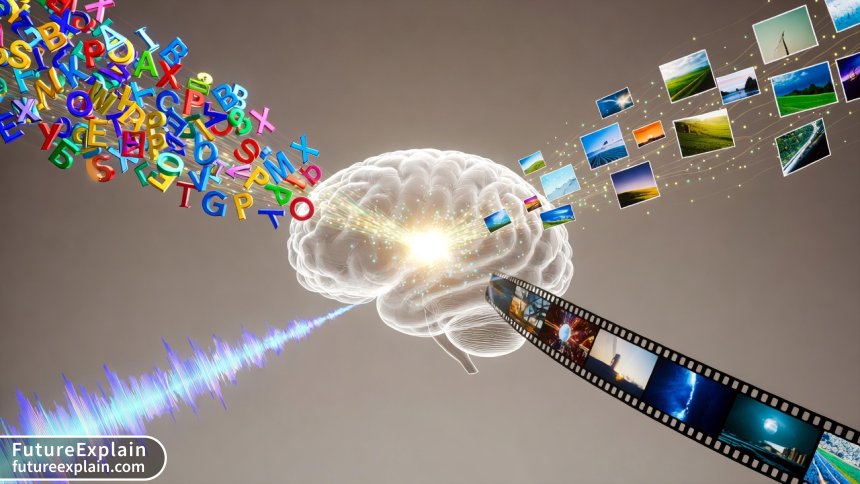
Multimodal search breaks down these barriers. It allows artificial intelligence to process, understand, and retrieve information from multiple types of data—or "modalities"—all at once. This means you can ask a question and get an answer that pulls evidence from text, images, audio, and video, providing a far richer and more complete result.
This technology is moving us from simply finding documents to truly discovering knowledge, regardless of its original format. For businesses, researchers, students, and everyday users, it unlocks a world of information that was previously hidden or difficult to access. In this guide, we’ll explain what multimodal search is, how it works in simple terms, where it’s being used today, and what it means for the future of finding information.
What is Multimodal Search? Beyond the Keyword Box
At its core, multimodal search is an AI-powered capability to ingest, understand, and retrieve information across different content types like text, images, video, and audio from a single query. Unlike a unimodal system that handles just one type of data, a multimodal AI system combines and analyzes different forms of data to achieve a more comprehensive understanding.
Imagine you are researching how to prune a rose bush. A traditional search might give you blog posts. A multimodal search could also find:
- A step-by-step diagram embedded in a gardening PDF.
- A video tutorial where a gardener demonstrates the technique.
- A photo gallery showing the before-and-after results of proper pruning.
The system understands that all these different media are about the same core concept. It’s this ability to connect meaning across formats that makes multimodal search so powerful. As one resource notes, it makes information retrieval systems less likely to overlook important visual details and provides users with detailed answers that can be traced back to their original sources, whether text or image.

Visuals Produced by AI
Why Does This Matter Now?
The shift towards multimodal search is being driven by the explosion of non-text data and the advancement of AI models that can understand it. We live in a world rich with visual and audio information. From product photos and instructional videos to scientific charts and medical scans, a vast amount of knowledge isn't contained in plain text.
Furthermore, new generative AI models are inherently multimodal. Models like GPT-4V(ision), Google's Gemini, and others are designed from the ground up to handle text, images, and other data types within a single architecture. This foundational shift in AI capability is what makes sophisticated multimodal search applications not just possible, but increasingly practical.
How Does Multimodal Search Work? The Technical Core Explained Simply
The magic of multimodal search happens by translating different types of data into a common language that a computer can compare and understand. Don't worry—we'll break this down into digestible parts.
The Challenge: Apples and Oranges (and Text and Images)
The fundamental problem is that a paragraph of text and a JPEG image are as different as, well, apples and oranges to a computer. They have different structures, file formats, and properties. To search across them, we need to find a way to represent their meaning or semantic content in a comparable form.
The solution is to convert everything into vectors—mathematical representations (think of them as unique fingerprints or coordinates in a vast space) that capture the essence of the content.
Step-by-Step: The Multimodal Search Pipeline
While implementations vary, a typical multimodal search system follows these key steps:
1. Content Extraction and Processing: The system first "cracks open" the source material. For a document, this means separating the page text from any inline images, charts, or screenshots. Each modality is then processed with a specialized tool:
- Text is analyzed using Natural Language Processing (NLP).
- Images are processed using Computer Vision techniques.
- Audio is converted and analyzed through speech recognition and sound analysis.
2. Creating a Unified Understanding (The Fusion Step): This is the crucial part. The system must now relate the processed information from each modality. There are different strategies for this "fusion" :
- Early Fusion: Raw or lightly processed data from different modalities is combined right at the beginning before deep analysis.
- Late Fusion: Each modality is processed independently and deeply (e.g., an image is classified, text is summarized), and these high-level results are combined at the end.
- Joint Embedding (The Most Common for Search): This is the powerhouse method for modern search. Both the text and the image (or other media) are converted into vectors that are placed into a shared semantic space. In this space, a vector for the text "a happy dog running in a park" will be located very close to the vector for a *photo* of a happy dog running in a park, even though they started as completely different data types.
3. Indexing and Retrieval: All these vectors—representing text snippets, images, audio clips—are stored in a special database optimized for fast similarity matching, often called a vector database. When you make a query (with text, an image, or both), it is also converted into a vector. The system then performs a "similarity search" through the vector database to find the stored vectors closest to your query vector. The closest matches are returned as your search results.
Two Roads to Multimodal Search: Verbalization vs. Direct Embeddings
When building a search system that includes images, developers often choose between two primary architectural paths. Understanding this choice is key to seeing how different multimodal applications are built.
Path 1: Image Verbalization (Turning Pictures into Words)
This method uses a large language model (LLM) to generate a concise, natural-language description of each image during the data processing phase. For example, a complex flow chart in a business process document might be described as: "Five-step workflow diagram for employee onboarding starting with HR form submission."
How it works for search:
- The text description is stored alongside the document's regular text.
- The entire text (original + descriptions) is then converted into text-based vectors and indexed.
- When you search with text, the engine matches your query against both the body text and the AI-generated image descriptions.
Pros: Excellent for capturing the semantic meaning and relationships within a diagram. It provides ready-made context that an LLM can cite in an answer. It's often more interpretable because the "reasoning" is expressed in language.
Cons: Requires an LLM call for every image, which adds cost and time during indexing. The quality of search depends entirely on the accuracy and completeness of the verbal description.
Path 2: Direct Multimodal Embeddings
This approach bypasses language altogether. It uses a specialized "multimodal embedding model" that can take an image (or text) as input and output a vector directly into a shared vector space. No intermediate description is created.
How it works for search:
- Text and images are fed into the same embedding model, which outputs compatible vectors.
- These vectors are indexed.
- You can search with text, an image, or both. An image query is vectorized and matched against the image and text vectors in the index.
Pros: Highly efficient for pure visual similarity (e.g., "find products that look like this sofa"). No LLM cost during indexing. Supports image-based queries natively.
Cons: The vector representation is purely mathematical. It doesn't provide an explicit, human-readable reason *why* two images are related, which can make it harder to generate detailed, cited explanations.
Many sophisticated systems use a hybrid approach, verbalizing diagrams for semantic understanding while using direct embeddings for product photos or artwork.

Visuals Produced by AI
Where is Multimodal Search Used Today? Practical Applications
This isn't just a lab experiment. Multimodal search is solving real problems across industries by making inaccessible information findable and actionable.
1. Supercharging E-Commerce and Retail
This is one of the most visible applications. Imagine taking a photo of a friend's stylish shoes or a piece of furniture you saw in a café. With multimodal search, you can upload that photo to an app and find visually similar products for sale. It goes beyond color and shape; the AI can understand style, pattern, and even material. Furthermore, by analyzing a customer's past purchases (text data) alongside images they've clicked on, retailers can provide hyper-personalized recommendations that blend textual and visual preferences.
2. Revolutionizing Customer Support and Knowledge Bases
Internal company knowledge is often trapped in slides, PDF manuals, and process diagrams. An employee asking, "How do I reset my multi-factor authentication?" might need to sift through a dozen PDFs. A multimodal search system can ingest all these documents, understand the charts and screenshots inside them, and instantly direct the employee to the exact slide or diagram that shows the steps. This dramatically reduces resolution time and improves accuracy.
3. Accelerating Academic and Scientific Research
Researchers can search through vast archives of scientific papers not just by abstract, but by the data in the figures. A query like "graph showing population growth over 50 years in sub-Saharan Africa" could surface relevant charts from thousands of PDFs, even if the accompanying paper's text doesn't contain that exact phrase. In life sciences, tools are being used to predict protein structures from amino acid sequences—a form of cross-modal translation from text (the sequence) to a 3D model (the structure).
4. Transforming Content Management and Media Archives
Media companies and archives can finally make their video and audio libraries truly searchable. Instead of relying only on manually written titles or tags, a multimodal system can generate transcripts (audio-to-text), describe scenes (video-to-text), and index it all. A producer could search for "interview clip where the speaker expresses optimism about renewable energy" and find the precise moment in a hours-long archive.
5. Enhancing Accessibility
Multimodal search can power tools that make digital content more accessible. For instance, it can help automatically generate accurate, detailed alt-text for complex images on websites by understanding the image content. Conversely, it can allow users to search for information using the modality most comfortable for them, whether that's typing, speaking, or uploading an image.
Challenges and Considerations on the Road Ahead
While promising, multimodal search is not a solved problem. Several significant challenges remain:
Data Complexity and Cost: Creating and labeling high-quality, aligned multimodal datasets (e.g., millions of images with accurate, detailed text descriptions) is expensive and time-consuming. The models themselves require immense computational power to train.
The Alignment Problem: Ensuring that the AI correctly aligns elements across modalities is difficult. For a video, the audio of a dog barking must be correctly synchronized with the visual of the dog, not the cat sitting nearby.
Interpretability and Hallucination: It can be hard to understand why a multimodal model returned a specific image for a text query. Furthermore, like all generative AI, these systems can sometimes "hallucinate" or create incorrect associations between modalities.
Privacy and Bias: These systems often process personal or sensitive data (e.g., medical images, personal photos). Robust data governance is essential. There is also a risk of amplifying societal biases present in the training data across multiple modalities.
The Future of Finding: What's Next for Multimodal Search?
The trajectory is clear: search is becoming less about strings and more about meaning and context. We are moving towards truly conversational and contextual discovery interfaces. You might have a dialogue with a search agent, showing it a picture, asking a clarifying question by voice, and receiving a synthesized answer that draws from text, video, and data.
Integration with Augmented Reality (AR) is a compelling frontier. Point your phone at a machine, and a multimodal search system could pull up the relevant maintenance manual diagram overlaid on the real-world components. The rise of smaller, efficient models capable of running on devices (edge AI) will also make multimodal search faster and more private.
Ultimately, the goal is to make our interaction with the world's information as natural as human conversation. Multimodal search is a giant leap in that direction, breaking down the format barriers that have long constrained our ability to discover, learn, and innovate.
Further Reading
To continue your exploration of AI and how it understands our world, consider these related articles on FutureExplain:
- Multimodal AI: Combining Text, Image, Audio, and Video - A deeper dive into the foundational AI models that make this technology possible.
- Vector Search vs Keyword Search: Choosing the Right Approach - Understand the core technology shift from matching words to matching meanings.
- AI-Powered Accessibility: Make Content More Inclusive - Learn how technologies like multimodal analysis are being used to create a more accessible digital world.