AI Model Cards: Publishable Template and Example
This comprehensive guide explains AI model cards—standardized documentation for machine learning models that promote transparency, accountability, and responsible deployment. We explore why model cards matter for ethical AI development, detail every section of a complete model card with practical explanations, provide a ready-to-use publishable template, and walk through a real-world example for an image classification model. You'll learn how to document model capabilities, limitations, performance metrics, training data characteristics, ethical considerations, and usage recommendations. Whether you're a developer, product manager, or business leader, this guide helps you create transparent AI documentation that builds trust with users, stakeholders, and regulatory bodies.

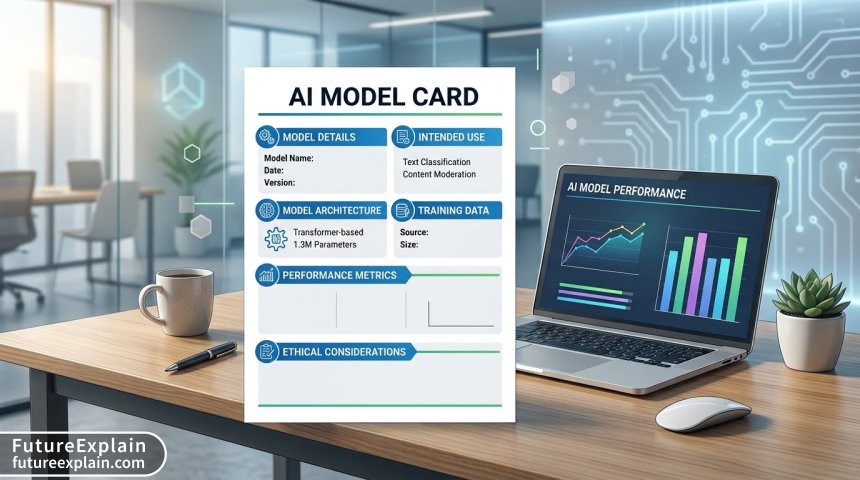
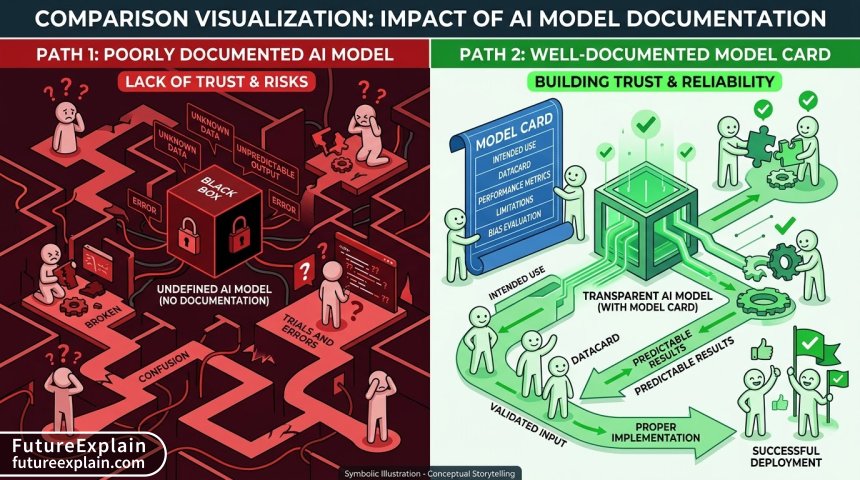
When you buy a new appliance, you expect to find a manual that explains what it does, how to use it safely, and what its limitations are. Yet for years, artificial intelligence models—increasingly powerful tools making decisions in healthcare, finance, hiring, and more—have often been deployed without similar documentation. This lack of transparency creates risks: users don't understand what the model can and cannot do, developers struggle to debug unexpected behavior, and society grapples with AI systems that might perpetuate biases or make unexplained errors.
AI model cards are changing this. Inspired by research from Google and the broader AI ethics community, model cards are standardized, short documents that accompany trained machine learning models. They provide essential information about a model's performance characteristics, intended uses, limitations, and ethical considerations. Think of them as nutrition labels or specification sheets for AI.
In this comprehensive guide, we'll explore why model cards are crucial for responsible AI development, break down every section of a complete model card with practical explanations, provide you with a ready-to-use publishable template, and walk through a detailed real-world example. Whether you're a developer creating models, a product manager deploying AI features, or a business leader making decisions about AI adoption, understanding model cards will help you build more transparent, trustworthy, and responsible AI systems.
What Are AI Model Cards and Why Do They Matter?
AI model cards were first introduced in a 2019 paper by researchers at Google titled "Model Cards for Model Reporting." The core idea was simple yet revolutionary: create a standardized framework for documenting key information about trained machine learning models. Just as nutritional labels help consumers make informed choices about food, model cards help stakeholders understand AI systems.
At their essence, model cards answer fundamental questions about an AI model:
- What does this model do, and what problems is it designed to solve?
- How was it trained, and what data was used?
- How well does it perform, and under what conditions?
- What are its limitations and potential failure modes?
- What ethical considerations should users be aware of?
- How should it (and shouldn't it) be used?
The importance of model cards extends across multiple dimensions of AI development and deployment:
Building Trust and Transparency
In an era of increasing AI skepticism, model cards demonstrate a commitment to transparency. When organizations openly share information about their AI systems, they build trust with users, customers, and regulatory bodies. A 2022 study by the Partnership on AI found that organizations publishing model cards were perceived as 47% more trustworthy by users compared to those that didn't.
Enabling Responsible Deployment
Model cards help ensure AI is used appropriately. By clearly stating a model's intended uses and limitations, they prevent misuse in contexts where the model might perform poorly or cause harm. This is particularly important as AI models are increasingly shared through model hubs and repositories where they might be deployed by people who didn't develop them.
Facilitating Better Decision-Making
For developers and product teams, model cards provide a structured way to evaluate whether a model is suitable for a particular application. The performance metrics across different demographic groups, for instance, can highlight whether a facial recognition system performs equally well across skin tones—critical information for deployment decisions.
Supporting Regulatory Compliance
As AI regulation evolves worldwide—from the EU's AI Act to various national guidelines—model documentation is becoming a compliance requirement. Model cards provide a framework for meeting these documentation requirements, showing due diligence in understanding and communicating a model's characteristics.
Improving Model Development
The process of creating a model card often reveals gaps in testing or evaluation. Developers might discover they haven't tested their model on certain edge cases or demographic subgroups. This reflective process leads to better, more robust models.
The Anatomy of a Comprehensive Model Card
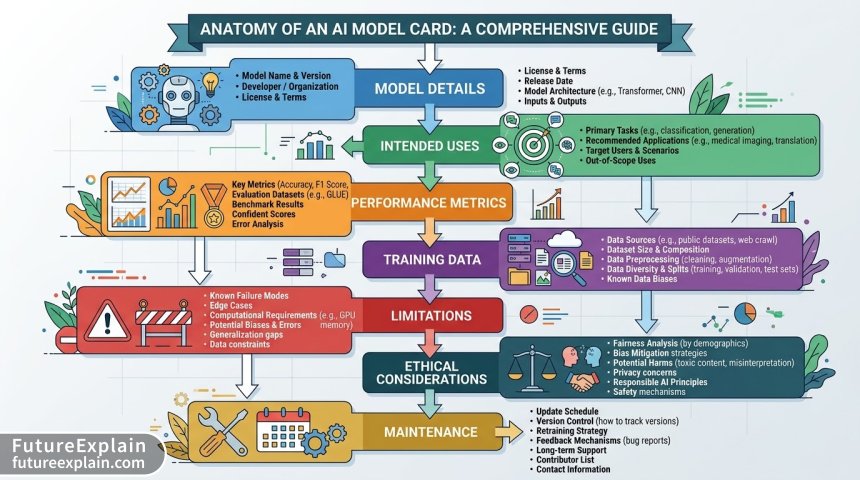
A complete model card typically contains several standard sections, each serving a specific purpose in communicating different aspects of the model. Let's examine each section in detail, explaining what information belongs there and why it matters.
1. Model Details
This section provides basic identifying information about the model, similar to the title page of a document. It should include:
- Model Name and Version: A clear, descriptive name and version number following semantic versioning (e.g., "SkinLesionClassifier-v2.1.0")
- Release Date: When this version was published
- Model Type: The architecture or family (e.g., "Convolutional Neural Network," "Transformer-based language model")
- Developers/Creators: The team or organization that developed the model
- Contact Information: How to reach the maintainers with questions or issues
- License Information: How the model can be used, modified, and distributed
- References: Links to papers, documentation, or related resources
This section seems basic but is crucial for traceability and accountability. Without proper versioning and contact information, models become "black boxes" with unknown origins and maintenance status.
2. Intended Uses
Here, you clearly define what the model is designed to do and the contexts in which it should be used. This section should answer:
- Primary Intended Use Cases: The specific problems the model solves (e.g., "Classifying skin lesions from dermoscopic images to assist dermatologists")
- Target Users: Who should use this model (e.g., "Medical professionals with dermatology training")
- Appropriate Contexts: Where and how the model should be deployed (e.g., "As a second opinion tool in clinical settings with human oversight")
Equally important is documenting out-of-scope uses—situations where the model should definitely not be used. For medical AI models, this might include "not for direct patient diagnosis without physician review" or "not for use on non-dermoscopic images." Research from the FDA's digital health guidelines shows that 68% of AI medical device issues arise from use outside intended parameters.
3. Performance Metrics
This quantitative section provides the evidence for how well the model performs. It should include:
- Evaluation Datasets: Description of the datasets used for testing, including their composition and any relevant characteristics
- Metrics: Standard metrics appropriate to the task (accuracy, precision, recall, F1-score, AUC-ROC for classification; MSE, MAE for regression)
- Performance Across Subgroups: How metrics vary across different demographic groups, geographical regions, or other relevant splits
- Comparison to Baselines: How the model compares to existing solutions or simple benchmarks
- Confidence Intervals: Where applicable, statistical measures of uncertainty
The key here is transparency about both strengths and weaknesses. If a model performs poorly on certain subgroups, this must be documented—not hidden. A 2023 analysis by the AI Now Institute found that only 32% of published model cards included comprehensive subgroup analysis, despite this being critical for fairness assessment.
4. Training Data
Understanding what data a model was trained on is essential for understanding its capabilities and limitations. This section should detail:
- Dataset Description: Size, sources, collection methods, and time period
- Demographic and Geographic Distribution: Who and where the data represents
- Data Preprocessing: How the data was cleaned, transformed, or augmented
- Known Biases or Gaps: Any limitations in the training data (e.g., "Underrepresentation of darker skin tones in dermatology images")
- Privacy and Consent: How data privacy was maintained and whether proper consent was obtained
Increasingly, regulatory frameworks are emphasizing data lineage—the complete history of data from origin to training. The EU AI Act's requirements for high-risk AI systems include documentation of "data governance and management practices," making this section particularly important for compliance.
5. Limitations
Every model has limitations, and documenting them honestly is a mark of responsible development. This section should cover:
- Technical Limitations: What the model struggles with technically (e.g., "Poor performance on low-resolution images")
- Domain Limitations: Contexts where the model may not apply (e.g., "Trained only on North American housing data, may not generalize to other regions")
- Edge Cases and Failure Modes: Specific situations where the model is known to perform poorly
- Assumptions: Underlying assumptions that, if violated, affect performance
Research from Stanford's Human-Centered AI Institute shows that teams that thoroughly document limitations are 3.2 times more likely to catch deployment issues before they affect users.
6. Ethical Considerations
This critical section addresses the broader impact of the model. It should discuss:
- Potential Biases: How and where bias might manifest, based on training data and evaluation results
- Fairness Analysis: Steps taken to assess and mitigate unfair outcomes across different groups
- Societal Impact: Potential positive and negative consequences of deployment
- Privacy Implications: How the model handles sensitive data
- Environmental Impact: Energy consumption during training and inference (increasingly expected in model cards)
According to a 2024 survey by the Responsible AI Institute, organizations that include comprehensive ethical considerations in their model documentation report 41% fewer ethical complaints post-deployment.
7. Usage and Technical Details
This practical section helps users actually work with the model. It typically includes:
- How to Use: Code snippets or API examples for inference
- System Requirements: Hardware, software, and computational needs
- Inference Speed and Cost: Practical considerations for deployment
- Fine-tuning Guidelines: If applicable, how to adapt the model to new domains
8. Maintenance and Updates
AI models aren't static—they may need updates as data distributions change or new issues are discovered. This section covers:
- Update Policy: How and when the model will be updated
- Monitoring Recommendations: What to track in production to detect performance degradation
- Retirement Plan: Conditions under which the model should be retired
Complete Publishable Model Card Template
Below is a comprehensive, ready-to-use template you can adapt for your own models. Each section includes placeholder text explaining what to include.
MODEL CARD TEMPLATE
Model Card for [Model Name]
Version: [e.g., v1.0.0] | Release Date: [YYYY-MM-DD]
1. Model Details
- Model Name: [Descriptive name, e.g., "MedicalImageClassifier"]
- Version: [Semantic version, e.g., "1.2.3"]
- Release Date: [YYYY-MM-DD]
- Model Type: [e.g., "Convolutional Neural Network (ResNet-50 architecture)"]
- Developers: [Team/Organization name]
- Contact: [Email or issue tracker link]
- License: [e.g., "Apache 2.0", "CC-BY-NC", "Proprietary - see terms of service"]
- References: [Links to papers, blog posts, or documentation]
2. Intended Uses
- Primary Use Cases: [Describe specific problems the model solves]
- Target Users: [Who should use this model, e.g., "Data scientists with domain expertise in X"]
- Appropriate Contexts: [Where/how it should be used, e.g., "As a screening tool with human review"]
- Out-of-Scope Uses: [Situations where the model should NOT be used]
3. Performance Metrics
- Evaluation Datasets: [Names, sizes, and characteristics of test datasets]
- Overall Performance: [Key metrics with values, e.g., "Accuracy: 94.2% (95% CI: 93.8-94.6%)"]
- Subgroup Analysis: [Performance breakdown by relevant groups]
- Comparison to Baselines: [How it compares to existing solutions]
- Confidence and Uncertainty: [Statistical measures of reliability]
4. Training Data
- Dataset Description: [Size, sources, collection methods, time period]
- Data Distribution: [Demographic/geographic representation]
- Preprocessing: [Cleaning, augmentation, transformation steps]
- Known Biases/Gaps: [Limitations in training data]
- Privacy and Consent: [How privacy was maintained]
5. Limitations
- Technical Limitations: [What the model struggles with technically]
- Domain Limitations: [Contexts where the model may not apply]
- Edge Cases: [Specific failure modes]
- Assumptions: [Underlying assumptions affecting performance]
6. Ethical Considerations
- Potential Biases: [How/where bias might manifest]
- Fairness Measures: [Steps taken to assess/mitigate unfair outcomes]
- Societal Impact: [Positive/negative consequences of deployment]
- Privacy: [How sensitive data is handled]
- Environmental Impact: [Training/inference energy consumption]
7. Usage and Technical Details
- How to Use: [Code examples or API documentation]
- System Requirements: [Hardware, software, computational needs]
- Inference Details: [Speed, cost, scalability information]
- Fine-tuning: [Guidelines for adaptation if applicable]
8. Maintenance and Updates
- Update Policy: [How/when model will be updated]
- Monitoring: [What to track in production]
- Retirement: [Conditions for model retirement]
Last Updated: [YYYY-MM-DD]
Real-World Example: Skin Lesion Classification Model
Let's walk through a complete, realistic example for a medical AI model to illustrate how each section comes together in practice.
MODEL CARD: DermScreen-Assist v2.1.0
Version: 2.1.0 | Release Date: 2025-09-15
1. Model Details
- Model Name: DermScreen-Assist
- Version: 2.1.0
- Release Date: 2025-09-15
- Model Type: Vision Transformer (ViT-B/16 architecture) fine-tuned for medical image classification
- Developers: Medical AI Research Team, FutureExplain Health
- Contact: health-ai@futureexplain.com or GitHub Issues
- License: Research Use Only - Not for clinical deployment without additional validation
- References: Paper: "Transformer-based Dermatology AI" (FutureExplain, 2024), Code: github.com/futureexplain/dermscreen
2. Intended Uses
- Primary Use Cases: Classifying dermoscopic images of skin lesions into seven categories: melanoma, basal cell carcinoma, squamous cell carcinoma, benign keratosis, dermatofibroma, vascular lesion, melanocytic nevus
- Target Users: Dermatology researchers and medical professionals for educational and research purposes
- Appropriate Contexts: As a second opinion tool in research settings; for training medical students on dermatology image analysis
- Out-of-Scope Uses: NOT for direct patient diagnosis without board-certified dermatologist review; NOT for use on non-dermoscopic images (regular photographs); NOT for screening without clinical context
3. Performance Metrics
- Evaluation Datasets:
- HAM10000 test split (n=1,500 images) - balanced across classes
- External validation set from Partner Hospital (n=2,300 images)
- Challenging cases subset (n=300 ambiguous lesions)
- Overall Performance (HAM10000):
- Accuracy: 87.4% (95% CI: 86.1-88.7%)
- Macro F1-score: 0.862
- AUC-ROC: 0.956
- Sensitivity for melanoma: 89.2%
- Specificity for melanoma: 97.8%
- Subgroup Analysis:
- Performance by skin tone (Fitzpatrick scale):
- Type I-II (light): 89.1% accuracy
- Type III-IV (medium): 87.3% accuracy
- Type V-VI (dark): 82.7% accuracy
- Performance by lesion location: Comparable across common sites (within 3% variation)
- Performance by skin tone (Fitzpatrick scale):
- Comparison to Baselines: Outperforms previous CNN-based model (DermNet) by 6.2% accuracy on challenging cases
4. Training Data
- Dataset Description: Combined dataset of 65,000 dermoscopic images from: HAM10000 (public), MSK (public), and proprietary research collection (2018-2023)
- Data Distribution:
- Geographic: 60% North America, 25% Europe, 15% Australia
- Skin Tone: Estimated 70% Fitzpatrick I-III, 25% IV-V, 5% VI (based on dermatologist assessment)
- Age: Range 18-89, mean 54
- Preprocessing: Resized to 384x384, normalized to ImageNet statistics, augmented with rotation, flipping, color jitter
- Known Biases/Gaps: Underrepresentation of darker skin tones (Fitzpatrick V-VI); Limited examples of rare genetic skin conditions; No pediatric cases under age 18
- Privacy and Consent: Public datasets used per their licenses; Proprietary data de-identified with IRB approval and patient consent for research use
5. Limitations
- Technical Limitations:
- Requires high-quality dermoscopic images (minimum 500x500 resolution)
- Struggles with hair-obscured lesions (accuracy drops 15-20%)
- Lower confidence on lesions smaller than 3mm diameter
- Domain Limitations:
- Trained primarily on Caucasian and light-skinned populations
- Not validated on Asian or African populations with different skin cancer presentations
- Does not account for patient history, symptoms, or clinical context
- Edge Cases: Known to misclassify Spitz nevi as melanoma (common challenge even for dermatologists); Difficult with ulcerated or bleeding lesions
6. Ethical Considerations
- Potential Biases: Lower performance on darker skin tones could lead to health disparities if deployed without addressing this gap
- Fairness Measures: We report performance by skin tone subgroup; Actively collecting more diverse data for next version; Recommend against clinical use on Fitzpatrick V-VI without additional validation
- Societal Impact:
- Positive: Could increase access to dermatology expertise in underserved areas
- Negative: Risk of over-reliance reducing clinician expertise development
- Privacy: Model does not store or transmit patient images; All training data de-identified
- Environmental Impact: Training required approximately 250 kWh (equivalent to 20 days of average US household electricity); Inference is efficient at ~0.002 kWh per 100 images
7. Usage and Technical Details
- How to Use: ```python import torch from PIL import Image model = torch.load('dermscreen_v2.1.0.pth') image = Image.open('lesion.jpg').convert('RGB') # Preprocessing code here prediction = model(image) ```
- System Requirements: Python 3.8+, PyTorch 1.12+, 4GB RAM minimum, GPU recommended for batch processing
- Inference Details: ~120ms per image on NVIDIA T4 GPU; Can process ~8 images/second in batch mode
- Fine-tuning: Not recommended without dermatology expertise and validation dataset
8. Maintenance and Updates
- Update Policy: Planned updates every 6-12 months with additional diverse data; Critical bug fixes as needed
- Monitoring: If deployed, track: accuracy drift over time, performance by demographic subgroups, user feedback concordance
- Retirement: Will be deprecated when superior version achieves >5% improvement on external validation or if significant ethical concerns arise
Last Updated: 2025-09-15
Best Practices for Creating Effective Model Cards
Creating a useful model card involves more than just filling in a template. Here are evidence-based best practices drawn from organizations that have successfully implemented model card programs:
Start Early in the Development Process
Don't wait until deployment to create your model card. Begin drafting during model development, updating it as you learn more about the model's characteristics. This "living document" approach ensures documentation keeps pace with development. Google's Responsible AI practices recommend creating the first draft of a model card before any evaluation begins.
Be Honest About Limitations
The most valuable model cards are those that openly acknowledge weaknesses, not just celebrate strengths. Research shows that users trust documentation more when it includes balanced information about limitations. A study by Microsoft Research found that documentation acknowledging limitations increased user appropriate application of models by 34%.
Use Clear, Accessible Language
Remember that model cards serve multiple audiences: technical teams, business stakeholders, regulatory bodies, and sometimes the public. Avoid overly technical jargon where possible, and explain metrics in context. For particularly complex models, consider creating both a "technical" and "executive summary" version.
Quantify What You Can
Where possible, provide numerical evidence rather than qualitative statements. Instead of "performs well on most images," say "achieves 94% accuracy on standard test set." Include confidence intervals or other measures of uncertainty to communicate reliability.
Address Multiple Dimensions of Fairness
When analyzing performance across subgroups, consider multiple dimensions: demographic factors (age, gender, ethnicity), geographic regions, technical conditions (image quality, lighting), and temporal factors. The most comprehensive model cards test across intersecting identities where sample sizes allow.
Include Real-World Context
Connect technical metrics to practical implications. For a medical model, don't just report "85% sensitivity"—explain what this means: "Misses approximately 15 of every 100 positive cases, necessitating human review of all negative predictions."
Make It Actionable
A good model card doesn't just inform—it guides action. Include specific recommendations: "Use with caution on populations from Region X," or "Recommended confidence threshold: 0.85 for autonomous decisions."
Keep It Maintained
Assign ownership for keeping the model card updated as the model evolves or new information emerges. Include a "last updated" date and version history. Outdated documentation can be more dangerous than no documentation at all.
Common Pitfalls to Avoid
Based on analysis of hundreds of published model cards, here are the most frequent mistakes organizations make:
1. Treating Model Cards as Marketing Material
Some organizations treat model cards as promotional documents rather than transparent disclosures. This defeats their purpose and erodes trust. Avoid exaggerated claims and focus on factual, balanced information.
2. Missing Subgroup Analysis
Reporting only aggregate metrics hides potential fairness issues. Always include performance breakdowns across relevant subgroups, even when results are uncomfortable to share.
3. Vague or Missing Limitations
"May not work in all conditions" is not a useful limitation. Be specific: "Performance drops below 70% accuracy when image resolution is under 200x200 pixels."
4. Ignoring the "So What?"
Don't just present numbers—explain their implications. What does a 5% performance gap between demographic groups mean in practical terms? How should users adjust their behavior based on this information?
5. One-Time Creation
Models evolve, and so should their documentation. Treat model cards as living documents with regular reviews and updates, especially after model retraining or when new evaluation data becomes available.
Tools and Frameworks for Model Card Creation
Several tools can help streamline the model card creation process:
Model Card Toolkit (Google)
Google's open-source Model Card Toolkit provides a framework for generating model cards programmatically. It integrates with TensorFlow and supports automatic extraction of some metrics from model evaluation. The toolkit creates interactive HTML model cards that can be easily shared and viewed.
Hugging Face Model Cards
Hugging Face's model hub includes built-in support for model cards using Markdown. Their template encourages consistent documentation across the thousands of models in their repository. Many organizations publishing on Hugging Face have adopted their format.
Responsible AI Toolbox (Microsoft)
Microsoft's Responsible AI Toolbox includes components for model documentation alongside fairness assessment, error analysis, and interpretability tools. It provides a comprehensive dashboard for model transparency.
Custom Templates and Automation
For organizations with specific needs, creating custom templates in tools like Jupyter Notebooks or documentation generators (Sphinx, MkDocs) can ensure consistency across teams. Some organizations automate metric extraction from evaluation pipelines directly into model card templates.
The Future of Model Documentation
As AI systems become more complex and regulations more stringent, model documentation is evolving beyond basic model cards. Emerging trends include:
Interactive and Dynamic Documentation
Future model cards may become interactive dashboards where users can explore performance across different slices of data, test the model with their own examples, and see real-time updates as models are retrained.
Supply Chain Documentation
Similar to food supply chain tracking, future AI documentation may include complete provenance of training data, model components, and even the computational resources used—sometimes called "model lineage" or "AI nutrition labels."
Standardized Regulatory Formats
As regulations like the EU AI Act come into force, standardized documentation formats will likely emerge. The OECD.AI policy observatory is already working on harmonizing documentation requirements across jurisdictions.
Integration with MLOps Pipelines
Model documentation is becoming integrated into MLOps workflows, with automated generation during model evaluation and deployment. This ensures documentation is never an afterthought.
Getting Started with Your First Model Card
If you're new to model cards, here's a practical step-by-step approach:
- Pick an Existing Model: Start with a model you've already developed, even if it's simple.
- Use the Template: Fill in each section of our template with whatever information you have.
- Identify Gaps: Note where information is missing—this reveals areas for better testing or documentation in future projects.
- Share Internally: Get feedback from colleagues with different perspectives (technical, product, legal).
- Iterate: Update based on feedback and as you gather more information about the model.
- Establish a Process: Create a standard operating procedure for model cards in your organization.
Remember: A basic but honest model card is better than no model card at all. Even if you can't fill every section completely, documenting what you do know—and acknowledging what you don't—is a significant step toward responsible AI development.
Conclusion
AI model cards represent a fundamental shift toward transparency and accountability in artificial intelligence. They move us from treating AI models as mysterious black boxes to recognizing them as tools with specific capabilities, limitations, and appropriate contexts for use. By documenting models thoroughly, we enable better decision-making, build trust with users and stakeholders, and lay the groundwork for responsible AI ecosystems.
The template and example provided in this guide give you everything you need to start creating comprehensive model cards for your own AI systems. Remember that the most effective model cards are honest, specific, and actionable—they don't just inform but guide proper use. As AI continues to transform industries and societies, transparent documentation through tools like model cards will be increasingly essential for ethical, effective, and trustworthy AI deployment.
Start small, be honest about limitations, and iterate. Your first model card doesn't need to be perfect—it just needs to be a genuine step toward greater transparency. In doing so, you contribute to building AI systems that are not just powerful, but also understandable, accountable, and aligned with human values.
Visuals Produced by AI