
Safety Testing for Autonomous Agents: A Checklist
This comprehensive guide provides a practical, step-by-step safety testing checklist for autonomous AI agents. We cover the complete testing lifecycle from pre-deployment validation to runtime monitoring and post-deployment evaluation. Learn how to systematically assess agent behaviors, implement fail-safes, monitor for unintended consequences, and establish continuous safety protocols. The checklist includes specific testing methodologies, risk assessment frameworks, and real-world implementation strategies to ensure autonomous agents operate safely and reliably in production environments. Whether you're deploying simple automation agents or complex multi-agent systems, this guide offers actionable safety testing procedures that balance innovation with responsibility.


Introduction: The Critical Importance of Autonomous Agent Safety Testing
As autonomous AI agents become increasingly sophisticated and integrated into critical business processes, safety testing has transitioned from a best practice to an absolute necessity. Unlike traditional software, autonomous agents make decisions, interact with external systems, and adapt their behaviors in ways that can't be fully predicted during development. This unpredictability demands rigorous, systematic safety testing protocols that go beyond conventional quality assurance.
The stakes are particularly high because autonomous agents often operate with minimal human supervision, making real-time decisions that can have significant consequences. A financial trading agent making erroneous transactions, a customer service agent providing harmful advice, or a healthcare diagnostic agent misinterpreting data—these scenarios highlight why comprehensive safety testing is non-negotiable. This checklist provides a structured approach to ensuring your autonomous agents operate safely, reliably, and within their intended boundaries.
Understanding Autonomous Agent Safety: Beyond Traditional Testing
Before diving into the checklist, it's crucial to understand what makes autonomous agent safety testing unique. Traditional software testing focuses on verifying that code executes as specified, but autonomous agent testing must address:
- Behavioral unpredictability: Agents learn and adapt, potentially developing behaviors not seen during training
- Environmental complexity: Real-world environments are messy and unpredictable
- Cascading failures: Small errors can propagate through complex decision chains
- Adversarial inputs: Malicious or accidental inputs that trigger unsafe behaviors
- Goal misalignment: Agents optimizing for the wrong objectives
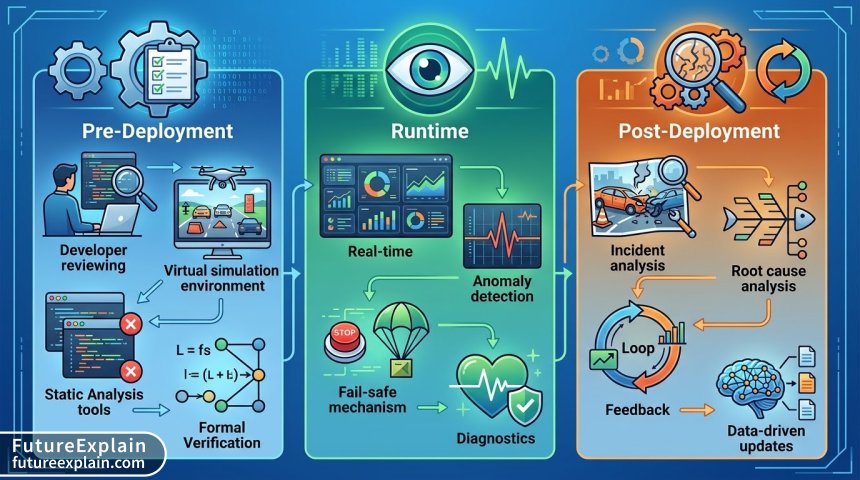
The Complete Safety Testing Checklist
This comprehensive checklist is divided into three primary phases: Pre-Deployment Testing, Runtime Monitoring, and Post-Deployment Evaluation. Each phase contains specific, actionable testing items with implementation guidance.
Phase 1: Pre-Deployment Testing
Before any agent touches production environments, thorough pre-deployment testing establishes foundational safety.
1.1 Agent Architecture Safety Review
Begin with a systematic review of the agent's architectural design:
- Boundary Definition: Clearly document what the agent is and isn't allowed to do
- Decision Transparency: Implement logging for all significant decisions
- Fail-Safe Mechanisms: Design graceful degradation pathways
- Resource Constraints: Set limits on computational resources and API calls
- Human-in-the-Loop Points: Identify where human oversight is required
1.2 Code and Model Security Assessment
Security vulnerabilities can become safety issues:
- Static code analysis for common vulnerabilities
- Model poisoning detection mechanisms
- Input validation and sanitization testing
- API security testing for all external integrations
- Authentication and authorization validation
1.3 Behavioral Simulation Testing
Simulate the agent's behavior across diverse scenarios:
- Normal operation scenarios (100+ variations)
- Edge case scenarios (50+ boundary conditions)
- Adversarial scenario testing (malformed inputs, attacks)
- Stress testing under high-load conditions
- Long-duration stability testing
1.4 Goal Alignment Verification
Ensure the agent optimizes for the correct objectives:
- Reward function validation (for RL agents)
- Objective function testing under corner cases
- Proxy goal identification and mitigation
- Multi-objective optimization balance testing
- Human preference alignment verification
Phase 2: Runtime Safety Monitoring
Once deployed, continuous monitoring catches issues that pre-deployment testing might miss.
2.1 Real-Time Behavior Monitoring
Monitor agent behaviors as they occur:
- Decision anomaly detection systems
- Behavior drift monitoring against baseline
- Resource usage monitoring and alerting
- Response time tracking and optimization
- Error rate monitoring and analysis
2.2 Environmental Adaptation Monitoring
Track how the agent adapts to changing conditions:
- Learning rate monitoring for adaptive agents
- Environmental change detection systems
- Adaptation stability analysis
- Novel situation detection and response
- Transfer learning safety monitoring
2.3 Interaction Safety Monitoring
Monitor interactions with users and other systems:
- User feedback sentiment and safety analysis
- Multi-agent interaction safety protocols
- API call safety and rate limiting
- Data privacy compliance monitoring
- Communication content safety filtering

2.4 Emergency Response Systems
Implement and test emergency safety mechanisms:
- Kill switch functionality and testing
- Safe mode transition protocols
- Human takeover procedures
- Incident response automation
- Rollback and recovery systems
Phase 3: Post-Deployment Evaluation
Regular evaluation ensures ongoing safety and identifies improvement opportunities.
3.1 Periodic Safety Audits
Schedule regular comprehensive safety reviews:
- Quarterly full safety assessment
- Monthly behavior pattern analysis
- Incident review and learning processes
- Regulatory compliance verification
- Stakeholder safety feedback integration
3.2 Long-Term Behavior Analysis
Study agent behavior over extended periods:
- Six-month behavior trend analysis
- Seasonal pattern identification
- Long-term goal drift detection
- Cumulative error analysis
- Evolving risk assessment
3.3 Safety Metric Tracking
Establish and monitor key safety metrics:
- Safety incident frequency and severity
- Near-miss detection and analysis
- User safety satisfaction scores
- System reliability metrics
- Compliance adherence rates
Implementing the Checklist: Practical Considerations
Having a checklist is one thing; implementing it effectively is another. Here are practical considerations for putting this safety testing framework into practice.
Tooling and Automation
While manual testing has its place, automation is essential for comprehensive safety testing:
- Testing Frameworks: Leverage existing AI safety testing frameworks where possible
- Custom Tool Development: Build specialized tools for your specific agent architecture
- Continuous Integration: Integrate safety tests into your CI/CD pipeline
- Monitoring Dashboards: Create real-time safety monitoring interfaces
- Alerting Systems: Implement tiered alerting for different safety issues
Team Structure and Responsibilities
Safety testing requires clear organizational structure:
- Dedicated Safety Engineer: Someone specifically responsible for safety
- Cross-Functional Safety Team: Include developers, product managers, and domain experts
- Clear Escalation Paths: Define who needs to know what, and when
- Regular Safety Reviews: Schedule mandatory safety discussion meetings
- Safety Culture Development: Foster an environment where safety concerns are welcomed
Documentation and Knowledge Management
Comprehensive documentation supports effective safety testing:
- Safety Testing Procedures: Documented, repeatable testing protocols
- Incident Response Playbooks: Clear procedures for safety incidents
- Risk Register: Ongoing documentation of identified risks and mitigations
- Learning Repository: Archive of safety incidents and lessons learned
- Regulatory Compliance Documentation: Evidence of compliance efforts
Advanced Safety Testing Techniques
For particularly critical or high-risk agents, consider these advanced testing methodologies.
Formal Verification Methods
Formal methods provide mathematical certainty about certain safety properties:
- Model Checking: Exhaustive testing of finite state systems
- Theorem Proving: Mathematical proof of safety properties
- Formal Specification: Precise, mathematical specification of safe behavior
- Contract-Based Design: Pre- and post-condition verification
- Temporal Logic Analysis: Verification of time-dependent properties
Adversarial Testing Approaches
Actively try to break your agents to find weaknesses:
- Red Team Exercises: Dedicated teams trying to find safety vulnerabilities
- Fuzz Testing: Random, malformed inputs to test robustness
- Adversarial Example Generation: Specifically crafted inputs to trigger failures
- Competitive Testing: Multiple agents competing to find vulnerabilities
- Stress Testing: Extreme conditions beyond normal operating parameters
Multi-Agent Safety Testing
When multiple agents interact, new safety challenges emerge:
- Emergent Behavior Testing: Looking for unanticipated group behaviors
- Communication Protocol Safety: Ensuring inter-agent communication remains safe
- Resource Competition Testing: Testing scenarios where agents compete for resources
- Coordination Failure Testing: What happens when coordination breaks down
- Scalability Safety Testing: Safety at different scales of agent deployment
Case Studies: Safety Testing in Practice
Real-world examples illustrate how these testing principles apply in practice.
Case Study 1: Financial Trading Agent Safety
A hedge fund deploying autonomous trading agents implemented a comprehensive safety testing regimen that prevented a potential multi-million dollar loss. Their testing included:
- Pre-deployment testing of 500+ market scenario simulations
- Real-time position limit monitoring with automatic trading suspension
- Weekly safety audits of all trading decisions
- Adversarial testing simulating market manipulation attempts
When an unexpected market event occurred that hadn't been simulated, the agent's fail-safe mechanisms triggered appropriately, limiting losses to acceptable levels while human traders were notified and took over.
Case Study 2: Healthcare Diagnostic Agent Validation
A healthcare provider implementing diagnostic assistance agents employed rigorous safety testing:
- Validation against 10,000+ historical cases with known outcomes
- Continuous monitoring of diagnostic confidence scores
- Regular comparison against human expert diagnoses
- Strict boundaries on agent recommendations (never direct treatment)
The testing regimen identified several edge cases where the agent's confidence was misplaced, leading to improved training data and better uncertainty quantification in the final deployment.
Case Study 3: Customer Service Multi-Agent System
An e-commerce platform deploying multiple customer service agents faced coordination challenges:
- Testing of handoff protocols between specialized agents
- Consistency checking across agent responses
- Load balancing safety under peak traffic conditions
- Escalation pathway validation to human agents
Comprehensive testing revealed a critical bug where two agents could give contradictory advice on return policies, which was fixed before major holiday shopping seasons.
Common Pitfalls and How to Avoid Them
Even with good intentions, safety testing efforts can fall short. Here are common pitfalls and how to avoid them.
Pitfall 1: Testing Only Normal Operations
Many teams test only how agents should work, not how they might fail:
- Solution: Dedicate at least 30% of testing effort to failure scenarios
- Solution: Include "negative testing" as a mandatory test category
- Solution: Brainstorm failure modes with diverse team members
Pitfall 2: Over-Reliance on Automated Testing
Automation is essential but insufficient alone:
- Solution: Combine automated tests with regular manual review
- Solution: Include human judgment in safety evaluation
- Solution: Use automation to support, not replace, human oversight
Pitfall 3: Ignoring Long-Term Behavior Changes
Agents that learn can develop new behaviors over time:
- Solution: Implement continuous behavior monitoring
- Solution: Schedule regular re-testing of core safety properties
- Solution: Monitor for goal drift and behavior evolution
Pitfall 4: Inadequate Incident Response Planning
Teams often focus on prevention but neglect response:
- Solution: Develop and practice incident response procedures
- Solution: Create clear escalation paths and decision authorities
- Solution: Document and learn from all safety incidents
Regulatory and Compliance Considerations
As autonomous agents become more prevalent, regulatory attention is increasing. Stay ahead of compliance requirements.
Current Regulatory Landscape
While comprehensive AI regulation is still evolving, several frameworks apply:
- GDPR and Data Privacy: Requirements for transparent automated decision-making
- Industry-Specific Regulations: Financial, healthcare, and automotive regulations
- Emerging AI Regulations: EU AI Act, US Executive Orders, etc.
- Product Liability Laws: Traditional liability frameworks applying to AI systems
Building Compliance into Testing
Integrate regulatory requirements into your testing processes:
- Document all testing procedures for regulatory review
- Implement audit trails for all safety-related decisions
- Regularly review and update testing for regulatory changes
- Engage legal and compliance teams early in development
Future Trends in Autonomous Agent Safety Testing
The field of autonomous agent safety testing is rapidly evolving. Stay prepared for these emerging trends.
Increasing Automation of Safety Testing
We're seeing growth in automated safety testing tools:
- AI systems that test other AI systems
- Automated vulnerability scanning for agent behaviors
- Self-healing systems that detect and fix safety issues
- Predictive safety analytics anticipating future risks
Standardization Efforts
The industry is moving toward standardized safety testing:
- ISO standards for AI system safety (ISO/IEC 23894)
- Industry consortiums developing best practices
- Certification programs for safe AI systems
- Benchmark datasets for safety testing comparisons
Integrated Safety-by-Design Approaches
Safety is increasingly built into agent architectures:
- Formal methods integrated into development workflows
- Safety constraints learned during training
- Architectural patterns promoting safety
- Development frameworks with built-in safety features
Conclusion: Building a Culture of Safety
The most comprehensive checklist is useless without a corresponding culture of safety. Safety testing for autonomous agents isn't just a technical challenge—it's an organizational commitment. It requires:
- Leadership commitment to prioritizing safety over speed
- Adequate resources allocated to safety testing efforts
- Continuous learning from both successes and failures
- Transparent communication about safety risks and mitigations
- Ethical considerations integrated into technical decisions
As autonomous agents become more capable and more integrated into our lives and businesses, rigorous safety testing becomes not just good practice, but a moral and professional imperative. This checklist provides a starting point, but remember: safety is a journey, not a destination. Regular review and improvement of your safety testing protocols is essential as both technology and our understanding of risks evolve.
Visuals Produced by AI