AI-Assisted Customer Support: From Bots to Handoffs
This comprehensive guide explores AI-assisted customer support systems that seamlessly transition between automated bots and human agents. We cover the evolution from basic chatbots to sophisticated AI assistants capable of understanding complex queries, managing ticket routing, and providing contextual handoffs to human support teams. Learn about implementation strategies, tool selection, best practices for maintaining quality while scaling support operations, and how to measure ROI effectively. Whether you're a small business owner or enterprise support manager, this guide provides actionable insights for building efficient, customer-centric hybrid support systems.


The Evolution of Customer Support: From Manual to AI-Assisted
Customer support has undergone a remarkable transformation over the past decade. What began as simple email ticketing systems and basic phone support has evolved into sophisticated, multi-channel ecosystems powered by artificial intelligence. Today, AI-assisted customer support represents not just a technological upgrade but a fundamental shift in how businesses interact with and serve their customers. This evolution has been driven by several factors: exponentially increasing customer expectations, the need for 24/7 availability, and the economic pressure to scale support operations efficiently.
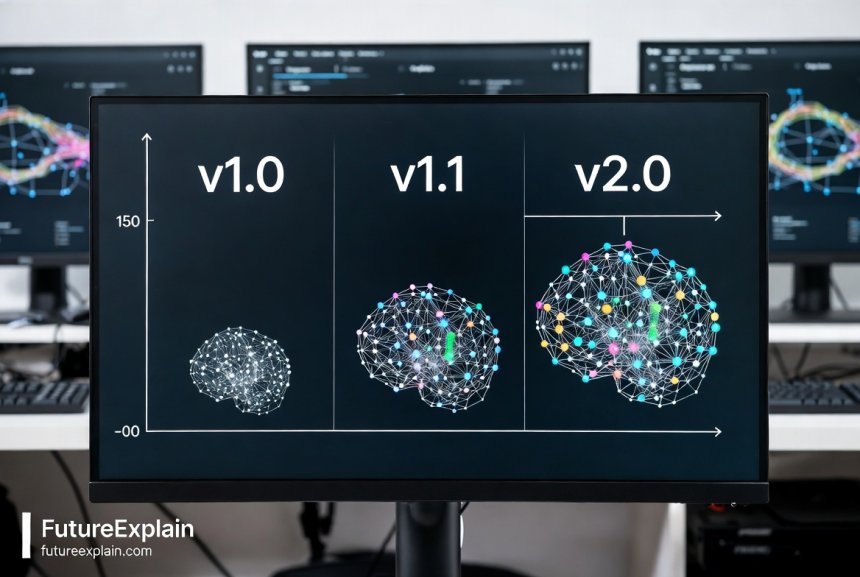
The journey from traditional support to AI-assisted models follows a clear progression. Initially, businesses implemented basic chatbots that could answer frequently asked questions. These early systems, while helpful, often frustrated customers with their limited understanding and inability to handle complex queries. The next phase introduced more sophisticated natural language processing (NLP) capabilities, allowing bots to understand context and intent better. Today, we're entering the era of "hybrid intelligence" – systems where AI and human agents work in seamless collaboration, each playing to their strengths.
According to recent industry analysis, companies implementing AI-assisted support systems report an average of 40% reduction in response times and a 35% decrease in operational costs within the first year of implementation. More importantly, these systems have been shown to improve customer satisfaction scores by 25-30% when properly implemented with effective human handoff protocols. The key differentiator between successful and failed implementations consistently comes down to one factor: the quality of the transition between automated systems and human support.
Understanding Modern AI Support Systems
Today's AI-assisted customer support systems are far more sophisticated than the simple rule-based chatbots of the past. Modern systems incorporate several layers of artificial intelligence working in concert:
- Natural Language Understanding (NLU): Advanced algorithms that comprehend customer intent, sentiment, and context beyond keyword matching
- Machine Learning Models: Systems that continuously learn from interactions to improve responses and routing accuracy
- Predictive Analytics: Capabilities that anticipate customer needs based on historical data and behavior patterns
- Multimodal Integration: Support across text, voice, and visual channels with consistent understanding
- Context Preservation: Systems that maintain conversation context throughout the customer journey
The architecture of these systems typically follows a tiered approach. Level 1 involves fully automated responses to common queries. Level 2 introduces AI-assisted human agents, where the AI suggests responses, provides relevant information, and automates routine tasks. Level 3 represents complex human-AI collaboration for sophisticated problem-solving. Each level requires increasingly sophisticated handoff mechanisms to ensure seamless customer experiences.
The Core Components of Effective AI Support
Building an effective AI-assisted support system requires careful integration of several key components:
- Intent Recognition Engine: The foundation that determines what the customer needs
- Knowledge Base Integration: Connection to existing documentation and information repositories
- Context Management System: Tracks conversation history and customer data across channels
- Escalation Protocol Engine: Determines when and how to transition to human support
- Agent Assistance Interface: Tools that help human agents during and after handoffs
The AI-Human Handoff: Where Magic Happens (or Systems Fail)
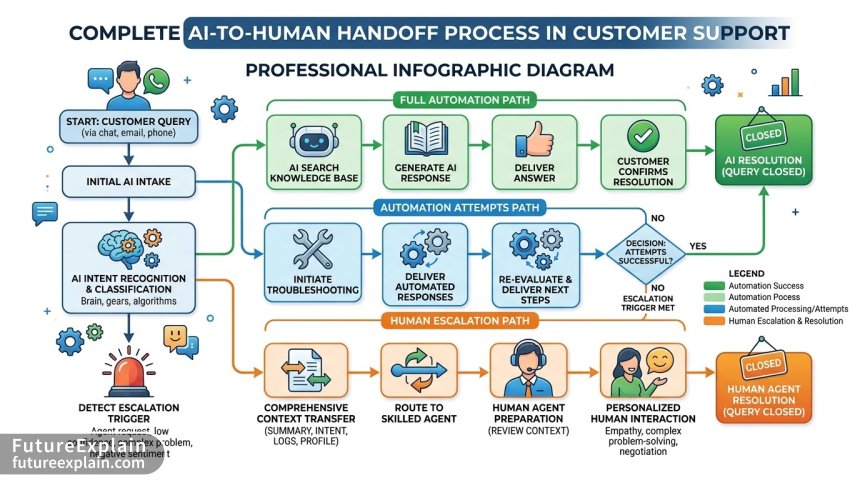
The transition point between AI and human support represents the most critical moment in modern customer service. A poorly executed handoff can negate all the efficiency gains of automation, while a smooth transition creates seamless experiences that customers barely notice. Successful handoffs share several characteristics:
- Context Preservation: The human agent receives complete conversation history and understanding
- Clear Escalation Reason: Both agent and customer understand why the handoff occurred
- Minimal Repetition: Customers don't need to repeat information already provided to the AI
- Smooth Technical Transition: No dropped conversations or technical glitches during transfer
Research across multiple platforms reveals that companies implementing standardized handoff protocols experience 60% higher customer satisfaction during transitions compared to those with ad-hoc approaches. The most effective protocols include specific triggers for handoff (escalation criteria), standardized context transfer formats, and agent preparation workflows.
Handoff Trigger Patterns
Determining when to escalate from AI to human support requires careful calibration. Common trigger patterns include:
- Complexity Thresholds: When query complexity exceeds AI capabilities
- Sentiment Detection: Escalation for frustrated or angry customers
- Repetition Patterns: When customers ask the same question multiple times
- Explicit Requests: When customers directly ask for human assistance
- Process Exceptions: Situations requiring human judgment or discretion
Visuals Produced by AI
Implementation Strategies for Different Business Sizes
The approach to implementing AI-assisted support varies significantly based on business size, resources, and customer volume. Here's a breakdown of strategies for different organizational contexts:
Small Businesses (1-50 Employees)
For small businesses, implementation should focus on low-cost, high-impact solutions. Key considerations include:
- Start with Chatbots on Existing Platforms: Many e-commerce and website platforms offer built-in AI support tools
- Leverage Multi-channel Platforms: Tools that handle email, chat, and social media in one interface
- Focus on FAQ Automation First: Automate responses to the most common 20% of questions
- Use Affordable AI Services: Many providers offer tiered pricing suitable for small volumes
Small businesses implementing AI support typically see ROI within 3-6 months when focusing on high-volume, repetitive queries. The key is to start with a limited scope (handling 15-20% of total queries) and expand gradually based on performance metrics and customer feedback.
Medium Businesses (50-500 Employees)
Medium-sized businesses can implement more sophisticated systems while maintaining cost efficiency:
- Integrated CRM + AI Solutions: Connect AI support to existing customer relationship management systems
- Custom Knowledge Base Development: Build tailored response systems for industry-specific queries
- Advanced Routing Rules: Implement skill-based routing combined with AI pre-qualification
- Performance Analytics: Implement detailed tracking to optimize AI-human balance
Enterprise Solutions (500+ Employees)
Large organizations require comprehensive, scalable solutions:
- Enterprise AI Platforms: Full-featured systems with custom model training capabilities
- Omnichannel Integration: Unified AI across phone, email, chat, social, and in-person channels
- Predictive Support Systems: AI that anticipates issues before customers contact support
- Advanced Security & Compliance: Enterprise-grade security and regulatory compliance features
Tool Selection and Platform Comparison
Choosing the right tools is critical for successful AI support implementation. The market offers solutions ranging from simple chatbot builders to enterprise AI platforms. Key evaluation criteria should include:
- Integration Capabilities: How well the tool connects with existing systems
- Customization Flexibility: Ability to tailor responses and workflows to specific business needs
- Scalability: Performance under increasing query volumes
- Analytics and Reporting: Depth of insights into performance and customer behavior
- Cost Structure: Pricing model alignment with business size and usage patterns
Popular Platform Categories
Entry-Level Chatbot Builders: Tools like ManyChat, Chatfuel, and Tars offer drag-and-drop interfaces for creating basic chatbots. These are ideal for small businesses starting with Facebook Messenger or simple website chat.
Mid-Range Conversational AI Platforms: Solutions like Dialogflow (Google), Watson Assistant (IBM), and LUIS (Microsoft) provide more sophisticated NLP capabilities with moderate learning curves. These suit businesses needing custom intent recognition and multi-channel deployment.
Enterprise Customer Service Platforms: Comprehensive solutions like Zendesk Answer Bot, Freshdesk Freddy, and Salesforce Service Cloud offer deeply integrated AI capabilities within full-featured support ecosystems. These provide the most seamless human-AI handoffs but come with higher complexity and cost.
Open-Source Alternatives: Frameworks like Rasa and Botpress offer maximum flexibility for organizations with technical resources. These require more development effort but provide complete control over data, models, and integration.
Building Effective Handoff Protocols
The quality of AI-human handoffs determines the overall success of AI-assisted support systems. Here's a comprehensive framework for building effective handoff protocols:
1. Context Transfer Standards
Establish standardized formats for transferring conversation context from AI to human agents. This should include:
- Complete conversation history with timestamps
- Customer intent and sentiment analysis
- Already attempted solutions and customer responses
- Customer profile information and historical context
- Priority level and suggested resolution approach
2. Escalation Criteria Matrix
Create a clear decision matrix for when handoffs should occur. This matrix should consider:
- Query Complexity Score: Based on factors like number of variables, required expertise, and process steps
- Customer Sentiment Score: Automated analysis of frustration, anger, or satisfaction levels
- Business Impact Assessment: Potential revenue impact, retention risk, or brand implications
- Compliance Requirements: Legal or regulatory considerations requiring human oversight
3. Agent Preparation Workflows
Develop systematic approaches to prepare human agents for incoming handoffs:
- Pre-handoff Briefing: Summary of situation before agent accepts the conversation
- Suggested Response Templates: AI-generated response suggestions based on similar past resolutions
- Knowledge Base Highlights: Relevant documentation and solutions surfaced automatically
- Escalation Path Guidance: Next steps if the issue requires further escalation
Training and Change Management
Successful AI support implementation requires careful attention to human factors. Support teams need training not just on using new tools, but on adapting to changed roles and responsibilities.
Agent Training Components
Effective training programs for support agents should include:
- AI Collaboration Skills: How to work effectively with AI suggestions and automation
- Complex Problem Resolution: Advanced skills for handling issues that require human intervention
- Quality Assurance in Hybrid Systems: Maintaining service standards in partially automated workflows
- Continuous Learning Practices: How to provide feedback to improve AI performance over time
Change Management Strategies
Managing the organizational transition to AI-assisted support requires:
- Phased Rollouts: Gradual implementation starting with low-risk, high-volume queries
- Transparent Communication: Clear explanation of changes to both staff and customers
- Performance Metric Adjustments: Evolving KPIs to reflect new hybrid work models
- Continuous Feedback Loops: Mechanisms for agents to suggest system improvements
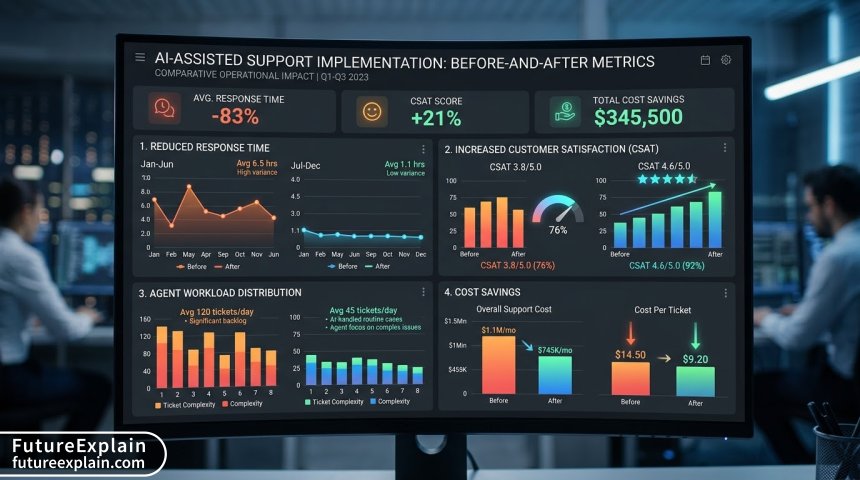
Visuals Produced by AI
Measuring Success: KPIs and ROI Analysis
Evaluating the effectiveness of AI-assisted support requires tracking the right metrics. Traditional support metrics often need adaptation for hybrid AI-human systems.
Key Performance Indicators
AI-Specific Metrics:
- AI Resolution Rate: Percentage of queries fully resolved without human intervention
- Handoff Quality Score: Customer satisfaction specifically with transition experiences
- Context Transfer Accuracy: How well information moves from AI to human agents
- AI Learning Velocity: Rate of improvement in AI responses over time
Hybrid System Metrics:
- First Contact Resolution (Hybrid): Issues resolved in initial interaction regardless of AI/human mix
- Average Handling Time (Composite): Combined AI and human time for resolution
- Customer Satisfaction (CSAT) by Channel: Satisfaction scores for different interaction paths
- Agent Assisted Resolution Rate: Percentage where agents use AI suggestions successfully
ROI Calculation Framework
Calculating return on investment for AI support systems should consider both quantitative and qualitative factors:
- Direct Cost Savings: Reduced agent hours, lower training costs, decreased turnover
- Revenue Impact: Increased sales from better support, higher retention rates
- Efficiency Gains: Faster resolution times, higher agent productivity
- Quality Improvements: Better customer experiences, higher satisfaction scores
- Strategic Advantages: 24/7 availability, multilingual support, scalability
A practical approach to ROI calculation involves tracking before-and-after metrics across three categories: operational efficiency (time/cost savings), customer impact (satisfaction/retention), and strategic value (scalability/innovation capability). Most businesses break even on implementation costs within 6-12 months, with ongoing annual returns of 30-50% on continued investment.
Common Implementation Challenges and Solutions
Despite the clear benefits, organizations often face specific challenges when implementing AI-assisted support systems. Here are common issues and proven solutions:
Challenge 1: Poor Handoff Experiences
Symptom: Customers repeat information, experience dropped conversations, or feel frustrated during transitions.
Solution: Implement standardized handoff protocols with mandatory context transfer. Conduct regular quality audits of handoff experiences and use customer feedback specifically about transitions to identify improvement areas.
Challenge 2: Agent Resistance
Symptom: Support teams view AI as a threat rather than a tool, leading to low adoption and poor collaboration.
Solution: Involve agents in implementation planning. Position AI as handling repetitive tasks so agents can focus on complex, rewarding work. Provide training on AI collaboration and recognize agents who excel in the new hybrid model.
Challenge 3: Inadequate Training Data
Symptom: AI provides poor responses due to insufficient or low-quality training data.
Solution: Start with a focused knowledge base rather than attempting to handle all queries immediately. Use existing support tickets and documentation as initial training material. Implement continuous learning processes where agents flag and correct AI errors.
Challenge 4: Integration Complexity
Symptom: AI systems operate in isolation from other business systems, limiting their effectiveness.
Solution: Choose platforms with strong API capabilities and pre-built integrations. Prioritize integration with core systems (CRM, knowledge base, ticketing) over nice-to-have features. Consider middleware solutions if direct integration proves challenging.
Future Trends in AI-Assisted Support
The field of AI-assisted customer support continues to evolve rapidly. Several emerging trends will shape the next generation of systems:
1. Predictive and Proactive Support
Future systems will increasingly anticipate customer issues before they occur. By analyzing usage patterns, error logs, and behavior data, AI will identify potential problems and reach out with solutions proactively. This shifts support from reactive to preventative models.
2. Emotional Intelligence Integration
Advanced sentiment analysis and emotional AI will enable systems to detect not just what customers say, but how they feel. This allows for more empathetic responses and appropriate escalation based on emotional state rather than just query complexity.
3. Multimodal Conversation Support
Support systems will seamlessly handle transitions between text, voice, and video channels while maintaining complete context. Customers could start with chat, switch to voice for complex explanations, and return to text for documentation—all within a single continuous conversation.
4. Self-Learning Systems with Human Feedback
Next-generation AI will incorporate more sophisticated reinforcement learning from human feedback. Every correction by a human agent will immediately improve the AI's future responses, creating continuously improving systems.
5. Personalized Support Experiences
AI will leverage customer history, preferences, and behavior to provide increasingly personalized support. This goes beyond using the customer's name to tailoring explanations, recommendations, and solutions to individual learning styles and technical expertise.
Ethical Considerations and Best Practices
As AI plays an increasing role in customer interactions, ethical considerations become crucial. Key principles include:
- Transparency: Clearly informing customers when they're interacting with AI versus humans
- Consent and Control: Giving customers choice in how their data is used and ability to request human support
- Bias Mitigation: Regular audits to ensure AI doesn't perpetuate or amplify human biases
- Privacy Protection: Secure handling of customer data and conversations
- Accountability: Clear responsibility for AI errors and established correction processes
Getting Started: A Practical Implementation Roadmap
For organizations ready to implement AI-assisted support, here's a step-by-step roadmap:
Phase 1: Assessment and Planning (Weeks 1-4)
- Analyze current support volume, channels, and common queries
- Define success criteria and ROI expectations
- Select pilot use cases (start with 3-5 common query types)
- Choose initial tools/platform based on budget and requirements
Phase 2: Pilot Implementation (Weeks 5-12)
- Build knowledge base for pilot use cases
- Configure basic AI responses and handoff rules
- Train support team on new systems and processes
- Launch limited pilot to small customer segment
Phase 3: Evaluation and Refinement (Weeks 13-16)
- Collect and analyze pilot performance data
- Solicit feedback from customers and agents
- Refine responses, handoff protocols, and workflows
- Address identified issues and gaps
Phase 4: Gradual Expansion (Months 5-12)
- Expand to additional query types and channels
- Implement more sophisticated AI capabilities
- Scale based on performance and resource availability
- Establish continuous improvement processes
Conclusion: The Future is Hybrid
AI-assisted customer support represents not the replacement of human agents, but their augmentation. The most successful organizations will be those that recognize the unique strengths of both AI and human intelligence, creating systems where each complements the other. AI excels at consistency, scalability, and handling repetitive tasks efficiently. Humans bring empathy, creativity, and complex problem-solving abilities. Together, they create support experiences that are both efficient and deeply human.
The journey toward effective AI-assisted support requires careful planning, continuous refinement, and attention to both technical and human factors. By focusing on seamless handoffs, appropriate tool selection, and ongoing training, organizations can build support systems that scale efficiently while maintaining—and often enhancing—the quality of customer experiences.
As AI technology continues to advance, the boundary between automated and human support will become increasingly blurred. Customers will care less about whether they're interacting with AI or humans, and more about getting their issues resolved quickly, accurately, and pleasantly. The organizations that master this hybrid approach will gain significant competitive advantages in customer satisfaction, operational efficiency, and business scalability.
Special Consideration: Multilingual Support For global businesses, implementing multilingual AI support presents both challenges and opportunities. Start with machine translation for common queries but invest in native-language training for high-volume markets. The handoff process becomes particularly important here—ensure human agents receive not just translated text but cultural context when taking over conversations.
Further Reading
- AI-Assisted Customer Support Workflows: From Bots to Humans - Detailed workflow analysis
- Building Chatbots That Hand Off Smoothly to Humans - Technical implementation guide
- Case Study: Small Business Automates Customer Onboarding - Real-world implementation example