
Adversarial Robustness: Simple Tests You Can Run
This comprehensive guide demystifies adversarial robustness testing for AI models. We break down complex security concepts into simple, actionable tests that developers and practitioners can implement immediately. Learn how to identify vulnerabilities in your models through practical manual tests, understand common attack vectors, and implement defensive strategies. The article covers testing across different data types including images, text, and tabular data, providing step-by-step procedures for both black-box and white-box testing scenarios. We also explore automated testing tools and frameworks while maintaining a focus on practical implementation over theoretical complexity.


Understanding Adversarial Robustness: Why It Matters
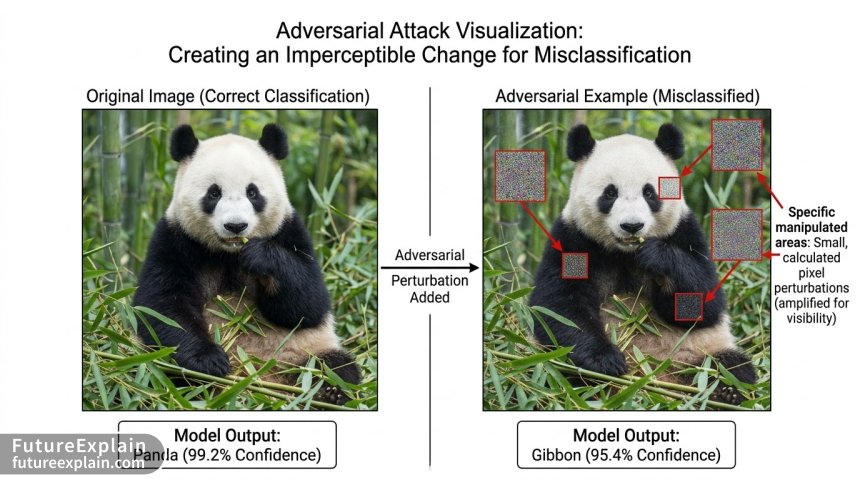
Adversarial robustness refers to an AI model's ability to maintain accurate predictions when presented with deliberately manipulated inputs designed to cause misclassification. These manipulated inputs, known as adversarial examples, are created by making subtle, often imperceptible changes to legitimate data. The concern isn't theoretical—research shows that even state-of-the-art models can be fooled by perturbations that humans wouldn't notice.
Consider this scenario: a self-driving car's vision system correctly identifies a stop sign 99.9% of the time. However, with just a few strategically placed stickers on the sign (creating what's called an "adversarial patch"), the system might classify it as a speed limit sign. The implications are immediately clear: adversarial robustness isn't just an academic exercise but a critical component of real-world AI safety.
The field gained significant attention in 2014 when researchers demonstrated that adding carefully crafted noise to an image of a panda could cause a neural network to classify it as a gibbon with high confidence. Since then, adversarial attacks have been demonstrated across all major AI domains: computer vision, natural language processing, audio processing, and even reinforcement learning systems.
The Spectrum of Adversarial Attacks
Before we dive into testing, it's crucial to understand the different types of adversarial attacks. These attacks are typically categorized along several dimensions:
- White-box vs. Black-box: White-box attacks assume complete knowledge of the model architecture and parameters, while black-box attacks treat the model as an opaque system, querying it to learn its behavior.
- Targeted vs. Untargeted: Targeted attacks aim to produce a specific incorrect classification, while untargeted attacks simply seek any incorrect output.
- Digital vs. Physical: Digital attacks manipulate data in the digital realm, while physical attacks involve real-world modifications to objects.
- Evasion vs. Poisoning: Evasion attacks occur during inference, while poisoning attacks compromise the training data.
Simple Manual Tests for Adversarial Robustness
You don't need a PhD in machine learning to start testing your models. These simple manual tests can reveal significant vulnerabilities and help you understand your model's failure modes.
1. The Gradient Sign Method (FGSM) Test
The Fast Gradient Sign Method (FGSM) is one of the simplest adversarial attack algorithms, making it an excellent starting point for testing. Here's how to implement a basic version:
Start by taking a correctly classified input and calculating the gradient of the loss function with respect to the input. The adversarial example is created by perturbing the original input in the direction that increases the loss:
Adversarial Example = Original Input + ε * sign(∇_x J(θ, x, y))
Where ε is a small perturbation magnitude. Even with ε values as low as 0.007 (for normalized image data), many models will misclassify the resulting image. To test your model manually:
- Select 10-20 correctly classified test samples
- Apply FGSM with increasing ε values (start with 0.001, then 0.003, 0.01, 0.03)
- Record the success rate of attacks at each ε level
- Note which classes are most vulnerable
2. Boundary Exploration Test
This test explores the decision boundaries of your classifier by finding the minimum perturbation needed to change a classification. The concept is simple: starting from a correctly classified point, move incrementally toward the decision boundary until the classification changes.
For image classifiers, you can implement this by:
- Choosing two semantically similar classes (like different dog breeds)
- Finding examples that are correctly classified near the boundary
- Creating linear interpolations between examples of the two classes
- Testing at what point the classification flips
Models with poor robustness will have decision boundaries very close to training points, meaning tiny perturbations cause misclassification. Robust models maintain consistent classifications within reasonable neighborhoods around training points.
3. Universal Perturbation Test
Universal adversarial perturbations are single perturbation patterns that, when added to any input, cause misclassification with high probability. To test for vulnerability to universal perturbations:
- Generate a random noise pattern
- Add it to 50-100 test samples with increasing magnitudes
- Track when the accuracy drops below an acceptable threshold (typically 90%, then 80%, etc.)
This test is particularly important for real-world applications where attackers might apply stickers, filters, or other consistent modifications.
Testing Text Models: Special Considerations
Text models present unique challenges for adversarial testing because discrete text data doesn't allow for infinitesimal perturbations like continuous image data. Here are simple tests for text model robustness:
1. Synonym Replacement Test
This test evaluates how sensitive your model is to semantic-preserving changes:
- Take correctly classified text samples
- Replace key words with synonyms (using WordNet or similar resources)
- Track classification consistency
- Note which word replacements cause the most instability
For example, in sentiment analysis, changing "excellent" to "outstanding" shouldn't flip sentiment from positive to negative. Yet many models show surprising sensitivity to such changes.
2. Character-Level Perturbation Test
Character-level attacks are particularly concerning for production systems. Test your model's resilience to:
- Common typos (replacing 'o' with '0', 'i' with '1', 'e' with '3')
- Adding/removing whitespace in strategic locations
- Inserting invisible Unicode characters
- Using homoglyphs (different characters that look identical)
A robust text classifier should maintain consistent outputs despite these superficial changes, especially when the semantic meaning remains clear to human readers.
Testing Tabular Data Models
Models trained on tabular data (like those used in finance, healthcare, or business analytics) also need adversarial testing. Here are practical approaches:
1. Feature Perturbation Within Bounds
For each feature in your dataset:
- Determine its realistic range (minimum and maximum plausible values)
- Create test cases where features are perturbed within 1%, 5%, and 10% of their range
- Track how predictions change with these perturbations
Models that show dramatic prediction changes with tiny feature perturbations may be overfitting or have learned unstable decision boundaries.
2. Missing Data Robustness Test
Real-world data often has missing values. Test your model's robustness by:
- Systematically setting different percentages of features to missing (10%, 30%, 50%)
- Testing both random missing patterns and correlated missing patterns
- Comparing predictions with and without imputation
Automated Testing Tools and Frameworks
While manual tests provide valuable insights, automated tools can scale your testing efforts. Here are the most accessible options:
1. IBM Adversarial Robustness Toolbox (ART)
ART is one of the most comprehensive libraries for adversarial machine learning. Despite its depth, beginners can start with these simple tests:
# Basic ART test for image classification
from art.attacks.evasion import FastGradientMethod
from art.estimators.classification import TensorFlowClassifier

# Create attack object
attack = FastGradientMethod(estimator=classifier, eps=0.1)
# Generate adversarial examples
x_test_adv = attack.generate(x=x_test)
# Evaluate accuracy
predictions = classifier.predict(x_test_adv)
accuracy = np.sum(np.argmax(predictions, axis=1) == y_test) / len(y_test)
ART supports TensorFlow, PyTorch, scikit-learn, and other frameworks, making it versatile for different tech stacks.
2. TextAttack Framework
For testing NLP models, TextAttack provides a user-friendly interface:
# Simple TextAttack example
from textattack import Attack
from textattack.attack_recipes import TextFoolerJin2019

# Create attack recipe
attack = Attack(TextFoolerJin2019, model_wrapper)
# Run attack on test samples
attack_results = attack.attack_dataset(test_dataset)
TextAttack includes pre-built attack recipes and evaluation metrics, lowering the barrier to NLP security testing.
3. Foolbox: Lightweight and Intuitive
Foolbox excels at providing a clean, Pythonic interface for adversarial attacks:
import foolbox as fb

# Instantiate model
fmodel = fb.PyTorchModel(model, bounds=(0, 1))
# Create attack
attack = fb.attacks.LinfFastGradientAttack()
# Run attack
raw, clipped, is_adv = attack(fmodel, images, labels)
# Calculate robustness
robust_accuracy = 1 - is_adv.float().mean()
Foolbox's strength lies in its simplicity and extensive collection of attack implementations.
Developing a Systematic Testing Protocol
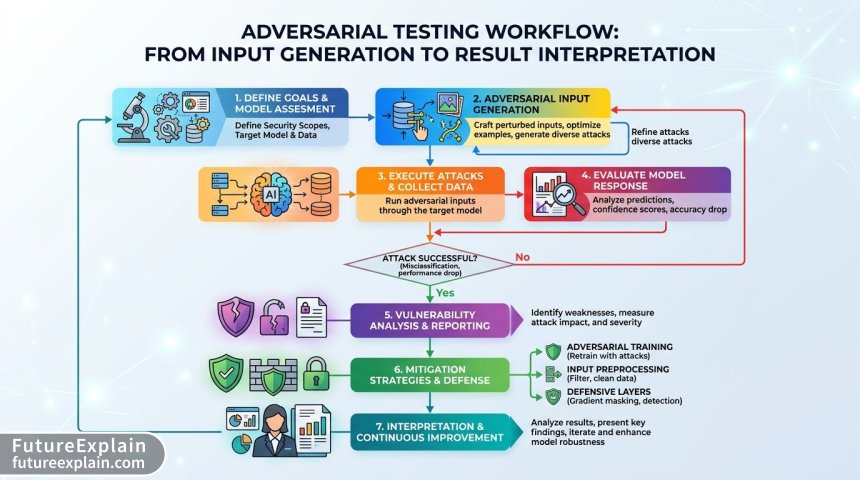
Random testing provides limited value. Instead, develop a systematic protocol that ensures comprehensive coverage:
Phase 1: Baseline Establishment
- Measure clean accuracy on a diverse test set
- Establish performance benchmarks for different data subgroups
- Document expected behavior for edge cases
Phase 2: Simple Perturbation Tests
- Apply Gaussian noise with increasing standard deviations
- Test with common data augmentations (rotation, scaling, cropping)
- Evaluate brightness/contrast adjustments for vision models
Phase 3: Gradient-Based Attacks
- Implement FGSM with varying ε values
- Test Projected Gradient Descent (PGD) attacks
- Evaluate Carlini & Wagner (C&W) attacks for targeted scenarios
Phase 4: Black-Box Attacks
- Simulate realistic attack scenarios with limited model knowledge
- Test transferability of adversarial examples
- Evaluate query-based attacks (like Square Attack)
Phase 5: Physical World Simulation
- Apply realistic transformations (blur, compression artifacts, lighting changes)
- Test with adversarial patches and stickers
- Evaluate robustness to viewpoint changes for vision systems
Interpreting Test Results: What the Numbers Mean
Test results without interpretation are just numbers. Here's how to make sense of your findings:
Accuracy Under Attack (AUA)
AUA measures model accuracy when subjected to adversarial examples. A robust model should maintain:
- >90% AUA against simple noise attacks
- >70% AUA against gradient-based white-box attacks
- >80% AUA against practical black-box attacks
Perturbation Magnitude Analysis
The ε value at which accuracy drops significantly indicates robustness:
- ε < 0.01: Highly vulnerable model
- ε = 0.01-0.05: Moderate robustness
- ε > 0.05: Good robustness for many applications
Remember that acceptable ε values depend on your data domain. For image pixels normalized to [0, 1], ε=0.03 represents barely visible changes.
Class-Wise Vulnerability Analysis
Some classes are inherently more vulnerable than others. Analyze:
- Which classes are easiest to attack
- Which attack directions (source→target class pairs) are most successful
- Whether vulnerabilities correlate with training data quantity/quality
Mitigation Strategies When Tests Fail
When your model fails adversarial tests, you have several mitigation options:
1. Adversarial Training
The most effective defense involves training on adversarial examples:
# Simplified adversarial training loop
for epoch in range(num_epochs):
    for batch in dataloader:
        # Generate adversarial examples
        adv_batch = attack.generate(batch)
        # Train on mixed batch
        loss = criterion(model(batch), labels) + criterion(model(adv_batch), labels)
        loss.backward()
        optimizer.step()
Adversarial training typically reduces clean accuracy by 1-5% while significantly improving robustness.
2. Defensive Distillation
This technique trains a second model to mimic a first model's soft labels, smoothing the decision landscape:
- Train Teacher model normally
- Generate soft labels (probabilities) from Teacher
- Train Student model using soft labels with temperature scaling
- The Student model learns smoother decision boundaries
3. Input Preprocessing and Detection
Preprocess inputs to remove adversarial perturbations:
- Random resizing and padding for images
- Feature squeezing (reducing color bit-depth)
- JPEG compression for images
- Spell checking and normalization for text
Detection approaches identify adversarial examples before they reach the model:
- Train a separate detector on clean and adversarial examples
- Use statistical tests (like kernel density estimation)
- Monitor prediction confidence distributions
Building a Continuous Testing Pipeline
Adversarial testing shouldn't be a one-time event. Integrate it into your development workflow:
1. Pre-commit Hooks
Add lightweight adversarial tests to your pre-commit checks:
# .pre-commit-config.yaml
repos:
  - repo: local
    hooks:
      - id: adversarial-test
        name: Run basic adversarial tests
        entry: python -m pytest tests/adversarial/test_basic.py -v
        language: system
        pass_filenames: false
2. CI/CD Integration
Include adversarial tests in your continuous integration pipeline:
# GitHub Actions example
name: Adversarial Testing
on: [push]
jobs:
  adversarial-tests:
    runs-on: ubuntu-latest
    steps:
      - uses: actions/checkout@v2
      - name: Run adversarial robustness tests
        run: |
          python -m pytest tests/adversarial/ --cov=src --cov-report=xml
3. Periodic Deep Testing
Schedule comprehensive adversarial testing:
- Weekly: Lightweight tests on current models
- Monthly: Medium-depth testing with expanded attack types
- Quarterly: Comprehensive evaluation including new attack research
Common Pitfalls in Adversarial Testing
Avoid these common mistakes that undermine testing effectiveness:
1. Testing Only on Easy Examples
Many teams test only on examples near decision boundaries or challenging cases. Include:
- Examples the model is highly confident about
- Diverse data from all training subgroups
- Real-world noisy data, not just clean benchmarks
2. Overfitting to Specific Attacks
Models can become robust to specific attack types while remaining vulnerable to others. Test against:
- Multiple attack algorithms (not just FGSM)
- Both white-box and black-box scenarios
- Various perturbation budgets (ε values)
3. Ignoring Transfer Attacks
Adversarial examples often transfer between models. Test:
- Whether examples crafted for your model affect similar models
- If examples from public models affect your deployment
- Cross-framework transferability (PyTorch ↔ TensorFlow)
Ethical Considerations in Adversarial Testing
Adversarial testing involves creating attacks against AI systems. Follow these ethical guidelines:
1. Responsible Disclosure
If you discover vulnerabilities in third-party systems:
- Document the vulnerability thoroughly
- Contact the system owners through proper channels
- Allow reasonable time for remediation before public disclosure
- Consider coordinated disclosure for critical systems
2. Testing Scope and Authorization
Only test systems you own or have explicit permission to test. Unauthorized testing may violate:
- Terms of service agreements
- Computer fraud and abuse laws
- Data protection regulations
3. Dual-Use Considerations
Adversarial research can be used both defensively and offensively. To promote responsible use:
- Focus publications on defense mechanisms
- Consider omitting attack details that could harm deployed systems
- Engage with the broader AI safety community
Case Study: Testing a Production Image Classifier
Let's walk through testing a real-world image classification system for an e-commerce platform:
System Context
- Model: ResNet-50 fine-tuned on product images
- Application: Automatic product categorization
- Deployment: Cloud API serving thousands of requests daily
Testing Approach
- Baseline Establishment: Achieved 94.2% accuracy on clean test set
- Simple Perturbations: 10% Gaussian noise reduced accuracy to 87.3%
- FGSM Attacks: ε=0.03 caused accuracy drop to 62.1%
- Black-box Testing: Using only API access, achieved 45% attack success rate
Key Findings
- Certain product categories (electronics, accessories) were significantly more vulnerable
- White backgrounds increased vulnerability compared to natural backgrounds
- Small products in images were easier to attack than large products
Implemented Mitigations
- Added adversarial training with ε=0.02 perturbations
- Implemented input preprocessing (random cropping and color jitter)
- Added confidence thresholding for predictions
- Result: Robustness improved (ε=0.03 attacks now only reduce accuracy to 85.7%)
Future Directions in Adversarial Testing
The field of adversarial robustness continues to evolve. Emerging trends include:
1. Testing Foundation Models
Large language models and multimodal foundation models present new testing challenges:
- Prompt injection attacks bypassing safety filters
- Jailbreaking techniques through creative prompting
- Multimodal attacks combining text and image manipulations
2. Formal Verification Approaches
Mathematically proving model robustness within certain bounds:
- Interval bound propagation for neural networks
- Mixed-integer linear programming formulations
- Abstract interpretation techniques
3. Human-in-the-Loop Testing
Combining automated testing with human evaluation:
- Crowdsourcing adversarial example creation
- Human evaluation of attack perceptibility
- Interactive red teaming exercises
Getting Started: Your First Week of Adversarial Testing
Here's a practical one-week plan to begin adversarial testing:
Day 1: Education and Setup
- Read foundational papers on adversarial examples
- Set up testing environment with required libraries
- Create a simple test model if you don't have one ready
Day 2-3: Implement Basic Tests
- Add Gaussian noise testing to your evaluation pipeline
- Implement FGSM with three ε values (0.01, 0.03, 0.1)
- Test on 100 representative samples
Day 4: Analyze Results
- Calculate Accuracy Under Attack metrics
- Identify most vulnerable classes/samples
- Document initial findings
Day 5: Implement First Mitigation
- Add simple adversarial training or input preprocessing
- Re-run tests to measure improvement
- Update documentation with before/after comparisons
Conclusion: Building a Culture of Robustness
Adversarial testing isn't just a technical checklist—it's a mindset shift toward building more reliable, secure AI systems. By starting with simple tests and gradually incorporating more sophisticated methods, teams can significantly improve their models' real-world performance.
The most important step is beginning. Even basic adversarial testing provides insights that pure accuracy metrics miss. As you integrate these practices into your workflow, you'll develop intuition for model vulnerabilities and build more robust systems.
Remember that perfect robustness is unattainable, but substantial improvements are achievable with systematic testing. Focus on making your models robust enough for their specific applications, considering the realistic threat models and failure consequences.
Visuals Produced by AI
Further Reading
- AI Ethics & Safety - Explore broader AI safety considerations
- Mitigating Hallucinations: Techniques and Tooling - Address another critical AI reliability issue
- Explainability Tools: XAI for Non-Experts - Understand how to interpret model decisions