
How to Implement Continuous Learning in Production (Update)
This comprehensive 2025 guide demystifies continuous learning implementation for machine learning models in production. We break down the complete process from monitoring and detection to automated retraining and deployment, with practical templates for decision-making frameworks. Learn how to design hybrid retraining strategies that balance performance with cost efficiency, implement robust monitoring for data and concept drift, and establish security protocols for automated model updates. We provide step-by-step implementation guides using both cloud platforms and open-source tools, along with a ready-to-use continuous learning policy template. This updated guide incorporates lessons from real-world deployments and addresses common pitfalls in maintaining always-learning AI systems.


Introduction: The Evolving Landscape of Continuous Learning
In the fast-paced world of production machine learning, models don't remain static after deployment. The concept of continuous learning—where AI systems automatically improve themselves by learning from new data—has evolved from an academic ideal to a practical necessity. As we approach 2025, organizations that successfully implement continuous learning systems gain significant competitive advantages through constantly improving accuracy, adaptation to changing conditions, and reduced manual intervention.
This updated guide builds upon foundational MLOps principles to provide a comprehensive, practical approach to implementing continuous learning in production environments. We'll move beyond theory to address real-world challenges including cost optimization, security considerations, and decision frameworks that determine when automated retraining makes business sense.
What Continuous Learning Really Means in 2025
Continuous learning, also called continuous training or online learning, refers to the automated process of periodically retraining machine learning models with new data while maintaining production stability. Unlike traditional one-time model training, continuous learning systems create a feedback loop where:
- Production models generate predictions and collect new data
- Monitoring systems detect when retraining is needed
- Automated pipelines retrain, validate, and deploy updated models
- The cycle continues with minimal human intervention
The 2025 landscape introduces new considerations: edge computing enables faster local updates, federated learning preserves privacy during distributed training, and increasingly stringent regulations require audit trails for all model changes. Understanding these evolving contexts is crucial for designing effective continuous learning systems.
Core Components of a Continuous Learning System
Before diving into implementation, let's break down the essential components that every continuous learning system requires:
1. Robust Monitoring and Detection
Effective monitoring goes beyond basic performance metrics. A comprehensive system should track:
- Data Drift: Changes in input data distribution over time
- Concept Drift: Changes in relationships between inputs and outputs
- Performance Degradation: Declining accuracy or increasing error rates
- Infrastructure Metrics: Latency, throughput, and resource utilization
- Business Metrics: How model predictions impact key business outcomes
Tools like Evidently AI, WhyLabs, and AWS SageMaker Model Monitor provide specialized drift detection capabilities. For custom implementations, statistical tests like Kolmogorov-Smirnov for distribution changes and performance degradation alerts using moving averages form the foundation.
2. Automated Training Pipeline
The training pipeline must handle:
- Data collection and preprocessing
- Feature engineering consistent with production
- Model training with hyperparameter optimization
- Version control for code, data, and model artifacts
- Reproducibility guarantees through containerization
Modern approaches use Docker containers for environment consistency and MLflow or DVC for experiment tracking. The key advancement in 2025 is the integration of automated hyperparameter optimization directly into continuous learning pipelines, reducing the need for manual tuning cycles.
3. Validation and Testing Framework
Before any model reaches production, it must pass rigorous validation:
- A/B testing against current production model
- Statistical significance testing of performance improvements
- Fairness and bias assessment on new data
- Computational efficiency verification
- Integration testing with downstream systems
Establish clear acceptance criteria before automation. A common standard is requiring at least 2% improvement in primary metrics with statistical significance (p < 0.05) before automated deployment.
4. Safe Deployment Mechanisms
Continuous learning requires deployment strategies that minimize risk:
- Canary deployments to limited user segments
- Shadow deployments running in parallel without affecting users
- Blue-green deployments for instant rollback capability
- Feature flags to control model activation
These strategies ensure that even with automated updates, you maintain control over production stability and can quickly revert if issues arise.
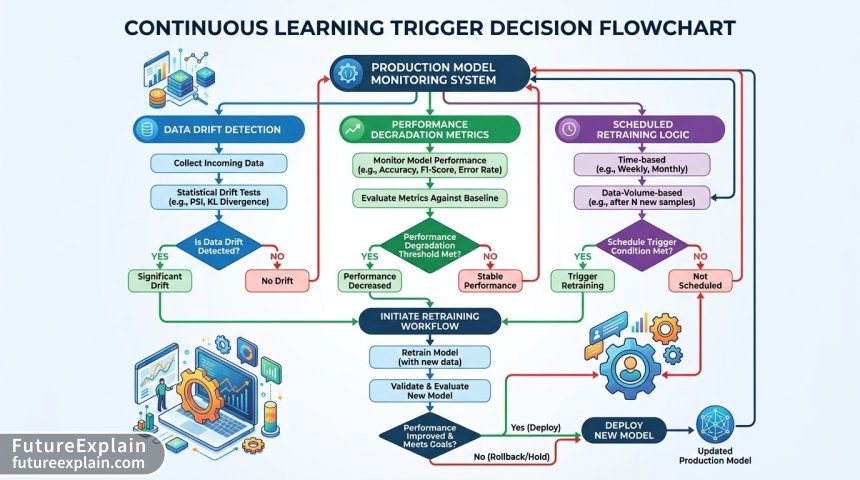
When to Retrain: The Decision Framework
One of the most critical aspects of continuous learning is determining WHEN to trigger retraining. Automated systems need clear decision rules to avoid unnecessary computation costs while maintaining model performance.
The Retraining Decision Matrix
Consider these four factors when designing retraining triggers:
- Performance-Based Triggers: When evaluation metrics fall below predefined thresholds (e.g., accuracy < 92%, F1-score < 0.85)
- Data-Based Triggers: When statistical tests detect significant drift in input distributions or feature correlations
- Schedule-Based Triggers: Regular intervals (daily, weekly) regardless of current performance
- Event-Based Triggers: Specific business events (new product launch, regulatory changes, season transitions)
Cost-Benefit Analysis Framework
Before automating any retraining decision, calculate the expected value:
Expected Benefit = (Performance Improvement × Business Value per Improvement) × Confidence in Improvement
Expected Cost = Compute Costs + Data Processing Costs + Opportunity Costs of Development Time
Only automate retraining when Expected Benefit > Expected Cost × Safety Factor (typically 2-3x). This framework prevents wasteful retraining on marginal improvements.
Hybrid Retraining Strategy Template
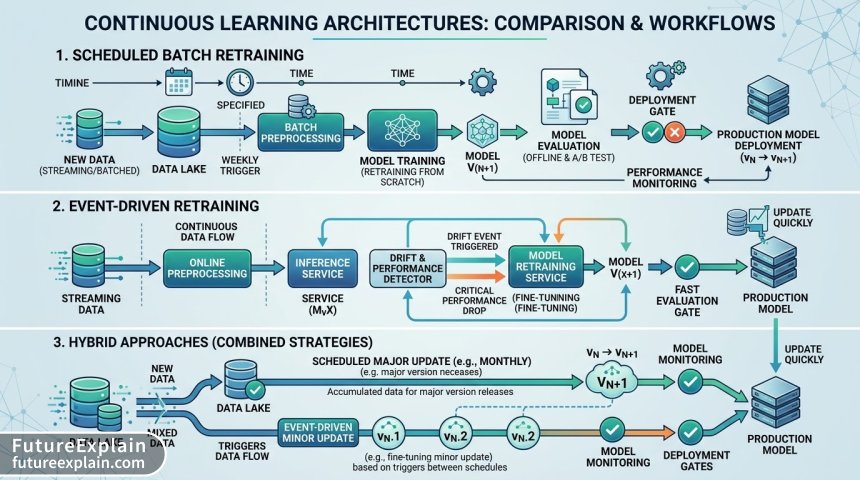
Most successful implementations use a hybrid approach:
- Daily: Lightweight monitoring and statistical tests
- Weekly: Performance degradation checks with rolling windows
- Monthly: Full retraining regardless of metrics (catches gradual concept drift)
- Event-Driven: Immediate retraining on significant business changes
This balances responsiveness with computational efficiency, ensuring models adapt to both sudden and gradual changes in the environment.
Step-by-Step Implementation Guide
Let's walk through a practical implementation using open-source tools that can be adapted to any infrastructure.
Phase 1: Infrastructure Setup
Begin with a reproducible environment:
# Dockerfile for consistent training environment
FROM python:3.9-slim
WORKDIR /app
COPY requirements.txt .
RUN pip install --no-cache-dir -r requirements.txt
COPY . .
CMD ["python", "train_pipeline.py"]
Key packages for your requirements.txt should include: scikit-learn, pandas, numpy, mlflow, evidently, prefect (for orchestration), and your ML framework of choice.
Phase 2: Monitoring Implementation
Implement drift detection with statistical rigor:
# Example drift detection using Evidently AI
from evidently.test_suite import TestSuite
from evidently.tests import TestValueDrift

def check_data_drift(reference_data, current_data):
    drift_test = TestSuite(tests=[
        TestValueDrift(column_name='feature1'),
        TestValueDrift(column_name='feature2'),
        # Add all important features
    ])
    drift_test.run(reference_data=reference_data,
                   current_data=current_data)
    return drift_test.as_dict()
Set up alerts when drift scores exceed thresholds (typically 0.1-0.3 depending on feature importance).
Phase 3: Pipeline Orchestration
Use Prefect or Apache Airflow to coordinate the continuous learning workflow:
from prefect import flow, task
from datetime import timedelta
from prefect.schedules import IntervalSchedule

# Schedule: Run daily at 2 AM
schedule = IntervalSchedule(interval=timedelta(days=1))

@flow(name="continuous-learning", schedule=schedule)
def continuous_learning_flow():
    # 1. Check monitoring metrics
    needs_retraining = check_monitoring_metrics()

    if needs_retraining:
        # 2. Retrain model
        new_model = retrain_model()

        # 3. Validate against current model
        passes_validation = validate_model(new_model)

        if passes_validation:
            # 4. Deploy new model
            deploy_model(new_model)
            # 5. Update monitoring baseline
            update_monitoring_baseline(new_model)
Phase 4: Validation Gates
Implement multiple validation checkpoints:
- Technical Validation: Model loads successfully, predictions within expected ranges
- Statistical Validation: Outperforms current model with statistical significance
- Business Validation: Improves key business metrics in shadow deployment
- Operational Validation: Meets latency and throughput requirements
Each validation failure should trigger specific alerting and stop the automated deployment.
Cloud Platform Implementations
For teams using managed services, here are updated 2025 implementation guides:
AWS SageMaker Continuous Learning
SageMaker's MLOps capabilities have expanded significantly:
- Use SageMaker Model Monitor for drift detection with custom baselines
- Implement SageMaker Pipelines with condition steps for retraining decisions
- Leverage SageMaker Model Registry for version control and approval workflows
- Use SageMaker Edge Manager for continuous learning on edge devices
The key advantage is integration with AWS's security and monitoring ecosystem, though vendor lock-in remains a consideration.
Google Vertex AI Continuous Training
Vertex AI provides particularly strong continuous training features:
- Continuous evaluation against a held-out dataset
- Automated retraining triggers based on performance thresholds
- Integrated feature store ensuring consistency between training and serving
- Explainable AI integration for monitoring prediction explanations over time
For teams already in Google Cloud ecosystem, this offers the most streamlined implementation.
Azure Machine Learning
Azure ML's continuous learning implementation focuses on:
- Dataset monitors for data drift with email alerts
- Automated ML retraining pipelines
- Integration with Azure DevOps for CI/CD
- Responsible AI dashboard for monitoring fairness over time
The tight integration with Microsoft's enterprise security stack makes this appealing for regulated industries.
Cost Optimization Strategies
Continuous learning can become expensive without careful planning. Here are proven cost optimization techniques:
1. Intelligent Retraining Scheduling
Instead of retraining on every data point, implement:
- Strategic Sampling: Retrain only on representative or difficult samples
- Transfer Learning: Fine-tune only the last layers for gradual adaptation
- Warm Starts: Use previous model weights as initialization
- Off-Peak Scheduling: Schedule heavy retraining during low-cost compute periods
2. Infrastructure Optimization
Right-size your compute resources:
- Use spot instances for fault-tolerant training jobs
- Implement auto-scaling based on pipeline queue depth
- Cache feature transformations to avoid redundant computation
- Use model compression techniques before deployment to reduce serving costs
3. Data Management
Control data-related costs:
- Implement data retention policies aligned with model relevance windows
- Use incremental updates instead of full dataset retraining when possible
- Compress training data storage with efficient formats like Parquet
- Implement data quality gates to avoid training on corrupted data
Monitoring your continuous learning costs should be as important as monitoring model performance. Establish cost-per-prediction improvement metrics to evaluate efficiency.
Security Considerations for Automated Systems
Automated model updates introduce unique security challenges that must be addressed:
Security Checklist for Continuous Learning Pipelines
- Access Controls: Strict IAM policies limiting who can modify pipelines
- Code Signing: Digital signatures for all pipeline code changes
- Model Provenance: Immutable audit trail of all training data and code versions
- Adversarial Robustness: Testing against data poisoning attacks
- Encryption: End-to-end encryption for training data in transit and at rest
- Approval Workflows: Critical model updates requiring human approval
- Rollback Mechanisms: Automated reversion to last known good state on failure
Protecting Against Data Poisoning
Continuous learning systems are vulnerable to adversarial attacks through training data:
- Implement anomaly detection on incoming training data
- Use differential privacy during training to limit influence of individual data points
- Regularly audit model behavior for unexpected changes
- Maintain a clean validation set untouched by continuous updates
Security should be baked into the pipeline design, not added as an afterthought. Regular security audits of your continuous learning infrastructure are essential.
Performance Monitoring and Alerting
Effective monitoring is the nervous system of any continuous learning implementation. Beyond basic metrics, monitor:
Key Performance Indicators (KPIs)
- Model Performance KPIs: Accuracy, precision, recall, F1-score (tracked with rolling windows)
- Business Impact KPIs: Conversion rates, customer satisfaction, operational efficiency
- System Health KPIs: Pipeline success rate, average retraining time, compute utilization
- Cost Efficiency KPIs: Cost per accuracy point gained, ROI of retraining cycles
Alerting Strategy
Implement tiered alerting to avoid alert fatigue:
- Low Severity: Performance degradation < 2% - Weekly digest email
- Medium Severity: Performance degradation 2-5% - Slack/Teams notification
- High Severity: Performance degradation > 5% or security issue - PagerDuty/phone alert
- Critical: Complete pipeline failure or significant data drift - Immediate escalation
Regularly review and tune alert thresholds based on false positive rates and business impact.
Continuous Learning Policy Template
Every organization implementing continuous learning should have a documented policy. Here's a template you can adapt:
CONTINUOUS LEARNING POLICY
Organization: [Your Organization]
Effective Date: [Date]
Version: 1.0

1. PURPOSE
This policy establishes guidelines for automated machine learning model updates in production environments.

2. SCOPE
All machine learning models in production that utilize continuous learning capabilities.

3. RESPONSIBILITIES
- Data Science Team: Design and validation of retraining pipelines
- MLOps Team: Infrastructure and monitoring
- Security Team: Security review and approval
- Business Owners: Approval of performance thresholds

4. RETRAINING TRIGGERS
Models shall be retrained when ANY of the following conditions are met:
- Primary performance metric degrades by more than [X]% for [Y] days
- Statistical drift detection exceeds threshold of [Z]
- Scheduled retraining interval of [Time Period] is reached
- Specific business event occurs: [List Events]

5. VALIDATION REQUIREMENTS
All retrained models must pass the following before production deployment:
- Statistical superiority over current model (p < 0.05)
- All integration tests pass
- Performance within latency budget of [Time]
- Fairness metrics within acceptable ranges
- Security scan passes

6. DEPLOYMENT PROCEDURES
- Canary deployment to [X]% of traffic initially
- Full deployment only after [Y] hours of successful canary
- Automatic rollback if error rate exceeds [Z]%

7. MONITORING AND ALERTING
[Specify monitoring tools and alert thresholds]

8. DOCUMENTATION AND AUDITING
All retraining events must be logged with:
- Timestamp and initiating trigger
- Training data statistics
- Performance metrics before and after
- Validation results
- Deployment details and approval chain

9. EXCEPTIONS
Exceptions to this policy require written approval from [Role].

10. REVIEW CYCLE
This policy shall be reviewed every [Time Period].
Common Pitfalls and How to Avoid Them
Based on real-world implementations, here are the most common failure modes:
Pitfall 1: Over-Retraining
Symptom: High compute costs with minimal performance improvements
Solution: Implement the cost-benefit framework described earlier and increase retraining thresholds
Pitfall 2: Under-Retraining
Symptom: Gradual performance degradation goes unnoticed
Solution: Implement scheduled retraining as a safety net and monitor business metrics, not just technical metrics
Pitfall 3: Training-Serving Skew
Symptom: Models perform well in validation but poorly in production
Solution: Use consistent feature engineering pipelines and validate on production-like data
Pitfall 4: Feedback Loops
Symptom: Model predictions influence future training data, creating bias
Solution: Implement holdout periods and counterfactual evaluation
Pitfall 5: Lack of Rollback Capability
Symptom: Bad model updates cause extended outages
Solution: Always maintain immediate rollback capability and test it regularly
The Future of Continuous Learning (2026 and Beyond)
As we look beyond 2025, several trends are shaping the future of continuous learning:
- Federated Continuous Learning: Models improving across decentralized data without centralization
- Resource-Aware Learning: Models that adapt their complexity based on available compute
- Explainable Updates: Automated documentation of what the model learned and why it changed
- Cross-Model Learning: Transfer learning between different but related models
- Regulatory Compliance Automation: Built-in compliance checks for regulated industries
The organizations that will succeed are those that view continuous learning not as a technical feature but as a core business capability. The ability to adapt quickly to changing conditions while maintaining stability and security will be a key competitive differentiator.
Getting Started: Your 30-Day Implementation Plan
If you're new to continuous learning, follow this phased approach:
Week 1-2: Foundation
- Select one non-critical model for your pilot
- Implement basic monitoring for data drift and performance
- Document current retraining process and pain points
- Define success metrics for your pilot
Week 3-4: Automation
- Automate the retraining pipeline (without auto-deployment)
- Implement validation gates and testing
- Create dashboards for monitoring metrics
- Document your continuous learning policy draft
Week 5-6: Productionization
- Implement safe deployment mechanisms (canary, feature flags)
- Add security controls and audit logging
- Run parallel comparisons with manual process
- Refine based on learnings and scale to additional models
Remember: Start simple, measure rigorously, and iterate based on data. The goal isn't perfection but continuous improvement—both for your models and your processes.
Conclusion
Implementing continuous learning in production is no longer optional for organizations serious about maintaining competitive AI capabilities. The 2025 landscape offers more tools and best practices than ever before, but also introduces new complexities around cost, security, and decision-making.
The key to success lies in balancing automation with control, innovation with stability, and performance with efficiency. By following the frameworks and templates provided in this guide, you can build continuous learning systems that not only keep your models current but also create sustainable competitive advantages through adaptive intelligence.
Remember that continuous learning is itself a continuous process. Regularly review and refine your implementations as tools evolve, business needs change, and new best practices emerge. The organizations that master this cycle of continuous improvement will be best positioned to thrive in an increasingly AI-driven future.
Visuals Produced by AI