
Real-Time AI: Latency, Throughput, and System Design
This comprehensive guide explores the critical aspects of designing and deploying real-time AI systems. We'll demystify the complex trade-offs between latency and throughput, explaining how to optimize both for different application scenarios. You'll learn practical system design patterns for low-latency inference, techniques for maximizing throughput without sacrificing accuracy, and strategies for building resilient AI systems that can handle production workloads. The article covers everything from hardware selection and model optimization to monitoring and scaling strategies, providing actionable insights for engineers, architects, and product managers working with real-time AI applications in 2025.


Introduction: The Real-Time AI Imperative
Real-time AI systems represent one of the most significant technological shifts of our era. From instant language translation and live video analysis to autonomous vehicle decision-making and real-time fraud detection, the ability to process AI inferences with minimal delay is transforming industries. However, designing systems that deliver both low latency and high throughput while maintaining accuracy and reliability presents unique challenges that require careful architectural consideration.
In this comprehensive guide, we'll explore the fundamental concepts of real-time AI system design, focusing on the critical balance between latency and throughput. We'll move beyond theoretical discussions to provide practical, actionable strategies that you can implement in your own projects. Whether you're building a recommendation engine that needs to respond in milliseconds or a video processing pipeline handling thousands of frames per second, understanding these principles is essential for success.
What makes real-time AI different from traditional batch processing? The answer lies in the strict timing requirements and the interactive nature of the applications. Real-time systems must process inputs and produce outputs within defined time constraints, often measured in milliseconds or even microseconds. This requirement introduces complex trade-offs between speed, accuracy, cost, and scalability that we'll explore throughout this article.
Understanding the Core Concepts
Latency: The Speed of Intelligence
Latency in AI systems refers to the time delay between receiving an input and producing the corresponding output. In real-time applications, latency is typically measured from end-to-end, encompassing data preprocessing, model inference, and post-processing stages. Different applications have dramatically different latency requirements:
- Sub-10ms: High-frequency trading, autonomous vehicle obstacle detection
- 10-100ms: Real-time translation, voice assistants, gaming AI
- 100-500ms: Content recommendations, search relevance
- 500ms-2s: Batch processing with near-real-time requirements
Understanding your specific latency requirements is the first step in designing an appropriate system. A common mistake is optimizing for lower latency than actually needed, which can lead to unnecessary complexity and cost.
Throughput: The Volume of Intelligence
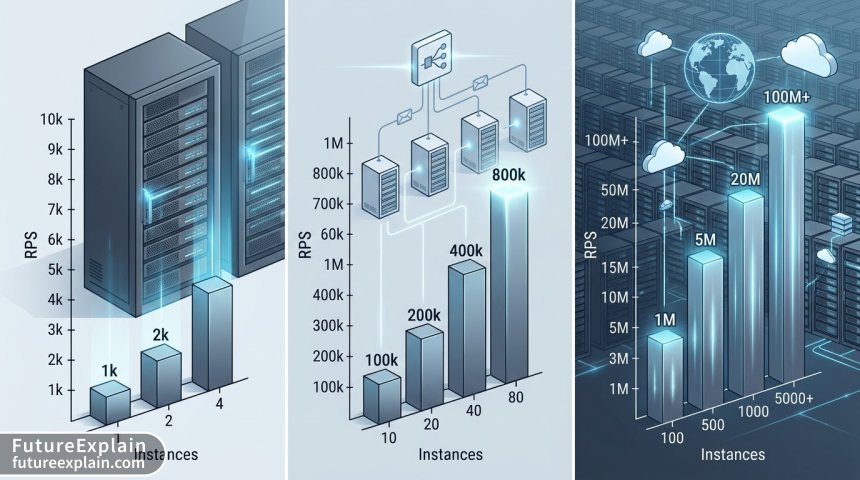
Throughput measures how many inferences a system can process per unit of time, typically expressed as requests per second (RPS) or inferences per second (IPS). High-throughput systems are designed to handle large volumes of requests efficiently, often through parallel processing and optimized resource utilization.
The relationship between latency and throughput is often inverse: as you push for higher throughput, latency may increase due to resource contention. However, well-designed systems can optimize both through careful architecture. The key metric here is latency at target throughput – not just peak performance under ideal conditions.
Quality of Service (QoS) Metrics
Beyond raw latency and throughput numbers, real-time systems must consider several QoS metrics:
- Tail latency (P99, P99.9): The worst-case latency experienced by a small percentage of requests
- Latency variance: Consistency of response times
- Availability: System uptime and reliability
- Cost per inference: Economic efficiency of the solution
These metrics provide a more complete picture of system performance than average latency alone. For example, a system with an average latency of 50ms but P99 latency of 500ms would be unacceptable for many real-time applications.
End-to-End Latency Breakdown
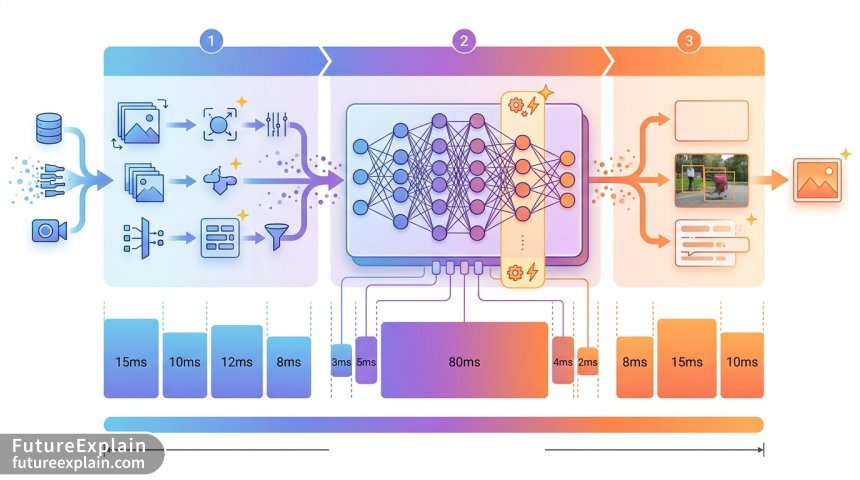
To optimize real-time AI systems effectively, we must understand where time is spent in the inference pipeline. A typical end-to-end latency breakdown for a web-based AI service might look like this:
Network Latency (5-50ms)
Network latency encompasses the time for data to travel between client and server. This includes DNS resolution, TCP handshake, TLS negotiation, and actual data transmission. For global applications, geographical distance between users and servers can significantly impact this component.
Optimization strategies include:
- Using edge computing to process requests closer to users
- Implementing HTTP/2 or HTTP/3 for reduced connection overhead
- Optimizing payload sizes through efficient serialization
- Implementing connection pooling and keep-alive connections
Request Processing Latency (1-20ms)
Once a request reaches your application server, it must be parsed, validated, and prepared for inference. This stage often includes:
- Request parsing and validation
- Authentication and authorization checks
- Input data deserialization
- Format conversion and normalization
Optimizing this stage involves efficient request handling frameworks, minimal validation overhead, and streamlined data processing pipelines.
Data Preprocessing Latency (5-100ms)
Raw input data rarely matches the exact format required by AI models. Preprocessing transforms inputs into the appropriate format, which may include:
- Image resizing, cropping, and normalization
- Text tokenization and embedding
- Audio feature extraction
- Data augmentation for robustness
This stage can become a bottleneck if not optimized. Strategies include preprocessing caching, parallel processing, and hardware acceleration (GPU/TPU).
Model Inference Latency (10-500ms)
The core AI inference represents the most significant portion of latency for many applications. Factors affecting inference latency include:
- Model complexity and size
- Hardware capabilities (CPU, GPU, TPU, NPU)
- Batch size (individual vs. batched inference)
- Model optimization techniques applied
We'll explore model optimization techniques in depth later in this article.
Post-processing Latency (1-50ms)
After model inference, results often require additional processing:
- Converting model outputs to application-friendly formats
- Applying business logic and rules
- Formatting responses for clients
- Logging and monitoring data collection
Response Latency (5-50ms)
The final stage involves serializing the response and transmitting it back to the client. Optimization strategies mirror those for network latency on the request side.
System Design Patterns for Real-Time AI
Pattern 1: The Edge-First Architecture
Edge computing brings computation closer to data sources, significantly reducing network latency. In edge-first architectures:
- Lightweight models run on edge devices (phones, IoT devices)
- Complex models run in the cloud when needed
- Intelligent routing determines where to process each request
- Edge caching stores frequently used inferences
Implementation considerations include model size constraints, hardware heterogeneity, and synchronization between edge and cloud components.
Pattern 2: The Predictor-Corrector System
This pattern combines fast, approximate predictions with slower, accurate corrections:
- A lightweight model provides immediate but approximate results
- A heavyweight model refines these results asynchronously
- Users receive instant feedback with gradual improvements
- System learns from corrections to improve the lightweight model
This pattern works well for applications where immediate feedback is more important than perfect accuracy, such as real-time transcription or translation.
Pattern 3: The Cascade System
Cascade systems apply increasingly complex models only when needed:
- Simple rules or heuristics filter out easy cases
- Lightweight models handle moderate complexity
- Heavyweight models process only the most difficult cases
- Early exits reduce average inference time
This approach optimizes for the common case while maintaining capability for edge cases.
Pattern 4: The Streaming Architecture
For continuous data streams (video, audio, sensor data), streaming architectures provide:
- Continuous inference on data windows
- Overlap between processing and data collection
- State maintenance across inferences
- Adaptive processing based on content complexity
Apache Kafka, Apache Flink, and specialized ML frameworks like TensorFlow Extended (TFX) support these architectures.
Throughput Optimization Strategies
Batch Processing Optimization
Batching multiple requests together can dramatically improve throughput by amortizing overhead across multiple inferences. However, batching increases latency for individual requests, creating a classic throughput-latency trade-off.
Advanced batching strategies include:
- Dynamic batching: Adjust batch sizes based on load
- Priority-aware batching: Process high-priority requests separately
- Timeout-based batching: Wait for a minimum number of requests or maximum time
- Model-aware batching: Optimize batch sizes for specific model architectures
Model Parallelism and Pipeline Parallelism
For large models that don't fit on a single device, parallelism techniques distribute computation:
- Model parallelism: Different model layers on different devices
- Pipeline parallelism: Different batches at different pipeline stages
- Tensor parallelism: Individual tensor operations distributed
- Data parallelism: Different data batches on different devices
These techniques require careful synchronization and communication optimization to avoid bottlenecks.
Hardware Utilization Optimization
Maximizing hardware utilization is key to achieving high throughput:
- GPU utilization monitoring: Track and optimize GPU memory and compute usage
- Memory hierarchy optimization: Leverage cache hierarchies effectively
- Mixed precision computation: Use FP16 or INT8 where acceptable
- Kernel fusion: Combine operations to reduce memory transfers
Load Balancing Strategies
Distributing requests across multiple inference servers requires intelligent load balancing:
- Round-robin with health checks: Simple but effective for homogeneous workloads
- Least connections: Prefer servers with fewer active connections
- Latency-based routing: Direct requests to servers with lowest response times
- Model-aware routing: Route to servers with appropriate models loaded
- Geographic routing: Consider physical distance to reduce network latency
Model Optimization Techniques
Quantization: Trading Precision for Speed
Quantization reduces the numerical precision of model weights and activations, significantly decreasing memory usage and computation time:
- Post-training quantization (PTQ): Convert trained models to lower precision
- Quantization-aware training (QAT): Train models with quantization simulated
- Dynamic quantization: Adjust precision at runtime based on needs
- Per-channel quantization: Different precision for different model channels
Modern frameworks like TensorFlow Lite, PyTorch Mobile, and ONNX Runtime provide extensive quantization support.
Pruning: Removing Unnecessary Connections
Pruning identifies and removes less important weights or neurons from neural networks:
- Magnitude-based pruning: Remove smallest magnitude weights
- Structured pruning: Remove entire neurons or channels
- Iterative pruning: Alternate between pruning and retraining
- Lottery ticket hypothesis: Find trainable subnetworks within larger models
Pruning can reduce model size by 50-90% with minimal accuracy loss when done carefully.
Knowledge Distillation: Teaching Smaller Models
Knowledge distillation trains smaller "student" models to mimic larger "teacher" models:
- Response distillation: Match final outputs
- Feature distillation: Match intermediate representations
- Relational distillation: Match relationships between samples
- Self-distillation: Use the same model as teacher and student
Distilled models often achieve better performance than models trained from scratch at the same size.
Architecture Search for Efficiency
Neural architecture search (NAS) can discover model architectures optimized for specific hardware:
- Hardware-aware NAS: Incorporate latency/throughput measurements
- Once-for-all networks: Train once, deploy at multiple scales
- EfficientNet family: Compound scaling of depth, width, and resolution
- MobileNet variants: Depthwise separable convolutions
Hardware Considerations
CPU vs. GPU vs. TPU vs. NPU
Different hardware accelerators offer different latency/throughput characteristics:
- CPUs: Versatile, good for small models and preprocessing
- GPUs: Excellent for parallel computation, high throughput
- TPUs: Specialized for matrix operations, consistent latency
- NPUs: Neural processing units in mobile/edge devices
- FPGAs: Reconfigurable, good for fixed-function pipelines
- ASICs: Custom-designed for specific models
The optimal hardware choice depends on your specific workload, scale, and constraints.
Memory Hierarchy Optimization
Understanding and optimizing memory access patterns is crucial for latency-sensitive applications:
- Cache-aware algorithms: Design algorithms to maximize cache hits
- Memory alignment: Ensure data structures align with memory boundaries
- Prefetching: Load data before it's needed
- Memory pooling: Reuse memory allocations to avoid fragmentation
Power-Performance Trade-offs
For battery-powered devices, power consumption becomes a critical constraint:
- Dynamic voltage and frequency scaling (DVFS): Adjust power based on load
- Race-to-idle: Complete work quickly then enter low-power state
- Workload-aware scheduling: Schedule computation during expected power availability
- Approximate computing: Accept occasional errors to save power
Monitoring and Observability
Key Performance Indicators (KPIs)
Effective monitoring requires tracking the right metrics:
- End-to-end latency percentiles: P50, P90, P95, P99, P99.9
- Throughput metrics: Requests per second, inferences per second
- Error rates: Inference errors, timeouts, failures
- Resource utilization: CPU, GPU, memory, network
- Cost metrics: Cost per inference, resource efficiency
- Business metrics: User satisfaction, conversion rates
Distributed Tracing
For complex microservice architectures, distributed tracing provides visibility across service boundaries:
- Trace collection: Jaeger, Zipkin, OpenTelemetry
- Span correlation: Link related operations across services
- Latency breakdown: Identify bottlenecks across components
- Context propagation: Maintain request context through the pipeline
Anomaly Detection and Alerting
Proactive monitoring detects issues before they impact users:
- Statistical anomaly detection: Identify deviations from normal patterns
- Machine learning-based monitoring: Learn normal patterns automatically
- SLO-based alerting: Alert when service level objectives are at risk
- Multi-signal correlation: Combine metrics, logs, and traces
Case Studies: Real-World Implementations
Case Study 1: Real-Time Video Analytics Platform
A security company needed to process live video streams from thousands of cameras with sub-200ms latency for object detection and recognition.
Challenges: High bandwidth requirements, variable network conditions, strict latency requirements, 24/7 operation.
Solution: Hybrid edge-cloud architecture with:
- Edge devices performing initial motion detection and frame selection
- Regional edge servers running lightweight object detection
- Cloud servers for heavy recognition and tracking
- Intelligent streaming adjusting quality based on network conditions
Results: 150ms average latency, 95% reduction in bandwidth costs, 99.9% availability.
Case Study 2: Financial Fraud Detection System
A payment processor needed to evaluate transactions for fraud in under 50ms while handling peak loads of 10,000 transactions per second.
Challenges: Extreme latency sensitivity, high throughput requirements, zero tolerance for false negatives, regulatory compliance.
Solution: Multi-stage inference pipeline with:
- Rule-based filtering for obvious cases (5ms)
- Lightweight gradient boosting model for moderate risk (15ms)
- Deep learning ensemble for high-risk transactions (30ms)
- Asynchronous human review for borderline cases
Results: 45ms average latency, 99.99% detection rate, 0.01% false positive rate.
Case Study 3: Real-Time Language Translation Service
A communication platform needed to provide instant translation for video calls with under 100ms added latency.
Challenges: Audio stream processing, context maintenance across utterances, speaker diarization, natural sounding output.
Solution: Streaming transformer architecture with:
- Overlapping audio chunks with attention to previous context
- Monotonic attention for streaming alignment
- Adaptive chunk sizing based on punctuation prediction
- Specialized audio codec for low-latency transmission
Results: 85ms added latency, 95% BLEU score parity with batch translation.
Implementation Checklist
Pre-deployment Checklist
- ✅ Define clear latency and throughput requirements
- ✅ Establish Service Level Objectives (SLOs) and Indicators (SLIs)
- ✅ Profile end-to-end latency in test environment
- ✅ Load test to determine maximum sustainable throughput
- ✅ Implement comprehensive monitoring and alerting
- ✅ Design fallback mechanisms for degraded performance
- ✅ Plan scaling strategies for expected growth
- ✅ Document performance characteristics and limitations
Optimization Checklist
- ✅ Apply model quantization appropriate for target hardware
- ✅ Implement intelligent batching strategies
- ✅ Optimize data preprocessing pipelines
- ✅ Configure hardware for optimal performance
- ✅ Implement caching for frequent requests
- ✅ Set up connection pooling and keep-alive
- ✅ Configure load balancing with health checks
- ✅ Implement circuit breakers and retry logic
Monitoring Checklist
- ✅ Track latency percentiles (P50, P90, P99, P99.9)
- ✅ Monitor throughput and error rates
- ✅ Set up distributed tracing
- ✅ Implement anomaly detection
- ✅ Track resource utilization and costs
- ✅ Establish alerting based on SLO violations
- ✅ Create dashboards for different stakeholders
- ✅ Regularly review and refine monitoring
Future Trends and Considerations
Hardware Specialization
The trend toward specialized AI hardware continues to accelerate:
- Domain-specific architectures: Hardware optimized for specific model types
- In-memory computing: Reduce data movement bottlenecks
- Photonic computing: Ultra-low latency optical processing
- Neuromorphic hardware: Brain-inspired asynchronous processing
Algorithmic Advances
New algorithms continue to push the boundaries of efficiency:
- Sparse models: Leveraging inherent sparsity in neural networks
- Dynamic networks: Adjust computation based on input difficulty
- Mixture of experts: Route to specialized sub-networks
- Continual learning: Adapt models without full retraining
System-Level Innovations
Holistic system design approaches are emerging:
- Co-design of models and hardware: Joint optimization
- Federated learning at scale: Privacy-preserving distributed training
- Automatic system optimization: AI optimizing AI systems
- Quantum-inspired algorithms: For specific optimization problems
Conclusion: Balancing Art and Science
Designing real-time AI systems that deliver both low latency and high throughput remains as much art as science. The optimal solution depends on your specific requirements, constraints, and trade-off preferences. What works for a video streaming service may not work for a financial trading platform, even if both require "real-time" processing.
The key insight is that real-time AI system design requires thinking holistically across the entire stack – from algorithms and models to hardware and networking. Optimizing any single component in isolation often leads to suboptimal overall performance. Instead, consider the end-to-end pipeline and how components interact.
As you design your real-time AI systems, remember that requirements evolve, technology advances, and user expectations increase. Build systems that are not just performant today but adaptable for tomorrow. Instrument everything, measure relentlessly, and iterate continuously. The journey to optimal real-time AI is never complete, but each improvement delivers tangible value to your users and your business.
Remember: The perfect real-time AI system doesn't exist – but with careful design, informed trade-offs, and continuous optimization, you can build systems that meet your users' needs today while evolving to meet tomorrow's challenges.
Visuals Produced by AI
Further Reading
Share
What's Your Reaction?
 Like
1542
Like
1542
 Dislike
23
Dislike
23
 Love
456
Love
456
 Funny
89
Funny
89
 Angry
12
Angry
12
 Sad
8
Sad
8
 Wow
312
Wow
312
















Could you do a follow-up article specifically on video enhancement? I have old family videos that need similar treatment, and the principles might be different.
The section about combining multiple tools is gold. I've been using just one tool and wondering why results were inconsistent. Processing different image types with different tools makes so much sense!
As an archivist, I found the ethical considerations particularly valuable. We're digitizing a historical collection and debating how much enhancement is appropriate. This article gives us a framework for making those decisions.
I tried the starter project with a photo of my dog that was slightly out of focus. The improvement was noticeable but not magical - I think my expectations were too high. The article is honest about what AI can and can't do, which I appreciate.
Silas, you've hit on an important point! AI enhancement works best with specific types of images. Severely out-of-focus shots are challenging because there's limited information to work with. Try using the 'recover faces (pets)' feature if available - some tools have specific models for animal features.
The future trends section is fascinating. Real-time enhancement in cameras could revolutionize mobile photography. Imagine getting DSLR-quality images from smartphone sensors!
I appreciate that you included information about hardware requirements. Some of these AI tools need decent GPUs, which isn't always mentioned in marketing materials. Saved me from buying software my computer couldn't run!