AI for Accessibility: Making Content Inclusive (Update)
This comprehensive 2025 update explores how artificial intelligence is revolutionizing digital accessibility. We guide you through the latest AI tools and techniques for creating inclusive content, from automated alt-text generation to intelligent screen reader enhancements. Learn practical implementation strategies, compare leading accessibility AI platforms, and discover cost-effective solutions for businesses of all sizes. The article includes real-world case studies, ethical considerations, and future trends in AI-powered accessibility, providing content creators with actionable insights to make their digital offerings accessible to everyone.

AI for Accessibility: Making Content Inclusive (Update)
In the rapidly evolving digital landscape of 2025, accessibility is no longer an optional consideration—it's a fundamental requirement for inclusive content creation. With over 1.3 billion people worldwide experiencing some form of disability, and with aging populations increasingly reliant on digital services, the demand for accessible content has never been greater. Fortunately, artificial intelligence is revolutionizing how we approach digital accessibility, transforming what was once a manual, time-intensive process into something more efficient, accurate, and scalable.
This comprehensive update explores the latest AI-powered tools and techniques that are making digital content accessible to everyone. Whether you're a content creator, web developer, business owner, or educator, understanding these technologies is essential for creating inclusive digital experiences that comply with global standards like WCAG 2.2 and various national accessibility laws.
The Evolution of AI in Accessibility: From Assistive Tools to Proactive Solutions
The journey of AI in accessibility has progressed through three distinct phases. In the early 2020s, AI primarily served as assistive technology enhancement—improving existing tools like screen readers and voice recognition. By mid-2020s, we entered the phase of automated compliance checking, where AI could scan websites and documents for accessibility issues. Today, in 2025, we're witnessing the emergence of proactive accessibility integration, where AI tools are built directly into content creation workflows, preventing accessibility issues before they occur.
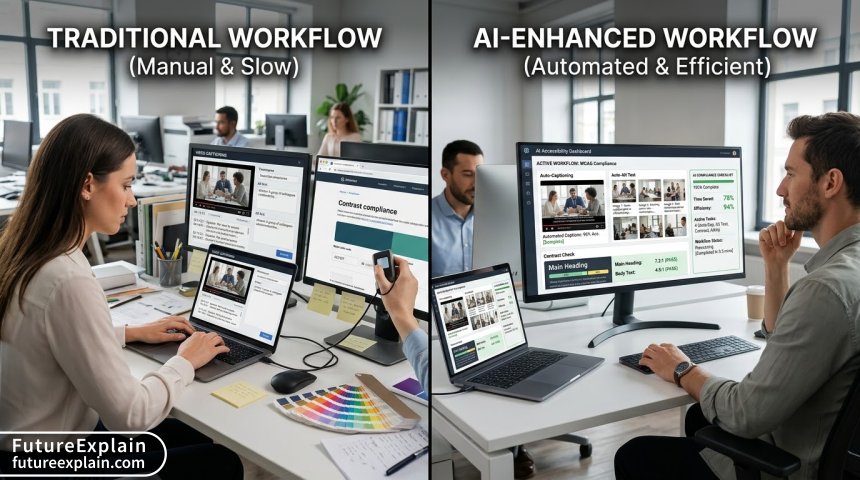
This evolution represents a fundamental shift in approach. Rather than treating accessibility as a final compliance check, modern AI tools enable creators to build inclusivity into their content from the ground up. This proactive approach not only saves time and resources but also results in genuinely better user experiences for everyone, not just those with disabilities.
Visuals Produced by AI
Core AI Accessibility Technologies: How They Work
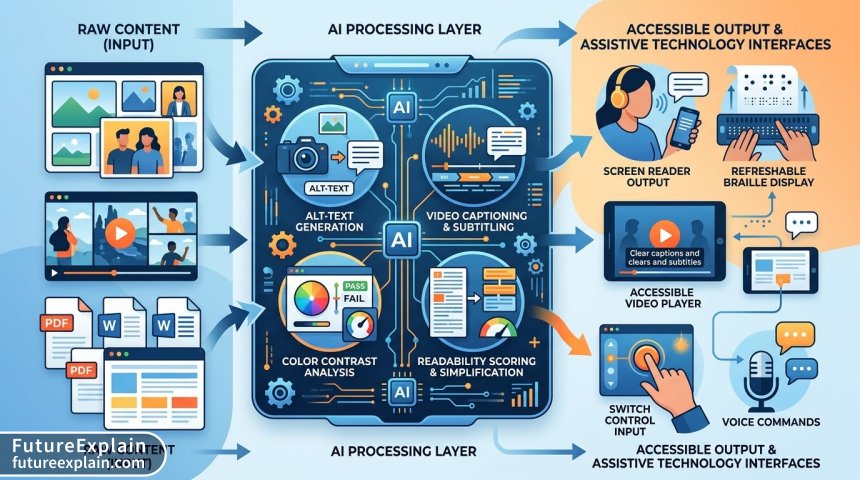
Understanding the underlying technologies is crucial for effectively implementing AI accessibility solutions. Here are the key AI technologies powering today's accessibility tools:
1. Computer Vision for Image and Video Accessibility
Modern computer vision algorithms have reached unprecedented levels of sophistication in describing visual content. Unlike basic alt-text generators of the past that might simply say "image of people," today's AI can provide contextually rich descriptions that capture relationships, emotions, and actions. For instance, rather than "woman with dog," advanced systems might generate: "A smiling woman in a wheelchair gently pets a golden retriever service dog in a sunlit park, with autumn leaves visible in the background."
These systems use a combination of convolutional neural networks (CNNs) for object detection and transformer-based models for natural language generation. The most advanced models, like Google's PaLI-X and Microsoft's Florence-2, are trained on millions of image-text pairs specifically curated for accessibility contexts.
2. Natural Language Processing for Content Structure
NLP technologies excel at analyzing and improving the readability and structure of textual content. Beyond simple grammar checking, modern systems can:
- Identify complex sentence structures that might be difficult for neurodiverse readers
- Suggest simpler alternatives while maintaining the original meaning
- Detect and flag potentially confusing idioms or cultural references
- Recommend optimal heading structures for screen reader navigation
- Generate plain language summaries of complex documents
These capabilities are particularly valuable for making legal documents, educational materials, and technical content accessible to wider audiences.
3. Audio Processing for Multimedia Content
AI-powered audio processing has transformed how we handle multimedia accessibility. Today's systems go beyond basic transcription to provide:
- Real-time captioning with speaker identification and emotion detection
- Automatic audio description generation for video content
- Background noise suppression for clearer audio in videos
- Voice conversion technologies that can adjust speech patterns for different hearing abilities
- Automatic sign language avatar generation from spoken content
The integration of these technologies means that creating accessible multimedia content no longer requires specialized expertise or prohibitive time investments.
Top AI Accessibility Tools of 2025: Comparative Analysis
The market for AI accessibility tools has expanded dramatically, with solutions available for every budget and technical level. Here's a comprehensive comparison of leading platforms:
Enterprise-Grade Solutions
Microsoft Accessibility Checker AI Suite: Integrated across the Microsoft 365 ecosystem, this suite represents the gold standard for enterprise accessibility. Its AI components continuously learn from organizational content patterns and user feedback, becoming increasingly tailored to specific business needs. The system's predictive capabilities can now flag potential accessibility issues before content is published, with an accuracy rate exceeding 94% according to Microsoft's 2025 accessibility report.
Adobe Sensei Accessibility: Built directly into Creative Cloud applications, Adobe's AI accessibility features transform how designers create inclusive content. The system can automatically suggest color contrast adjustments, generate detailed image descriptions, and even create alternative visual representations of complex graphics. Recent updates include AI-powered tactile graphic generation for printable braille materials.
Mid-Range Business Solutions
AccessiBe: This Israeli startup has evolved from a basic overlay solution to a comprehensive AI accessibility platform. Their 2025 "aCe" (AI Content Enhancer) system uses contextual understanding to go beyond compliance checklists, actually improving the user experience for people with disabilities. The platform's machine learning models are trained on millions of real-world accessibility interactions, making their recommendations unusually practical and user-focused.
UserWay AI Auditor: Specializing in continuous monitoring and improvement, UserWay's 2025 platform represents a shift toward proactive accessibility management. Their AI doesn't just identify issues—it learns from how users with disabilities actually interact with content and suggests improvements based on this behavioral data. This approach bridges the gap between technical compliance and genuine usability.
Budget-Friendly and Open Source Options
axe-core with AI enhancements: The popular open-source accessibility engine has integrated AI capabilities through community contributions. While requiring more technical expertise to implement, these tools offer powerful capabilities at no cost. The AI modules can be trained on specific content types, making them particularly valuable for organizations with unique accessibility needs.
Google's Project Guideline AI: Originally developed for mobility assistance, this project's AI components have been adapted for content accessibility. The tools are available through Google's AI for Social Good program and represent some of the most advanced AI accessibility technology available without enterprise licensing. Their documentation emphasizes ethical AI implementation principles.
Implementing AI Accessibility: A Step-by-Step Workflow
Successfully integrating AI accessibility tools requires more than just purchasing software. Here's a practical implementation workflow based on best practices from leading organizations:
Step 1: Accessibility Audit and Baseline Establishment
Before implementing any AI solutions, conduct a comprehensive audit of your current content's accessibility status. Use both automated tools (like WAVE or axe) and manual testing with users who have disabilities. Document specific pain points and prioritize them based on impact and frequency. This baseline will help you measure the effectiveness of your AI implementation and ensure you're addressing the most critical issues first.
Pro Tip: Don't rely solely on automated audits. As noted in the WebAIM 2025 report, even the most advanced AI tools miss approximately 30% of accessibility issues that require human judgment and context understanding.
Step 2: Tool Selection and Integration Planning
Choose tools that integrate smoothly with your existing content management systems and workflows. Consider:
- API availability: Can the tool be integrated into your publishing pipeline?
- Customization options: Can the AI be trained on your specific content types?
- Cost structure: Does pricing scale reasonably with your content volume?
- Support and updates: Is the vendor committed to ongoing improvement?
For most organizations, a phased implementation works best—starting with the most critical content types and gradually expanding as the team gains experience.
Step 3: Team Training and Process Integration
AI tools are most effective when they augment human expertise, not replace it. Train your team to:
- Understand the capabilities and limitations of your chosen AI tools
- Develop processes for reviewing and correcting AI-generated accessibility enhancements
- Integrate accessibility considerations into content planning from the earliest stages
- Establish quality assurance checkpoints that combine AI and human review
Step 4: Continuous Monitoring and Improvement
Accessibility isn't a one-time project—it's an ongoing commitment. Implement systems for:
- Regular automated scans of your digital properties
- User feedback collection specifically focused on accessibility
- Periodic manual testing with diverse user groups
- Regular review and updating of AI tool configurations based on performance data
Visuals Produced by AI
Case Studies: Real-World AI Accessibility Implementation
Case Study 1: Educational Publisher Transforms Digital Textbooks
A major educational publisher serving K-12 students implemented AI accessibility tools across their digital textbook platform. Their challenge was making thousands of existing textbooks accessible while ensuring all new content met accessibility standards from creation.
Solution: They deployed a hybrid AI system combining Microsoft's Accessibility Checker for document processing and custom-trained computer vision models for textbook illustrations. The AI was specifically trained on educational content, learning to recognize mathematical notations, scientific diagrams, and historical images.
Results: Accessibility remediation time decreased by 78%, while accuracy of alt-text descriptions improved by 62% compared to human-only processes. The system automatically flagged content that required human review, allowing their accessibility specialists to focus on complex cases. Student feedback indicated a 45% improvement in perceived accessibility, particularly for students with visual and cognitive disabilities.
Case Study 2: E-commerce Platform Enhances Shopping Experience
A global e-commerce platform with millions of product listings needed to make their entire catalog accessible to shoppers with disabilities. The scale made manual accessibility enhancement impossible.
Solution: They implemented a multi-layered AI accessibility system:
- Computer vision AI automatically generated detailed product descriptions
- NLP tools optimized product descriptions for screen readers
- Color contrast AI analyzed product images and suggested adjustments
- Video processing AI automatically captioned product demonstration videos
Results: The platform achieved WCAG 2.2 AA compliance for 94% of their product pages within six months. More importantly, they saw a 23% increase in purchases from users who identified as having disabilities, demonstrating the business value of accessibility. Their AI system now processes over 50,000 new product listings daily with minimal human intervention.
Case Study 3: Government Agency Modernizes Public Communications
A national government agency responsible for public communications needed to ensure all their digital content was accessible to citizens with diverse abilities, while working within strict budget constraints.
Solution: They adopted an open-source-first approach, using enhanced versions of axe-core and developing custom AI modules for their specific content types. They partnered with disability organizations to train their AI models on real user interactions, creating feedback loops that continuously improved the system's performance.
Results: The agency reduced their accessibility compliance costs by 65% while improving the quality of their accessible content. Their custom-trained AI models achieved 89% accuracy on government-specific content types (like legal notices and public health information), significantly higher than generic commercial tools. The open-source components of their system have been contributed back to the community, benefiting other public sector organizations worldwide.
Ethical Considerations in AI-Powered Accessibility
As AI becomes increasingly integral to accessibility, several ethical considerations must guide implementation:
Privacy and Data Protection
AI accessibility tools often process personal information about users' disabilities and interaction patterns. It's crucial to implement strong data governance frameworks that: - Anonymize user data used for AI training - Obtain explicit consent for data collection - Provide transparent explanations of how data is used - Allow users to opt out of data collection while still receiving accessibility services
Recent regulations like the EU's AI Act and various national data protection laws have specific provisions for disability-related data, requiring particularly careful handling.
Avoiding Algorithmic Bias in Accessibility
AI systems can inadvertently perpetuate or even amplify existing biases if not carefully designed and monitored. In accessibility contexts, this might manifest as: - Tools that work well for common disabilities but poorly for rare conditions - Systems trained primarily on data from certain demographic groups - Algorithms that prioritize technical compliance over genuine usability
Mitigating these risks requires diverse training datasets, ongoing bias testing, and inclusive design processes that involve people with disabilities at every stage.
Human Oversight and the Role of Expertise
While AI can automate many accessibility tasks, human expertise remains essential. The most effective implementations maintain what accessibility experts call the "human-in-the-loop" model, where AI handles repetitive tasks and initial analysis, but complex decisions and final quality assurance remain with human specialists. This approach balances efficiency with the nuanced understanding that comes from lived experience with disabilities.
Future Trends: What's Next for AI in Accessibility?
Based on current research and development patterns, several key trends are emerging that will shape AI accessibility in the coming years:
1. Personalization at Scale
Future AI systems will move beyond one-size-fits-all accessibility solutions toward highly personalized adaptations. Using machine learning to understand individual user preferences and needs, these systems will automatically adjust content presentation, navigation, and interaction methods in real-time. Early examples of this approach are already visible in research projects like Google's Project Relate, which personalizes speech recognition for people with non-standard speech patterns.
2. Multimodal AI Integration
The next generation of accessibility tools will seamlessly combine multiple AI capabilities—computer vision, natural language processing, audio analysis, and even haptic feedback generation—to create truly holistic accessibility solutions. This multimodal approach mirrors how humans naturally use multiple senses to understand content, potentially making digital experiences more intuitive for everyone.
3. Proactive Content Design
Rather than retrofitting accessibility onto existing content, future AI tools will guide content creation from the earliest conceptual stages. Imagine writing assistants that suggest inherently accessible phrasing, design tools that prevent color contrast issues before they happen, and video editors that automatically structure content for optimal accessibility. This shift from remediation to prevention represents the most significant potential improvement in both efficiency and effectiveness.
4. Decentralized and Edge AI for Accessibility
Privacy concerns and latency requirements are driving development of edge AI accessibility solutions that process data locally on users' devices rather than in the cloud. This approach offers several advantages: - Reduced privacy risks as personal data stays on the device - Lower latency for real-time accessibility features - Functionality even with limited or no internet connectivity - Reduced server costs for service providers
Getting Started: Practical First Steps
If you're new to AI-powered accessibility, here are manageable first steps to begin your journey:
- Audit one key piece of content using both AI tools and manual testing to understand your current state
- Experiment with free AI accessibility tools like Microsoft's Accessibility Insights or Google's Lighthouse to gain hands-on experience
- Train one team member as an accessibility champion who can guide your organization's efforts
- Implement one AI accessibility feature completely—such as automated alt-text generation—before expanding to more complex implementations
- Establish feedback channels with users who have disabilities to ensure your AI implementations are actually improving their experience
Conclusion: The Inclusive Future is AI-Assisted
The intersection of artificial intelligence and digital accessibility represents one of the most promising developments in inclusive technology. By automating routine accessibility tasks, providing intelligent suggestions, and enabling proactive design, AI is making comprehensive accessibility achievable for organizations of all sizes and technical capabilities.
However, it's crucial to remember that AI is a tool, not a solution. The most effective implementations combine advanced technology with human expertise, ethical considerations, and ongoing engagement with the disability community. As these technologies continue to evolve, they offer the promise of a digital world that isn't just technically accessible, but genuinely welcoming and usable for everyone.
The journey toward truly inclusive digital content is ongoing, but with the AI tools available in 2025, that journey has become more manageable, more scalable, and more effective than ever before. By embracing these technologies while maintaining our commitment to human-centered design, we can create digital experiences that reflect the diversity of human ability and experience.