
AI for Climate Tech: Using Models to Monitor Environment
This article explains how Artificial Intelligence is becoming a fundamental tool for monitoring and protecting our environment. It breaks down, in beginner-friendly terms, how AI models process vast amounts of data from satellites, sensors, and drones to track deforestation, predict extreme weather, monitor air and water quality, and optimize renewable energy. We explore the core technologies like machine learning and computer vision, showcase real-world case studies from agriculture to disaster prevention, and provide a balanced look at both the transformative potential and the current challenges—including AI's own environmental footprint and the need for responsible policies. The guide concludes with a practical roadmap for how organizations can start implementing these powerful tools for a more sustainable future.

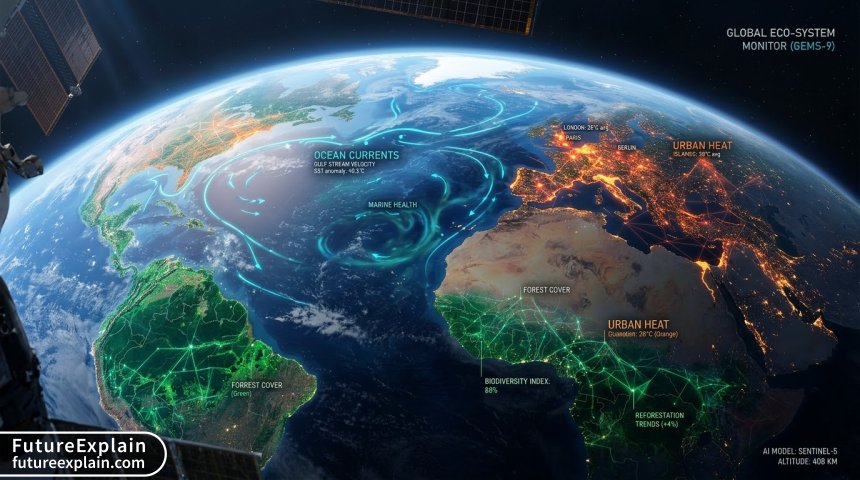
When we think about fighting climate change and protecting our environment, images of scientists in the field, wind turbines, and conservationists planting trees often come to mind. But there’s a powerful, less visible ally increasingly at work: Artificial Intelligence. AI is not a silver bullet, but it is fast becoming a fundamental tool in our efforts to understand and respond to planetary changes[citation:10]. This guide is for anyone curious about how this technology works behind the scenes. We’ll explain, in simple terms, how AI models are helping to monitor the pulse of our planet, predict its future, and guide smarter decisions for a sustainable world.
From Data Overload to Clear Insight: The AI Revolution in Monitoring
For decades, environmental monitoring relied on manual data collection—scientists taking water samples, rangers patrolling forests, and fixed weather stations taking readings. This work is vital but has limitations in scale, speed, and cost. Today, we are surrounded by a flood of environmental data: satellites capture constant imagery of the entire Earth, networks of sensors track air and water quality, and acoustic devices listen to ecosystems. The challenge is no longer collecting data, but making sense of it all.
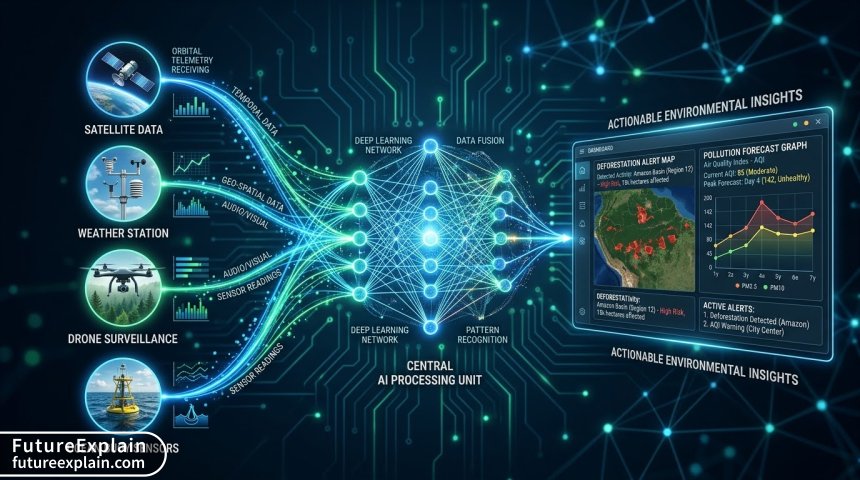
This is where AI excels. At its core, AI for environmental monitoring acts as a super-powered pattern recognition and prediction engine. It can automatically sift through terabytes of satellite images to spot illegal deforestation, analyze historical and real-time sensor data to forecast air pollution spikes hours in advance, or process sound recordings from the ocean to track whale populations[citation:5]. Unlike traditional methods that might offer a delayed, broad-brush view, AI enables continuous, high-resolution, and predictive monitoring[citation:6]. It turns raw data into timely, actionable insight, allowing us to move from reactive responses to proactive protection.
How It Works: The AI Toolkit for the Planet
The term “AI” encompasses a suite of technologies, each suited to different environmental tasks. Let’s break down the key tools in this kit.
Machine Learning and Deep Learning: Finding Patterns in Complexity
Machine Learning (ML) is the foundation. In environmental science, ML algorithms are trained on vast historical datasets—like decades of sea surface temperatures or global CO2 levels. By learning from this past data, the models can identify complex, non-linear relationships between different climate variables that might elude traditional statistical methods. This allows for more accurate predictions, such as forecasting seasonal rainfall or the potential intensity of hurricane seasons[citation:1].
Deep Learning, a more advanced subset of ML, uses artificial neural networks. These are particularly powerful for processing unstructured data like images and sounds. For example, Convolutional Neural Networks (CNNs) are exceptionally good at analyzing satellite and aerial imagery[citation:1]. They can be trained to automatically classify land cover (forest, urban, water), detect changes over time (like glacier retreat or urban sprawl), and even identify specific objects like individual trees in distress or illegal fishing vessels[citation:5].
Computer Vision: The Eyes in the Sky (and Sea, and Forest...)
This is the practical application of deep learning for visual data. AI-powered computer vision is revolutionizing satellite imagery analysis. Organizations like the European Space Agency's Climate Change Initiative use AI to analyze data from hundreds of satellites, tracking essential climate variables with unprecedented precision[citation:2]. These systems can monitor deforestation in the Amazon in near real-time, track the health of coral reefs by analyzing their color in images, and map the spread of wildfires by identifying smoke plumes and thermal signatures[citation:1]. What might take a team of analysts weeks to review, AI can process in hours, flagging only the areas that need human attention.
Predictive Analytics and Simulation: Forecasting the Future
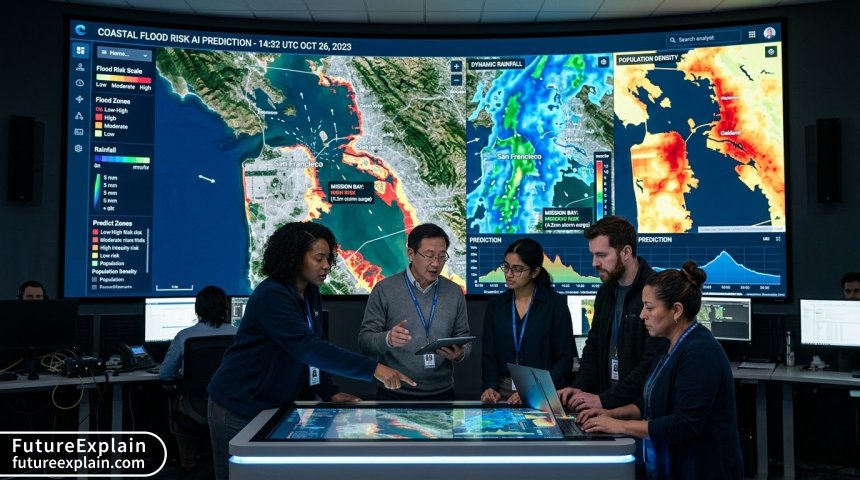
Beyond seeing the present, AI helps us anticipate the future. Predictive analytics models combine historical data with real-time feeds to forecast environmental events. For instance, companies like Previsico use AI to provide real-time, property-level flood risk forecasts up to 48 hours in advance by aggregating live data from sensors, satellites, and weather models[citation:10]. Similarly, AI can predict smog formation in cities or algal blooms in lakes, enabling authorities to issue preemptive health warnings or manage water treatment processes[citation:6].
Furthermore, AI is used to create sophisticated simulations. It can generate highly detailed “synthetic” climate data—for example, simulating thousands of possible hurricane tracks for a region—which is invaluable for risk assessment, urban planning, and insurance modeling, especially in data-scarce parts of the world[citation:10].
AI in Action: Real-World Applications Protecting Our World
The theory is compelling, but how is this being used on the ground? Here are key areas where AI for climate tech is making a tangible difference.
1. Protecting Ecosystems and Biodiversity
AI is a game-changer for conservation. Ecologists use AI to analyze camera trap images, automatically identifying and counting species, from jaguars in the rainforest to birds in backyards. This provides accurate population data without disturbing animals. Acoustic AI listens to forest sounds to detect illegal logging activity or monitor ecosystem health based on insect and bird calls. Satellite imagery analysis tracks habitat loss and fragmentation, helping to plan wildlife corridors and protected areas[citation:5].
2. Monitoring Pollution and Ensuring Public Health
Air and water quality monitoring has gone hyperlocal and real-time. Networks of low-cost sensors deployed across cities feed data to AI models that create dynamic pollution maps, showing block-by-block variations in PM2.5 or nitrogen dioxide levels. This empowers citizens with knowledge and helps cities target interventions. For water, AI systems can predict bacterial contamination at beaches with high accuracy, issuing swift safety alerts instead of relying on slower lab tests[citation:6]. An example is an AI system in England that predicts bacterial contamination with 87% accuracy, providing quick updates via a mobile app[citation:6].
3. Powering Climate-Smart Agriculture
Agriculture faces the twin challenges of feeding a growing population and adapting to a changing climate. AI aids in “precision agriculture.” By analyzing data from satellite imagery, soil sensors, and weather forecasts, AI can advise farmers on the optimal amount of water, fertilizer, and pesticide to use for each specific plot of land. This maximizes yield while minimizing environmental runoff and resource waste. For example, one agritech partnership using AI and IoT devices reported a 15% increase in crop yield alongside a 25% reduction in resource waste[citation:2].
4. Disaster Prevention, Response, and Resilience
From wildfires to floods, AI is enhancing community resilience. In Australia, AI-powered camera systems can spot bushfires an average of six minutes faster and from up to 20 kilometers away, dramatically speeding up emergency response[citation:6]. After a disaster, AI can rapidly analyze satellite damage assessments to direct aid efforts. Furthermore, as mentioned, predictive models for floods, landslides, and storm surges allow for better early warning systems and urban planning to reduce future risk[citation:10].
5. Optimizing the Clean Energy Transition
The shift to renewable energy depends on efficiency and reliability. AI optimizes the operation of wind farms by predicting wind patterns and adjusting turbine angles for maximum energy capture, potentially boosting output by up to 20%[citation:2]. It forecasts solar energy production based on weather data, helping grid operators balance supply and demand. AI also manages smart grids, integrating diverse renewable sources and storage batteries to ensure stability and reduce waste[citation:8].
The Other Side of the Coin: Challenges and Responsible AI
While the benefits are significant, it’s crucial to approach AI for climate tech with a clear-eyed view of its challenges and costs. A responsible discussion must address AI’s own environmental footprint and other key hurdles.
The Environmental Footprint of AI Itself
Training and running large AI models requires substantial computational power, which consumes energy and water for cooling data centers. A 2025 report projected that global AI water withdrawals could reach 4.2–6.6 billion cubic meters by 2027 without efficiency gains[citation:7]. However, context is key. Recent measurements show significant improvements in efficiency. For instance, Google reported that by late 2025, the energy used to answer a typical AI prompt (an action called inference) had been reduced 33-fold compared to 2024, with the median prompt using energy comparable to watching just nine seconds of television[citation:7]. The challenge is to ensure this efficiency trend continues and that data centers are powered by renewable energy.
It’s also vital to distinguish between the one-time cost of training a massive model and the recurring cost of using (inferring with) it. While training can have a large footprint, the per-use impact in optimized systems is becoming very small[citation:7]. The goal is for the environmental benefits enabled by AI—like reduced emissions from optimized energy grids or prevented deforestation—to vastly outweigh its operational footprint.
Data Gaps, Bias, and the "Black Box" Problem
AI is only as good as the data it’s trained on. Many parts of the world, particularly developing nations most vulnerable to climate change, lack high-quality, long-term environmental datasets. This can lead to AI models that are less accurate or even biased for those regions, potentially exacerbating global inequalities[citation:10]. Furthermore, some complex AI models can be “black boxes,” making it difficult for scientists to understand exactly how they arrived at a prediction. For high-stakes decisions in policy or disaster response, this lack of explainability is a significant concern[citation:3].
The Policy Lag: Using AI Without Sufficient Guardrails
Adoption of AI tools by government agencies is accelerating faster than the development of policies to govern them. In 2025, U.S. agencies like the Environmental Protection Agency (EPA) increasingly used AI for tasks like prioritizing pollution inspections and analyzing chemical risks[citation:3]. However, clear guidelines on how these AI-influenced decisions are documented, how the models can be reviewed by the public, and how to ensure fairness are still lagging. This “governance gap” creates uncertainty for both regulators and the communities they serve[citation:3].
A Practical Roadmap: How to Start Using AI for Environmental Goals
For a business, non-profit, or local government inspired to explore this technology, the path forward doesn’t require building a massive AI lab. Here is a beginner-friendly roadmap to getting started.
- Define a Clear, Specific Problem: Start small. Don’t ask “How can we use AI?” Instead, ask “What specific environmental challenge do we face where better data or prediction would help?” Examples: “We need to identify illegal dumping sites in our river system faster,” or “We want to predict peak energy demand in our city to integrate more solar power.”
- Audit Your Data: What data do you already have? (e.g., historical energy bills, satellite images of your region, water quality reports). What data could you reasonably collect? (e.g., sensor readings, drone footage). Remember, AI needs data to learn.
- Explore Existing Tools and Partnerships: You likely don’t need to build from scratch. Many platforms offer AI-powered environmental monitoring as a service. Look for providers of satellite imagery analysis, IoT sensor networks with AI analytics, or consult with universities and tech firms specializing in climate tech.
- Prioritize Transparency and Ethics: When evaluating an AI tool, ask about its explainability. How does it make its predictions? What data was it trained on? Ensure your use of AI aligns with principles of fairness and does not inadvertently harm vulnerable communities.
- Plan for Human-in-the-Loop: The most effective systems combine AI’s speed with human expertise. Use AI to flag potential issues, analyze trends, and generate forecasts, but keep human experts in the loop to make final decisions, provide context, and validate results.
As University College London Professor Mark Maslin notes, AI can play a critical role in three major areas: mitigation (reducing emissions), adaptation (adjusting to changes), and nature restoration[citation:8]. By following a structured approach, organizations of any size can begin to harness AI as a powerful tool in one or more of these crucial missions.
The Path Ahead: Collaboration for a Sustainable Future
AI for climate tech is not a magic solution that will operate autonomously. Its success hinges on collaboration. Climate scientists must work with data engineers to build meaningful models. Policymakers must create frameworks that encourage innovation while protecting public and planetary interest. Communities must be engaged to ensure these tools address real needs and don’t create new disparities.
The technology is evolving at a breathtaking pace, with efficiency gains rapidly reducing its own footprint[citation:7]. The focus for 2026 and beyond will be on integration, responsibility, and scale. The promise is a future where we have a finely tuned, predictive understanding of our planet’s systems, allowing us to protect ecosystems, build resilient communities, and transition to a clean economy with unprecedented precision and foresight. AI, used wisely and ethically, can be one of humanity’s most powerful allies in the defining challenge of our time.
Visuals Produced by AI
Further Reading
- Explore the foundations of this technology in our guide: How Does Machine Learning Work? Explained Simply.
- See how AI is creating other forms of data in Synthetic Data for Training: When and How to Use It.
- For a broader look at future trends, read Predictions for AI in 2026: Realistic Trends to Watch.
Share
What's Your Reaction?
 Like
15210
Like
15210
 Dislike
95
Dislike
95
 Love
1850
Love
1850
 Funny
120
Funny
120
 Angry
65
Angry
65
 Sad
110
Sad
110
 Wow
1000
Wow
1000














A masterfully written overview. It's rare to find such a comprehensive yet accessible primer on a complex topic. Shared this with my entire team at the urban planning office.
This has inspired me to look for a career pivot. Are there roles bridging environmental science and AI for someone with a biology background but not a PhD in computer science?
Absolutely, Audrey! The field desperately needs "bilingual" experts. Roles like "Environmental Data Analyst," "AI for Conservation Specialist," or "Sustainability Solutions Architect" are growing. Building skills in data literacy (Python/R, GIS, stats) on top of your domain knowledge in biology is a very powerful combination. Check out our article on <a href="/learning-path-how-to-start-a-career-in-ai-non-technical">Learning Path: How to Start a Career in AI (Non-Technical)</a>.
The comparison of one AI prompt's energy use to nine seconds of TV was the most memorable fact for me. It really helps combat the fatalistic idea that using any digital tool is bad. Efficiency matters immensely.
I wish there was a bit more detail on the sensors themselves. What does an "AI-powered" air quality sensor look like compared to a traditional one? Is the AI in the cloud or on the device?
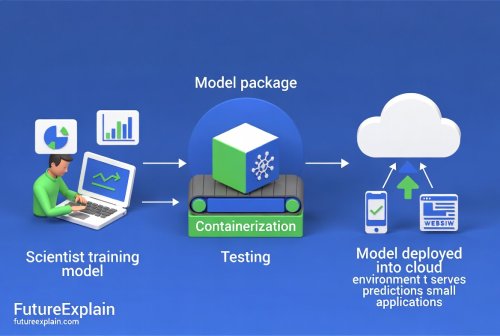
Good technical question, Anthony. Typically, the sensor hardware (measuring particles, gases) is similar. The "AI-powered" part usually refers to the backend. Raw data from many such sensors is streamed to the cloud, where an AI model analyzes patterns across the network, calibrates for errors, and generates the high-resolution map. Some newer devices have basic on-board chips for initial processing, but the heavy lifting is cloud-based.
The agritech example with a 25% reduction in waste is staggering. As a farmer's son, I can tell you that kind of efficiency isn't just good for the planet; it's the difference between profit and loss for a family business.
Thank you for a balanced article! So much tech writing is either all hype or all doom. This explained the powerful applications while honestly addressing the footprint and governance issues. More of this, please.