
Accessibility Testing with AI: Tools and Methods
This comprehensive guide explores how artificial intelligence is revolutionizing accessibility testing for digital products. Learn about AI-powered tools that automate WCAG compliance checking, identify accessibility barriers in real-time, and provide actionable remediation guidance. We cover commercial tools like axe, WAVE, and Siteimprove alongside emerging AI solutions, practical implementation workflows, and best practices for integrating AI into your accessibility testing strategy. Discover how machine learning models detect color contrast issues, semantic HTML problems, keyboard navigation barriers, and screen reader compatibility challenges with unprecedented accuracy and speed.


Introduction: The AI Revolution in Accessibility Testing
Digital accessibility—ensuring websites, applications, and digital content are usable by people with disabilities—has long been a complex, manual, and often overlooked aspect of development. Traditional accessibility testing requires specialized knowledge, extensive manual testing, and constant vigilance as content evolves. Enter artificial intelligence: a transformative force that's automating and enhancing accessibility testing in ways previously unimaginable.
AI-powered accessibility testing tools are revolutionizing how organizations approach Web Content Accessibility Guidelines (WCAG) compliance, Americans with Disabilities Act (ADA) requirements, and inclusive design principles. These tools leverage machine learning, computer vision, and natural language processing to automatically detect accessibility barriers, suggest remediation, and even predict potential issues before they affect users.
Why AI is Particularly Suited for Accessibility Testing
Accessibility testing presents unique challenges that make it ideal for AI augmentation. The combination of technical standards (like WCAG 2.1/2.2), subjective user experience considerations, and the sheer volume of digital content creates a perfect storm of complexity. AI addresses these challenges through:
- Scale and Speed: AI can scan thousands of pages in minutes, something that would take human testers weeks or months
- Consistency: Unlike human testers who might miss issues due to fatigue, AI applies the same rigorous standards to every element
- Pattern Recognition: Machine learning algorithms identify subtle patterns that might indicate accessibility barriers
- Continuous Monitoring: AI tools can monitor live websites and detect new accessibility issues as they emerge
- Cost Efficiency: Automated testing reduces the need for expensive manual audits while increasing coverage
Core AI Technologies Powering Modern Accessibility Testing
Computer Vision for Visual Accessibility Analysis
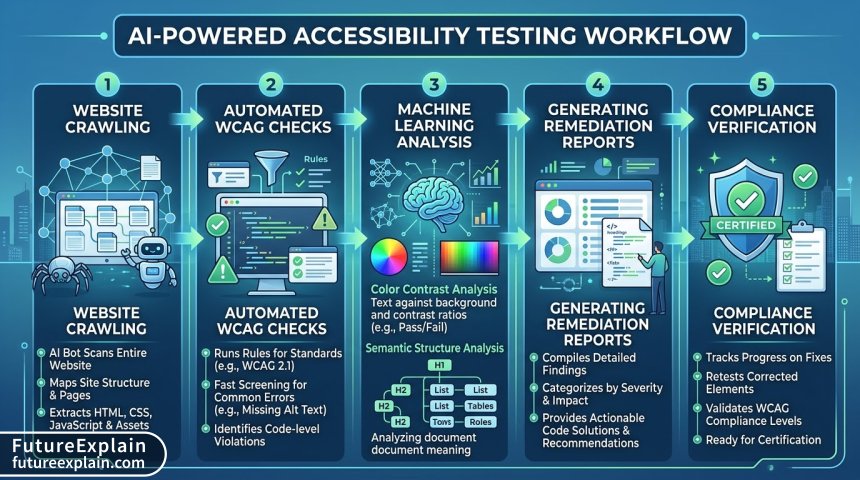
Modern AI accessibility tools use sophisticated computer vision algorithms to analyze visual elements just as a human would, but with mathematical precision. These systems can:
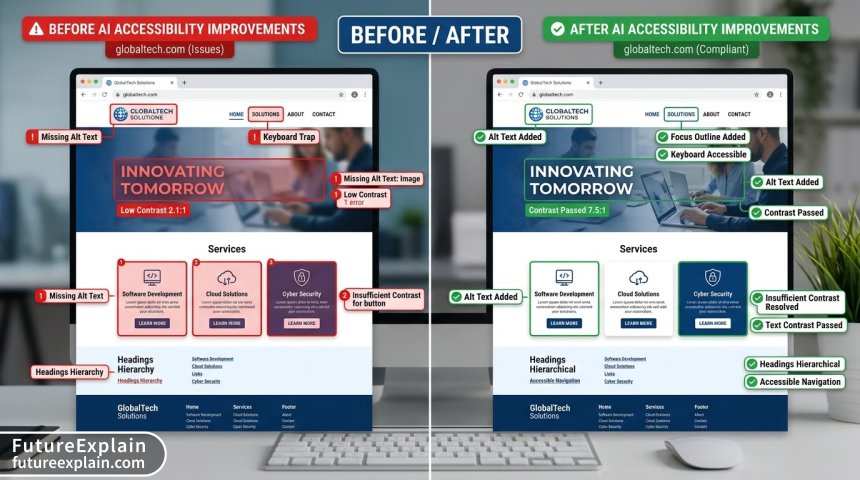
- Calculate color contrast ratios between text and background with pixel-level accuracy
- Detect problematic color combinations for users with color vision deficiencies
- Identify text that's too small or has insufficient spacing
- Recognize images that lack appropriate alternative text descriptions
- Detect visual hierarchy and reading order issues that affect screen reader users
Advanced computer vision models, often built on architectures like convolutional neural networks (CNNs), have been trained on millions of web pages to recognize accessibility patterns with over 95% accuracy for common issues like insufficient color contrast and missing alt text.
Natural Language Processing for Content Accessibility
Natural Language Processing (NLP) enables AI to understand and evaluate textual content for accessibility. Key applications include:
- Analyzing link text for clarity and descriptiveness (avoiding "click here" phrases)
- Evaluating heading hierarchy and structure for logical content organization
- Detecting complex language that might be difficult for users with cognitive disabilities
- Identifying inappropriate or missing language attributes in multilingual content
- Analyzing form labels and error messages for clarity and helpfulness
Semantic Analysis and DOM Understanding
AI systems trained on web semantics can understand the Document Object Model (DOM) at a deeper level than traditional rule-based checkers. These systems:
- Identify improper or missing ARIA (Accessible Rich Internet Applications) attributes
- Detect semantic HTML misuse (like using divs for buttons or headings)
- Analyze focus management and keyboard navigation flows
- Identify interactive elements that lack proper accessible names or descriptions
- Understand component relationships and dependencies for complex web applications
Leading AI-Powered Accessibility Testing Tools
Commercial Enterprise Solutions
axe by Deque Systems
Perhaps the most widely recognized AI-enhanced accessibility testing tool, axe combines rule-based testing with machine learning for intelligent issue detection. Its AI capabilities include:
- Intelligent impact analysis prioritizing issues by severity and user impact
- Machine learning models trained on millions of accessibility violations
- Context-aware suggestions that consider the specific implementation
- Integration with CI/CD pipelines for automated testing during development
- Browser extensions for real-time testing during design and development
axe's AI components have been particularly effective at reducing false positives—a common problem with purely rule-based checkers. The system learns from human verification to refine its detection algorithms continuously.
Siteimprove Accessibility Checker
Siteimprove combines traditional scanning with AI-powered analysis for comprehensive accessibility monitoring. Key AI features include:
- Predictive analytics identifying pages likely to develop new accessibility issues
- Content change detection that automatically tests new or modified content
- Intelligent prioritization based on user traffic and business impact
- Automated monitoring of dynamic content and single-page applications
- Machine learning models that improve detection accuracy over time
AccessiBe
AccessiBe takes a different approach by combining automated scanning with AI-driven remediation. Its system includes:
- Computer vision scanning that renders pages to detect visual accessibility barriers
- Contextual understanding that goes beyond code analysis to evaluate rendered experience
- Automated fixes for certain common issues without developer intervention
- Continuous monitoring and adjustment as website content changes
- User behavior analysis to identify accessibility pain points through actual usage
Open Source and Developer-Focused Tools
Pa11y
Pa11y is an open-source accessibility testing tool that has incorporated AI capabilities through community contributions and integrations. Its strengths include:
- Command-line interface for automated testing in development workflows
- Integration with machine learning models for issue classification
- Customizable rulesets that can be trained on specific accessibility patterns
- JSON output that can be processed by other AI systems for deeper analysis
- Active community contributing to its machine learning training data
Lighthouse (with AI Extensions)
While Google's Lighthouse is primarily rule-based, numerous AI extensions and integrations have enhanced its accessibility testing capabilities:
- AI-powered interpretation of Lighthouse audit results
- Machine learning models that suggest specific code fixes
- Integration with larger AI systems for comprehensive analysis
- Predictive scoring that estimates real-world user impact
Emerging AI-First Accessibility Testing Platforms
UserWay's AI Widget
UserWay has developed an AI-powered widget that provides both testing and remediation capabilities. Its AI features include:
- Real-time analysis of user interactions to identify accessibility barriers
- Context-aware suggestions that consider user demographics and disabilities
- Machine learning models trained on disability-specific usage patterns
- Automated adjustment of interface elements based on detected needs
EqualWeb
EqualWeb combines scanning with AI-driven compliance monitoring, featuring:
- Predictive compliance scoring that estimates legal risk
- Machine learning algorithms that identify complex accessibility patterns
- Automated monitoring of regulatory changes and compliance requirements
- Intelligent reporting that highlights most critical issues first
Practical Implementation: Integrating AI Accessibility Testing into Your Workflow
Development Phase Integration
Integrating AI accessibility testing early in the development process yields the best results. Consider this implementation workflow:
- Pre-commit Hooks: Configure AI testing tools to run automatically before code commits
- CI/CD Pipeline Integration: Add accessibility testing as a required step in your continuous integration pipeline
- Real-time IDE Feedback: Use AI-powered plugins that provide accessibility suggestions as you code
- Design System Integration: Incorporate AI testing into your design system components
- Automated Regression Testing: Ensure new features don't introduce accessibility regressions
Content Management and Publishing Workflows
For content-heavy websites, integrate AI accessibility testing into your publishing workflow:
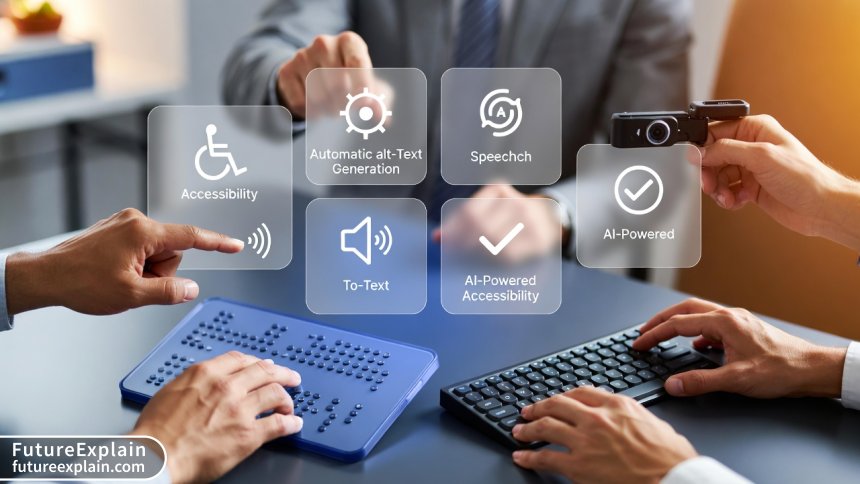
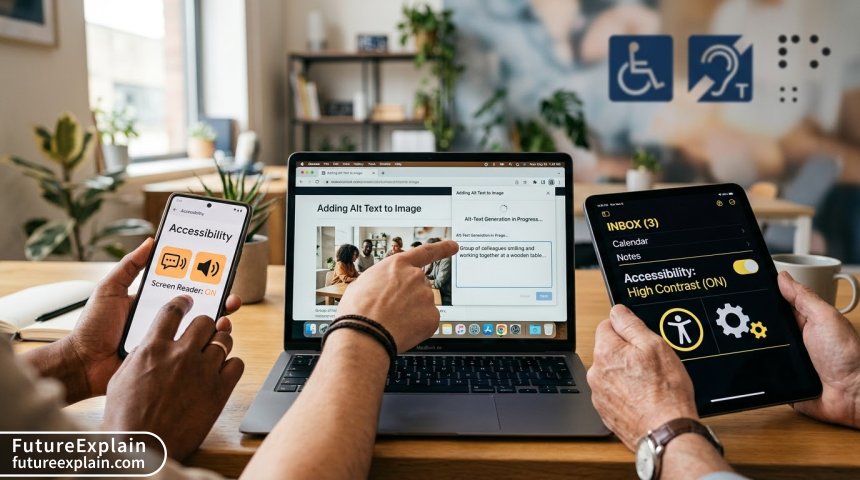
- Automated alt-text generation and suggestion for uploaded images
- Real-time color contrast checking in your content editor
- Automated heading structure analysis for long-form content
- Link text quality assessment before publication
- Multimedia accessibility checking for videos and interactive content
Monitoring and Maintenance Strategies
AI enables proactive accessibility monitoring that was previously impractical:
- Scheduled scanning of entire websites with trend analysis
- Alert systems for newly introduced accessibility violations
- Automated testing of user-generated content
- Third-party content monitoring (embedded videos, social media feeds, etc.)
- Compliance dashboard with predictive analytics
Advanced AI Techniques in Accessibility Testing
Machine Learning Model Training for Accessibility
The effectiveness of AI accessibility tools depends heavily on their training data. Modern approaches include:
- Supervised Learning with Expert-Verified Data: Models trained on millions of human-verified accessibility violations
- Semi-supervised Learning: Combining labeled data with unlabeled web content for broader understanding
- Transfer Learning: Applying models trained on general web patterns to specific accessibility contexts
- Federated Learning: Training across multiple organizations without sharing sensitive data
- Active Learning: Systems that ask for human input only when uncertain, improving efficiency
Computer Vision Breakthroughs for Visual Analysis
Recent advances in computer vision have dramatically improved visual accessibility testing:
- Attention Mechanisms: Models that focus on visually salient elements likely to cause accessibility issues
- Generative Adversarial Networks (GANs): Used to simulate how users with visual impairments experience interfaces
- Transformer Architectures: Providing better context understanding for complex visual layouts
- Multi-modal Learning: Combining visual analysis with semantic understanding for comprehensive evaluation
Natural Language Understanding for Content Evaluation
Advanced NLP techniques enable more nuanced content accessibility evaluation:
- Transformer Models (BERT, GPT variants): Understanding context and nuance in textual content
- Sentiment and Tone Analysis: Ensuring content is appropriate for users with cognitive disabilities
- Readability Scoring: Advanced algorithms that go beyond traditional formulas
- Multilingual Analysis: Ensuring accessibility across language boundaries
Limitations and Challenges of AI in Accessibility Testing
Technical Limitations
Despite significant advances, AI accessibility testing still faces technical challenges:
- Context Understanding: AI may miss nuanced context that affects accessibility
- Dynamic Content: Testing content that changes based on user interaction remains challenging
- Subjective Judgments: Some accessibility requirements involve subjective quality assessments
- Novel Patterns AI systems may miss entirely new types of accessibility barriers
- False Positives/Negatives: Even with machine learning, some incorrect detections occur
Ethical Considerations
The use of AI in accessibility testing raises important ethical questions:
- Bias in Training Data: Models may reflect biases in their training data
- Over-reliance on Automation: Risk of neglecting human testing and user feedback
- Privacy Concerns: Some testing methods may raise privacy issues
- Accessibility of AI Tools Themselves: Ensuring AI testing tools are accessible to disabled testers
- Transparency and Explainability: Understanding why AI makes specific accessibility recommendations
Legal and Compliance Considerations
Organizations must consider legal implications when using AI for accessibility testing:
- Regulatory Acceptance: Whether automated testing satisfies legal compliance requirements
- Documentation Requirements: Maintaining audit trails of AI testing processes
- Liability Issues: Responsibility when AI misses critical accessibility barriers
- International Standards: Adapting to different accessibility regulations globally
Best Practices for Effective AI-Powered Accessibility Testing
Combining AI with Human Expertise
The most effective approach combines AI automation with human judgment:
- AI for Discovery, Humans for Validation: Use AI to identify potential issues, then human testers to verify
- Human-in-the-Loop Systems: Design workflows where AI suggests and humans confirm
- Expert Oversight: Have accessibility specialists review AI findings regularly
- User Testing Integration: Combine automated testing with real user testing
Continuous Improvement Strategies
Maximize the effectiveness of AI accessibility testing through continuous improvement:
- Feedback Loops: Incorporate human corrections back into AI training
- Regular Model Updates: Keep AI models current with evolving standards and patterns
- Performance Monitoring: Track AI accuracy and adjust processes accordingly
- Cross-tool Validation: Use multiple AI tools to validate findings
Organizational Implementation Guidelines
Successful organizational adoption requires careful planning:
- Stakeholder Education: Ensure decision-makers understand AI capabilities and limitations
- Skill Development: Train team members to work effectively with AI testing tools
- Process Integration: Embed AI testing into existing development and quality assurance processes
- Budget Allocation: Invest in both tools and the human expertise needed to use them effectively
The Future of AI in Accessibility Testing
Emerging Trends and Innovations
The field of AI-powered accessibility testing continues to evolve rapidly:
- Predictive Accessibility: AI that predicts potential issues during design phase
- Personalized Accessibility: Systems that adapt interfaces to individual user needs
- Real-time Remediation: AI that fixes accessibility issues as they're detected
- Cross-platform Testing: Unified testing across web, mobile, and emerging platforms
- Generative AI for Accessibility: Using models like GPT-4 to generate accessible code and content
Research Frontiers
Academic and industry research is pushing boundaries in several areas:
- Emotional Intelligence: AI that understands emotional impact of accessibility barriers
- Cross-disability Optimization: Systems that balance different accessibility needs
- Proactive Design Guidance: AI that suggests accessible design patterns from the start
- Quantum Computing Applications: Potential future applications for complex accessibility optimization
Case Studies: Real-World Success Stories
Large E-commerce Platform Implementation
A major e-commerce company implemented AI accessibility testing across their platform, achieving:
- 85% reduction in time spent on manual accessibility audits
- Detection of 12,000+ previously unknown accessibility issues
- 40% improvement in mobile accessibility compliance scores
- Significant reduction in accessibility-related customer support tickets
- Improved search engine rankings due to better semantic structure
Government Portal Accessibility Overhaul
A government agency used AI testing to overhaul their digital services portal:
- Automated testing of 50,000+ pages across multiple departments
- Priority-based remediation guided by AI impact analysis
- Continuous monitoring preventing regression after initial fixes
- Demonstrated compliance with Section 508 and WCAG 2.1 AA
- Positive feedback from disability advocacy groups
Educational Institution Digital Transformation
A university system implemented AI accessibility testing for their online learning platform:
- Integration with learning management system for automatic course content testing
- Real-time feedback for instructors creating accessible materials
- Automated captioning and transcription quality assessment
- Improved accessibility for students with diverse disabilities
- Scalable solution for thousands of courses and instructors
Getting Started with AI Accessibility Testing
Implementation Roadmap
For organizations beginning their AI accessibility testing journey:
- Assessment Phase: Evaluate current accessibility status and identify key pain points
- Tool Selection: Choose AI tools based on your specific needs and technical environment
- Pilot Implementation: Start with a small, manageable pilot project
- Training and Documentation: Train your team and document processes
- Full Integration: Scale successful approaches across the organization
- Continuous Optimization: Regularly review and improve your implementation
Resource Allocation and Planning
Effective implementation requires proper resourcing:
- Budget Planning: Account for tool costs, training, and potential consulting
- Team Structure: Define roles and responsibilities for AI testing management
- Timeline Development: Create realistic timelines with measurable milestones
- Success Metrics: Define how you'll measure the success of your implementation
Conclusion: The Symbiotic Future of AI and Accessibility
AI-powered accessibility testing represents a paradigm shift in how we approach digital inclusion. By automating detection of common barriers, providing intelligent remediation guidance, and enabling continuous monitoring, AI tools are making comprehensive accessibility achievable at scale. However, the most successful implementations recognize that AI augments rather than replaces human expertise.
The future of digital accessibility lies in this symbiotic relationship between artificial intelligence and human understanding. As AI tools become more sophisticated and integrated into development workflows, we move closer to a world where digital accessibility is not an afterthought but an intrinsic quality of all digital experiences.
Organizations that embrace AI-powered accessibility testing today position themselves not only for regulatory compliance but for market leadership in inclusive design. The tools and methods exist; the opportunity to create more accessible digital worlds is here.
Visuals Produced by AI
Further Reading
Share
What's Your Reaction?
 Like
15234
Like
15234
 Dislike
87
Dislike
87
 Love
2105
Love
2105
 Funny
432
Funny
432
 Angry
56
Angry
56
 Sad
23
Sad
23
 Wow
1486
Wow
1486















I'd love to see more about mobile app accessibility testing with AI. The article focuses heavily on web, but mobile presents unique challenges with touch gestures, screen readers, and platform-specific accessibility APIs.
Great suggestion, Marisol. Mobile accessibility is indeed a different beast with platform-specific considerations. We have an article planned for early next year focusing specifically on AI for mobile accessibility testing across iOS and Android.
The organizational implementation guidelines are what most articles miss. Technical tools are great, but without proper process integration and stakeholder buy-in, they often fail to deliver value.
As a UX designer, I find AI color contrast tools incredibly helpful during the design phase. Being able to check palettes against WCAG standards in Figma has improved our accessibility from the start.
The future trends section got me excited about predictive accessibility. Imagine AI suggesting accessible patterns during the design phase instead of finding issues after implementation!
I'm concerned about the bias in training data mentioned in the article. If AI models are trained primarily on English-language websites with Western design patterns, how well do they work for global audiences with different cultural contexts?
Excellent question, Ariana. This is a real concern. Many tools are indeed biased toward Western web patterns. Some newer platforms are addressing this by training on more diverse datasets and offering regional compliance profiles. It's definitely an area needing more attention from tool developers.
The comparison between commercial and open source tools is very useful. As a startup, we need to balance cost with effectiveness. Has anyone successfully used Pa11y in production at scale?