Hiring for AI Teams: Roles, Salaries, and Job Descriptions
This comprehensive guide provides everything you need to know about building effective AI teams in 2025. We cover the essential roles needed in modern AI organizations, from machine learning engineers and data scientists to AI product managers and ethics specialists. You'll find up-to-date salary benchmarks across different regions and company sizes, practical job description templates you can adapt, and proven hiring strategies for attracting top talent. We also explore team structures for startups vs. enterprises, interview best practices, portfolio evaluation techniques, and how to create inclusive hiring processes that reduce bias. Whether you're a startup founder or enterprise leader, this guide offers actionable insights for building competitive AI capabilities.


Introduction: The AI Talent Landscape in 2025
Building an effective AI team has become one of the most critical strategic challenges for organizations worldwide. As artificial intelligence transitions from experimental projects to core business operations, the demand for specialized talent continues to outpace supply. According to recent data from LinkedIn's 2025 Emerging Jobs Report, AI and machine learning roles have seen a 74% year-over-year growth in demand, making them among the fastest-growing positions across all industries.
However, hiring for AI teams presents unique challenges that differ significantly from traditional tech recruitment. The field combines deep technical expertise with domain knowledge, ethical considerations, and rapidly evolving toolkits. Many hiring managers find themselves navigating unfamiliar territory, unsure which roles they truly need or how to evaluate candidates effectively.
This comprehensive guide addresses these challenges head-on. We'll explore the complete ecosystem of AI roles, provide up-to-date salary benchmarks, offer practical job description templates, and share proven hiring strategies. Whether you're a startup founder building your first AI team or an enterprise leader expanding existing capabilities, this resource will help you make informed decisions and avoid common pitfalls.
Understanding AI Team Structures
Before diving into specific roles, it's essential to understand how AI teams can be structured based on organizational needs, size, and strategic objectives. The optimal structure varies significantly between different types of companies.
Startup AI Teams (1-10 people)
Early-stage startups typically need versatile generalists who can wear multiple hats. A common effective structure includes:
- AI Lead/Head of AI: Strategic direction, architecture decisions, and hands-on implementation
- Machine Learning Engineer: Model development, deployment, and infrastructure
- Data Engineer: Data pipelines, storage, and preprocessing
- Product Manager (AI-focused): User needs, prioritization, and business alignment
In many startups, these roles overlap significantly. The AI Lead might also function as the primary ML engineer, while the data engineer might handle basic MLOps responsibilities. The key is flexibility and broad competency across the AI lifecycle.
Scale-up Teams (10-50 people)
As companies grow, specialization becomes necessary. A typical scale-up structure includes:
- AI/ML Manager: Team leadership and project coordination
- Machine Learning Engineers (2-5): Specialized by domain (NLP, computer vision, etc.)
- Data Scientists (2-3): Analysis, experimentation, and statistical modeling
- Data Engineers (1-2): Scalable data infrastructure
- MLOps Engineer: Deployment, monitoring, and automation
- AI Product Manager: Roadmap and stakeholder management
At this stage, clear role definitions and career paths become important for retention and effectiveness.
Enterprise AI Organizations (50+ people)
Large organizations require more complex structures with multiple teams and specialized functions:
- AI Center of Excellence: Cross-functional expertise hub
- Domain-specific AI Teams: Embedded in business units (marketing, operations, etc.)
- Platform/Infrastructure Team: Shared tools and infrastructure
- Research & Innovation Group: Long-term exploration
- Ethics & Governance Office: Compliance and responsible AI
Enterprise structures often balance centralized expertise with decentralized implementation to maximize both innovation and business impact.
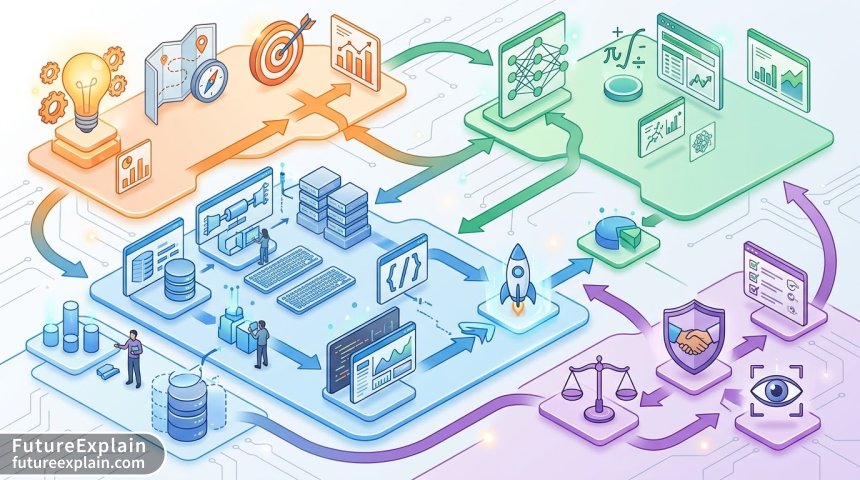
Essential AI Roles and Responsibilities
Let's explore the key roles that make up modern AI teams, detailing their responsibilities, required skills, and how they interact within the organization.
Machine Learning Engineer
The Machine Learning Engineer (MLE) is often considered the backbone of AI implementation. Unlike data scientists who focus primarily on analysis and experimentation, MLEs specialize in taking models from prototype to production.
Primary Responsibilities:
- Design, build, and maintain scalable ML systems
- Implement and optimize machine learning algorithms
- Develop data pipelines for training and inference
- Collaborate with data engineers on infrastructure
- Monitor model performance and implement improvements
- Ensure system reliability and scalability
Required Skills:
- Strong programming skills (Python, with some requiring Java/Scala)
- Deep understanding of ML frameworks (TensorFlow, PyTorch, scikit-learn)
- Experience with cloud platforms (AWS SageMaker, GCP Vertex AI, Azure ML)
- Knowledge of software engineering best practices
- Understanding of MLOps principles and tools
Typical Background: Computer Science or Software Engineering degree, often with additional ML coursework or bootcamps. Increasingly, we're seeing successful MLEs from non-traditional backgrounds who have built substantial portfolios through open-source contributions and personal projects.
Data Scientist
Data Scientists focus on extracting insights from data through statistical analysis, experimentation, and predictive modeling. While there's significant overlap with ML engineers, data scientists typically emphasize exploratory analysis and business understanding.
Primary Responsibilities:
- Perform exploratory data analysis to identify patterns
- Design and analyze A/B tests and experiments
- Build statistical models for prediction and inference
- Communicate findings to non-technical stakeholders
- Collaborate with business teams to define problems
- Stay current with statistical methods and tools
Required Skills:
- Advanced statistics and mathematics
- Proficiency in Python/R and data analysis libraries
- SQL and database knowledge
- Data visualization expertise
- Business acumen and communication skills
Evolution in 2025: The role has increasingly specialized, with many data scientists focusing on specific domains (marketing analytics, operational research) or techniques (causal inference, Bayesian methods).
Data Engineer
Data Engineers build and maintain the infrastructure that enables data collection, storage, and processing. As AI systems become more data-hungry, this role has gained critical importance.
Primary Responsibilities:
- Design and implement data pipelines
- Build and maintain data warehouses/lakes
- Ensure data quality, reliability, and accessibility
- Implement data governance and security measures
- Optimize data systems for performance and cost
- Collaborate with ML engineers on feature stores
Required Skills:
- Expertise in big data technologies (Spark, Hadoop, Kafka)
- Cloud data services (AWS Redshift, Google BigQuery, Snowflake)
- Strong SQL and database design skills
- Programming (Python, Java, Scala)
- Understanding of data modeling and architecture
Specialization Trends: Many data engineers now specialize in ML-specific infrastructure, focusing on feature stores, experiment tracking systems, and model-serving platforms.
MLOps Engineer
A relatively new but crucial role, the MLOps Engineer bridges the gap between machine learning and operations, ensuring models can be reliably deployed, monitored, and updated.
Primary Responsibilities:
- Automate ML model deployment and monitoring
- Implement CI/CD pipelines for machine learning
- Manage model registry and versioning
- Monitor model performance and data drift
- Optimize inference performance and costs
- Ensure compliance and reproducibility
Required Skills:
- DevOps and cloud infrastructure expertise
- Containerization (Docker, Kubernetes)
- ML platform tools (MLflow, Kubeflow, Weights & Biases)
- Monitoring and observability tools
- Understanding of machine learning lifecycle
Growing Importance: As organizations deploy more models to production, MLOps has shifted from "nice to have" to essential function, with dedicated roles becoming standard in mature AI organizations.
AI Research Scientist
AI Research Scientists push the boundaries of what's possible, developing new algorithms and approaches. While often associated with tech giants and academia, many forward-looking companies now employ research scientists.
Primary Responsibilities:
- Conduct original research in machine learning
- Publish papers and contribute to open source
- Explore novel approaches to challenging problems
- Collaborate with engineering teams on implementation
- Stay at the forefront of AI advancements
- Mentor junior researchers and engineers
Required Skills:
- Advanced degree (Ph.D. common) in relevant field
- Deep mathematical and theoretical understanding
- Strong publication record or equivalent portfolio
- Expertise in specific AI subfields
- Ability to translate research to practical applications
Industry vs. Academia: Industry research scientists typically focus more on applied research with clearer paths to production, while maintaining academic rigor and publication standards.
AI Product Manager
The AI Product Manager translates business needs into technical requirements and ensures AI solutions deliver real value. This role requires unique hybrid skills combining technical understanding with business acumen.
Primary Responsibilities:
- Define AI product vision and strategy
- Prioritize features and projects based on impact
- Bridge communication between technical and business teams
- Define success metrics and track outcomes
- Manage stakeholder expectations and communications
- Ensure ethical and responsible AI implementation
Required Skills:
- Strong understanding of AI capabilities and limitations
- Product management fundamentals
- Business and domain expertise
- Excellent communication and stakeholder management
- Data-driven decision making
Unique Challenges: AI PMs must navigate technical uncertainty, explain probabilistic outputs to stakeholders, and manage expectations around what AI can realistically achieve.
AI Ethics Specialist / Responsible AI Lead
As AI systems become more powerful and pervasive, ensuring they're developed and deployed responsibly has created a new specialized role.
Primary Responsibilities:
- Develop and implement AI ethics guidelines
- Conduct bias audits and impact assessments
- Ensure compliance with regulations and standards
- Train teams on ethical AI practices
- Establish governance processes for AI systems
- Serve as internal advocate for responsible AI
Required Skills:
- Understanding of AI ethics frameworks and principles
- Knowledge of relevant regulations (EU AI Act, etc.)
- Bias detection and mitigation techniques
- Cross-functional collaboration and influence
- Technical understanding of AI systems
Emerging Role: Still evolving, with backgrounds ranging from philosophy and law to technical AI roles with ethics specialization.
AI Solutions Architect
AI Solutions Architects design end-to-end AI systems, considering technical requirements, business constraints, and user needs.
Primary Responsibilities:
- Design scalable AI system architectures
- Select appropriate technologies and platforms
- Balance technical requirements with business constraints
- Create implementation roadmaps
- Evaluate third-party AI solutions and vendors
- Ensure system security, privacy, and compliance
Required Skills:
- Broad knowledge of AI/ML technologies and platforms
- System design and architecture principles
- Understanding of business and operational constraints
- Cloud architecture expertise
- Excellent communication and visualization skills
Salary Benchmarks for 2025
AI salaries vary significantly based on role, experience, location, and company size. The following benchmarks reflect current market rates based on aggregated data from multiple compensation surveys and job platforms.
United States Salary Ranges
Machine Learning Engineer:
- Entry-level (0-2 years): $110,000 - $140,000
- Mid-level (3-5 years): $140,000 - $190,000
- Senior (6-10 years): $190,000 - $280,000
- Principal/Staff (10+ years): $250,000 - $400,000+
Data Scientist:
- Entry-level: $95,000 - $125,000
- Mid-level: $125,000 - $170,000
- Senior: $170,000 - $240,000
- Lead/Principal: $220,000 - $350,000
MLOps Engineer:
- Entry-level: $105,000 - $135,000
- Mid-level: $135,000 - $180,000
- Senior: $180,000 - $250,000
- Lead: $230,000 - $320,000
AI Research Scientist (Industry):
- PhD Entry-level: $150,000 - $200,000
- Mid-level: $200,000 - $280,000
- Senior: $280,000 - $400,000+
- Research Director: $350,000 - $600,000+
Regional Variations within US:
- San Francisco Bay Area: +15-25% above national average
- New York City: +10-20%
- Seattle: +5-15%
- Boston: +5-10%
- Austin: Comparable to national average
- Remote positions: Typically based on company location with some adjustment for candidate location
European Salary Ranges
United Kingdom (London):
- Machine Learning Engineer: £65,000 - £120,000
- Senior ML Engineer: £100,000 - £160,000
- Data Scientist: £55,000 - £95,000
Germany:
- ML Engineer: €70,000 - €110,000
- Senior ML Engineer: €95,000 - €140,000
Netherlands:
- ML Engineer: €65,000 - €100,000
- Senior: €85,000 - €130,000
Switzerland (Zurich/Geneva):
- ML Engineer: CHF 120,000 - CHF 180,000
- Senior: CHF 160,000 - CHF 250,000
Asia-Pacific Salary Ranges
Singapore:
- ML Engineer: SGD 90,000 - SGD 150,000
- Senior: SGD 130,000 - SGD 200,000
India (Major Tech Hubs):
- ML Engineer: ₹1,200,000 - ₹3,000,000
- Senior: ₹2,500,000 - ₹6,000,000+
Australia (Sydney/Melbourne):
- ML Engineer: AUD 120,000 - AUD 180,000
- Senior: AUD 160,000 - AUD 250,000
Compensation Structure Trends
Beyond base salary, AI roles typically include:
- Equity/Stock Options: Startups often offer 0.1%-1% equity for key early hires
- Annual Bonus: Typically 10-30% of base salary, performance-dependent
- Signing Bonus: Common for senior roles, often $20,000-$100,000
- Relocation Assistance: Particularly for international hires
- Education/Conference Budgets: $3,000-$10,000 annually for professional development

Creating Effective AI Job Descriptions
A well-crafted job description attracts the right candidates and sets clear expectations. Here are templates and best practices for key AI roles.
Machine Learning Engineer Job Description Template
Job Title: Senior Machine Learning Engineer
Location: [City/Remote/Hybrid]
About the Role:
We're seeking an experienced Machine Learning Engineer to design, build, and deploy scalable ML systems that power our [specific product/feature]. You'll work closely with data scientists, product managers, and infrastructure teams to take models from concept to production, ensuring reliability, performance, and continuous improvement.
Responsibilities:
- Design and implement machine learning systems for [specific use case]
- Develop and maintain scalable data pipelines for training and inference
- Collaborate with data scientists to productionize models and algorithms
- Implement monitoring and alerting systems for model performance
- Optimize ML systems for latency, throughput, and cost
- Mentor junior engineers and contribute to team best practices
- Stay current with emerging ML technologies and approaches
Requirements:
- 5+ years of experience building and deploying machine learning systems
- Strong proficiency in Python and experience with ML frameworks (TensorFlow/PyTorch)
- Experience with cloud ML platforms (AWS SageMaker, GCP Vertex AI, or Azure ML)
- Solid understanding of software engineering principles and best practices
- Experience with containerization (Docker) and orchestration (Kubernetes)
- Strong problem-solving skills and ability to work independently
- Excellent communication and collaboration skills
Preferred Qualifications:
- Experience with [specific domain, e.g., NLP, computer vision, recommendation systems]
- Contributions to open-source ML projects
- Publications or presentations in ML conferences/journals
- Experience with [specific tools/technologies relevant to your stack]
What We Offer:
- Competitive salary and equity package
- Comprehensive health, dental, and vision insurance
- Flexible work hours and remote-friendly culture
- Annual learning and development budget
- [Other company-specific benefits]
Common Mistakes to Avoid in AI Job Descriptions
1. Unrealistic Requirements: Listing every possible technology creates artificial barriers. Focus on core competencies rather than exhaustive tool lists.
2. Vague Responsibilities: "Work on exciting AI projects" doesn't tell candidates what they'll actually do. Be specific about projects and impact.
3. Overemphasis on Academic Credentials: While advanced degrees can be valuable, many excellent AI practitioners come from non-traditional backgrounds. Consider equivalent experience.
4. Ignoring Team and Culture Fit: AI work is highly collaborative. Describe team dynamics and working style.
5. Lack of Growth Opportunities: Top candidates want to know how they'll develop. Include information about career paths and learning opportunities.
Interviewing AI Candidates: Best Practices
Effective interviewing requires balancing technical assessment with evaluation of soft skills, problem-solving approach, and cultural fit.
Technical Assessment Strategies
Take-home Assignments vs. Live Coding:
- Take-home: Better for assessing real-world problem-solving but time-consuming for candidates
- Live coding: Efficient but can create artificial pressure; best for algorithmic thinking
- Hybrid approach: Short take-home followed by discussion/deep dive
Portfolio Review: For experienced candidates, reviewing their GitHub, publications, or past projects can be more informative than contrived exercises.
System Design Interviews: Essential for senior roles. Present a realistic problem and ask candidates to design an end-to-end solution.
Sample Interview Questions by Role
For Machine Learning Engineers:
- "Walk me through how you would approach building a recommendation system for [specific scenario]"
- "How do you handle class imbalance in a classification problem?"
- "Describe your experience with model deployment and monitoring"
- "How would you optimize a model for low-latency inference?"
- "Explain a time you had to collaborate with non-technical stakeholders on an ML project"
For Data Scientists:
- "How would you design an experiment to test [specific business hypothesis]?"
- "Explain the difference between correlation and causation with an example"
- "How do you communicate complex statistical results to non-technical audiences?"
- "Describe your process for exploratory data analysis"
- "What metrics would you use to evaluate [specific type of model]?"
For MLOps Engineers:
- "How would you design a CI/CD pipeline for machine learning?"
- "What strategies would you use to monitor model performance in production?"
- "How do you handle model versioning and rollbacks?"
- "Describe your experience with scaling model inference"
- "What security considerations are important for ML systems?"
Evaluating Soft Skills and Cultural Fit
AI roles require more than technical prowess. Assess:
- Communication: Can they explain complex concepts clearly?
- Collaboration: How do they approach working in teams?
- Curiosity: Do they continue learning beyond requirements?
- Ethical Awareness: Do they consider implications of their work?
- Adaptability: How do they handle changing requirements or failures?
Building Diverse and Inclusive AI Teams
Diversity in AI teams isn't just about fairness—it's a strategic imperative. Homogeneous teams are more likely to create biased systems and miss innovative solutions.
Strategies for Inclusive Hiring
Expand Sourcing Channels: Go beyond traditional tech hubs and networks. Partner with organizations focused on underrepresented groups in tech.
Blind Resume Screening: Remove identifying information to reduce unconscious bias in initial screening.
Structured Interviews: Use consistent questions and evaluation criteria for all candidates.
Diverse Interview Panels: Ensure candidates meet people from various backgrounds and roles.
Inclusive Job Descriptions: Use gender-neutral language and emphasize inclusion in company values.
Retention and Growth
Hiring diverse talent is only the beginning. Retention requires:
- Clear career progression paths
- Mentorship and sponsorship programs
- Inclusive team culture and psychological safety
- Equitable compensation and promotion processes
- Support for work-life integration
Remote and Hybrid AI Teams
The pandemic accelerated remote work adoption, and many AI teams now operate in distributed environments. This presents both challenges and opportunities.
Best Practices for Distributed AI Teams
Communication Protocols: Establish clear norms for synchronous vs. asynchronous communication.
Collaboration Tools: Invest in tools that support remote collaboration on code, data, and models.
Documentation Culture: Compensate for reduced informal communication with thorough documentation.
Inclusive Meetings: Design meetings that work equally well for in-person and remote participants.
Regular Check-ins: Balance autonomy with connection through regular one-on-ones and team syncs.
Challenges Specific to AI Work
Data Security: Ensure secure access to datasets and models across locations.
Compute Resources: Provide equitable access to computational resources regardless of location.
Time Zone Coordination: Balance flexibility with need for synchronous collaboration.
Knowledge Sharing: Facilitate serendipitous learning and cross-pollination of ideas.
Upskilling Existing Employees vs. External Hiring
While external hiring brings fresh perspectives, upskilling current employees offers significant advantages:
Advantages of Upskilling:
- Faster onboarding (existing domain knowledge)
- Higher retention rates
- Cultural continuity
- Cost-effective compared to market-rate hiring
- Boosts morale and demonstrates investment in employees
Effective Upskilling Programs:
- Structured learning paths with clear milestones
- Mentorship from experienced AI practitioners
- Hands-on projects with increasing complexity
- Time allocation for learning (e.g., 20% time)
- Recognition and career progression for completed programs
Working with AI Recruiters and Agencies
Specialized AI recruiters can be valuable partners but require careful management:
When to Use Recruiters:
- For hard-to-fill senior or specialized roles
- When internal recruitment capacity is limited
- For rapid team scaling
- When targeting passive candidates
Selecting the Right Partner:
- Look for AI/tech specialization, not general tech recruitment
- Check track record with similar roles and companies
- Evaluate their candidate screening and evaluation process
- Consider their network and sourcing strategies
- Review their understanding of your specific needs
Managing the Relationship:
- Provide detailed role briefings and context
- Establish clear communication protocols and feedback loops
- Set expectations for candidate quality and diversity
- Monitor performance metrics (time-to-hire, retention rates)
Legal and Compliance Considerations
AI hiring involves several legal considerations:
Equity and Non-discrimination: Ensure hiring practices comply with equal opportunity regulations.
Intellectual Property: Clear agreements regarding IP ownership, particularly for research-oriented roles.
Background Checks: Balance thorough vetting with privacy considerations and relevance.
International Hiring: Navigate visa requirements, tax implications, and employment laws.
Data Privacy: Handle candidate data in compliance with GDPR, CCPA, and other regulations.
Measuring Hiring Success
Effective AI hiring requires ongoing measurement and improvement:
Key Metrics:
- Time-to-Hire: Average time from opening to acceptance
- Quality of Hire: Performance ratings, retention rates, impact metrics
- Candidate Experience: Feedback from all candidates (including rejects)
- Source Effectiveness: Which channels yield the best candidates?
- Diversity Metrics: Representation at each hiring stage
- Cost-per-Hire: Total recruitment costs divided by number of hires
Continuous Improvement:
- Regularly review and update job descriptions
- Analyze interview feedback and outcomes
- Benchmark compensation against market data
- Solicit feedback from new hires and hiring managers
- Stay informed about evolving AI skills and roles
Future Trends in AI Hiring
The AI talent landscape continues to evolve. Key trends to watch:
Increasing Specialization: Roles are becoming more specialized as the field matures.
Democratization of AI Tools: Lower barriers to entry may expand the talent pool but increase the need for discernment.
Focus on Responsible AI: Growing demand for ethics, fairness, and transparency expertise.
Global Talent Distribution: Remote work enables tapping into global talent pools but increases competition.
Lifelong Learning: Continuous skill development becomes integral to career progression.
Conclusion
Building an effective AI team requires thoughtful strategy, careful execution, and continuous adaptation. By understanding the diverse roles needed, offering competitive compensation, crafting clear job descriptions, implementing fair hiring practices, and fostering inclusive team cultures, organizations can attract and retain the AI talent necessary to thrive in an increasingly AI-driven world.
Remember that AI hiring isn't just about technical skills—it's about building teams that can navigate complexity, collaborate across disciplines, and create solutions that are both innovative and responsible. The most successful AI organizations will be those that approach talent as a strategic asset and invest in creating environments where AI professionals can do their best work.
As you embark on or continue your AI hiring journey, use this guide as a foundation but remain flexible. The field evolves rapidly, and today's best practices may need adjustment tomorrow. Stay curious, keep learning, and don't hesitate to reach out to the broader AI community for insights and collaboration.