AI Agents in 2026: How AI Is Moving From Chatbots to Autonomous Systems
In 2026, artificial intelligence is undergoing a fundamental paradigm shift from passive conversational chatbots to goal-oriented autonomous AI agents. Unlike standard chatbots that simply answer queries in isolated turns, AI agents possess multi-step planning, tool integration, and persistent memory capabilities that allow them to execute complex workflows independently. This article explains the key architectural pillars behind AI agents—including perception, reasoning, tool execution, and reflection—and breaks down how they interact with real-world software, databases, and APIs. We explore practical use cases across industries, evaluate safety guardrails and permission models, and discuss what non-technical beginners and professionals need to know to adapt to the autonomous AI era.

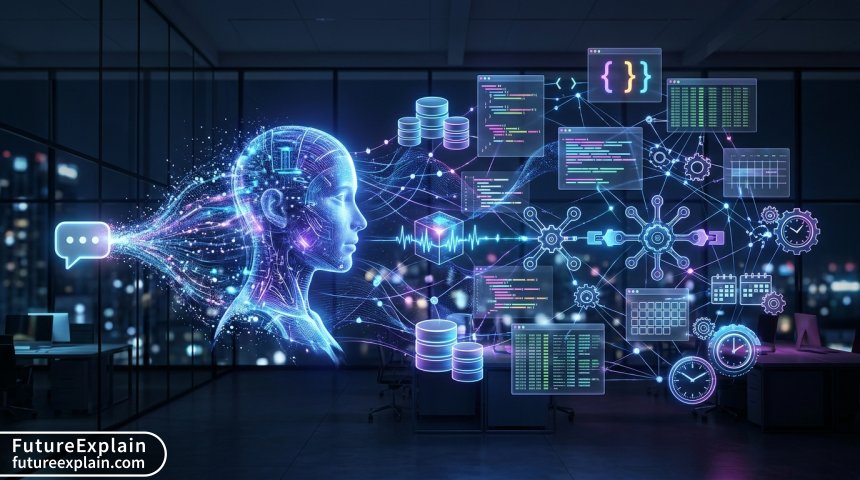
For several years, the public experience with artificial intelligence was defined almost entirely by conversational chatbots. You entered a text prompt, waited a few seconds, and received a generated response. Whether you were drafting an email, summarizing a document, or brainstorming ideas, the interaction model remained passive, reactive, and text-bound. The human user was strictly responsible for breaking down big projects into small steps, feeding information into the prompt window, copying the generated outputs, and carrying out the actual execution in external software tools.
As we navigate through 2026, that traditional paradigm is undergoing its most significant structural shift since the launch of consumer AI. Artificial intelligence is transitioning rapidly from conversational assistants that talk about tasks to autonomous AI agents that actively execute them. Rather than serving merely as clever text generators or digital sounding boards, modern AI systems act as goal-driven digital collaborators capable of reasoning through complex objectives, breaking projects into multi-step action plans, querying software APIs, and working persistently until a desired outcome is achieved.
This comprehensive, in-depth educational guide provides a thorough explanation of how AI is moving from simple chatbots to fully autonomous systems in 2026. We will examine the core definition of an AI agent, explore how its cognitive architecture differs fundamentally from traditional language models, break down the technical mechanisms behind tool calling and persistent memory, evaluate real-world enterprise applications across multiple sectors, examine safety guardrails and permission models, and outline actionable strategies for beginners and professionals looking to thrive in the autonomous tech era.
1. The Historical Evolution: From Search Engines to Autonomous Agents
To fully appreciate the magnitude of the 2026 transition, it is helpful to examine the historical trajectory of human-computer interaction over the past three decades. Digital technology has evolved through four distinct eras of operational delegation:
- Era 1: The Manual Command Era (1990s–2000s): Software was strictly deterministic and menu-driven. Users had to know exact keyboard commands, file paths, or interface buttons to trigger actions. Technology possessed zero understanding of natural human language.
- Era 2: The Information Search Era (2000s–2010s): Search engines enabled keyword-based information retrieval. Computers indexed the world's web pages, allowing users to find facts quickly, but humans still had to read, synthesize, and execute tasks manually.
- Era 3: The Conversational Chatbot Era (2020–2024): Generative Large Language Models (LLMs) enabled fluid natural language understanding. Users could ask open-ended questions, summarize lengthy texts, and generate creative drafts in single-turn text interactions. However, the AI remained isolated inside a prompt window without the ability to interact directly with external software.
- Era 4: The Autonomous Agent Era (2025–Present): AI systems combine natural language reasoning with active tool utilization, persistent memory, and self-reflection loops. Instead of answering a query about how to complete a task, the AI independently navigates digital environments to complete the task on your behalf.
In 2026, this evolution is driven by the realization that human productivity is constrained not by a lack of information, but by the operational friction of switching between dozens of disparate software tools. Autonomous AI agents eliminate this friction by serving as the unified execution layer across software applications.
2. What Defines an Autonomous AI Agent? (Core Concepts)
While the word "agent" is frequently used in tech headlines, it has a precise computer science definition. An AI agent is an autonomous software program that perceives its environment through data feeds, makes logical decisions based on defined objectives, takes actions using digital tools, and evaluates the outcomes of those actions to achieve a specific goal with minimal human supervision.
To differentiate an AI agent from other forms of software, experts evaluate five defining attributes:
1. Autonomy: An agent possesses the capacity to operate independently once initialized. It does not require a human to enter a new prompt for every single sub-step of a project.
2. Environmental Perception: An agent constantly senses its operational environment—reading user instructions, inspecting file structures, parsing incoming webhooks, or querying database schemas.
3. Dynamic Reasoning & Goal Decomposition: Unlike traditional software scripts that follow rigid, hard-coded IF/THEN rules, an agent uses flexible probabilistic reasoning to determine how to achieve a goal even when unexpected obstacles arise.
4. Tool Utilization: An agent is equipped with digital "hands"—APIs, web browsers, command-line terminals, and database connectors that allow it to read and write data in real-world applications.
5. Persistence & Reflection: An agent maintains a memory log of past actions and evaluates whether its recent steps were successful. If a step fails, the agent diagnoses the error and formulates an alternative approach through a self-correction loop.
In simple terms, if a traditional LLM is a knowledgeable consultant who offers advice when asked a question, an autonomous AI agent is an empowered project manager who takes the goal, hires the necessary specialists, uses the required tools, solves problems along the way, and delivers the finished result.
Visuals Produced by AI
3. Chatbots vs. AI Agents: A Deep Comparison
To illustrate why the shift from chatbots to agents is so transformative, let us analyze their differences across key operational dimensions in the comprehensive comparison table below:
Operational Paradigm: Chatbots operate on a passive, prompt-response model. They sit idle until a human user submits a query. AI agents operate on a proactive, goal-driven model. Once assigned an objective, they loop continuously until the goal is fulfilled.
Task Execution: Chatbots generate text representations or instructions about tasks. AI agents execute the actual actions in software systems—sending emails, updating database records, committing code changes, or reserving travel flights.
Context & Memory: Chatbots rely strictly on the active context window of a single chat thread, losing continuity when the thread ends. AI agents utilize multi-tiered memory architectures, combining short-term working context with long-term vector vaults that store user preferences and historical project decisions permanently.
Error Recovery: If a chatbot produces an incorrect or incomplete answer, the human user must spot the mistake and manually refine the prompt. An AI agent inspects its own outputs against success metrics, identifies syntax or logic errors, and automatically attempts alternative solutions through reflection loops.
Software Interoperability: Chatbots operate in a closed text sandbox. AI agents use standardized protocols (such as function calling and the Model Context Protocol) to discover, authenticate with, and operate external software tools seamlessly.
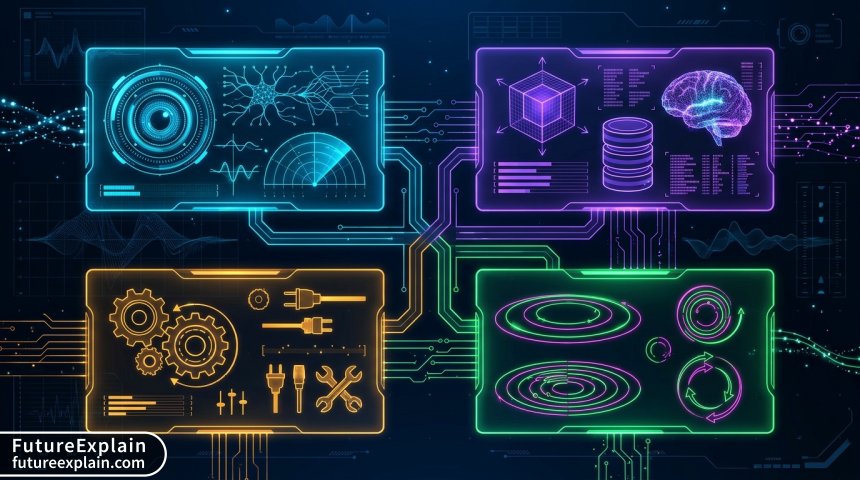
4. The Four Pillars of AI Agent Architecture
Behind every functioning AI agent in 2026 lies a sophisticated four-part architectural blueprint. Understanding these four pillars demystifies how software can achieve complex goals without constant human intervention.
Pillar 1: Perception & Parsing
The perception layer receives raw signals from the digital world. This includes natural language goals submitted by users, scheduled cron triggers, incoming email notifications, or system alerts. The perception engine parses unstructured inputs, extracts key constraints, and establishes the baseline environment state.
Pillar 2: Reasoning & Planning Engine
At the center of the agent is its reasoning core, typically powered by advanced models trained in multi-step logic. The planning engine decomposes large goals into structured sub-task lists using strategies such as ReAct (Reasoning + Acting) or Tree-of-Thoughts. It evaluates dependencies, calculates token costs, and determines the optimal execution order.
Pillar 3: Tool Execution Harness
The tool harness provides the interface channels through which the agent impacts external software. By generating structured JSON or XML payloads, the agent invokes REST APIs, executes code inside isolated sandboxes, browses web pages via headless browser drivers, or queries database servers directly.
Pillar 4: Memory Vault & Reflection Loop
The memory vault stores short-term execution context, episodic action logs, and long-term vector embeddings. After every tool execution, the reflection loop checks whether the output met expectations. If an API call fails or a web page fails to load, the reflection module captures the error message, updates the episodic memory log, and instructs the reasoning engine to attempt a revised strategy.
To explore system architecture in greater depth, read our guide on AI agent architecture explained.
5. Tool Calling: How Agents Interact With Software
The key technological breakthrough enabling autonomous agents in 2026 is native tool calling (also known as function calling). In early language models, getting an AI to interact with software required complex prompt engineering that frequently failed due to minor syntax errors.
Today, models are trained with specialized weights optimized for structured output. When tools are registered with an agent, the model recognizes when an external tool is required. Instead of generating conversational text, it outputs a precise, machine-readable JSON payload specifying the function name and required parameter arguments:
{ "function": "schedule_calendar_event", "parameters": { "title": "Q1 Planning", "date": "2026-01-15", "time": "10:00" } }
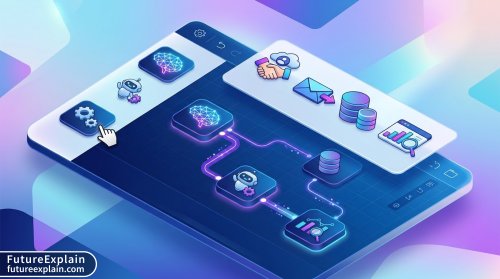
The host application intercepts this command, executes the actual calendar API call, retrieves the confirmation payload, and returns the result to the AI model. This seamless payload exchange allows AI agents to orchestrate complex software workflows across cloud applications, databases, and local file systems under intelligent automation standards.

Visuals Produced by AI
6. Real-World Applications Across Key Industries in 2026
Autonomous AI agents are actively deployed across major commercial sectors in 2026, delivering measurable operational improvements:
A. Autonomous Software Engineering
In software development, coding agents do far more than offer auto-complete suggestions. An engineering agent can read an issue ticket from a project board, clone the code repository, reproduce the reported bug in a sandboxed container, write a fix, run automated unit test suites to prevent regressions, and submit a pull request for senior developer review.
B. Enterprise Business Operations
In corporate finance and operations, agents streamline complex administrative workflows. An accounting agent can retrieve incoming invoices from email attachments, extract line items, cross-reference them against purchase orders in an enterprise ERP system, flag discrepancies for human review, and queue payments automatically.
C. Healthcare & Clinical Workflow Support
In healthcare administrative systems, clinical assistant agents summarize patient histories from electronic health record (EHR) databases, cross-reference clinical guidelines for drug interactions, pre-populate insurance authorization paperwork, and schedule follow-up appointments—reducing administrative burden for medical staff.
D. Personal Productivity & Life Management
For individual consumers, personal AI agents manage daily logistics. They coordinate conflicting family and work calendars, screen spam calls and emails, compile customized morning briefings based on news feeds, and automate routine online shopping orders.
7. Persistent Memory: Overcoming Session Amnesia
A central limitation of early conversational tools was their inability to remember users over time. Every new conversation started with a blank slate. Autonomous agents solve this through a three-part memory hierarchy:
- Short-Term Working Memory: Retains active task context inside the model's immediate prompt window during execution.
- Episodic Memory: Logs a chronological history of past actions, tool outputs, and error traces, allowing the agent to learn from past execution attempts.
- Semantic Memory & Vector Vaults: Uses high-dimensional vector embeddings and vector databases to store permanent facts, brand guidelines, and user preference profiles across all sessions through Retrieval-Augmented Generation (RAG).
For a detailed analysis of memory architecture, read our full guide on AI agent memory explained.
8. Safety, Security, and Governance Frameworks
As AI software gains the authority to execute real-world actions, security becomes a paramount priority. Granting an autonomous agent access to financial accounts, private customer databases, or production servers introduces risks that do not exist with passive chatbots. Modern 2026 deployments implement strict security controls:
1. Human-in-the-Loop (HITL) Checkpoints: High-risk actions—such as sending wire transfers, deleting database records, or publishing public communications—require mandatory human confirmation before execution.
2. Principle of Least Privilege: Agents are granted narrow, time-bound API tokens restricting access exclusively to the specific data and tools required for the immediate task.
3. Isolated Sandboxing: Code execution and web browsing occur inside ephemeral micro-VMs or containerized sandboxes, preventing malicious web content or indirect prompt injection attacks from compromising local network infrastructure.
4. Immutable Audit Tracing: Every thought, tool call, parameter argument, and API response is recorded in a tamper-proof audit log, allowing security teams to inspect execution chains and verify compliance.
For more on governance, explore our dedicated section on AI ethics and safety.
9. Current Challenges & Engineering Limitations
Despite rapid advancements, autonomous AI agents in 2026 face several technical challenges that require ongoing engineering research:
- Cascading Error Propagation: If an agent makes a subtle error during step two of a ten-step plan, that error can compound in subsequent steps, leading to a failed final output if the reflection loop fails to detect it early.
- Infinite Execution Loops: Agents can occasionally get stuck in repetitive error loops, repeatedly invoking a failing API. System architects implement strict execution timeout counters to interrupt stuck processes.
- Token Cost & Latency Overhead: Running multi-step planning loops, memory retrievals, and tool executions consumes significantly more compute tokens and network latency than a single conversational prompt response.
- Ambiguous Human Goal Definitions: Natural language is inherently ambiguous. If a human user provides vague instructions, an agent may make logical assumptions that nevertheless conflict with unstated human preferences.
10. Actionable Roadmap: Preparing for the Agentic Era
Adapting to the transition toward autonomous AI agents does not require a computer science degree. Here is a practical four-step roadmap for individuals and organizations in 2026:
1. Master Goal Specification: Focus on defining clear, unambiguous goals with explicit success metrics, input parameters, and constraint boundaries. Precise goal definition is the primary management skill of the AI era.
2. Understand API & Software Workflows: Learn the basics of how digital applications communicate via APIs, webhooks, and data schemas. Understanding data flow makes it vastly easier to design effective agent workflows.
3. Implement Supervised Delegation: Start by deploying AI agents in copilot or supervised modes (Level 2 autonomy). Review execution logs, verify outputs, and gradually grant higher autonomy as system reliability is proven.
4. Enforce Strict Data Governance: Always review permission settings when connecting third-party AI agents to personal or corporate accounts. Never grant unrestricted administrative credentials without active monitoring.
Frequently Asked Questions (FAQs)
What is the primary difference between a chatbot and an AI agent?
A chatbot is a passive, text-focused system that responds to human prompts in single-turn conversations. An AI agent is an autonomous system that takes high-level goals, formulates multi-step plans, uses software tools, remembers context across sessions, and executes real-world tasks independently.
Can an AI agent operate without any human supervision?
While fully autonomous (Level 4) agents exist for low-risk tasks like data monitoring, safe enterprise deployments enforce Human-in-the-Loop (HITL) checkpoints for high-risk actions like payments, data deletion, or public communications.
Are AI agents more expensive to run than chatbots?
Yes. Because an agent executes multiple sequential reasoning steps, tool calls, and memory retrievals to complete a task, it consumes more compute tokens than a single chat interaction. However, the human time saved often yields a massive net positive ROI for businesses.
What is tool calling in AI agents?
Tool calling (or function calling) is a feature where an AI model generates structured, machine-readable JSON payloads that trigger external software tools, web browsers, databases, or APIs—allowing the AI to interact directly with digital software.
How do AI agents remember information across sessions?
AI agents store information in long-term vector databases using Retrieval-Augmented Generation (RAG). When an agent needs past facts or user preferences, it performs a semantic similarity search and retrieves relevant context into its active working memory.
What happens if an AI agent makes a mistake during a multi-step task?
Modern agent architectures feature self-reflection loops. After executing a tool, the agent inspects the output. If an error is detected, the reflection module analyzes the failure and instructs the reasoning core to attempt an alternative approach.
Do AI agents have consciousness or human feelings?
No. AI agents do not possess consciousness, feelings, or intentionality. They are highly sophisticated mathematical systems that follow probabilistic algorithms and control loops to achieve programmed goals.
What software tools can an AI agent use?
AI agents can use virtually any software tool that provides an API, command-line interface, or web interface—including email gateways, databases, spreadsheets, code sandboxes, web browsers, and cloud ERP systems.
What is the Model Context Protocol (MCP)?
The Model Context Protocol (MCP) is an open industry standard established in 2026 that provides a universal client-server interface for connecting AI agents to external software tools, databases, and file systems seamlessly.
How can non-technical professionals start using AI agents today?
Non-technical users can leverage no-code agent platforms, productivity suites with built-in agent features, and automated workflow tools that allow users to configure autonomous agentic pipelines using plain natural language instructions.
Will AI agents eliminate human jobs in 2026?
AI agents are automating repetitive administrative data entry, routine code debugging, and manual research. Rather than eliminating human roles entirely, they are shifting job responsibilities toward system management, goal definition, creative direction, and strategic supervision.
How do security teams prevent AI agents from being hacked?
Security teams enforce isolated container sandboxing, role-based access control, parameter sanitization layers, and immutable audit logs to protect agents against indirect prompt injection and unauthorized system access.
Conclusion & Further Reading
The transition from conversational chatbots to autonomous AI agents represents one of the most significant paradigm shifts in the history of computing. By surrounding advanced reasoning models with structured planning frameworks, multi-tiered memory systems, standardized tool harnesses, and continuous reflection loops, technology is evolving from a passive reference tool into an active, productive digital partner.
As these systems continue to mature throughout 2026, understanding their architecture, capabilities, and governance frameworks empowers individuals and organizations to navigate the future of technology with confidence and purpose.
To continue your learning journey on FutureExplain, explore these related technical articles: